
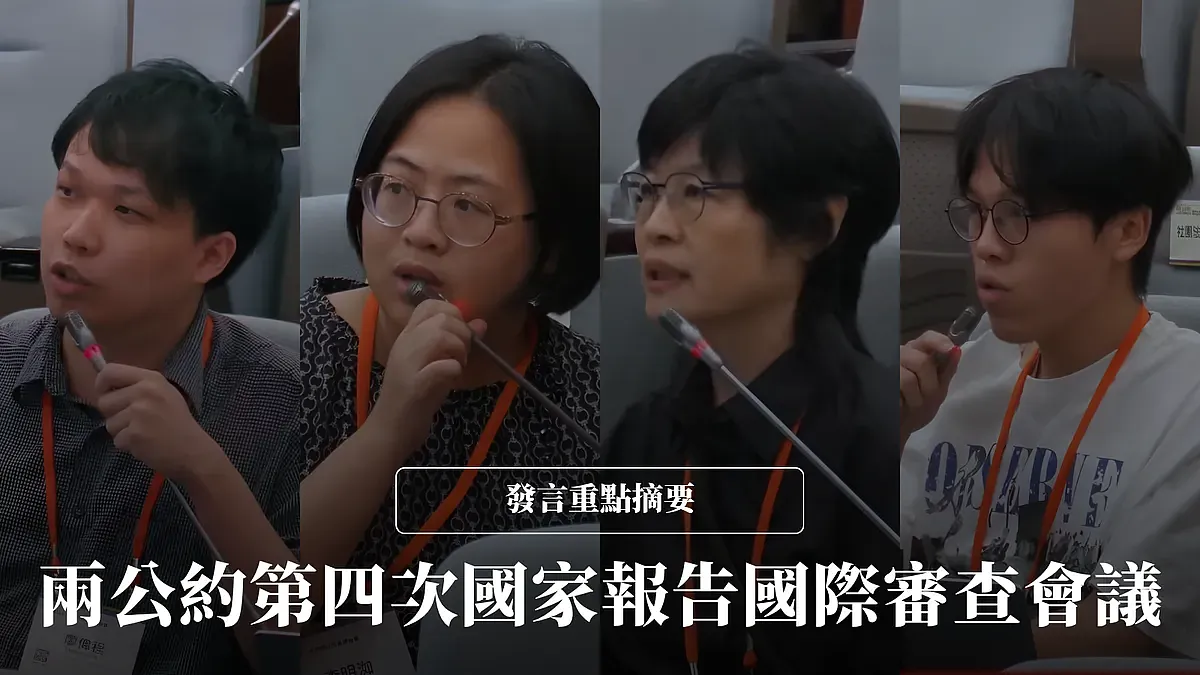
The 4th National Report International Review Meeting for the Two Covenants: Summary of Statements
Last edited: 2026-08-26
1. May 11, 2026, regarding "How to view Taiwan's overall human rights progress?" (Video Link)
Manfred Nowak:
I want to ask a general question: Do you think things are really going backward, or are there also some improvements? How is it overall?
Lee Ming-ju, CEO of JRF:
Over the past two or three years, facing chaotic political circumstances, the Taiwanese government has not firmly upheld a human rights stance. Whether it is the legislative stagnation regarding the Convention against Torture and Other Cruel, Inhuman or Degrading Treatment or Punishment or the Anti-Discrimination Act, or even when the opposition party proposed harsh legislative amendments such as corporal punishment or life imprisonment without parole—thereby putting forward bills that violate human rights even further—we believe that Taiwan's current progress in human rights and the rule of law is regressing.
Furthermore, the government demonstrates a severe lack of understanding regarding its obligations under the Covenants. Thank you.
References:
- Joint Statement: Sugar-Coated Public Opinion, Rule of Law Poison - Joint Statement Opposing the Evil Law of "Life Imprisonment"
- Is the Constitutional Court Sick, and the Ministry of Justice Taking Advantage to Cause Chaos? - Civil Society Organizations' Press Release Opposing the Evil Law of "Life Imprisonment"
2. May 11, 2026, regarding "The state of the nation's overall implementation of human rights?" (Video Link)
Manfred Nowak:
Regarding the human rights assessment, are there any views?
Liao Wei-cheng, Associate Researcher at JRF:
In these past two years, I believe that our government's respect for the constitutional adjudication authority has been diminishing.
First, over the past few years, we had a constitutional interpretation regarding the death penalty, which essentially required the government to handle the death penalty with greater caution. However, last year, our government executed a certain death sentence, which I believe was completely hasty.
That constitutional judgment pointed out that all controversial cases must, as much as possible, be finalized through retrials or extraordinary remedy procedures before execution. Yet, the government deliberately singled out a case where the attorney had not yet filed an extraordinary appeal to carry out the execution. Moreover, given our cultural belief that killing people before the Lunar New Year is inauspicious, the government specifically chose to carry it out right before the New Year, executing the sentence only two hours after the execution was announced to the public. I believe our government shows a lack of respect for the constitutional adjudication authority in this regard.
Secondly, regarding life imprisonment, the earliest life imprisonment terms in our country could actually be paroled after 10 years a long time ago. However, the public always felt that criminals were not locked up long enough, so it was later raised to 15 years, and in recent years even to 25 years. Furthermore, such harsh provisions were coupled with the rule that if a parolee commits a minor mistake or simply forgets to report during the parole period, they must return to prison and serve at least another 25 years before becoming eligible for parole again. After this cruel provision was declared unconstitutional by the constitutional adjudication authority the year before last, the government's response was to propose a provision which, according to a criminal law scholar I spoke with at a seminar two weeks ago, fundamentally failed to follow the intent of the constitutional judgment when amending the law. This is the phenomenon I wish to reflect upon. Thank you.
3. May 11, 2026, regarding "What is going on with the paralysis of the Constitutional Court?" (Video Link)
Liao Wei-cheng, Associate Researcher at JRF:
Because this issue is somewhat complex and involves various chronological factors, I hope I can explain it simply and clearly. Several years ago, when the Constitutional Court was newly established, the rule was set so that as long as the attending justices reached a certain threshold, a court session could be lawfully held. However, our legislators later changed this after a certain incident to a fixed number of 10 people—10 people, rather than a percentage. This meant that out of 15 justices, once the number dropped to 8 remaining justices, the court could never hold a session again.
However, the bill requiring a quorum of 10 justices to hold sessions was subsequently declared unconstitutional by those very 8 justices in recent years, making it inapplicable. Of course, some people raise controversies over whether those 8 justices holding sessions back then was legal or illegal. This is currently a major controversy in our constitutional legal studies.
This is because some believe that the 10-justice bill itself had to first be declared unconstitutional or amended through other methods before those 8 justices could lawfully hold sessions. Others believe that if the bill itself was unconstitutional to begin with, those 8 justices could naturally declare the 10-justice quorum requirement unconstitutional as well. I hope my explanation has answered your question.
References:
- March 2025: Statement | Dismantle the Constitutional Time Bomb - Urging the Constitutional Court to Suspend the Application of Newly Amended Provisions of the Constitutional Court Procedure Act
- October 2025: Press Conference | "270 Days of Constitutional Crisis! The Constitutional Court Cannot Be Paralyzed Any Longer; Breaking Through on Our Own Is Not an Overreach of Power" Press Release
- December 2025: Statement | Resolve Legislative-Executive Infighting, Publicly Support the Constitutional Court!
4. May 12, 2026, regarding the right to life and protection of personal liberty (Video Link)
Huang Yi-pi, CEO of Covenants Watch:
【Regarding the Su Chien-ho Case – Exclusion of Torture-Obtained Evidence】
First, looking back to 2013, the same international review committee dealt with death penalty cases, specifically the Su Chien-ho case and the Chiou Ho-shun case. The Su Chien-ho case later resulted in a criminal acquittal, but I must report to the committee: the three defendants involved in the Su Chien-ho case are currently still facing civil tort lawsuits. The reason they continue to be pursued in civil litigation after more than 30 years of drawn-out proceedings is largely because civil courts still admitted the evidence extracted through torture inflicted upon these three individuals while they were detained.
Therefore, because of this, we strongly hope that the experts will re-emphasize in this year's concluding observations that evidence obtained through torture must not only be barred from criminal prosecution, but must also be strictly barred from all proceedings, including civil litigation and administrative litigation. This means that any evidence obtained via torture should never enter any judicial proceedings whatsoever, so as to prevent individuals who have already been exempted from criminal prosecution from still facing civil damages.
【Regarding the Chiou Ho-shun Case – A Wrongful Death Penalty Case While Incarcerated】
Another case, the Chiou Ho-shun case, has long been a subject of international rescue efforts. Human rights groups truly believe it is a completely wrongful conviction. We also report to the committee that since his arrest in 1988 up until this year, he has been imprisoned for as long as 38 years. Experts previously requested in their 2013 concluding observations that if a pardon could not be granted, an opportunity for sentence reduction must at least be provided to him. Based on our recent visits with him, in reality, after being imprisoned for 38 years, his current psychological state is on the verge of a breakdown. Therefore, we still hope that the experts will re-examine the current status of the Chiou Ho-shun and Su Chien-ho cases in this year's concluding observations and once again petition the President for a pardon for Chiou Ho-shun.
【Regarding the Effectiveness of External Visiting Groups】
Next, I would like to respond to the experts' inquiries regarding external visiting groups. In fact, every correctional institution—all 51 correctional institutions across Taiwan—has its own external visiting group. However, a major problem with the external visiting groups is that, although the Ministry of Justice responded to the experts' inquiries by stating that it began establishing a task force over the past two years called the Selection Committee for External Visiting Groups, in reality, the vast majority of the preliminary candidate lists, as well as the situation in the first two terms, were entirely nominated by the correctional institutions themselves—the very entities that are supposed to be monitored—thereby creating the absurd situation where the monitored parties pick their own monitors. As Committee Member Manfred Nowak just mentioned, do these external visiting groups have the opportunity to conduct unannounced, surprise visits? I must report to the committee that in reality, external visiting groups have almost no opportunity to independently exercise their powers. From something as small as whether they can use their own recording equipment to capture interview contents with the interviewees inside the correctional institution, they face all sorts of obstructive difficulties from the prison authorities. For instance, they strictly limit external visiting group members to using only video or audio recording equipment provided by the correctional institution itself to conduct related interviews. Yet, we have no guarantee that even if these audio and video files can eventually be extracted from these devices, the prison authorities might not have found some way to recover those files. Therefore, my point is—I cite this example to let committee members know that the exercise of external visiting groups' functions is, in truth, severely restricted by the prison authorities. If the authorities—meaning prison administration—do not cooperate, it is extremely difficult for the external visiting groups to function effectively.
Furthermore, while external visiting groups appear to consist of multidisciplinary experts, I must state that the vast majority of external visiting group members are completely unfamiliar with prison human rights, and many members are even entirely unacquainted with the Mandela Rules or Taiwan's own Prison Act regulations. Therefore, it is truly difficult to expect these external visiting groups, who are unfamiliar with prison human rights and legal regulations, to genuinely perform their visiting and monitoring functions.
Moreover, since last year, many members of the external visiting groups do not consider themselves to possess visiting and monitoring functions; instead, they feel they should play the role of "friends of the prison," assisting the prison to improve while ignoring their own professional roles of visiting and monitoring. Finally, I must criticize the role that the Control Yuan and the National Human Rights Commission can play regarding prison human rights. In fact, the Control Yuan itself has a standing Judiciary and Prison Administration Committee. Under their jurisdiction, they have the full authority to conduct unannounced surprise visits to all correctional institutions. However, over the past few years, they only visit about 10 to 15 prisons a year. From 2022 to 2023, for instance, they visited only about 20 prisons over a one-year period, and each visit usually lasted less than one to two hours. They have never used such visiting activities to interview inmates and prisoners to understand the true reality of prison administration. A large part of their visits is merely a formalistic exercise of listening to business reports from the prison authorities, meaning that the oversight functions that the Judiciary and Prison Administration Committee could potentially exercise under the Constitution of the Republic of China and the Control Act have completely failed to materialize.
Additionally, according to the current Control Act and the Organic Act of the Control Yuan National Human Rights Commission, just as Committee Member Manfred Nowak stated, even without passing the Convention against Torture and Other Cruel, Inhuman or Degrading Treatment or Punishment, they can still perform the functions of an NPM (National Preventive Mechanism). Therefore, we strongly recommend and urge the Control Yuan's Judiciary and Prison Administration Committee and the National Human Rights Commission to shoulder the responsibility of safeguarding prison human rights. Thank you.
References:
- Press Release | After 35 Years of Wandering Courts, How the Su Case Walks Toward Dawn Again
- Press Release | Sixes Bring Misfortune: Press Conference Urging President Lai to Pardon Wrongfully Convicted Death Row Inmate Chiou Ho-shun
- Press Conference | "End the Chaos of Committee Selection, Restore the True Face of Independent External Correctional Institution Visiting Groups"
- Op-Ed | June 26 International Day in Support of Victims of Torture ── How Much Longer Must We Wait for the Convention against Torture and Other Cruel, Inhuman or Degrading Treatment or Punishment?
5. May 13, 2026, regarding fair trial procedures (Video Link)
Manfred Nowak:
Welcome back. In our dialogue with civil society organizations concerning Articles 12 to 17—which include freedom of movement, fair trials, access to justice, as well as the right to privacy and data protection—we have already had extensive discussions with government agencies. Next, please continue to provide additional information or supplement the written materials previously submitted regarding these issues. Anyone wishing to supplement is welcome to speak.
Liao Wei-cheng, Associate Researcher at JRF:
Speaking for the Judicial Reform Foundation, I would like to raise two points regarding fair trials. In the previous session, a committee member asked a question concerning the searching of law firms. I must regretfully state that due to the Constitutional Court's judgment in our country, its legal opinion on this matter is—while everyone agrees that conversations between lawyers and defendants should not be used as evidence—the Constitutional Court holds that procedures for searching law firms do not require special safeguards. Consequently, subsequent legislative amendments by our government agencies did not focus on this point. At the time, when we and other legal teams discussed this legislative amendment with other agencies, we did indeed observe that some countries, such as California in the United States, might utilize a "Special Master" to execute searches to prevent investigators from directly coming into contact with evidence, or that numerous judgments by the European Court of Human Rights emphasize that special procedural safeguards are required when searching law firms, such as France's rule requiring the president of the bar association to be present. However, because our country's government agencies ultimately focused only on what items should or should not be admissible as evidence, regardless of the current draft bills—whether the Judicial Yuan's version or the Ministry of Justice's version—they only discuss what cannot be used as evidence up to the current draft versions, while ignoring the chilling effect that excessive searches of law firms may cause. Therefore, there is no legislative protection in this regard. This is the first point.
The second point I wish to discuss is that certain safeguards concerning confrontation procedures in our country may be insufficient. About 15 years ago, there was a very famous case in Taiwan—the Tu brothers case—where two Taiwanese individuals went to China to do business and were subsequently repatriated to Taiwan after being accused of murder. The evidence used to sentence both individuals to death consisted entirely of interrogation transcripts and investigative appraisal reports produced by Chinese public security organs, and even the so-called physical evidence was viewed through re-photographed pictures rather than physical evidence. At the time, a scholar even characterized the Tu brothers case as the biggest scandal in Taiwan's judicial circles. Similar views have not changed much over the past few years, in my opinion. In 2018 (ROC year 107), we had a criminal division resolution, but the conclusion they subsequently discussed was that they deemed interrogation transcripts made by Chinese public security organs to be no different from those made by Taiwan's police. Therefore, under certain circumstances, if the state has already tried its best to conduct investigations or safeguard the right of confrontation, they can still be used as evidence. However, this development—where the government has supposedly tried its best to conduct investigations in recent years—might mean we attempt to summon or use remote methods to conduct so-called confrontation with these Chinese public security personnel. Sometimes, if attempts to contact them yield no results, the government may rule that because the government has tried its best to safeguard your right of confrontation, this evidence may still be admissible. This is where we believe deficiencies lie. Thank you.
Manfred Nowak:
Are there any other questions?
Tsai Ta-jung, Assistant Researcher at JRF:
This is the second statement from the Judicial Reform Foundation. Here, we would like to continue the discussion on the right to a fair trial mentioned earlier. Regarding fair trials, Article 14, Paragraph 2 of the ICCPR, along with General Comment No. 32, actually mentions that government agencies should make every effort to uphold the presumption of innocence, and the media should also uphold the principle of the presumption of innocence. We must avoid the problem of prejudgment. To face the problem of prejudgment, there is a so-called rule of "non-disclosure of investigation" within legal norms. In Taiwan's Code of Criminal Procedure, this is only briefly regulated as non-disclosure of investigations, while supplementary regulations are established through administrative orders known as the Regulations Governing the Non-Disclosure of Investigations. In terms of maintaining a fair trial, we believe there are massive loopholes in Taiwan's non-disclosure of investigations in recent years.
First, regarding these Regulations Governing the Non-Disclosure of Investigations, there is an exception scope allowing for appropriate disclosure under the condition of matters of major public concern. This criterion is extremely broad, so there is indeed such a loophole within the institutional norms. What are the impacts of this loophole?
First, in Taiwan, many cases of major public concern have been continuously disclosed to the public in recent years. For instance, in the case of former Taipei City Mayor Ko Wen-je, even before the indictment, numerous media reports detailed Ko Wen-je's reporting contents and even what evidence was obtained during the investigative process, including what people previously discussed regarding an Excel file found during the search of Mayor Ko containing an entry of "1500," allegedly serving as evidence of bribery.
Alternatively, not long ago in Taiwan, there was an incident involving the abuse and death of an infant, and news reports on this case were continuously broadcast throughout the process. Moreover, fraud has been continuously occurring in Taiwan in recent years. There was a Taiwanese man named Pan Li-min who was tricked into Cambodia; after the police apprehended suspects, they immediately reported the relevant information of their apprehension, which led to Mr. Pan—who was still being controlled by the Cambodian fraud syndicate—being beaten as a result. Thus, leaks of information subject to non-disclosure have continuously occurred in Taiwan in recent years. This is a very serious issue affecting doubts about Taiwan's maintenance of a fair trial system. Under such circumstances, we do not see any self-examination or review by the government. For example, in the Ko Wen-je case, up until now, we still cannot see how far the government's review progress has reached.
In fact, according to the aforementioned Regulations Governing the Non-Disclosure of Investigations, local prosecutors' offices are required to conduct reviews and continuously review media outlets that have reported on cases. However, regarding that review mechanism, we can only see the number of reviews they conducted, how many units were established, and the final disciplinary results. What cases were specifically reviewed is something we do not know. For example, whether the Ko Wen-je case, the aforementioned nanny case, or the aforementioned case of Mr. Pan Li-min were reviewed—these are things that the public has no way of examining through a transparent and public mechanism. That is all. Thank you.
References:
This article is an AI-generated translation of the original Chinese text. In the event of any discrepancy, the Chinese version shall prevail.