
The Path of an Ordinary Man: An Interview with Attorney Lin Yung-sung
Last edited: 2026-08-26
Judicial Reform Foundation

30TH ANNIVERSARY PROFILE
Attorney Lin Yung-sung
Founding Initiator · Second Executive Director · Former Chairperson
Executive Director: 1996.5–1998 / Chairperson: 2015.2–2022.12
"I just want to ask, can Taiwan really only be this way?"
For three decades, Attorney Lin Yung-sung has walked hand in hand with the Judicial Reform Foundation. Witnessing the suffering of ordinary people amid the fractures of the judicial system, he has consistently started from the perspective of the people to advance the footsteps of judicial reform.
What leaves the deepest impression on us is Attorney Lin's steadfastness on many issues, and most memorably, his frequent questioning: "I just want to ask, can Taiwan really only be this way?"
Encounters with Judicial Reform
The starting point of Attorney Lin's participation in judicial reform stemmed from an invitation issued by the times.
In 1994, during a period when Taiwanese society was picking up the pieces following the lifting of martial law, the newly appointed President of the Judicial Yuan, Shih Chi-yang, was tasked with promoting judicial reform and actively organizing the Judicial Reform Committee. Among the few representatives from civil society, he convened lawyers such as Lin Min-sheng and Kao Jui-cheng from the Taiwan Bar Association. Upon the invitation of his seniors, Attorney Lin joined as a member of the lawyers' advisory team. However, under official dominance, the Judicial Reform Committee did little more than hold meetings, taking virtually no concrete action. Attorney Lin, who had been straightforward and outspoken since his youth, bluntly remarked: "Are we playing for real? They're playing games—they're really just playing around. So, are we going to play for real? Is civil society going to play for real?"
Attorney Lin Min-sheng, then-Chairman of the Bar Association, responded firmly: "We'll play for real. Of course we are going to do this for real." The advisory team subsequently split into two factions: one focused on studying the official reform meetings, while the other began preparing for the establishment of the Judicial Reform Foundation, with Attorney Chen Chuan-yueh serving as the convener of the preparation committee and Attorney Lin as the deputy convener.
During the preparation of the Foundation, choosing an organizational name was a critical issue, as the name would carry the organization's working path and ideological positioning. After much deliberation, the preparation committee ultimately settled on the "Judicial Reform Foundation": "Civil" signified that the perspective must be taken from the people. Although most participants in the organization were lawyers, the vision for reform had to be rooted in the needs of the public; "judicial reform" was the core mission of the organization; and "foundation" symbolized a long-term commitment to the work. Additionally, Attorney Lin jested that they had once considered naming it the "Civil Judicial Reform Movement Foundation." By using the word "movement," they hoped to stir up a social trend and forge a long-term, sustained campaign. However, they later concluded that the spirit of practice embodied in a "movement" should be manifested through personal dedication and action, and thus "movement" was ultimately omitted from the official name.
Nevertheless, the somatic sense of a "movement" became the DNA of the JRF. Just as Attorney Lin was drawn into the advisory team back then, the lawyers of the JRF linked up one after another, further pulling in scholars, students, and citizens, rolling it all into a massive force for judicial reform that generated reform pressure on the government that could not be ignored.
Reflecting on the reasons why judicial reform could achieve success, Attorney Lin stated that "having a philosophy, having a group of people, and being willing to invest a period of time" were indispensable elements. Moreover, the founding process of the JRF seemed to condense the occurrence and trajectory of every subsequent judicial reform movement in Taiwan: bottom-up, coalesced and advocated by civil society, driving the government to initiate reforms and adjust systems.
Speaking Out Through Action (Part 1): The National Judicial Reform Conference
In 1995, the Judicial Reform Foundation was officially established. Attorney Chan Wen-kai served as the first Executive Director, and in 1996, Attorney Lin succeeded him as the second Executive Director. By that time, the Judicial Reform Committee had concluded its meetings, yet civil society still deeply felt that the judiciary had not genuinely moved toward democratization. Therefore, in 1997, the JRF began actively seeking to meet with President Lee Teng-hui, hoping to promote constitutional amendments and expecting President Lee to personally convene a "National Judicial Reform Conference" to ensure the financial independence of the judiciary and judicial trials free from interference. After a successful meeting, President Lee expressed his welcome regarding the JRF's demands, but subsequently handed the matter over to the then-President of the Judicial Yuan, Shih Chi-yang. However, when faced with civil society's demands for judicial reform, Shih Chi-yang restricted the conference agenda, stating that official representatives must form the majority. Upon hearing this, Attorney Lin angrily retorted: "I said you should just hold it yourself, why are you involving us? The President told you to discuss convening this with us, and you say you need to be the majority—then just hold it yourself! This issue cannot be discussed, that issue cannot be discussed; well then, let's not discuss anything at all."
Faced with official apathy, Attorney Chen Chuan-yueh, the then-Chairperson of the JRF, gave the order to organize a protest to exert pressure on the authorities. Yet before applying pressure to the authorities, the JRF first faced pushback and pressure from within the legal profession. Attorney Lin noted that the temperament of legal professionals is conservative; the mere mention of taking to the streets for a protest immediately provoked internal criticism within the legal community. Furthermore, they had to persuade the bar associations, which had already reached a consensus with the Judicial Yuan and intended to participate in the Judicial Yuan-led National Judicial Reform Conference. Through various organizational coordination efforts, they successfully persuaded the bar associations and mobilized diverse groups representing human rights, women, labor, people with disabilities, and environmental protection to jointly form the "All-People Judicial Reform Action Alliance." Nearly 500 lawyers donned their robes and took to the streets alongside countless citizens. Attorney Lin remarked that at a time when there were only 2,000 to 3,000 practicing lawyers, this was truly a monumental feat.
On October 19, 1997, the JRF prepared a giant dinosaur balloon symbolizing the five great judicial dinosaurs. All parties gathered at the Chiang Kai-shek Memorial Hall, divided into four major brigades, and marched toward the Presidential Office shouting the slogan "Resurrect the Judiciary!" As it was their first time organizing a protest, everyone was extremely nervous. Attorney Lin shared that there were countless worries at the time—worrying about bad weather, worrying that people wouldn't show up. Fortunately, none of those worries materialized, though the great judicial dinosaur deflated right before reaching the Presidential Office! However, the momentum for judicial reform soared, successfully establishing the reputation of the JRF and prompting the traditionally conservative legal community to reflect that "lawyers don't necessarily have to only use their mouths; they can use action to express their opinions. Moreover, this was the first time the legal community took to the streets not for the rights of lawyers, but for the rights of the people."
The fire ignited by the protest ultimately paved the way for the 1999 "National Judicial Reform Conference," which brought together 125 representatives from various sectors including the judiciary, executive, legislative, academic, and civil realms, drafting 32 judicial reform proposals. These included the Legal Aid Act and criminal procedure reforms that Attorney Lin had vigorously advocated for earlier.
Speaking Out Through Action (Part 2): A Legal Aid System to Protect Vulnerable Groups
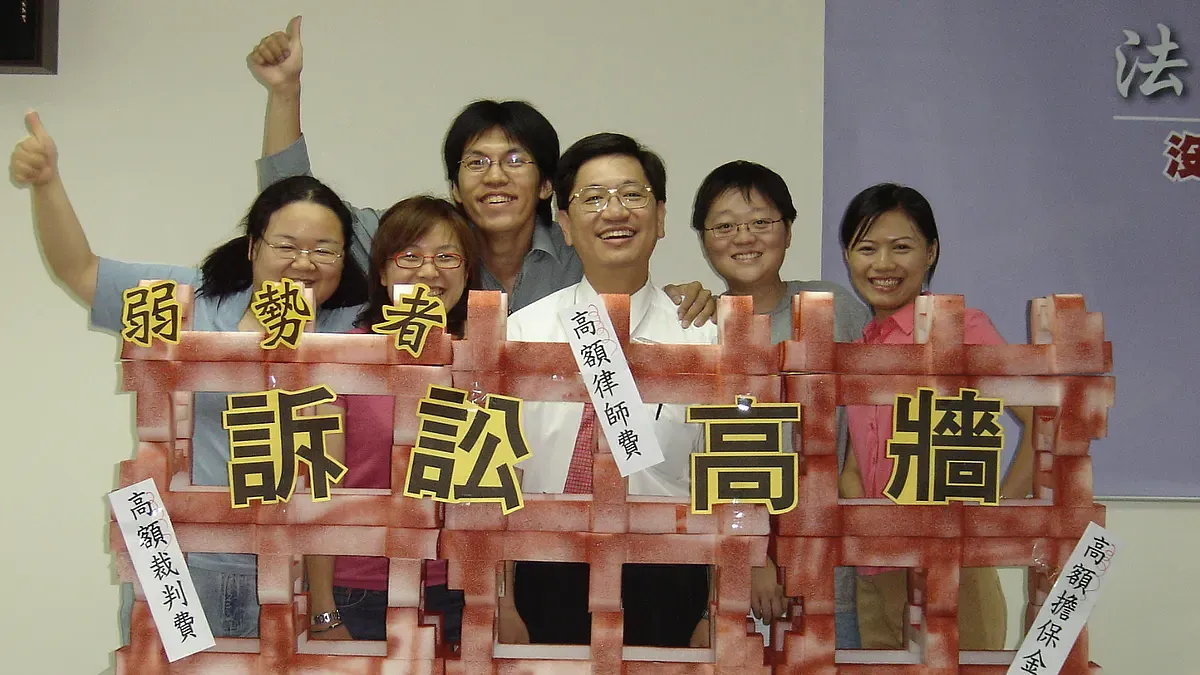
"Justice should not merely be the privilege of the wealthy." Although the law does not mandate that one must hire a lawyer to go to court, if one party has professional assistance while the other does not, a massive disparity in litigation capability arises between the two sides. For vulnerable individuals who are unable to effectively assert their rights because they cannot afford legal counsel, this results in the loss and deprivation of their rights.
To bridge this rights gap in the judicial system, after the establishment of the JRF, it actively advocated for the promotion of legal aid alongside the Taiwan Association for Human Rights (TAHR) and the Taipei Bar Association. However, both the Ministry of Justice and the Judicial Yuan adopted a passive attitude.
Attorney Lin described it as an awkward state where "no one opposed it, but no one supported it either." Fortunately, with the convening of the "National Judicial Reform Conference" and under the coordination of Professor Chiu Lien-kung of National Taiwan University, a proposal to establish the Legal Aid Act and the Legal Aid Foundation was passed. This in turn compelled the Judicial Yuan to shoulder the primary responsibility. With the participation of civil society figures from the JRF, TAHR, and the Taipei Bar Association in deliberations, the "Civil Draft of the Legal Aid Act" was finally completed.
However, when the draft entered the Legislative Yuan, although the legislature did not oppose it, the allocation of the budget for establishing the Legal Aid Foundation hit a snag. The civil legal aid promotion group had no choice but to lobby the Judicial Yuan once again, hoping that the Judicial Yuan would secure relevant budgets from the executive branch. Yet the Judicial Yuan considered legal aid a low-priority task and showed no willingness to take the initiative to promote it.
Witnessing the inaction of the public sector, the civil legal aid promotion group once again exercised its uncompromising action capability, turning its lobbying targets toward key political figures. They not only visited the President and the Premier, but also the chairpersons of both the Kuomintang (KMT) and the Democratic Progressive Party (DPP), ultimately securing broad support. This allowed the Legal Aid Act to pass its third reading in 2003, and in 2004, the Legal Aid Foundation was officially established.
Speaking Out Through Action (Part 3): Criminal Procedure Reform in Pursuit of Fairness and Justice
In addition to the Legal Aid Act, the amendment of the Code of Criminal Procedure was also a system reform issue that the JRF had long focused on. Before the amendment of the Code of Criminal Procedure in 2003, the trial process in criminal proceedings was extremely unfair. At that time, judges frequently took the initiative to question witnesses and often biasedly supported prosecutors. Moreover, when the defendant's defense counsel raised objections, judges would often forbid them from asking questions.
Lacking cross-examination between the prosecution and defense to clarify the truth, defendants were caught in a pincer attack by judges and prosecutors, leaving them utterly defenseless. For instance, in the Su Chien-ho case, prosecutors and judges successively and arbitrarily accepted coerced confessions without discerning the truth and evidentiary value of statement evidence, resulting in innocent miscarriages of justice. Such circumstances not only failed to protect defendants' rights but also buried the truth beneath the subjective mindset of the judges.
The aforementioned predicament of "inquisitorial proceedings"—where judges controlled the courtroom—was also discussed at the "National Judicial Reform Conference," which formulated criminal procedure reforms and proposed adopting an "adversarial system" incorporating cross-examination. The Code of Criminal Procedure was officially amended in 2003, placing prosecutors and defense counsel on equal footing during trials, allowing both sides to cross-examine witnesses, while the role of the judge shifted to supplementary questioning.
While this reform could not completely eliminate the occurrence of wrongful convictions nor resolve all problems, it undoubtedly provided more opportunities to expose potential false testimonies by witnesses, thereby giving the truth of a case a chance to be brought to light.
For example, in the Hsu Tzu-chiang case, the fabricated "confessions" mutually accusing each other given by witnesses Huang Chun-chi and Chen Yi-lung were not scrutinized and overturned until the implementation of the cross-examination system. Such changes played a pivotal role in numerous cases. Although it could not guarantee that unfair trials would be avoided in every single case, and wrongful judgments might still occur, this systemic change prevented judges from acting as both "players and referees" in criminal proceedings, taking the judiciary one step closer to democratization.
"The Tears of Litigants Are My Driving Force"
The path of judicial reform is by no means easy; it is not only time-consuming, but frustrations and obstacles repeatedly arise. Unlike conservative legal elites aligned with the establishment, Attorney Lin's absolute sense of justice and fearless courage to offend others precisely embody the JRF's organizational trait of speaking out boldly for justice. Yet beyond steadfast determination, how to continuously maintain strength while traversing the endless valley where success remains uncertain is also a crucial lesson for judicial reform workers.
Attorney Lin said: "The tears of litigants are my driving force." Looking back at his original aspiration and mission in participating in judicial reform, Attorney Lin's starting point was often rooted in the frustrating experiences of litigants. In addition to the aforementioned promotion of the Legal Aid Act and amendments to criminal procedures, Attorney Lin's impressive casework also included exoneration rescue work, the RCA industrial injury litigation, and relief for victims of credit card debt. In these cases, Attorney Lin helped litigants navigate the plight of litigation while also accompanying them to sort through their life experiences, offering comfort and support. He further transformed these into reflections and advocacy regarding the judicial system, elevating the suffering of litigants from mere tragedy into the cornerstone of judicial reform.
Among them, the Hsu Tzu-chiang case, the Lu Cheng case, the Taipower coal procurement case, and others—Attorney Lin had encountered numerous defendants of wrongful convictions in his litigation experience, and their tears were deeply etched into his heart.
▍The Lu Cheng Case
In 1998, Lu Cheng was accused of involvement in the murder of a woman named Chan Chun-tzu in Tainan. After being detained at the police station for 31 hours, he made a confession and was taken into custody. Later, Lu Cheng retracted his statement, proclaiming his innocence. Coupled with inconsistencies between his confession and physical evidence, as well as numerous suspicious points during the investigation, people questioned the authenticity of Lu Cheng's crime. Nonetheless, the prosecutor still indicted him. Following verdicts in the first and second instances, Lu Cheng was sentenced to death, and the Supreme Court subsequently dismissed his appeal in 2000, finalizing the death sentence. Ultimately, Lu Cheng was executed 70 days after the final verdict.
Having experienced the successful rescue in the Hsu Tzu-chiang case, Attorney Lin expressed that Lu Cheng's execution dealt a severe blow to him, leaving him unsettled for a long time. Attorney Lin remembered that on the day of Lu Cheng's execution, he received a call from Lu Cheng's brother-in-law informing him that Lu Cheng had passed away at the Tainan Detention Center. At that moment, Attorney Lin was completely speechless and unable to comfort Lu Cheng's family. He recalled how Lu Cheng's family had once asked him whether this case carried any danger; citing the precedent of the Hsu Tzu-chiang case, Attorney Lin had assessed that there should be no problem. But when Attorney Lin received that phone call, the entire world went quiet, and he felt utterly powerless. His brother-in-law told Attorney Lin that on the way from the detention center to the execution ground, Lu Cheng had shouted his grievance all along the road, and even after death, Lu Cheng's eyes could not close—he died with an unvindicated grievance—a thought that still fills Attorney Lin with profound sadness to this day.
Attorney Lin noted that although he had never met Lu Cheng in person, the process of handling the case made him feel as though he had formed a connection and relationship with Lu Cheng. Therefore, after sleeping on it and letting his emotions settle, Attorney Lin decided he still had to do something for Lu Cheng. He contacted Lu Cheng's family once again to ask if they were willing to continue investigating the case. Attorney Lin explained that although Lu Cheng was already dead and true exoneration might never be achieved, they could at least uncover the truth of the matter. Propelled by the tears of Lu Cheng's family, Attorney Lin assisted in requesting the Control Yuan to launch an investigation. The Control Yuan subsequently produced an investigative report, yet Lu Cheng's wrongful grievance continues to be cried out amid the heartache of his family.
▍The Taipower Coal Procurement Case
In 1989, a corruption scandal broke out at Taiwan Power Company (Taipower), leading to investigations and indictments ranging from the chairman down to rank-and-file civil servants. A low-ranking civil servant assisted by Attorney Lin was found guilty in both the first and second instances. However, the perfunctoriness of the trials and investigations left the client feeling profoundly wronged: "Why were the typos in the prosecutor's indictment identical to those in the first-instance and second-instance judgments? We didn't have copy-and-paste back then, yet even the typos were wrong." Court hearings often lasted only a few dozen minutes, ending before the judge had even opened the case file. Attorney Lin recalled that whenever this client came to see him back then, he would shed tears every time, asking Attorney Lin when he could be vindicated. Sharing the Christian faith with his client, Attorney Lin could only encourage him to pray more, telling him that "God knows your grievance," and that if he ever met a conscientious judge with a sense of responsibility, his grievance would surely be vindicated.
Yet Attorney Lin fought this case for over a decade, until the client grew frail and elderly, and the client's suffering spread endlessly with the passage of time. By the fourth retrial, the client told the judge: "Judge, if you find me guilty, I will appeal. Supposing the Supreme Court remands the case again, by the time it comes back, I might be in a coffin." The judge simply replied coldly: "If you come back in a coffin, it will actually be easier for the judge to issue a ruling."
Faced with protracted litigation in wrongful cases and no end in sight for vindication, Attorney Lin stated: "My accompanying you does not guarantee success, but at least I am walking with you." Through prolonged companionship, the tears of litigants had long since dissolved into the lawyer's own body, sharing hardships and trials alongside them. Attorney Lin remembered that after Hsu Tzu-chiang was exonerated, he once said to Hsu's mother: "Why did I have to meet you? If I didn't know you, your suffering wouldn't be my suffering. But knowing you, before we finish fighting this battle, you suffer, and I suffer too."
Of course, Attorney Lin was not complaining. His companionship with litigants made him a part of their stories. Amidst their suffering, Attorney Lin found a sense of responsibility and forged empathy, setting foot on the path of speaking out for the vulnerable amidst the choices of life's fortunes.
The Tears of Litigants: The RCA Industrial Injury Case
Another representative rescue case in which Attorney Lin spoke out for the vulnerable is the RCA industrial injury litigation. In 1969, RCA (Radio Corporation of America) established a plant in Taoyuan, requiring employees to work with organic solvents such as trichloroethylene and tetrachloroethylene, and illegally dumping them into nearby groundwater, causing thousands of employees to contract cancer and triggering environmental pollution disasters.
In 1998, victimized RCA employees organized a self-help association, and pro bono lawyers from all directions stepped in to help. Attorney Lin and his wife also devoted themselves to the cause. As the legal team began operating, lacking experience in class-action lawsuits, they thought of Attorney Lin's experience as Executive Director of the JRF and elected him as the convener of the legal team. This initiated Attorney Lin's profound relationship with the RCA case.
Attorney Lin recounted that the primary objective of the case at the time was to seek compensation. Consequently, an immense amount of time and energy was spent studying how to attach RCA's assets to prevent the company from transferring assets out of reach. However, before the court trial even began, RCA had already completed asset stripping, making the damage compensation lawsuit difficult to sustain.
The self-help association decided to shift the litigation to the United States. Meanwhile, Attorney Lin began dedicating himself to the work of the Legal Aid Foundation, and due to being pulled in too many directions, he could no longer continue following the RCA case. Yet, as if a mission remained unfulfilled, a few years later, a reporter mentioned to Attorney Lin that the RCA case was still being litigated in Taiwan.
At that time, RCA had hired Taiwan's largest law firm, Lee and Li, along with other firms totaling eight lawyers, whereas the self-help association could only afford two lawyers. Such an extremely unequal lineup made an already difficult case even more disadvantageous.
Upon learning the news, despite already being swamped, Attorney Lin contacted the Industrial and Commercial Association, a familiar organization that had long assisted RCA workers. The chairman of the association relayed the message to the new president of the self-help association, who hoped Attorney Lin could step forward to assist with the case. Although Attorney Lin's mind was filled with doubts—since the previous legal team had disbanded and the heavy workload at Legal Aid made it difficult for him to carve out time—he reconsidered: wasn't such a vulnerable case precisely the target of legal aid's services? After internal discussions within Legal Aid, Attorney Lin decided to take on the case.
Yet, just like in the beginning, the litigation did not go smoothly. On one hand, most of the data was in the hands of the company; how could they prove the causal relationship between the workers' health problems and the use of organic solvents? And to what degree of proof would suffice? Facing the difficulty under Taiwan's civil procedure law requiring plaintiffs (victims) to bear the burden of proof, coupled with the compensation issues stemming from RCA's asset stripping, every hurdle was formidable.
Through long-term preparation, protests, and litigation, aided by cross-disciplinary expertise in epidemiology, toxicology, and public health, the case ultimately won a partial victory in court. Next came the problem of recovering compensation; but facing a parent company far overseas, how could compensation be retrieved? Day in and day out, he pondered this, until one day Attorney Lin saw in the newspaper that RCA's parent company, General Electric (GE), had won a Taipower engineering contract worth NT$15.7 billion in Taiwan—and precisely because the bid had just been won and funds had not yet been disbursed, Attorney Lin immediately asked lawyers to verify if it was the defendant company. Upon confirmation, they promptly applied to attach NT$3 billion of the funds. GE, which had originally been unwilling to pay compensation, anxiously paid out the compensation settlement at that point. Even so, the RCA case has not yet fully concluded to this day, and parts of the litigation are still ongoing.
Reviewing the RCA case, Attorney Lin stated that it broke through many traditional judicial concepts. This included shifting the burden of proof for "causation" onto RCA after expert testimony demonstrated the impact of toxic substances on disease risk; starting the statute of limitations for compensation claims from the point when professional appraisal definitively identified the link between the disease and organic solvents; and applying the "piercing the corporate veil" principle to hold RCA's parent and affiliated companies jointly and severally liable for compensation.
Attorney Lin concluded that although the process of the RCA case was filled with setbacks and pressure, every breakthrough and progress witnessed the advancement of the judiciary. The newly formed legal interpretations in the RCA case contributed to winning the lawsuit and also provided a reference for future judicial litigation.
The Tears of Litigants: Relief for Credit Card Debt Victims
No one wishes to fall into a debt crisis, but when caught in one, society often stigmatizes them, assuming these individuals are merely extravagant and wasteful. The tears of credit card debtors constituted another heartache lingering in Attorney Lin's mind as he walked the path of judicial reform.
In 2005 and 2006, Taiwan was struck by the "dual-card storm" (credit and cash cards). Many people left their original places of residence to escape debts, and some even resorted to charcoal-burning suicide because they could not bear the pressure. However, the laws at that time were completely inadequate to resolve these dilemmas. Although the judicial authorities subsequently introduced the Consumer Debt Clearance Act under strong demands from the Legislative Yuan—which passed in 2007 and was implemented in 2008—even with the law in place, due to judges' insufficient understanding of the relevant provisions, the clearance approval rate during the early stages of implementation was extremely low. This caused widespread dissatisfaction with the judiciary among many people. Attorney Lin, working at the Legal Aid Foundation, likewise witnessed how the operation of the judiciary failed to effectively provide assistance to the vulnerable, and accordingly helped establish the Credit Card Debtors' Self-Help Association in 2010.
Attorney Lin recounted that during his time establishing the self-help association, he encountered many individual cases of former credit card debtors. Far from being the extravagant and wasteful figures depicted in media narratives, they were caught in an unjust economic environment where banks' exorbitant revolving interest rates and penalty fees caused debtors' liabilities to double within three years and quadruple within six years, leaving card debtors virtually no chance to turn their lives around or shake off their debts. Witnessing the plight of credit card debtors, Attorney Lin drew upon Japan's relief experience. On one hand, he pointed out the inadequacies in the approval and discharge rates of judicial liquidation and rehabilitation, while also borrowing office space from the JRF to provide services for credit card debtors. On the other hand, Attorney Lin organized credit card debtors to step forward, speak out for themselves, and engage in advocacy. Recalling that period, Attorney Lin noted that most litigants felt overwhelming shame and were unwilling to step forward to hold press conferences or make their stories public. Yet, encouraged by Attorney Lin, individuals gradually found the courage to step forward, share their genuine experiences, and use their own voices to counter social stigma, ultimately launching a protest in 2011 to demand amendments to the Consumer Debt Clearance Act.
His dedication to assisting credit card debtors spanned over a decade, and he continues to practice the mission entrusted to him by God to this day! From exoneration rescue to assisting credit card debtors, Attorney Lin firmly believes that the fairness of the judiciary depends not only on the efforts of judges or lawyers, but even more on whether the people can feel the fairness and justice of the judiciary—especially whether vulnerable groups can feel that the judiciary protects their rights. If the judiciary can help those in need, then "Taiwan's judiciary is a truly wonderful judiciary."
Conclusion: Thirty Years of Judicial Reform—Supervision Must Be Accompanied by Implementation
Having journeyed through 30 years alongside the JRF, looking toward the future, Attorney Lin believes that the vital spirit sustaining the JRF to this day lies in its daring to challenge unreasonable systems, even if such actions sometimes offend others. Engaging in judicial reform requires an uncompromising spirit; when injustice is discovered, one must persist in the fight. For instance, in the early years when judicial evaluations were promoted, even when facing lawsuits or heightened confrontation with authorities, the JRF's persistence led to the punishment of many unsuitably qualified judges and improved the judicial environment.
Yet alongside persistence, Attorney Lin believes that reading the political landscape and opportunities and knowing how to respond with agility are also essential skills. We cannot expect all reforms to go 100% our way; we must adjust our strategies according to the timing and make corresponding changes based on the political situation. Regardless of which faction holds political power, they tend to lean toward conservative stances. In such circumstances, figuring out how to unearth more opportunities demands greater wisdom from us.
Although many historical stories of judicial reform were recounted, Attorney Lin's participation in judicial reform has actually never been interrupted. During his later tenure as chairperson in 2020, he established the Committee to Alleviate Judicial Burdens, the Crime Victims' Rights Protection Alliance, and the Police-Prosecutorial Reform Team in one fell swoop. Each team held continuous monthly meetings, producing numerous concrete draft recommendations. In particular, the Crime Victims' Rights Protection Alliance successfully drove major amendments to Taiwan's crime victims protection laws. To this day, Attorney Lin is still vigorously supervising the implementation of these new laws at press conferences and during lobbying visits.
Furthermore, Attorney Lin hopes that future judicial reform can break out of its echo chamber. Whether concerning issues within the judicial system or the enhancement of legal education, more people need to be drawn into caring about judicial reform, making it a mainstream issue. Finally, with the evolution of the times, Attorney Lin believes that beyond the issues the JRF has long strived for, new topics can continue to be explored, such as discussions on digital jurisprudence. In addition to focusing on the institutional dimension, attention should also be paid to practical operational aspects, ensuring that the spirit of legislation is genuinely practiced so that the ethos of judicial reform can be embedded into the daily lives of the public.
Continue Reading the Stories of Other Predecessors
Back to Interview Overview View Judicial Reform Milestones
Last Edited: 2026-05-16 | Judicial Reform Foundation 30th Anniversary Special Interview Feature
This article is an AI-generated translation of the original Chinese text. In the event of any discrepancy, the Chinese version shall prevail.