
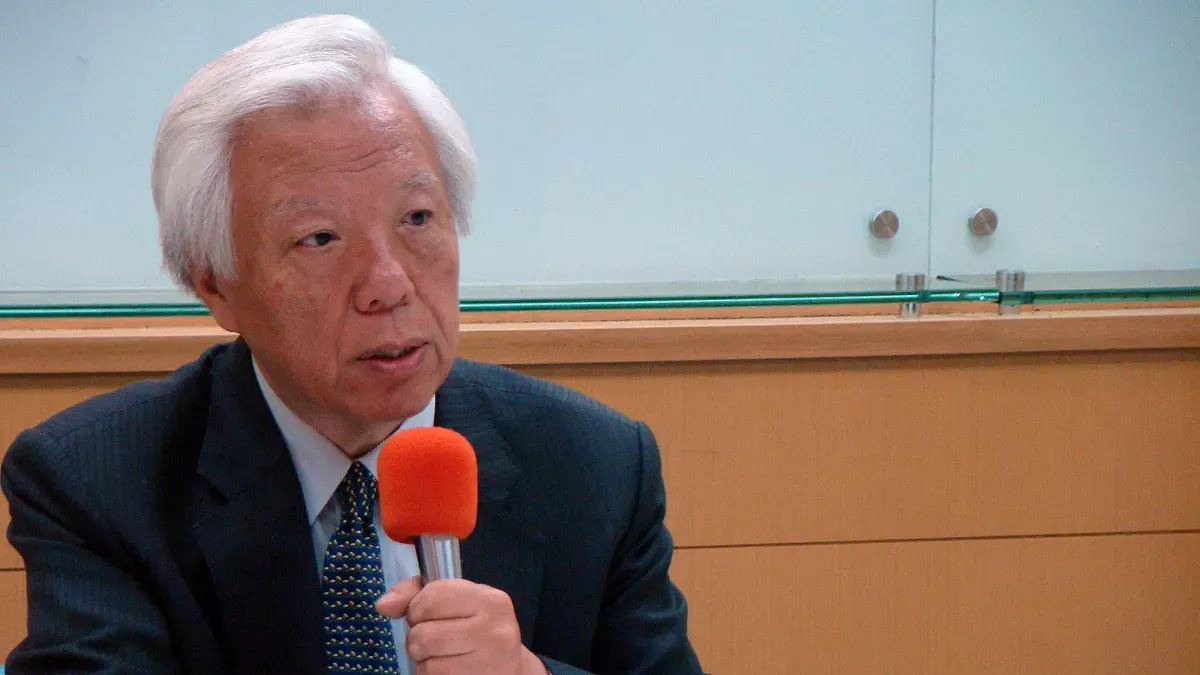
The Path of an Ordinary Citizen: An Interview with Professor Chiu Hei-yuan
Last edited: 2026-08-26

Former Chairperson · The Only One Without a Legal Background
Chairperson: February 2011 – February 2015
"When there is a problem in society, they look for you."
As the only chairperson in the history of the Judicial Reform Foundation without a legal background, how did Professor Chiu approach judicial reform through his sociological expertise and guide the development of the JRF?
From the Awakening Foundation to the JRF: A Sociologist's Concern for Justice
Professor Chiu was a student of Professor Yang Kuo-shu. In 1989, responding to the demands of social transformation following the lifting of martial law, Professor Yang rallied scholars from various fields to form the Cheng-she (The Awakening Foundation), acting as public intellectuals to critique current affairs, offer policy advice, and drive the maturation of democracy. As a key disciple of Professor Yang, Professor Chiu naturally became a founding member, serving twice as its president from 1991 to 1993 and from 1998 to 2000.
With his long-standing focus on social change, Professor Chiu naturally paid close attention to the judicial system, which remained deeply influenced by the martial law regime.
Building on the social influence established by Cheng-she, whenever public affairs required promotion, all sectors of society naturally thought of Cheng-she. Following the establishment of the JRF, Professor Chiu—who had stepped down as president of Cheng-she—was invited alongside Professor Huang Jong-tsun to join. Without a legal background, Professor Chiu brought with him a deep social prestige accumulated over the years, becoming a vital driving force for the JRF's advocacy efforts.
Coalition Convener: Amplifying Reform Forces Through Social Prestige
Reflecting on that period, Professor Chiu recalled that in promoting various issues, the JRF often needed to join forces with different civil society organizations to magnify its impact. Whether pushing for the Three Major Judicial Reform Acts, the abolition of the death penalty, or the reform of the Grand Justices system, the JRF consistently relied on organizational coalitions for advocacy. Whenever a gathering of forces was required, Professor Chiu, possessing high social prestige, became the undisputed choice to serve as the coalition convener.
Speaking on how he came to assume the chairmanship of the JRF, Professor Chiu explained that because a partner in former Chairperson Wellington Koo's (Ku Li-hsiung) law firm had assumed the presidency of the Judicial Yuan, Attorney Koo was no longer well-positioned to serve as chairperson given the JRF's supervisory and advocacy role. Under the governance structure of private foundations, new board members are typically designated and arranged by the incumbent chairperson and executive directors. After discussion among the board members, an invitation was extended to Professor Chiu, who readily accepted.
However, given Professor Chiu's lack of a legal background, there were initial concerns upon his assumption of the chairmanship that his unfamiliarity with the law might make it difficult for him to chair meetings. Fortunately, his long-term experience as an association president and institute director allowed him to quickly grasp the general outline of each agenda item and expertly synthesize diverse opinions. When differences arose, he helped facilitate further discussion to reach a consensus, earning high praise from the executive director at the time, Chen Yu-fan.
Because of his skill in integrating agendas, grasping the core points of discussion, and formulating clear conclusions after understanding the gist of each case, Professor Chiu became the most heavily relied-upon chair in the team. On one occasion, while he was traveling back and forth teaching across Europe and Henan, the JRF kept the position vacant, waiting for his return to the country before inviting him to serve as the convener of the Grand Justices Monitoring Coalition.
Throughout his long-term involvement with the JRF, although not a legal scholar, Professor Chiu exerted a unique influence through chairing meetings time and again, serving as a coalition convener, and participating in advocacy and protests. Among these, the promotion of the Three Major Judicial Reform Acts, the abolition of the death penalty, and public oversight of Grand Justices candidates remain unforgettable to him.
The Coalition for Promoting the Three Major Judicial Reform Acts
The Coalition for Promoting the Three Major Judicial Reform Acts was established in 2003 with the objective of advancing the passage of the Legal Aid Act and the Judges Act, as well as the amendment of the Judicial Yuan Organization Act, with Professor Chiu serving as its convener.
Recalling the promotion efforts of that era, Professor Chiu noted that the Legal Aid Act went relatively smoothly, whereas the amendment processes for the Judges Act and the Judicial Yuan Organization Act were much more arduous. After the promotion coalition was established, the Legal Aid Act was largely formed, primarily involving discrepancies in budget allocation between the government and the private sector[2]. However, the amendments to the Judges Act and the Judicial Yuan Organization Act involved not only the Judicial Yuan but also the personnel powers of the Examination Yuan, which in turn triggered systemic adjustments within the Control Yuan and the Executive Yuan. Amidst various mutual constraints, the resistance encountered by the reform became highly complex.
Starting from the promotion of legal amendments in 2003, under the Democratic Progressive Party administration while the Kuomintang held a majority in the Legislative Yuan, both the Judges Act and the Judicial Yuan Organization Act faced backlash from across the political spectrum. Faced with this situation, the JRF adopted a multi-pronged strategy, demanding that the Legislative Yuan promote legal amendments while also visiting various ministries and political leaders. On one hand, Professor Chiu visited Legislative Yuan President Wang Jin-pyng, and on the other hand, he met with Premier Su Tseng-chang and Examination Yuan President Yao Chia-wen. Nevertheless, amidst various political maneuvering, the Judges Act and the Judicial Yuan Organization Act repeatedly hit roadblocks, making their advancement extremely difficult.
Regarding the promotion of the Judicial Yuan Organization Act, as early as the National Judicial Reform Conference in 1999 under the Kuomintang administration, a resolution for amendment had already been reached. Regrettably, during the period when the JRF advocated for reform, when Professor Chiu led a delegation to visit Lien Chan—then KMT Chairman and former host of the National Judicial Reform Conference—Lien Chan merely passed the matter off to others without any genuine intent to promote it. Subsequently, the KMT legislative caucus even blocked the related bills in the Legislative Yuan.
As for the advancement of the Judges Act, due to prolonged inaction by the authorities, the JRF subsequently formed the Judges Act Promotion Coalition, also convened by Professor Chiu. After a ten-year advocacy process, it was finally officially passed in 2011.
The Anti-Death Penalty Movement: Meetings with Two Presidents
Aside from the arduous push for the Three Major Judicial Reform Acts, the abolition of the death penalty was another issue Professor Chiu considered the most difficult to advance.
At the end of 2003, the Taiwan Alliance to End the Death Penalty was officially established with Professor Chiu serving as its convener. Professor Chiu recalled that he frequently submitted opinion pieces to explain the relevant principles at the time. However, in a public opinion environment long inclined toward opposing abolition, the voices of anti-death penalty groups were often drowned out. Moreover, mass media such as newspapers and television generally supported the death penalty, or their coverage was dominated by the criticisms of victims' families, making it even harder for the voice of the abolition movement to reach the government.
To advance the abolition of the death penalty, Professor Chiu and his partners from the alliance also met with two presidents, Chen Shui-bian and Ma Ying-jeou. Although the DPP was theoretically more inclined to support abolition, they still found it difficult to speak out publicly when facing public pressure. During the meeting, former President Chen Shui-bian responded: "You all go figure out a way to change public opinion; public opinion is so strongly opposed." This led Professor Chiu to question how President Chen—who was also the chairman of the ruling party—could, despite having far greater capacity than civil society to guide public discourse, lack the courage to face the pressures of public opinion.
As for President Ma Ying-jeou, when facing Professor Chiu and his delegation, he merely stated: "I have never been firmly determined to abolish the death penalty." He was neither willing to explicitly support nor express opposition to the death penalty. Later, Professor Chiu accompanied foreign partners from the World Coalition Against the Death Penalty to visit Ma Ying-jeou; yet, having met with the abolitionist group on a Tuesday, the Ma administration executed a prisoner on Friday, highlighting the administration's retreat under public pressure.
The Coalition for Civilian Oversight of Judicial Yuan Grand Justices Candidates
In 2003, while busy navigating various coalitions, Professor Chiu also served as the convener of the "Coalition for Civilian Oversight of Judicial Yuan Grand Justices Candidates (including the President and Vice President)," conducting relevant evaluations during subsequent presidential nominations of Grand Justices in the hope that the government would incorporate civil society's voice.
Among these, the most memorable event for Professor Chiu occurred in 2016, when President Tsai Ing-wen was set to nominate new Grand Justices. As usual, the JRF submitted evaluations concerning the nominees for Grand Justices, President, and Vice President, and extended an invitation to meet with President Tsai. However, without responding to the coalition's request, the Presidential Office immediately proceeded with the nominations. The civil society organizations forming the coalition promptly issued protests, and only as public pressure mounted did President Tsai finally agree to receive the coalition members.
Recalling the process of visiting the president, Professor Chiu led a delegation of about 20 representatives into the Presidential Office for a dialogue chaired by President Tsai. Following the meeting, Professor Chiu promptly received a call from a presidential secretary indicating that President Tsai wished to visit Professor Chiu at his home. During her visit, the President personally explained the appropriateness of the Grand Justices nominations, which Professor Chiu did not accept, nor did President Tsai intend to persuade him. The true purpose of the President's visit was to invite Professor Chiu to participate in the National Judicial Reform Conference scheduled for 2017. Although Professor Chiu initially declined, citing his wife's declining health, he ultimately agreed after persuasion from the presidential office. As President Tsai was leaving Professor Chiu's home, she turned back and said to him, "Hsu Tzong-li and Lin Tzu-yi both guessed wrong; they both thought you wouldn't agree."
Upon joining the Preparatory Committee for the National Judicial Reform Conference, Professor Chiu served as the deputy convener, continually pushing the influence of judicial reform ideals further.
The Power of Coalitions: The JRF's Most Influential Strength
The Coalition for Promoting the Three Major Judicial Reform Acts, the Taiwan Alliance to End the Death Penalty, the Coalition for Civilian Oversight of Grand Justices Candidates... Throughout its journey, the JRF has organized and mobilized multiple coalitions across various issues, rallying numerous civil society organizations to speak with one voice. This is precisely what Professor Chiu considers the JRF's most powerful asset.
Compared to the independent actions of a single foundation, coalitions can effectively pool human resources, material resources, and social prestige, forming a more impactful collective action. The JRF's strength lies precisely in its ability to flexibly establish short-term or long-term coalitions according to issue requirements, summoning long-term civil society partners and related community groups concerned with the issues, thereby amplifying the public impact of judicial reform advocacy through the coalition format.
Camaraderie with Partners: "When There Is a Problem in Society, They Look for You"
Reviewing his interactions with colleagues at the JRF, Professor Chiu noted that their relationships were largely built upon public affairs with little personal socialization. Yet precisely because they met in the pursuit of the public good, Professor Chiu holds the camaraderie with his JRF partners as particularly precious and feels a deep admiration for them. These individuals all proactively cared about societal issues in need of reform and threw themselves into action—such as Attorney Clement Chen (Lo Ping-cheng), who focused on wrongful convictions and systemic flaws; Attorney Wellington Koo's dedication to public affairs; and notably Attorney Lin Yung-sung, who was an essential partner whom Professor Chiu repeatedly encountered across public issues.
Speaking of his camaraderie with Attorney Lin, Professor Chiu shared: "I first met Yung-sung at the JRF, then ran into him again during the rescue of underage prostitutes, and subsequently crossed paths yet again on the issue of child and youth sexual exploitation." Professor Chiu recounted how Attorney Lin once half-jokingly said to him, "When there is a problem in society, they look for you." Professor Chiu replied in kind: "I see you there, too."
This magnanimity toward social concern causes judicial reform advocates to "repeatedly encounter" one another in the fractures of society, hoping to grant future generations a better public space through voicing and committing to social issues.
Footnotes & References
[1] For the demands behind the promotion of the Three Major Judicial Reform Acts, see Judicial Reform Foundation (2003). "Why Are We Promoting the Three Major Judicial Reform Acts?", *Judicial Reform Magazine*, 48, Judicial Reform Foundation. Retrieved from https://digital.jrf.org.tw/articles/1170
[2] For the promotion of the Legal Aid Act, see the interview with Attorney Lin Yung-sung.
Continue Reading Stories of Other Predecessors
Back to Interview Overview View Judicial Reform Milestones
Last Edited: May 16, 2026 | Judicial Reform Foundation 30th Anniversary Special Profile Series
This article is an AI-generated translation of the original Chinese text. In the event of any discrepancy, the Chinese version shall prevail.