
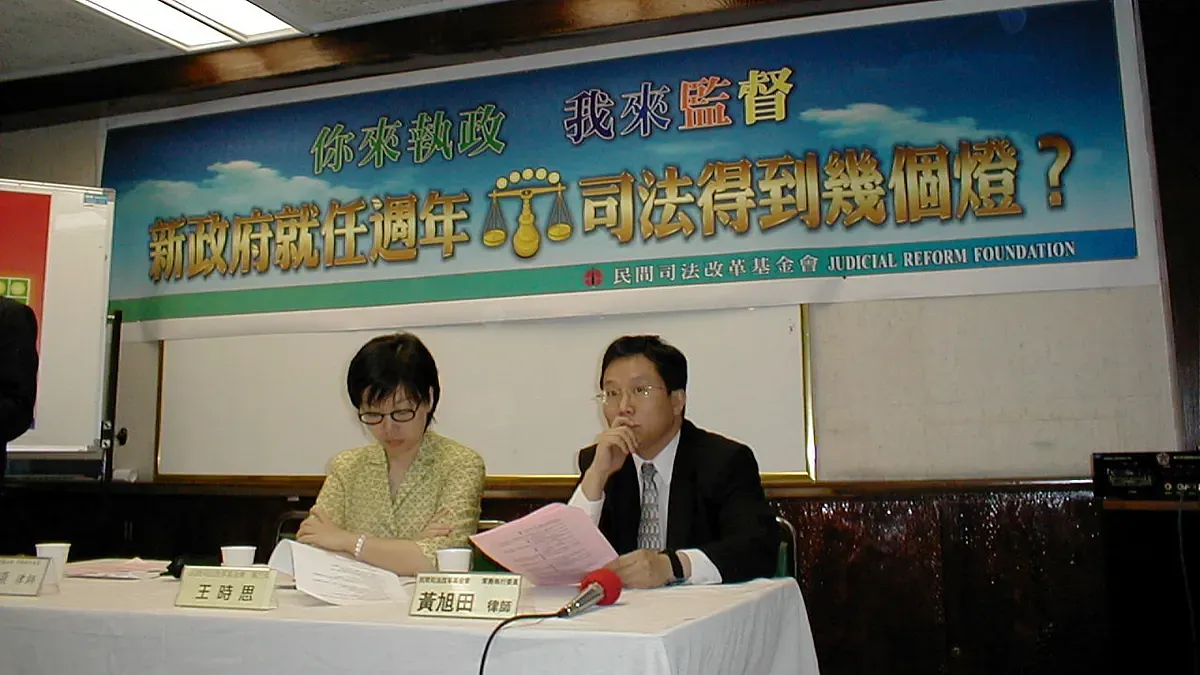
The Path of an Ordinary Person: An Interview with Attorney Huang Hsu-tien
Last edited: 2026-08-26
Judicial Reform Foundation

Attorney Huang Hsu-Tien
Current Chairperson
Chairperson: January 2023 – Present
"Doing judicial reform makes me feel alive alongside others."
One spring 30 years ago, the streets of Taipei still carried the lingering, stifling atmosphere following the lifting of martial law. Looking back, Attorney Huang was a young lawyer in his third year of practice. Though not yet a veteran, he was already feeling perplexed and uneasy in the face of an institutional impasse where the judiciary had yet to genuinely embrace democratization following the lifting of martial law. Carrying this state of mind, Attorney Huang was walking down the street one day when he happened to run into Attorney Lin Yung-sung, who had once taught him at a cram school.
"Attorney Huang, Attorney Huang, come, come, come, we have a Judicial Reform Foundation, would you like to join us?" JRF had been established not long before and was actively recruiting legal professionals dedicated to improving the judicial environment. Encouraged by founder Attorney Lin Yung-sung, this marked the beginning of Attorney Huang's journey in joining.
Joining the JRF was like opening a door to public participation, providing Attorney Huang with a space to voice his dissatisfaction with the judiciary at the time. Attorney Huang recalled that back then, the JRF brought together many senior figures from the legal community, as well as his upperclassmen and peers. Holding various visions for the judicial environment, through continuous discussion and exchange, they developed proactive judicial reform actions, binding him closely to judicial reform for the next 30 years. Attorney Huang also remarked sentimentally that engaging in judicial reform made him feel alive and moving forward together with others, rather than remaining a lonely, tiny, and vulnerable solitary individual.
The Starting Point of Encountering Judicial Reform: Beginning in the Courtrooms under Authoritarian Shadows
Courtroom injustice was the starting point of Attorney Huang's concern for judicial reform, and also a critical agenda for the JRF's reform initiatives. In 1987, Taiwan lifted martial law, but courtrooms still maintained asymmetrical power dynamics, and hostile attitudes from judges and prosecutors were exceptionally common.
Recalling that time, Attorney Huang remembered accompanying a victim's family member to court. Because the family member did not understand the prosecutor's questioning, they quietly asked Attorney Huang, who carefully and softly explained it to them. However, the prosecutor suddenly pointed at Attorney Huang and barked, "What are you talking about? Still talking? I'll have you thrown out in a minute!" This sparked a doubt in Attorney Huang's mind: "I am the litigation agent, I was just speaking softly, on what grounds are you going to have me removed?" However, as a young lawyer at the time, Attorney Huang felt he lacked the sufficient confidence to confront the prosecutor head-on and could only choose silence.
In that era, hostile attitudes from judges and prosecutors were an everyday occurrence; they could arbitrarily humiliate lawyers or litigants. "They showed you no respect whatsoever; they would scold whoever they wanted. If they didn't like what a party said, they would humiliate you with an attitude like, 'Don't speak that nonsense, who's going to listen to you? You'd better tell the truth or else.'" The remnants of the authoritarian era were reflected in the operation of the judiciary. Even though society was nominally de-martialized, profound democratic values still could not be practiced within the courtroom.
The Beginning of Monitoring: Student Volunteers and Court Observation
Against this backdrop, the JRF pondered how to let more people witness what actually happens in courtrooms. In 1995, the first year of JRF's establishment, the Court Observation program was officially launched. Through the observation and monitoring of judicial proceedings, it examined whether judicial personnel abused their power or afforded litigants adequate opportunities to state their cases and present arguments, culminating in observation and investigation reports that explored the causes of relevant malpractices and methods for improvement.
To achieve transparency and openness in courtroom proceedings, the JRF recruited numerous student volunteers alongside legal workers and litigants. After training, these volunteers recorded each judge's courtroom conduct during trials. Through the establishment of the court observation program, the JRF observed at the time that while some judges initially behaved quite fiercely when hearings began, their attitudes immediately turned amiable once unfamiliar college students entered the courtroom to observe.
"Judges knew they ought to be amiable, but they couldn't help revealing their unamiable side. Yet gradually, because of this transparent and public monitoring, judges' attitudes actually improved." In 2002, the JRF formed its first "Court Observation Team," visiting 17 courts nationwide in person. They incorporated not only courtroom proceedings but also 38 evaluation items such as the hardware facilities and staff service quality of each court, subsequently holding a court observation press conference to announce the results of the first court observation.
When the JRF was privately prosecuted for defamation by Taiwan High Court Judge Yang Kuei-chih—initiated against JRF Chairperson Attorney Kao Jui-cheng and former Executive Director Attorney Lin Yung-sung due to the "Judicial Evaluation" activities—Attorney Huang also assisted in their defense.
Through the auditing of students and volunteers, courtroom transparency was elevated, a better courtroom environment was fostered, and the public was enabled to understand how trials are conducted. This reduced the fear and alienation people traditionally held toward the judiciary under authoritarianism, further allowing court observation to serve a legal education function.
The Field Where Most Effort Was Invested: Legal Education
"Legal education" is the endeavor to which Attorney Huang has devoted the most effort over his 30 years at the JRF. Attorney Huang believes that truly changing the judiciary cannot rely solely on courtroom contention; society must be enabled to recognize and comprehend the spirit and values of the legal system, and to continuously deepen reform, the next generation is the crucial key.
In 1999, the JRF established the Legal Education Committee, inviting lawyers, teachers, and other members to hold regular meetings and discussions to evaluate and review issues such as teaching staff, legal teaching materials, and pedagogical methods. They also organized teacher training and curriculum seminars, discussing with teachers what democratic rule of law and judicial reform mean, and subsequently leading teachers on court visits with the expectation that once teachers gained a more concrete understanding of the rule of law, they could pass it on to our next generation.
However, during this process, teachers raised a pivotal question: "We completely agree with the lawyers' philosophy and explanations, and we very much hope to impart this knowledge to our students, but we lack suitable teaching materials. Can you help compile teaching materials for us to use in our teaching?" Attorney Huang recalled that such feedback felt like a bolt from the blue for the JRF, because while the JRF wanted to support teachers, creating teaching materials from scratch was an almost impossible task for the JRF at the time.
As it happened, following the 2000 presidential election, Taiwan completed its first-ever peaceful party rotation. Taiwan's transition from an authoritarian regime to a democratic system without bloodshed attracted high international attention and drew many scholars from overseas fields such as political science and sociology.
As these scholars began turning their attention to Taiwan, they also began suggesting that Taiwan needed to deepen and consolidate democracy through "legal education." Yet at the time, Taiwanese society was unfamiliar with the connotation of "legal education." The Rotary Club invited two Yale Law School professors to teach in Taiwan and approached the Taipei Bar Association for cooperation, hoping to promote relevant principles through lawyers.
Attorney Huang, who was then working at the Taipei Bar Association, became the liaison. Combined with the JRF's experience in legal education, both sides hit it off immediately. Attorney Huang told them that legal education was not an American monopoly and that Taiwan possessed its own practical experiences. He laughingly recalled that an event mockingly dubbed the "American Legal Education Missionary Rally" was renamed the "Taiwan-US Legal Education Missionary Observation Rally." The US side introduced the "Street Law" curriculum, allowing children to learn law from daily life contexts, while the Taiwan side shared its attempts at cooperating with schools. As discussions broadened, the Rotary Club, the Taipei Bar Association, and the JRF thus joined hands to embark on the systematic promotion of legal education.
Following the United States, Japan—due to the historical connection of having once colonized Taiwan—also wanted to come and see how Taiwan's democratic legal education was conducted. Around 2000, Japan also initiated judicial reform, one of whose core concepts was Access to Justice, aiming to make it easier for the people to access the judiciary. During the promotion process, Japan conducted numerous investigations and studies. However, some reform-minded lawyers within the Japanese legal community felt that Japan's reforms often merely "blindly copied the American model." They self-deprecatingly remarked: "American monks know how to chant scriptures, so we just need to copy America. But after copying, they say that's something America can do while Japan cannot do it well, because America is first-class and Japan is second-class."
Therefore, Japanese lawyers began to reflect that if they no longer relied on American experts, but instead sought a country that had once been colonized by Japan yet successfully promoted legal education, it would serve as a worthy model of reference. Through roundabout introductions, they heard that Taiwan was promoting legal education and thus decided to visit Taiwan for guidance. The Japanese side's liaison at the time was a Taiwanese lawyer who had studied in Japan; coincidentally, he happened to be Attorney Huang's colleague. Therefore, Attorney Huang explained and shared relevant experiences with him, met with Japanese lawyers to give a briefing, and subsequently traveled to Japan to deliver further briefings.
During the briefings in Japan, Attorney Huang met a lecturer from the Center for Civic Education in the United States, who had designed a curriculum titled Foundations of Democracy. It encompassed four major themes: Authority, Privacy, Responsibility, and Justice. This curriculum possessed a well-structured instructional system, including textbooks, teacher manuals, and a complete series ranging from kindergarten, elementary middle-upper grades, junior high to high school. This precisely solved the JRF's greatest difficulty in promoting legal education.
In 2006, the Rotary Club officially handed over the mission of legal education to the JRF. Utilizing a donation from Kingston Technology, the JRF established the Center for Rooting Legal Education Downward, which subsequently spun off from the JRF in 2011 to establish the "Foundation for Citizens and Legal Education."
In 2011, the Center for Rooting Legal Education Downward also began promoting the "Civic Action Project," utilizing Foundations of Democracy as its core teaching material. Following the exchanges in Japan that year, Attorney Huang and relevant fellow lawyers, accompanied by Professor Lin Chia-fan of National Taiwan Normal University, traveled to the United States to secure official authorization so that legal education could be progressively implemented on campuses.
Interestingly, in the process of promoting the Foundations of Democracy curriculum, the JRF discovered that because elementary school education offered greater flexibility, was less constrained by examination pressures, and granted teachers more freedom in curriculum design, the response to legal education promotion was met with the most enthusiastic reception. Consequently, the elementary school stage became the exemplary field for "rooting it downward."
Characteristics of Current JRF Legal Education
After the Legal Education Foundation began operating independently, driven by its lawyer partners, the JRF reconstructed a new path for legal education. Compared to the Foundation's focus on educational settings, the JRF's current legal education has developed "mock trials," "wrongful conviction story advocacy," "debate competitions," and "exhibitions" promoted by its Central Taiwan Office.
First, during the process of discussing the lay participation system ( Citizen Judge system) in Taiwan, the JRF extensively promoted mock trial activities, allowing students to concretely experience the operation of the judicial process through role-playing and trial simulation.
Second, combining its long-term experience in rescuing wrongful convictions, the JRF has invited victims of wrongful convictions such as Su Chien-ho and Hsu Tzu-chiang to speak in person, bringing stories of wrongful convictions onto campuses so that students can directly experience the heavy toll inflicted by judicial errors. Wrongful conviction advocacy is not limited to campuses; it is also a vital legal education pathway for fostering social dialogue. Many figures from cultural and media circles have disseminated issues of judicial errors through forms such as novels, films, and documentaries, enabling the general public to understand that the judiciary can err, and that judicial systems and human judgment inherently contain biases and blind spots. Therefore, the judiciary must possess self-correcting capabilities and the ability to accept external oversight, building a fair and reasonable litigation system while giving judicial authorities an opportunity to confront related problems head-on.
Furthermore, over the past decade or more, the JRF established the Central Taiwan Office in Taichung. From its inception, it received widespread support from central Taiwan lawyers and academia, especially the active participation of multiple professors from Providence University. This naturally enabled the Central Taiwan Office to establish close interactions with academia and practice circles, bringing greater possibilities to the Central Taiwan Office as a base for legal education, such as lawyers frequently being invited to give lectures at schools.
Additionally, the establishment of the Central Taiwan Office was also the JRF's response to a real structural problem: most of the energy of NGO groups is concentrated in Taipei, while central and southern Taiwan are relatively deficient in resource distribution. Therefore, the JRF positioned the Central Taiwan Office as a regional "knowledge center for democracy, freedom, rule of law, and human rights," aspiring to become an important promoter of local public education while filling the social education and legal promotion roles that the Taipei Office cannot support outside of its issue-response and administrative/legislative advocacy functions.
In recent years, the Central Taiwan Office has actively used exhibitions as a medium for education. Through three-dimensional presentations using imagery, graphics, and multimedia, judicial reform issues are transformed into formats that are easier for the public to understand and absorb, giving legal education an opportunity to expand into broader public spaces. Finally, the JRF also holds the annual JRF Cup National High School and Vocational School Debate Competition, translating trending judicial issues into topics for students to actually discuss and debate, thereby deepening the younger generation's participation in and critical thinking regarding legal education.
Through these activities, the JRF seeks to build deep dialogues with different strata of society, allowing legal education to transcend mere slogans and infiltrate daily learning and public discussion.
Conclusion: The JRF Calls for Critical Thinking and Action Alike
As the current chairperson of the JRF, after recounting his journey of participating in the promotion of JRF's legal education, Attorney Huang further shared his practical philosophy and vision for judicial reform as chairperson, offering prospective directions for judicial reform in the face of Taiwan's current social environment.
First, Attorney Huang believes that throughout the JRF's development process, research has always been a vital capacity. The establishment of the Legislative and Policy Department highlights the JRF's capability for research and professional analysis, elevating its negotiating strength against official authorities regarding bills over the past five to ten years, and ensuring that JRF advocacy is grounded in complete, mature, and viable research and policy foundations.
Furthermore, apart from knowledge, action is regarded by Attorney Huang as the JRF's most crucial value as chairperson. The chairperson's responsibility is to coordinate, organize, and inspire colleagues and volunteers, supporting what colleagues deem important. Attorney Huang noted that the way to inspire colleagues' motivation is not by instructing them on what to do, but by creating an environment where everyone can move forward autonomously and dedicate themselves fully, while the chairperson acts to foster consensus and resolve difficulties, allowing every member who invests in the JRF to unleash their maximum combat effectiveness.
Attorney Huang emphasized that agency and action are the core values of the JRF. He noted that as people accumulate more knowledge, their baggage often becomes so heavy that they ultimately lose the courage to act. The JRF's goal is not only to act as a think tank for knowledge and legal research, but also to stand up and take action. When an individual's courage is insufficient, people are brought together so they can mutually encourage one another and find ways to break through the status quo—and this precisely embodies the value of the JRF.
Moreover, facing the vision of judicial reform, Attorney Huang proposed that continued attention must be paid to the "rationalization of litigation systems" and "mechanisms for the selection and elimination of judges." Regarding the "rationalization of litigation systems," Attorney Huang pointed out numerous unreasonable phenomena in civil and criminal litigation, arguing that the mandatory legal representation system should be strengthened to prevent errors by judges or litigants caused by a lack of lawyer participation. Regarding "mechanisms for the selection and elimination of judges," Attorney Huang emphasized that while institutional reform is important, talent is the key. The legal system must encourage outstanding judges while weeding out unqualified ones to elevate the quality of the judicial system.
Finally, Attorney Huang raised a reflection: Why does Taiwan perform so brilliantly in many areas, yet struggle to gain social satisfaction regarding its judiciary? Why do citizens harbor so many complaints about the judiciary, and why is public trust in the judiciary so low? Why is the workload of judicial personnel so overwhelmingly burdensome? The chairperson believes this poses not only a challenge to legal professionals, but also a questioning of society as a whole: Shouldn't the people of Taiwan have a higher-standard judicial system? Because a sound judiciary is beneficial not merely to legal professionals, but to society as a whole; when the judiciary is unjust, no one can escape unscathed.
Continue Reading Stories of Other Predecessors
Back to Interview Overview View Judicial Reform Milestones
Last Edited: 2026-05-16 | JRF 30th Anniversary Special Interview Feature
This article is an AI-generated translation of the original Chinese text. In the event of any discrepancy, the Chinese version shall prevail.