
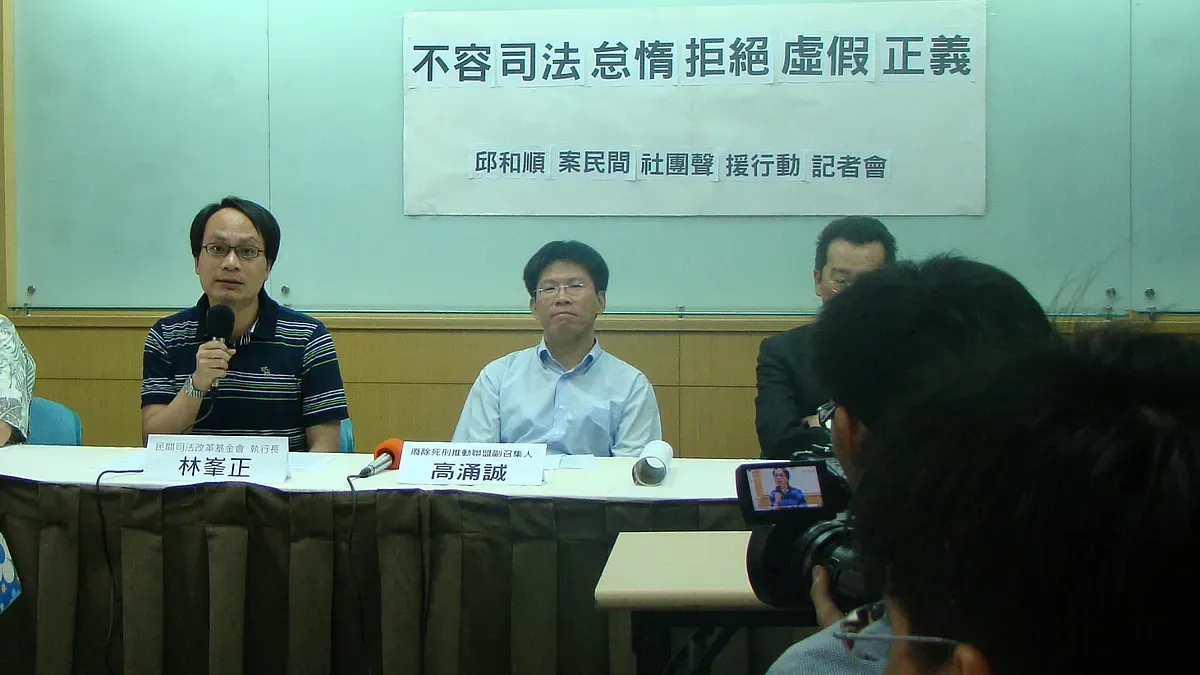
The Path of an Ordinary Citizen: An Interview with Attorney Kao Yung-cheng
Last edited: 2026-08-26
Judicial Reform Foundation

Attorney Kao Yung-cheng
Former Executive Director
Executive Director: 2004.7–2007.1
"Judicial reform is for ordinary citizens!"
Reflecting on his affinity with the JRF, Attorney Kao Yung-cheng begins by recalling the backwardness of Taiwan's judicial system when he first started practicing law. In the late 1980s, Taiwanese society was rapidly attempting to shed its authoritarian past. Social movements such as educational reform and the Onerous Nest movement were surging, yet the judiciary still heavily bore the vestiges of the authoritarian era.
Attorney Kao describes that period as a "dark era" where judges could openly scold lawyers and parties in the courtroom, and no one felt that was wrong. The quality and efficiency of trials were extremely poor. "At that time, we didn't have a court observation system yet, and judges berating people was commonplace. For instance, a very famous judge back then named Chen Ping-chang scolded so many lawyers that the bar association eventually reported the matter to President Weng Yueh-sheng, and Chen was finally removed."
It was not until around 1994 and 1995 that Room 303 of the Taiwan Taichung District Court initiated reforms to "return case assignments to judges' meetings," breaking the long-standing judicial custom of judges being assigned cases by court presidents. Subsequently, in 1999, then-President of the Judicial Yuan Weng Yueh-sheng convened the first National Conference on Judicial Reform, finally opening the prelude to Taiwan's judicial reform.
Against this historical backdrop, after completing his military service in 1993, Attorney Kao joined his father's law firm to practice. He personally experienced the rigidity and injustice of the judiciary, which in turn sparked his contemplation and concern for judicial reform.
Stepping Up on Short Notice to Serve as JRF Executive Director
Attorney Kao's connection with the JRF began through his participation in the Legal Education Committee. At that time, the Legal Education Committee was led by Attorney Huang Hsu-tien. Together with his fellow committee members, he co-authored the Student Rights Code, promoted innovative activities such as "Learning Law Through Movies," and assisted in editing introductory legal books such as Grand Justices, Give Us an Explanation!
Later, after the then-Executive Director Attorney Lin Ching-ping stepped down due to health reasons, Attorney Kao "stepped up on short notice" to take over the position of Executive Director. Attorney Kao shared that at the time, he was still practicing at his father's firm. He accepted the role of Executive Director because the JRF's board of directors generally believed that the Executive Director should be a lawyer with active practice experience to truly understand judicial problems. However, finding a lawyer who both had practice experience and was willing to give up their existing work to commit full-time was no easy task. As it happened, Attorney Kao was working at his father's firm, and with his father's support for the practice, Attorney Kao was able to transition to the JRF.
Faced with the heavy burden of the Executive Director position, Attorney Kao remarked that he "did not start with some grand sense of mission or ambition to execute, but rather learned gradually how to be an Executive Director." Adapting to the role transition from a lawyer to an executive director was one of Attorney Kao's most profound professional challenges at the time.
During Attorney Kao Yung-cheng's tenure as Executive Director, Taiwanese society and the judicial system also underwent numerous transformations. In the interview, Attorney Kao shared several major judicial reform events that left a deep impression on him.
Major Judicial Reform Event (1): The Kingston Donation and the Birth of Charitable Trusts
Recalling major judicial reform events that left a deep impression, Attorney Kao first mentioned that in 2004, President Chen Shui-bian, seeking re-election, narrowly won by a margin of less than 30,000 votes. His Blue-camp opponents, Lien Chan and James Soong, filed lawsuits for the annulment of the election and demanded a recount. Faced with intense disputes and conflicts in Taiwanese society, Kingston Technology intended to donate NT$100 million to fund the recount. They asked the JRF to assist in verifying vouchers for the litigation parties and disbursing the relevant funds. Upon completion of the entire execution process, a total of over NT$20 million was spent.
Subsequently, in accordance with its contract with Kingston, the JRF entrusted the Central Trust of China to establish the "Ethnic Harmony Charitable Trust Fund" using the remaining balance, directing the leftover funds from Kingston's donation toward promoting ethnic integration, human rights education, legal education, and judicial reform. This "charitable trust" became the first of its kind in Taiwan's history, making the JRF the very first organization in Taiwan to put the system into actual operation following the enactment of the Trust Act and the establishment of the charitable trust framework.
Attorney Kao stated that at the time, to discuss how these funds should be utilized, Professor Chiu Hei-yuan gathered social figures from various sectors to form an advisory committee to review whether each expenditure was reasonable item by item. The remaining funds were subsequently used to establish the "Legal Ethics Center" and the "Civil and Legal Education Foundation." Attorney Kao believes that through that operation, the JRF demonstrated to Taiwanese society what a "successful charitable trust" looks like—it was neither for personal gain nor resembling external suspicions of money laundering or parking funds, but entirely driven by a selfless public-interest spirit. Consequently, the government and banking sectors were able to witness how legal professionals execute a charitable trust and maintain its public-interest nature through advisory meetings. However, the JRF's experience did not form a systematic continuation or reference point in Taiwanese society, and subsequent controversies surrounding charitable trusts have made Attorney Kao feel that this was a tremendous pity.
Major Judicial Reform Event (2): The Cheng Chung-mo Incident
Attorney Kao recalled further that in 2011, then-Grand Justice and Vice President of the Judicial Yuan Cheng Chung-mo was photographed by the media visiting a motel with a woman, causing a public uproar. Taiwanese society had already entered the era of tabloid culture driven by Apple Daily and Next Magazine, with news reporting on the Cheng Chung-mo incident almost daily. Reporters also staked out outside the JRF every day, hoping the JRF would express its stance.
In line with public expectations regarding the untarnished reputation of a Grand Justice's office, the JRF issued a statement condemning the incident and expecting Cheng Chung-mo to resign to take responsibility. However, looking back at the narrative of that time, while ordinary citizens would naturally feel that Cheng Chung-mo should be held responsible and to some extent had to take accountability, from the perspective of judicial professionalism and whether he was fit to serve as Vice President, Attorney Kao—with the benefit of broader experience—believes that if he could do it over again, this incident should not have been used as the primary grounds for demanding his unfitness as Vice President.
Attorney Kao noted that this introspection also carried over into his work as a Control Commissioner. After taking office as a Control Commissioner, he said he increasingly disliked investigating cases concerning the "private morality" of judges, especially extramarital affairs, because fitness for office and private morality are fundamentally two different matters. Interestingly, it was rumored within judicial circles at the time that Judicial Yuan President Weng Yueh-sheng was at odds with Cheng Chung-mo and therefore allied with the JRF to oust Cheng. Although the developments at the time helped President Weng resolve part of his problem, looking back, Attorney Kao wants to clarify that there was no such thing as "collusion" between President Weng and the JRF. The situation was primarily driven by tabloid media reports and the backlash of public opinion, which led to Cheng Chung-mo's downfall.
Major Judicial Reform Event (3): Universal Fingerprinting and Interpretation No. 603
Another event that left a deep impression on Attorney Kao occurred in 2005, when the Ministry of the Interior planned to universally reissue national ID cards and establish a nationwide fingerprint identification database in the process. This move sparked high controversy in society, prompting civil organizations such as the JRF and the Taiwan Association for Human Rights (TAHR) to mobilize in protest, questioning the government's infringement upon citizens' privacy rights through administrative means.
Faced with pressure, the Democratic Progressive Party (DPP) Legislative Caucus filed a petition for constitutional interpretation regarding Article 8 of the Household Registration Act on May 30 of the same year. On June 10, the Grand Justices' meeting issued Interpretation No. 599, promulgating a provisional disposition to freeze the Ministry of the Interior's fingerprint recording measures, followed by a series of explanatory meetings and oral argument sessions. Ultimately, on September 28, Interpretation No. 603 was issued, declaring Paragraphs 2 and 3 of Article 8 of the Household Registration Act unconstitutional, and explicitly stating that the Ministry of the Interior's approach violated the principle of proportionality and infringed upon citizens' fundamental rights.
The consecutive significance of Interpretations No. 599 and No. 603 is profound. The former established the authority of the Grand Justices to issue "provisional dispositions," opening a new chapter in constitutional relief. The latter further elaborated on the core values of the right to privacy and human dignity, emphasizing that the state must respect personal autonomy and informational privacy when exercising public authority. This case not only made the application of the "principle of proportionality" more concrete but also provided an important constitutional basis for future cases involving citizens' rights and irrevocable harm.
Major Judicial Reform Event (4): Interpretation No. 582 and the Hsu Tzu-chiang Case
In addition, Attorney Kao mentioned that on July 23, 2004, the Grand Justices of the Judicial Yuan issued Judicial Yuan Interpretation No. 582 concerning the Hsu Tzu-chiang case, which the JRF had supported for many years. The interpretation stated that so-called "co-defendants" should be regarded as witnesses, and therefore, when using their statements as evidence, the statutory procedures for witness testimony under the Code of Criminal Procedure must be strictly followed. This also meant that two precedents previously established by the Supreme Court—Precedent Shang-Zi No. 2423 in the 31st Year of the Republic and Precedent Tai-Shang-Zi No. 419 in the 46th Year of the Republic—which held that "a co-defendant's statement disadvantageous to himself may be used as evidence of another co-defendant's criminal conduct," were declared unconstitutional.
Long criticized by human rights groups and criminal procedure scholars, "statements by co-defendants" were not officially prescribed evidentiary methods under the Code of Criminal Procedure. Yet, judicial practice treated them as grounds for conviction, often adopting them without procedural safeguards such as oath-taking, confrontation, or cross-examination, leading to a continuous stream of miscarriages of justice. The Hsu Tzu-chiang case was precisely one of the most representative examples. It spurred the birth of Interpretation No. 582, established boundaries for the use of evidence in judicial trials, and safeguarded citizens from being wrongfully convicted in the future based on others' arbitrary confessions.
Major Judicial Reform Event (5): Non-Disclosure of Investigation and Media Ethics
"Non-disclosure of investigation" is a key issue that the JRF has continuously advocated and monitored over the past few years. By placing constraints on prosecutors, police, investigators, and the media, the JRF aims to safeguard the rights of involved parties while implementing the "presumption of innocence."
Attorney Kao, who currently serves as a Control Commissioner, shared that upon taking office, he immediately focused on the relationship between the media and the non-disclosure of investigation. At the time, Professor Wu Chih-kuang informed him that Austrian media law explicitly stipulates the "presumption of innocence," requiring the media to exercise restraint in their reporting so as not to cause secondary harm to victims while also protecting the procedural rights due to perpetrators.
Although the 2017 National Conference on Judicial Reform incorporated "non-disclosure of investigation" as a major discussion item and tasked the National Communications Commission (NCC) with handling media regulations and related matters, the media industry generally believed this could only rely on self-regulation and could not be legally mandated. Until the formulation of the Citizen Judges Act, a new wave of discussions emerged. Scholars opposed to the lay participation system argued that if the media over-reports, public opinion is formed beforehand and the defendant's image is already predetermined, how can lay judges be expected to remain objective and neutral? Therefore, they specifically raised this issue for handling, incorporating it into the Enforcement Rules of the Citizen Judges Act. Although the media sometimes still fails to fully comply, most now add a note of "presumption of innocence" in their reports. Attorney Kao believes that awareness of the "non-disclosure of investigation" has slowly begun to take root. However, major cases still become topics of conversation on the streets, and related concepts still require subtle, long-term efforts so that the general public can understand that "this is merely the investigative stage and does not mean the defendant is guilty."
Conclusion: Hoping for a Day When Taiwan No Longer Needs Judicial Reform
It has been nearly 20 years since he stepped down as Executive Director in 2007. Looking back at the judicial reform work during his tenure, Attorney Kao noted that they also had short-term, medium-term, and long-term goals back then, but looking at many issues now, twenty years have passed with no progress. Taking police reform as an example, Attorney Kao mentioned that the JRF's relationship with "police reform" advocates was actually quite good at the time, and they had discussed establishing a "Public Security Commission." However, police reform involves central and local interests, making it even more difficult than prosecutor reform. Attorney Kao believes that for the JRF to advance in long-stagnant issues, it must build upon the ties and networks established by older generations and carry out proactive actions.
Tracing his encounters and affinity with the JRF, Attorney Kao expressed that the nourishment and strength for his growth all came from the JRF. The JRF has consistently been his vital pillar of support, sustaining his conviction to serve the public all the way through. The reason the "Judicial Reform Foundation" is called a "civil" foundation means that it must see where the people's sufferings lie and never forget that judicial reform is for ordinary citizens. Even after twenty years, Taiwanese society has progressed, but it is still some distance away from the true ideal state. The ultimate goal of an advocacy organization is to "eliminate itself"—hoping that one day, Taiwan will no longer need judicial reform.
Continue Reading Stories from Other Predecessors
Back to Interview Overview View Judicial Reform Timeline
Last Edited: 2026-05-16 | JRF 30th Anniversary Special Interview Publication
This article is an AI-generated translation of the original Chinese text. In the event of any discrepancy, the Chinese version shall prevail.