
The Path of an Ordinary Person: An Exclusive Interview with Attorney Lin Feng-cheng
Last edited: 2026-08-26

30TH ANNIVERSARY PROFILE
Attorney Lin Feng-cheng
Former CEO
CEO: 2007.1–2013.12
"To truly discover a problem, you must go to the most painful spot to make improvements."
Before joining the JRF, Attorney Lin Feng-cheng served at the Taiwan Association for Human Rights, laying the foundation for his involvement in social movements. In Taiwan during the early 1990s, society still bore the shadows of martial law. Attorney Lin joined the TAHR in rescuing political prisoners and encountered the defense of the Su Chien-ho case, through which he forged his connection with the JRF.
In 2000, he served as the President of the TAHR. After his term ended, he entered government service until leaving at the end of 2006. By that time, the JRF had been established for nearly a decade, but Taiwan's judicial system still had many foundational tasks urgently needing overhaul and promotion. JRF founders Lin Yung-sung and Chen Chuan-yueh learned that Attorney Lin had left the government sector and proactively invited him to serve as CEO. On January 1, 2007, Attorney Lin accepted the JRF's invitation and, alongside newly appointed Chairperson Huang Jui-ming, shouldered the heavy responsibilities of the JRF.
Advancing Reform: The Judges Act and Judicial Evaluation
Reflecting on the most impressive reforms during his tenure, Attorney Lin discussed the judicial evaluation system and the promotion of the Judges Act.
The Judges Act was a key agenda item continuously advocated by the JRF since its inception. This included proposing the "Directions for Judicial Evaluation" in 1995; jointly proposing the first civil-society version of the "Draft Judges Act" in 1998 with the Taipei Bar Association and the Taiwan Law Society;
publishing judicial evaluation results for the first time in 1998; and forming the Alliance for Promoting the Three Major Judicial Reform Acts with groups such as the Taipei Society in 2003, which was reorganized into the Judges Act Promotion Alliance in 2005.
In addition to advocating for legislation, court observation was an active mechanism implemented by the JRF to monitor judges right after its establishment. However, when Attorney Lin took office as JRF CEO in 2007, the establishment of the Judges Act remained unresolved, and the JRF's focus had shifted toward official coordination and communication, causing court observation to gradually lose attention.
Nevertheless, Attorney Lin believed that to arouse public concern regarding courtroom issues, court observation had to be continuously practiced.
Therefore, early in his tenure, Attorney Lin collaborated with law school professors across Taiwan, continuing to invite students into courtrooms to observe trials, judges' attitudes, and interactions. This was intended not only to let students understand how courtrooms operate and introduce them to the JRF, but also to extend the power of oversight outward.
However, facing civil-society advocacy and oversight, officials consistently stated they would demand self-discipline from judges, while arguing that criticizing judges or establishing a disciplinary system might compromise judicial independence. In contrast, Attorney Lin argued that "No matter how the system is adjusted, judgments are ultimately made by people. When there are no good norms to directly oversee decision-makers, no matter how well we revise the law, we remain helpless against the decision-makers." Therefore, to address official concerns and objections, civil society proposed that evaluations would not target legal interpretations, but requested the establishment of relevant systems. Finally, in 2011, after 20 years of relentless effort, the Legislative Yuan passed the Judges Act in its third reading.
Following the passage of the Judges Act, the Judicial Yuan established the Judicial Evaluation Committee, inviting judicial personnel, scholars, representatives from bar associations, and other sectors to serve as evaluation committee members. Recalling the initial establishment of the committee, Attorney Lin noted that out of concern there might be too many cases, apart from official channels, civil society initially restricted applications to legal professional organizations. Consequently, the JRF established a dedicated window to screen grievance cases, filtering out those that were clearly attributable to the complainants themselves. However, if a citizen's statements were verified and the JRF believed the judge's behavior was indeed inappropriate, it would assist in submitting a complaint. Through continuous operation and revision, the system was later expanded to incorporate channels for ordinary citizens to file complaints independently.
The establishment of the Judges Act and the judicial evaluation system provided society with a pathway to examine the conduct of judicial personnel, ensuring that judicial power was no longer confined to closed rooms but integrated back into democratization and public oversight mechanisms, thereby strengthening public trust in the judiciary.
Advancing Reform: The Complaint Center
While promoting the Judges Act, Attorney Lin also discovered that the connection between the JRF and society could seemingly be further strengthened. Many citizens felt dissatisfied with the judiciary but did not know where to voice their concerns. Consequently, during his tenure, Attorney Lin promoted the establishment of the "Complaint Center," setting up a dedicated hotline and a lawyer consultation system to provide citizens with concrete channels to seek assistance.
Furthermore, the establishment of the Complaint Center became an important lens for the JRF to discern broad trends and reveal structural issues within the system. "Through citizens' grievances and their issues, we point out the problems in the system." The cases received by the JRF ranged from people being verbally abused by judges and forced to confess, to facing coercion during investigations and suffering major miscarriages of justice. Issues involving all kinds of procedural improprieties in the judicial process and human rights violations were present. These grievances became vital evidentiary bases for the JRF's advocacy and lobbying before the Judicial Yuan and the Legislative Yuan, making legal amendments tangible and facilitating smoother cooperation between the JRF and official authorities.
The creation of the Complaint Center also represented a vital manifestation of the JRF's reform spirit—bottom-up democratic practice and public oversight. "We start from individual cases and continuously link them up, ultimately leading to systemic reform, which then benefits people in the future. I think this is precisely the function of an organization like the JRF."
Advancing Reform: Pursuing Misbehaving Prosecutors
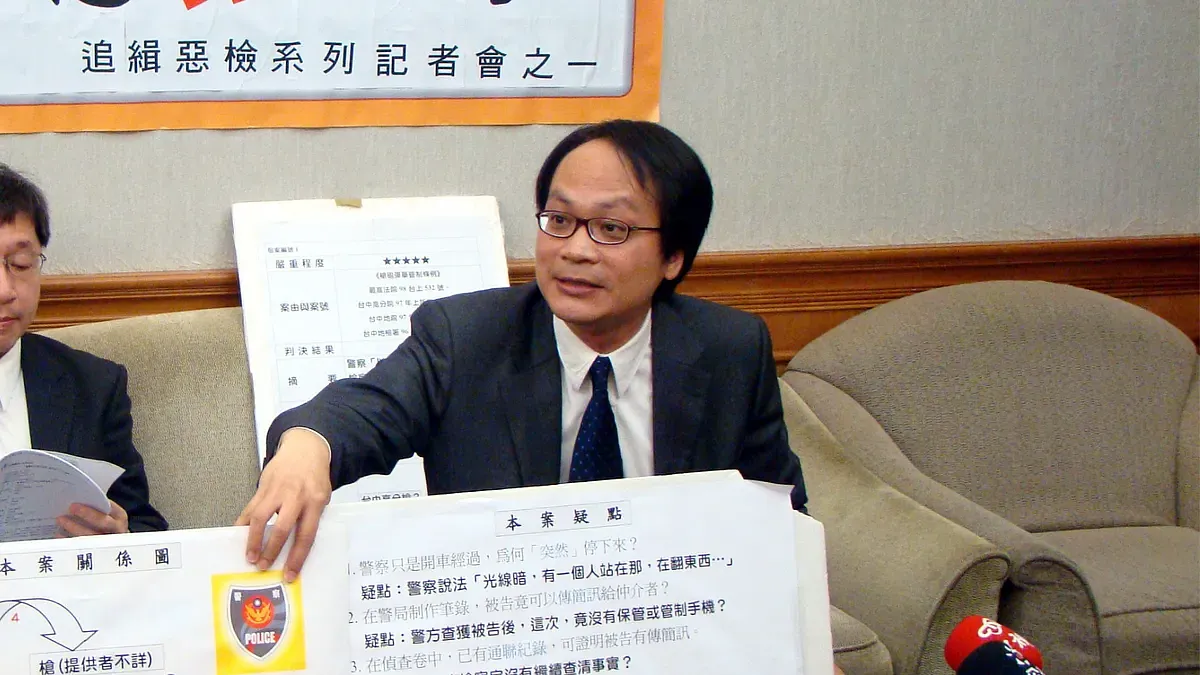
Through the establishment of the Complaint Center, the JRF received numerous complaints against prosecutors. Unlike courtrooms, which are open to public observation, prosecutors' investigative proceedings take place behind closed doors, making it difficult for outsiders to know the remarks and conduct of prosecutors during the process. However, because investigative procedures had incorporated a system of audio and video recording throughout, lawyers were able to obtain investigative audio recordings through file review. The JRF thus collaborated with lawyers to listen to and verify the cases under complaint, confirming whether prosecutors exhibited inappropriate speech or conduct during hearings, such as using abusive language or threatening the parties involved.
The JRF also used this evidence to hold press conferences exposing instances of prosecutorial misconduct. Attorney Lin recalled the situation during those press conferences, joking: "At that time, there were usually just Lin Yung-sung and me. We thought, if anyone is going to be villainized, let it just be the two of us. Besides, I was serving as a full-time CEO at the time and not practicing as a lawyer."
Through these press conferences, the JRF wanted prosecutors to understand that although supervising them was difficult, it was still possible. The accumulation of these actions also laid the foundation for the Ministry of Justice's later establishment of the prosecutor evaluation system. Attorney Lin believes that both the judicial and prosecutor evaluation systems serve to alert society to problems in the judiciary. By collecting information and revealing facts, they compel the authorities to confront and respond to those problems.
Advancing Reform: "When Lawyers Cannot Protect Themselves, the Public Is in Peril"
Press conferences have always been one of the JRF's principal advocacy strategies. Looking back on the press conferences that left the deepest impression during his tenure, Attorney Lin also mentioned "When Lawyers Cannot Protect Themselves, the Public Is in Peril."
In 2008, personnel from the Taipei City Field Office of the Investigation Bureau obstructed an attorney from reviewing a client's interview record, physically assaulted the attorney, and forcibly pushed the attorney away. Without access to the relevant record, the attorney could hardly assist the client in preparing a defense. Moreover, the incident jeopardized the attorney's professional safety. In response to this infringement of the rights and interests of both the public and attorneys, the JRF and bar associations jointly held a press conference, demanding that the Ministry of Justice thoroughly investigate the personnel responsible for unlawful or derelict conduct and review institutional deficiencies.
That same year, the JRF, bar associations, the Criminal Law Research Center at National Taiwan University, and the Coalition for the Promotion of Criminal Human Rights Legislation jointly organized a symposium. While discussing the case, Attorney Lo Ping-cheng jokingly called Article 245 of the Code of Criminal Procedure the "Hello Kitty provision." Because Hello Kitty "has ears but no mouth," even when an attorney was present, the attorney could only sit there like a decoration—like Hello Kitty—without understanding the case or knowing what was happening and with little ability to express an opinion. Only after this incident did the Ministry of Justice amend the Directions for Prosecutorial Agencies Handling Criminal Cases to permit attorneys to assist in reviewing interview records.
Individual cases themselves are crucial to the JRF's efforts to improve institutions. In addition to the Complaint Center and the experiences of legal practitioners, rescuing victims of wrongful convictions has remained a central driving force for reform since the JRF's establishment.
Sacrifices in Individual Cases That Brought About Institutional Change
Looking back on his tenure, Attorney Lin said the wrongful conviction cases that most impressed him and influenced institutional change included the Chiang Kuo-ching, Su Chien-ho, and Hsu Tzu-chiang cases.
The Criminal Compensation Act and the Chiang Kuo-ching Case
The amendment of the Criminal Compensation Act originated with the Chiang Kuo-ching case. After Chiang had been wrongly convicted and executed, scientific evidence established his innocence, provoking a public uproar. "We cannot allow someone to be wrongfully convicted and then executed." Faced with such a mistake, the only thing the state could do was provide compensation. Consequently, the Criminal Compensation Act was swiftly passed under intense public pressure, and the amount of compensation was substantially increased from the standard in the original draft. Attorney Lin said this experience made him deeply realize that "when a legal professional organization has long followed individual cases and promoted institutional reform, once its work is seen by society at a critical moment, it can gain powerful public support."
Complete Audio and Video Recording and the Su Chien-ho Case
The Su Chien-ho case was an important catalyst for establishing the system of complete audio and video recording during investigations. Attorney Lin noted that even before the Su case, civil society had vigorously called for an audio and video recording mechanism to prevent similar violence from recurring. Officials repeatedly opposed the proposal on various grounds, and it was only after the Su case that the system finally gained legislative support.
"After this system was adopted, the problem of torture improved tremendously, because no one could play tricks anymore," Attorney Lin said. Whenever a recording was interrupted, an attorney could question improper conduct by the police or prosecutors. This became an important safeguard against torture and meant that, among the grievance cases later received by the JRF, allegations of torture became exceedingly rare.
The Speedy Criminal Trials Act and the Hsu Tzu-chiang Case
The enactment of the Speedy Criminal Trials Act was closely connected to the Hsu Tzu-chiang case. Hsu was detained for more than a decade while his trial continued to drag on. Confronted with this situation, society began arguing: "You may investigate and try someone for however long it takes, but you cannot keep that person locked up forever without giving us an answer." The Speedy Criminal Trials Act was ultimately enacted in 2012, requiring the judicial system to take responsibility for the passage of time and preventing similar tragedies from recurring.
From the Judges Act, the evaluation systems for judges and prosecutors, and the advancement and implementation of defense rights, to the rescue of victims of wrongful convictions, these efforts embody the JRF's long-standing commitment to fighting for and protecting human rights in the criminal justice system. Beyond concern for and reform of particular incidents and institutions, the values and spirit embedded in the JRF's organizational character are also vital forces sustaining its reform energy and continued progress.
The Values and Spirit of Judicial Reform: Legal Expertise and Public Action
Attorney Lin said the JRF has long positioned itself as a professional organization whose primary mission focuses on legislative reform and policy advocacy directed at government agencies. In addition to initiating issues itself, the JRF frequently participates in the actions of other civil society groups through joint statements or collaboration.
After the Ma Ying-jeou administration took office in 2008, the Wild Strawberry student movement erupted to protest stringent police restrictions on assemblies and demonstrations and called for amendments to the Assembly and Parade Act to reduce restrictions on civic gatherings. At the time, the JRF was invited to participate in the legislative campaign, but whether it should intervene in such a highly "political" movement prompted some disagreement and discussion within the organization. Ultimately, from the standpoint of a legal professional organization, the JRF took responsibility for studying the legislation, convened scholars and attorneys to jointly prepare draft amendments, and joined social movement groups in forming the Coalition to Amend the Draconian Assembly and Parade Act.
Regarding frequent outside criticism that the JRF is "too political," Attorney Lin said that every time the organization participates in a politically controversial public event, it takes that step only after thorough internal discussion and consensus-building. "I oppose the claim that because something is very political, we should not participate. Politics is actually nothing extraordinary; it unfolds in everyone's life every day. If a framework says this is politics and cannot be crossed, leaving everyone unable to act, I do not think that is a good phenomenon," he said. In his view, democratic maturity means openly discussing issues without violence. Taiwanese society has now become "immune" with respect to freedom of speech, allowing majority and minority opinions to coexist. The JRF's value lies precisely in enabling continued dialogue between the rule of law and citizens, ensuring that institutions do not drift away from the people's voices.
Public Dialogue on Judicial Reform Is Difficult, but It Must Continue
During Attorney Lin's seven years as JRF CEO, public dialogue—beyond legislative reform and advocacy—was where he invested the greatest effort. He recalled writing an average of two newspaper opinion pieces each week to criticize and respond to current events. As these articles accumulated, both Attorney Lin and the JRF became increasingly well known. Reporters began proactively contacting the JRF and inviting him onto programs. His impartial commentary on those programs not only expanded the reach of the JRF's ideas, but also built public trust and established the organization's upright image.
Attorney Lin believes that public dialogue is a highly time-consuming process. He used the metaphor of moving "from points, to lines, to a web" to describe how the JRF connects its work: collecting the public's problems at the grassroots level, proactively publishing commentary, obtaining media coverage and invitations to appear on programs, and then enabling more people to learn that they can seek help from the JRF when encountering judicial problems. Only in this way can public dialogue on judicial reform gradually become three-dimensional.
The JRF's Development and Vision: Collective Power and Institutional Credibility
Looking back on the JRF's thirty-year history, Attorney Lin believes its greatest asset is its people. From the predecessors who founded the JRF and stepped forward to speak out without fear of being treated as troublemakers during an era when the judiciary remained highly traditional, conservative, and closed, the organization gradually brought together a group of people with a sense of justice who transcended their personal professional interests and demonstrated the power of collective action.
Recalling his tenure as CEO, Attorney Lin said that an internal staff meeting was held every Monday. He would review each project, discuss which attorneys could participate and who was interested in which issues. Although people came and went, the organization continued to grow. By the time of the Sunflower movement, the volunteer attorney group alone had more than one hundred members—something he could hardly have imagined years earlier.
Attorney Lin also emphasized that the credibility established through the JRF's consistently principled operation has meant that outsiders rarely suspect its actions are motivated by private interests. This public trust has become another important organizational asset. In his view, the JRF must continue demonstrating its core values by identifying problems, understanding them, collecting information, proposing directions for reform, and advancing practical change, thereby preserving the credibility of the JRF name.
Conclusion: The JRF Must Find the Pain Points and Make Changes!
Looking ahead, Attorney Lin reflected that Taiwan's judicial environment has changed significantly over the thirty years since the JRF was founded. "A new era requires us to discover new problems and use new methods to solve them," he said. Methods may draw upon past experience, but the issues will inevitably differ. After years of practical experience advancing reform, Attorney Lin believes the JRF no longer lacks the capacity to interact with the public, exert pressure, or adjust the content of legislation at a professional level to bring it closer to the ideal.
Regarding the JRF's traditional core mission of rescuing victims of wrongful convictions, Attorney Lin noted that the situation has improved markedly compared with the past. Many wrongful conviction cases discussed today are older cases, while new cases have become relatively less common. He believes future reform should shift from "treatment" to "prevention": "In addition to rescuing cases from the past, how can we prevent new ones from occurring, or reduce the probability that they will occur to a very low level? That is what it means to solve problems institutionally." He cited specialized fields such as forensic science as examples of areas still requiring greater investment of resources to ensure that the system operates properly.
Finally, speaking about his expectations for the future, Attorney Lin said: "To truly discover a problem, you must go to the most painful spot to make improvements." For him, judicial reform is not only about amending laws or rescuing individuals; it is an ongoing process of uncovering the roots of problems and courageously confronting their pain points.
Continue Reading Stories of Other Predecessors
Back to Interview Overview View Judicial Reform Milestones
Last Edited: 2026-05-16 | Special Issue on Personal Interviews for JRF's 30th Anniversary
This article is an AI-generated translation of the original Chinese text. In the event of any discrepancy, the Chinese version shall prevail.