
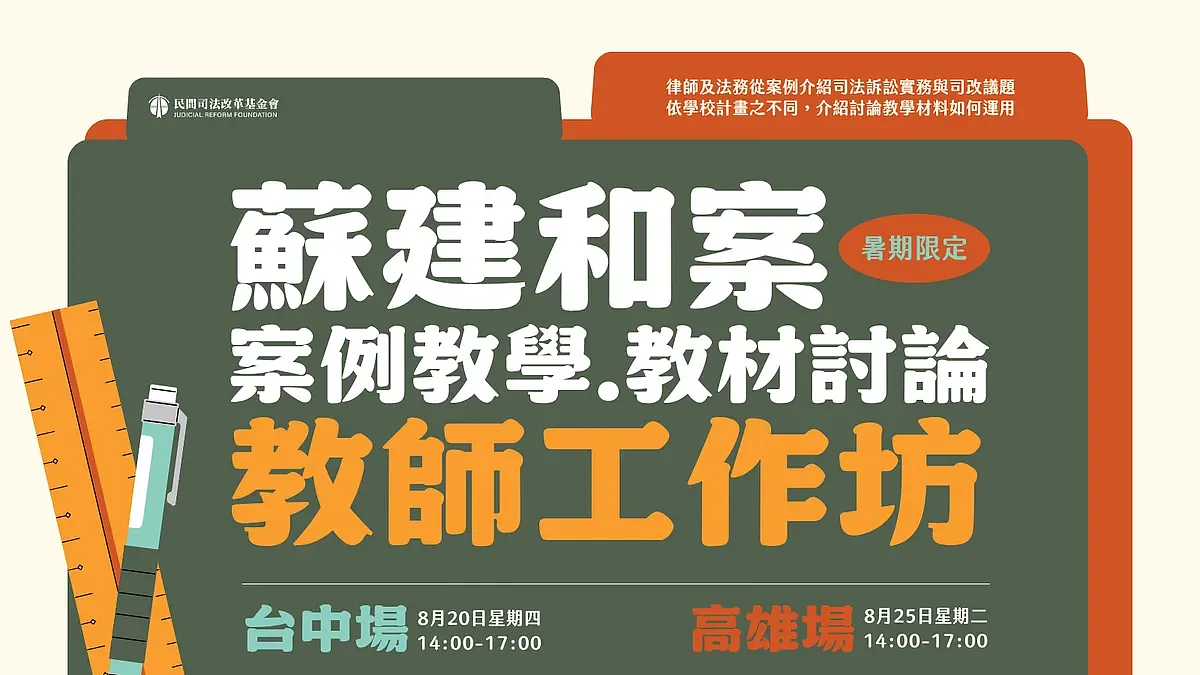
Workshop | Su Chien-ho Case • Teaching Material Focus Discussion • Teachers' Workshop
Last edited: 2026-08-28
Are you a teacher interested in incorporating judicial cases into your teaching?
Are you looking for teaching materials on legal issues?
You are cordially invited to register for this event hosted by the Judicial Reform Foundation in the summer of 2026:
Summer Special
Su Chien-ho Case Teachers’ Workshop and Teaching-Material Focus Group
Pursuing Justice in the Courtroom: Exploring the Su Case
Target Participants
School teachers interested in teaching controversial issues in the field of law and willing to incorporate relevant case materials into their teaching.
Workshop Content
Core Focus
Lawyers and legal professionals will use cases to introduce litigation practice and judicial reform issues.
In-Depth Exploration
The workshop will introduce and discuss ways of using the teaching materials based on the needs of different school programs.
About the Su Chien-ho Case
Su Chien-ho, Liu Bing-lang, and Chuang Lin-xun underwent repeated trials from 1991 to 2012. After three extraordinary appeals were successively filed by Prosecutor-General Chen Han, followed by retrials, remands, and further retrials, the three men endured a 21-year ordeal. Finally, on August 31, 2012, the Taiwan High Court acquitted all three men in the third retrial, finding that they had not participated in the crime. The acquittal was final.
The case arose in the 1990s, when Taiwan’s criminal procedure protections remained underdeveloped. The three men sacrificed the prime of their lives before major reforms to Taiwan’s criminal justice system were achieved.
In the related civil proceedings, both the trial court and the appellate court found that Su Chien-ho and the other two men were not liable for damages. On August 21, 2025, however, the Supreme Court’s Civil Division remanded for a second time the civil action attached to the criminal proceedings that had been brought against the three men and their families.
We believe that this case has substantial educational value for cultivating critical thinking about justice. The exclusionary rule, the allocation of the burden of proof, and the standards and methods used to evaluate scientific evidence in civil litigation all warrant serious reflection.
Taiwan’s mechanisms for preventing and ensuring accountability for torture also remain incomplete. The parties cannot yet invoke the proposed Enforcement Act of the Convention against Torture and Other Cruel, Inhuman or Degrading Treatment or Punishment and its Optional Protocol to urge the court to exclude unlawfully obtained evidence more actively, and the state as a whole has yet to assume responsibility for preventing torture and remedying the harm it causes.
What to Know Before Participating
What will I gain from attending this focus group?
☆ Take home teaching slides and worksheets that incorporate current judicial practice and relevant legal knowledge, helping students connect classroom learning with real-world issues.
What is the event’s core focus?
☆ Why have Su Chien-ho and the other two men, who became entangled in the case at age 18, still been unable to leave behind their identities as victims of wrongful conviction and torture and return to ordinary life as innocent people? We will guide participating teachers in analyzing the most critical issues in the judgments and other case materials.
Why choose the Su case? How common are prolonged civil actions attached to criminal proceedings, and what makes this case distinctive?
☆ Within the topic of “the organization and institutions of social life,” we selected the Su Chien-ho case as a case study. We hope to discuss with teachers how to guide students in developing critical thinking about justice through Pursuing Justice in the Courtroom: Exploring the Su Case.
Are there any precautions to keep in mind when inviting victims of wrongful conviction to speak and answer questions?
☆ We will discuss how to prepare students before a session on the Su case, including the overall lesson sequence, time allocation, whether videos should be used, and whether students should watch them independently before class or together during class. The JRF will also share its experience working with different schools for teachers’ reference.
Sessions and Registration
Taichung Session
August 20 (Thu.), 14:00–17:00
- Venue: Taichung Office, Judicial Reform Foundation
- Address: 10F.-2, No. 4-33, Sec. 1, Shuangshi Rd., East Dist., Taichung City
- Capacity: 30 in-person participants (a waiting list will be created once capacity is reached; online participation is not available)
- Contact: Legal Specialist Zhang Jiaqi
(04) 2329-2372 ext. 14
jc@jrf.org.tw
Register for the Taichung Session
Kaohsiung Session
August 25 (Tue.), 14:00–17:00
- Venue: Kaohsiung Office, Judicial Reform Foundation (Southern Office of the Taiwan Association for Human Rights)
- Address: 10F.-4, No. 157, Yixin 2nd Rd., Qianzhen Dist., Kaohsiung City
- Capacity: 20 in-person participants (a waiting list will be created once capacity is reached; online participation is not available)
- Contact: Legal Education Manager Pan Pei-chen
(02) 2523-1178 ext. 16
pbz@jrf.org.tw
This article is an AI-generated translation of the original Chinese text. In the event of any discrepancy, the Chinese version shall prevail.