
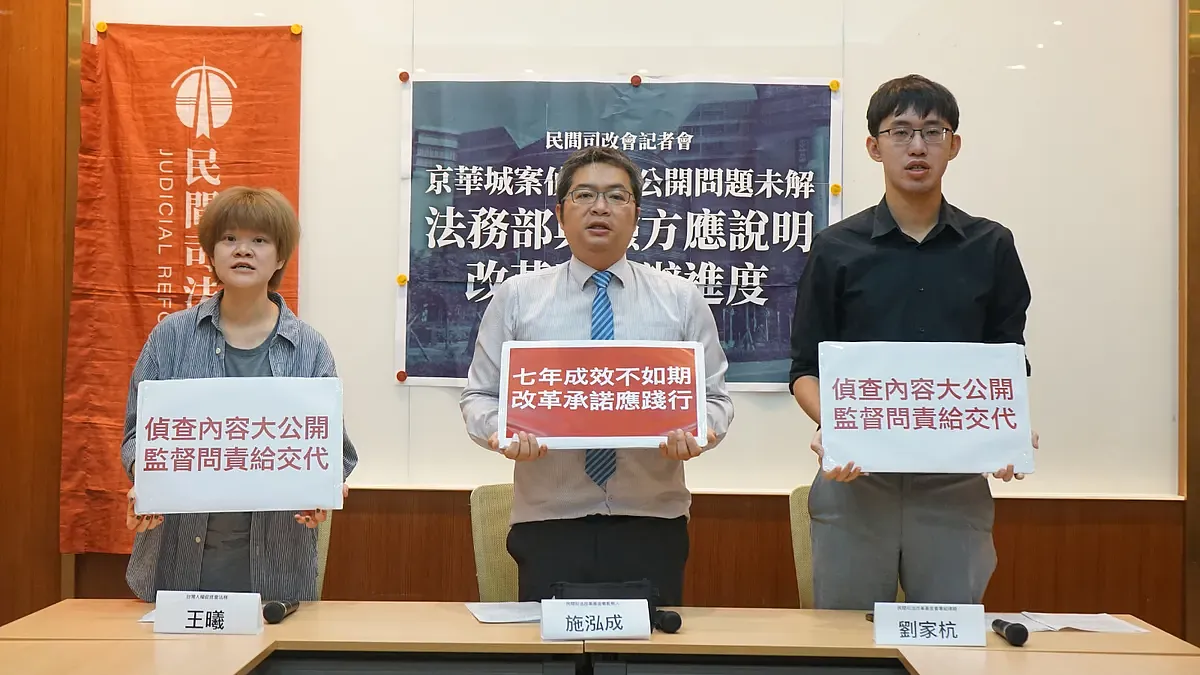
Press Release | Unresolved Issues of the Major Leak in the Core Pacific City Case: Ministry of Justice and Prosecutors Office Must Explain Reform and Investigation Progress—Press Release for the 7th Anniversary of the Enforcement of the Directions on the Non-Disclosure of Investigation
Last edited: 2026-08-28
Since the Regulations Governing the Non-Disclosure of Investigations underwent substantial amendments and entered into force on June 15, 2019, it has now entered its 7th year. Regrettably, mere regulatory amendments have failed to bring about progress, especially in cases of high public interest, leaving one to wonder whether the principle of non-disclosure of investigation has become a dead letter.
During the investigation of the Core Pacific City case, suspected leaks of investigative details occurred frequently, which not only sparked controversies over violations of the non-disclosure of investigation, but also severely undermined public trust in the fairness of judicial proceedings. The Foundation believes that the core of the problem lies not merely in information leakage, but in the perception of procedural unfairness caused by selective disclosure. To uphold public confidence in the judiciary, relevant authorities must promptly explain the progress of investigations and reforms to the public.
- Why did investigative details reach the media? The controversy over leaks in the Core Pacific City case still awaits clarification
- Extensive disclosure of investigative information severely damages trust in the judiciary, while disorder during investigations undermines the credibility of subsequent trials
- Institutional review must not become an empty promise: The Ministry of Justice and prosecutors must publicly explain the progress of their investigation and reforms
- Seven years after implementation, results remain inadequate: The JRF proposes six recommendations
1. Why did investigative details flow to the media? The controversy over leaks in the Core Pacific City case still awaits clarification
For years, the Foundation has closely monitored the implementation and enforcement of the non-disclosure of investigation. In the past, we have publicly urged relevant authorities to review improper information leaks in cases such as the Kaohsiung City Police Department's social media "Love and Blood" incident, the Nantou shooting case, and the Tainan police-killing case. However, instances where prosecutorial, police, and investigative agencies violate the "principle of non-disclosure of investigation" remain rampant to this day.
Since the investigation into the Core Pacific City case was launched, the Foundation has continuously monitored controversies surrounding suspected violations of the non-disclosure of investigation in this case. Particularly following the Taipei District Prosecutors Office's indictment in December 2024, comparing the indictment with media reports during the investigative stage, we criticized the apparent outflow of investigative secrets (see: Nine Questions on the Massive Exposure of Investigations: Competent Authorities Are Urged to Promptly Release an Investigation Report to Account to the Public!).
For example, even before the prosecutor's indictment, the media openly reported investigative details such as: "After the presidential election, NT$73 million in cash flowed into personal accounts; over NT$4 million in designated funds from MuKo Public Relations were wired to Ko's account," and "Ko Wen-je is involved in over NT$7 million in unexplained assets, and Chen Pei-chi repeatedly deposited large amounts of cash at ATMs." According to a report on October 1, 2024, the media described Chu Yea-hu's witness statement as a "major breakthrough," noting that "Sheen Ching-jing used 7 individuals as human figureheads in 2020 to bribe Ko in the form of political donations"; subsequent reports also broke the news that investigative and anti-corruption units cracked a flash drive and discovered records reading "2022/11/1 Little Shen 1500 Sheen Ching-jing."
Reviewing the examples above, it becomes apparent that media reports on the Core Pacific City scandal were not mere speculations or pieced-together public information; rather, they successively disclosed—following the timeline of the investigation—interrogation details, case files and evidence, search situations, prosecutors' investigative directions, and witness statements that emerged during the handling of the case, and these related reports clearly contained information that neither outsiders nor the defendants could have possibly known.
2. The massive exposure of investigations severely damages judicial trust, and out-of-control investigations drag down trial credibility
For the judicial system, this is precisely what warrants the highest vigilance: although the public cannot read all case files, nor do they necessarily possess the professional competence to judge legal disputes, the public determines whether the judiciary is trustworthy based on whether procedures are fair.
The core of our questioning in this case is not simply the outflow of information, but the "selective disclosure" vividly exhibited by such information. Information disadvantageous to the defendant frequently appears in media coverage, while information advantageous to the defendant or sufficient to balance the assessment of the case is relatively rare. When the flow of information presents an asymmetric state, the public naturally tends to form an impression—that the shaping of public opinion on the case is no accident, but rather someone intentionally guiding social perception through the release of information, which becomes the starting point for the general public to harbor doubts about the judicial proceedings of this case.
Once this impression is formed, it will inflict severe damage on public confidence in the judiciary. This is because what the public doubts is no longer just why specific data leaked out, but further whether the "entire criminal procedure" is fair. When the people believe that investigative authorities may influence public opinion through information manipulation, they tend to extend this distrust to all judicial procedures (including the court's detention rulings, evidence investigations, and even the final judgment result); every subsequent judicial decision related to this case is easily placed within a framework of political or conspiratorial interpretation.
Even if the court's subsequent trial procedures are lawful and appropriate, and the presiding judges maintain an objective and neutral stance, it will still be difficult to reverse the aforementioned impression. In other words, the prior "massive exposure of investigations" and "selective disclosure" by prosecutors, police, and investigative agencies drag down the credibility of judicial independence along with them.
3. Institutional reviews must not be broken promises: Ministry of Justice and prosecutors must publicly explain the progress of reforms and investigations
Three months have already passed since the first-instance judgment of the Core Pacific City case, and two years have elapsed since investigative information first began leaking. However, outsiders have yet to see relevant authorities present concrete investigation results, processing progress, or institutional review plans regarding the information leakage incident.
Precisely because this case commands high public attention, the impact caused by the leakage of investigative information is no longer confined to this case alone; rather, it directly strikes at public trust in the prosecutorial authorities' fair enforcement of the law. Especially when relevant investigations show no clear progress over a long period, it is inevitable for the general public to raise questions: What kind of difficulties are investigations into this case facing? Or are there other factors preventing the case from accounting for the investigation results to the general public to this day? Meanwhile, when the targets of investigation may involve internal personnel within the prosecutorial, police, and investigative systems, outsiders cannot help but further inquire: Have investigations of "insiders by insiders" led to the absence of results until now? What measures are in place to ensure the independence and impartiality of the investigation?
We have no intention of interfering in the direction of individual case investigations (and the case in question has already received a first-instance judgment); however, faced with the public's long-accumulated doubts, relevant authorities must, in accordance with the provisions of the Regulations Governing the Non-Disclosure of Investigations, moderately explain the case handling progress, investigation direction, and institutional review status to the public under the premise of not affecting the investigative procedure. Or is it necessary to let the general public understand what kind of investigative energy the prosecutors have invested in the issue of investigative information leakage involved in this case, and what investigative actions are currently still ongoing?
If these questions ultimately remain unanswered, the public's suspicion regarding the fairness of the investigative procedure will likely continue to expand, further affecting society's evaluation of the overall credibility of the judicial system. These are precisely the questions that relevant authorities have yet to clearly account for to the general public.
Meanwhile, in October 2024, the Supreme Prosecutors Office stated that it would compile the deficiencies in current laws and regulations related to the "principle of non-disclosure of investigation" and study concrete actions and measures to prevent violations thereof. It is understood that the Supreme Prosecutors Office has long since submitted the relevant report to the Ministry of Justice for review, and we also call upon the Ministry of Justice to concretely explain the situations of violations of the "principle of non-disclosure of investigation" and methods for improvement.
4. Ineffective results after 7 years of implementation: JRF proposes 6 recommendations
Regrettably, since the Regulations Governing the Non-Disclosure of Investigations underwent substantial amendments and entered into force on June 15, 2019, it has now entered its 7th year. Yet when dealing with cases of high public interest, one really has to wonder whether the "principle of non-disclosure of investigation" has become a dead letter. In response, we propose the following 6 reform recommendations:
1. Investigative authorities should implement a spokesperson system, and all press releases must be conducted through spokespersons. Case handlers and judicial police officers must not arbitrarily contact news media or release information.
2. Where case contents during the investigative stage are not released by a spokesperson but are reported by the news media, and it becomes known during the court's first-instance public trial stage after indictment that the reports match the findings obtained during the investigation, it shall be presumed that the investigative process of the case violated the principle of non-disclosure of investigation.
3. Where cases handled by investigative authorities violate the principle of non-disclosure of investigation, the supervisory responsibility of the heads of the relevant agencies shall be held accountable.
4. Regarding state compensation cases arising from state organs violating the principle of non-disclosure of investigation, the burden of proof for injured plaintiff citizens should be appropriately alleviated, and a punitive damages system should be introduced.
5. Investigative authorities should establish public and clear management regulations regarding matters such as restrictions on the access areas of news media interview personnel and interviewing principles.
6. An independent and impartial third-party investigative body should be established to take charge of investigation and determination matters concerning violations of the principle of non-disclosure of investigation, and to receive grievances from injured citizens.
Press Conference Time
Thursday, July 2, 2026, 10:00
Press Conference Location
Room 101, Legislative Yuan Research Building (Zhongxing Building), No. 3-1, Sec. 1, Jinan Rd., Zhongzheng Dist., Taipei City
Attendees
- Shi Hongcheng | Supervisor, Judicial Reform Foundation
- Lu Shaowei | Standing Executive Committee Member, Judicial Reform Foundation
- Liu Jiahang | Pro Bono Attorney, JRF Police and Prosecutorial Reform and Non-Disclosure of Investigations Monitoring Task Force
Press Contact
Attorney Elvin Lu, Deputy CEO, Judicial Reform Foundation
Phone: 02-2523-1178#37
Email: elvin@jrf.org.tw
This article is an AI-generated translation of the original Chinese text. In the event of any discrepancy, the Chinese version shall prevail.