
JRF Newsletter: April 2026
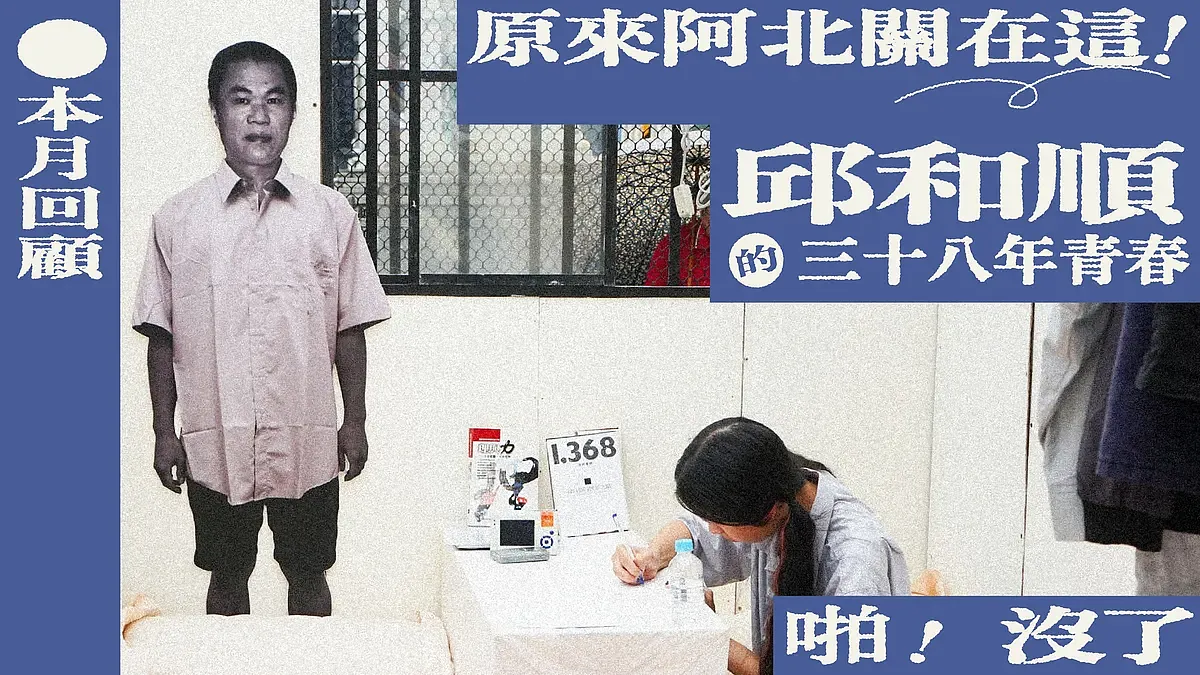
Turns Out A-Pei is Locked Up Here!
Last edited: 2026-08-28
"Turns Out A-Pei is Locked Up Here!" Ximending Recreates a 1.368-Ping Prison Cell; Civil Groups Call on President Lai Ching-te to Pardon Chiou Ho-shun and End 38 Years of Injustice
To raise public awareness about the Chiou Ho-shun case, the Chiou Ho-shun Rescue Team held a street solidarity action on April 11 at the Ximen MRT Station entitled "Turns Out A-Pei is Locked Up Here! Chiou Ho-shun's 38 Years of Youth, Poof! Gone." Through immersive performances and public participation, the event allowed citizens to intuitively experience the plight of long-term imprisonment and called on President Lai Ching-te to face this case and grant a pardon as soon as possible.
Chiou Ho-shun has been imprisoned since 1988, marking a staggering 38 years. From age 28 to 66, he is the prisoner who has waited the longest for the execution of a death sentence in Taiwan's history. The case has long lacked clear evidence, yet resulted in a conviction driven by torture and coerced confessions, highlighting the structural problems of judicial injustice under an authoritarian regime. The pro bono legal team and the rescue team formally submitted a petition for a pardon to President Lai Ching-te on April 7, earnestly imploring the President to exercise the power vested by the Constitution to grant Chiou Ho-shun a full pardon, ending this injustice spanning 38 years and realizing belated justice and freedom.
This action erected a simulated 1.368-ping detention space on the streets of Ximending, replicating the Tucheng Detention Center. It was built with the assistance of Hsu Tzu-chiang, a wrongfully convicted death row prisoner who was exonerated, allowing the public to intuitively experience the living conditions of inmates. Volunteers took turns playing Chiou Ho-shun at the site, entering the cell to give half-hour improvisational interpretations of "If You Were Chiou Ho-shun," portraying the state of life under prolonged deprivation of liberty. The event also opened the cramped space for the public to enter personally, using physical sensation to understand the oppression and isolation brought by long-term imprisonment, and further reflecting on how state violence and authoritarianism are imposed on ordinary people.
In addition, several speakers were invited to give brief talks at the site. Two of the speakers personally entered the simulated cell, responding to the plight of prolonged detention through actual experience and adding more perspectives from firsthand experiences to the action.


April 2 this year was Lo Ming-tsun's 75th birthday. Since we could not bring a cake into the correctional facility, we celebrated Big Brother Lo Ming-tsun's birthday outside the Yilan Prison, hoping that he can regain his freedom soon and personally attend his own birthday party.
Big Brother Lo Ming-tsun contracted cancer while serving his sentence, and was granted medical parole in August 2021 before returning to prison on February 29, 2024. Despite struggling with illness, Big Brother Lo has never given up striving for his own exoneration while inside. The JRF Secretariat frequently takes volunteers to visit Big Brother Lo in Yilan, hoping he will not lose heart or be discouraged.
In May 2024, the legal team submitted an application to the High Prosecutors Office's Review Committee for Conviction Cases, and once again supplemented new evidence to the Review Committee for Finalized Conviction Cases in April 2026.
⬇️ Click to Watch the Birthday Celebration Video


At the end of March, the Taichung Office of the Judicial Reform Foundation welcomed the opening of the "Originally Thought" special exhibition, inviting artist Lee Tzu-Tung to serve as the curator. Lee Tzu-Tung is not only an artist, but also a whistleblower in the 2023 #MeToo movement. In the opening lecture, she shared how she transformed from a survivor of sexual violence into a "defendant" within the judicial system, attempting to lead the public to re-see the truth beyond judicial rulings through art.
From Speaking Out to Defendant: Law and Strategic Lawsuits Against Public Participation (SLAPP)
In 2023, because she exposed a well-known literary figure for suspected sexual harassment, Lee Tzu-Tung was criminally prosecuted for "defamation" by the individual, with seven other netizens who were also whistleblowers being co-defendants. She pointed out that this phenomenon is internationally known as a Strategic Lawsuit Against Public Participation (SLAPP), where perpetrators use legal proceedings to subject defendants to immense psychological and financial pressure during prolonged litigation. Although the final result was a decision not to prosecute, she lamented that in certain contexts, the judiciary instead became a tool to persecute parties. For survivors, trauma occurs not only at the moment of violence, but further through the misunderstandings, blame, and legal persecution brought by the system and environment after speaking the truth.

By Chen Guanzhen / Legal Specialist, JRF
After the film was released, people often asked me: Does raising a child in prison really exist?
In fact, Article 12 of the current Prison Act already has clear regulations for such situations. Simply put, prisons take the "best interests of the child" into consideration when evaluating whether it is appropriate for a child under the age of three to live with their mother inside the prison. However, time eventually ticks away. Once the child turns three, where should they go?
According to the proviso of Paragraph 5 of the same Article, under the premise of meeting the best interests of the child, the stay may be extended for a maximum of another six months, meaning until the age of three and a half. As this period draws to a close, prison authorities will also begin planning subsequent referrals and placements, arranging for the child to leave the prison and enter other care systems.
I once heard a correctional volunteer share a truly unforgettable story.
She told me: "One afternoon, I saw someone standing at the door, waiting quietly. I didn't know what he was waiting for, so I curiously stopped in my tracks—" The scene she described was very clear, and fragments of her narrative flashed through my mind—
The dusk sunlight slanted across the high walls of the prison, and birds chirped as they returned to their nests, their calls echoing one after another. On such an evening, a tall figure stood quietly at the iron gate, waiting silently. It wasn't until he saw the kindergarten shuttle bus slowly approaching in the distance that his originally serious expression softened in an instant, even revealing an unimaginable, warm, and happy smile. As the bus door opened, two small figures jumped off, skipping and running toward him while calling out "A-Pei" (Uncle).
She said that the person standing at the door waiting for the children was actually the warden of this prison.
At that moment, the warden bent down, gently patted the children on the head, took each of their small hands, and turned toward the iron gate. That was not an ordinary door, but a space located behind one, two, and three layers of iron gates.
Right there was the place where the children and their mothers currently lived together—the Women's Prison.
She said that the kindergarten shuttle bus drives up to the prison gate like this every day. Before loading these children, the bus must be empty. The "A-Pei" or "A-Yi" (Aunt) inside the prison would hold the children's hands and walk them out, smiling as they sent them onto the bus. Here will forever be the first stop where they go to school, and the last stop when they return from it.
Those kindergarten children were just like blank sheets of paper. No one knew that they walked out from the other side of the high walls to attend classes with other children, and they themselves did not yet understand what crossing those high walls truly meant.
Yet perhaps precisely because of this, the adults were so cautious, using various methods to safeguard a sliver of the possibility for them to "grow up normally." When she talked about this, her tone was actually very calm, but I remained trapped in that fragment of the story for a long time. I suppose the public can hardly imagine the shock of holding a child's hand across three massive gates; that is also the time they have to spend with their mothers within a limited span of days.
Such a scene may not be witnessed firsthand by everyone, but it actually happens almost every day.
I also heard that with the rotation of cooperative kindergartens, the arrangement of being the "first stop to board and last stop to alight" may not always be maintained. Even so, prison authorities still pay attention to whether children might face strange looks from other classmates during their time at school. Behind these warm scenes, there are still aspects that need to be seen and examined.
The Investigation Report (114 Judicial Investigation 0028) issued by the Control Yuan on November 28, 2025, exposed the issues of treatment regarding children accompanying their mothers in the Taoyuan Women's Prison. The report pointed out that a foreign inmate (hereinafter referred to as classmate) had difficulty understanding prison regulations due to language barriers, and struggled to express her child's needs in a timely manner. She mentioned in the interview that she often fed her child while carrying them on her back while eating; before the child was able to walk independently, she was required to hold and care for them the entire time, and putting the child down might result in punishment. If the child cried or made a fuss, she even had to hold the child and wait in the restroom until they fell asleep before returning to the cell.
This investigation report also revealed that the co-parenting space in the Taoyuan Women's Prison had long exceeded its capacity limit. The originally planned space capable of accommodating a limited number of toddlers was shared with dozens of general inmates, making the space crowded and oppressive.
During an unannounced site inspection, investigators found that toddlers even lacked sufficient activity areas, making it difficult to arrange even basic dining spaces, with some mothers forced to eat while carrying their children on their backs. Under such an environment, children's opportunities to contact the outside world were also extremely limited. Toddlers who could walk had only very brief periods of outdoor activity each week and had to take turns using facilities; children who could not yet walk, or who were attached to their mothers due to the environment, had almost no possibility of exploring space.
In addition, nutrition and developmental support were also found to be insufficient. Some classmates reported that the toddlers' meals were monotonous with limited sources of nutrition, requiring them to cover extra baby food expenses on their own; furthermore, developmental assessments and subsequent assistance could not always be seamlessly integrated, delaying the growth needs of some children. When children cried, there was even a lack of a reassuring space in the environment to comfort them. Some mothers could only hold their children and wait for them to calm down in hallways, corners, or even restrooms.
These seemingly trivial daily matters actually accumulated bit by bit into pressure and burdens between parents and children. They were all mothers, but under differences in language and status conditions, whether they could receive assistance was not necessarily the same.
Inside the high walls, there were also people striving to let their children go to school and return home like other children. Those daily routines different from the outside world were thus quietly left behind the high walls. Perhaps it is difficult for all of us to truly understand life behind those three iron gates, but at least we can take one more look and think a little more—
In those places where the sunlight cannot reach, there are still people striving to ensure that life does not lose its original form.


2026/05/16 (Sat.) 14:00-16:00
Lay Judge Mock Trial | Public Session
Susppected Sexual Exploitation Case
Performance: Presiding Judge | Chang Kaiyu / Attorney, Gender Working Group Member of JRF
Location|Taichung Office, Judicial Reform Foundation
(10F-2, No. 4-33, Sec. 1, Shuangshi Rd., East Dist., Taichung City)

2026/07/01-03 (Wed.–Fri.)
Summer Student Camp
Gender Matters—Gender Temperature on Appeal!
Event Location|Providence University (No. 200, Sec. 7, Taiwan Blvd., Shalu Dist., Taichung City)
Accommodation|Student Dormitory on Providence University Campus
Target Participants|High school and vocational school students nationwide (including 9th graders and graduating 12th graders)
Registration Period|From now until 2026/05/30 (Sat.)

This article is an AI-generated translation of the original Chinese text. In the event of any discrepancy, the Chinese version shall prevail.