
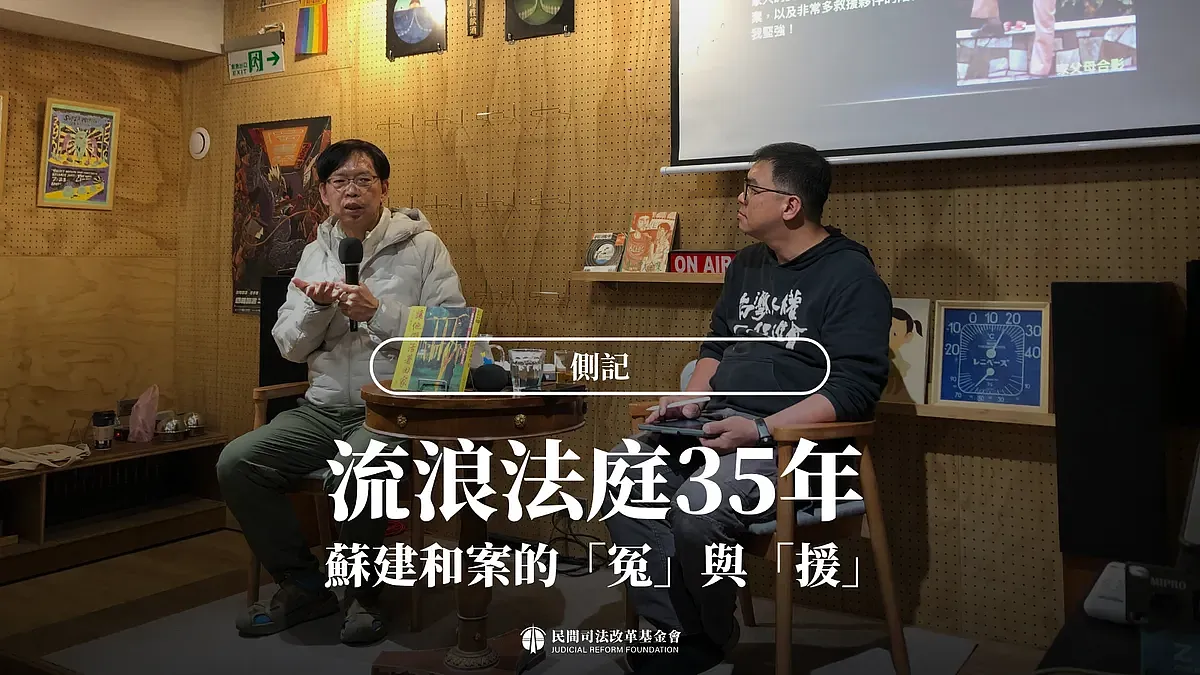
Sidelights | Wandering Courts for 35 Years: The Injustice and Solidarity in the Su Chien-ho Case
Last edited: 2026-08-28
Spanning more than thirty years, the Su Chien-ho case has yet to reach its final conclusion because the related civil compensation proceedings remain ongoing. This lecture served both as a historical retrospective and as a forum bringing together Su Chien-ho, the central figure in the case, and Shih Yi-hsiang, a longtime participant in the campaign, to discuss the actions that continue to unfold.
Su Chien-ho: From Wrongful Conviction to Human Rights Practice
At the beginning of the lecture, Su Chien-ho drew on his own experience to explain that wrongful convictions often arise from recurring factors, including a lack of scientific investigation. When investigators and evidence handlers fail to follow basic scientific principles and instead rely solely on police “intuition,” they violate not only due process but also the minimum ethical standards the justice system should uphold.
While highlighting systemic problems, he also spoke about what his experience of wrongful conviction taught him to expect from the judiciary: the law should treat every citizen equally, regardless of identity or circumstances. Equally important in the aftermath of a wrongful conviction is ensuring that every victim has an opportunity to reintegrate into society and live a stable life.
Su also recalled the period when he first returned to an “ordinary life” in society. Shaped by his experience, he resolved to work with nongovernmental organizations, insisting on approaching human rights and judicial issues with equality and without preconceived judgments. This ethical standard became both his conviction upon entering human rights work and his aspiration for judicial reform.
Su Chien-ho: The Journey into Human Rights Work
Su Chien-ho has worked with nongovernmental organizations as a volunteer for a decade. Recalling his early days at the Taiwan Association for Human Rights (TAHR), he said the first event in which he participated was “Removing Prejudice and Discriminatory Labels,” which focused on socially stigmatized groups such as gay people and people experiencing homelessness.
Through that experience, he came to understand that being disadvantaged is not merely a matter of lacking resources. Remembering how his own words and opinions had often been dismissed, he developed a deeper understanding of what it means to be treated with—or denied—respect.
He later explained that persisting in human rights work is, for him, a form of faith, and that his father was one of the people who first inspired that faith. Throughout the legal proceedings, his father quietly stood behind him and continuously devoted himself to the case.
These experiences gradually showed him that family support and everything he encountered during the case were crucial in guiding him toward human rights work. Human rights work was no longer merely a choice of action, but also a way to confront his trauma and seek resolution.
Shih Yi-hsiang: “Su Chien-ho Is Both a Victim and a Defender of Human Rights”
The first Su Case Volunteer Team training program was led by Su Chien-ho himself. Shih Yi-hsiang, then a trainee, recalled that Su conveyed human rights concepts in a vivid and compelling way. He invited filmmaker Mayaw Biho to screen an Indigenous documentary and often took trainees into the field, including on a visit to the Yenliao Anti-Nuclear Self-Help Association in Gongliao.
Those classes taught Shih that human rights cannot remain confined to written texts and press conferences; they require people to enter the field, observe, and understand matters firsthand. It was during that period that the idea of putting human rights theory into practice gradually took root in him.
“When I began working at TAHR, ‘Old Su’ was a very important figure.”
Beyond serving as an inspiration, Su also helped Shih realize that, even in democratic Taiwan, anyone could become the victim of a wrongful conviction. This realization became an important turning point in Shih’s human rights work and led him to see Su Chien-ho as both a victim of human rights violations and a defender of human rights.
Shih Yi-hsiang: The Diverse Forms of Action in the Su Case Campaign
Shih then returned to the Su case itself, explaining that Chinan Church served for many years as an important base for the campaign. In April 2000, supporters launched the “Walking Toward Dawn” campaign and marched around Chinan Church for 214 days. Although no one knew whether walking around the church would change the case or produce tangible results, Shih believed that the action embodied determination and showed that civil society would never give up. Despite the sadness and anger along the way, everyone understood that the road ahead remained long.
Although Shih did not participate directly in the bicycle journey held before the 2010 judgment, the campaign showed him the creativity and possibilities of Su case advocacy. As Su Chien-ho and others cycled from Eluanbi to Bitou Cape, they worked with local organizations along the route, including Hungya Bookstore in Chiayi, Providence University in Taichung, and Shencaifeiyang KTV in Kaohsiung.
Shencaifeiyang KTV supported the campaign by displaying “Save the Su Case” on its electronic marquee so that patrons could see the message. After the journey, the group returned to Chinan Church, where each volunteer wrote their reflections on a postcard. Shih also wore a campaign T-shirt and stood with everyone at the church as one of the many indispensable participants in the long effort to secure justice.
Thirty Years of the Su Case and Its Human Rights Significance
After the third retrial ended in Su Chien-ho’s acquittal in 2012, Shih reflected that forensic science had been crucial to the result. At the same time, nongovernmental organizations created a vital channel through which society could pay attention to the case and continuously reflect on the human rights, justice, and judicial issues it revealed. In Shih’s view, the Su case is not merely a wrongful-conviction case, but also a broad form of human rights education.
Looking back on this journey of more than thirty years—from the campaign against a wrongful conviction to the final acquittal—Su Chien-ho gradually transformed his personal experience into an understanding of and commitment to human dignity. Through advocacy and action, human rights ceased to be merely an institutional issue and became a fundamental condition that anyone might one day need.
The significance of the Su case may have long transcended the case itself. It reminds us that when the judiciary can err and individuals can be cast aside, the purpose of human rights work is to keep questioning and to ensure that no one loses their standing as a human being amid the operation of state power.
This article is an AI-generated translation of the original Chinese text. In the event of any discrepancy, the Chinese version shall prevail.