
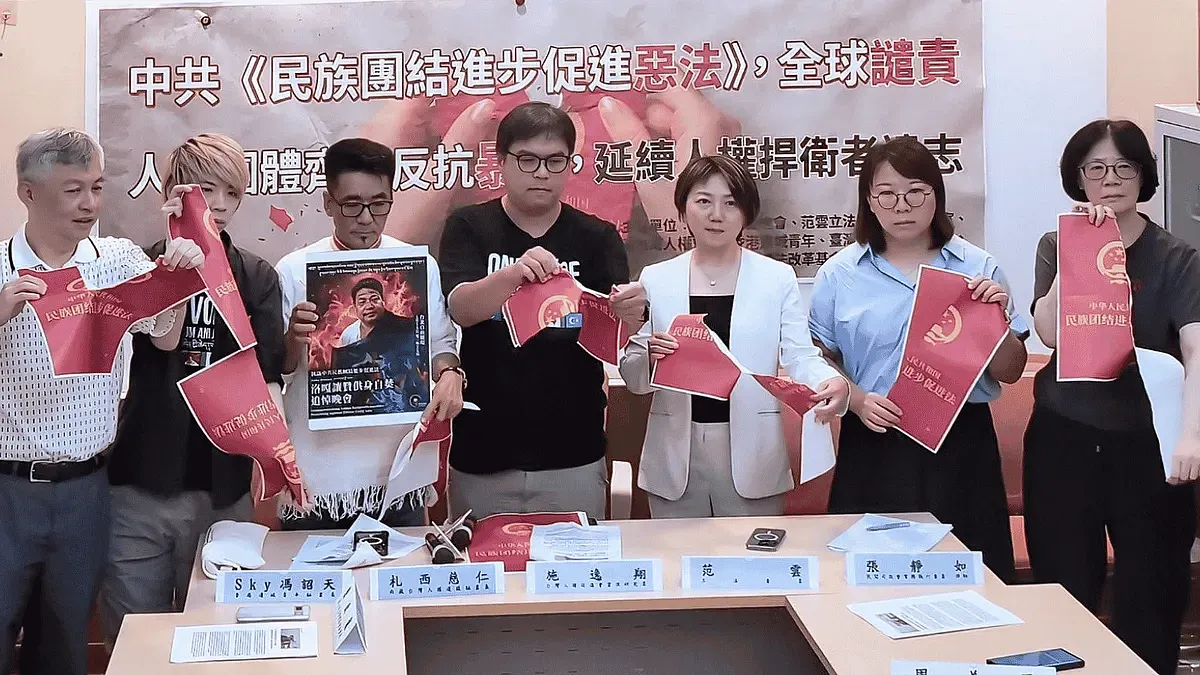
Statement by Attorney Chang Ching-ju | The CCP's "Law on Promoting Ethnic Unity and Progress" is an Evil Law Condemned Worldwide: Human Rights Groups Stand Together Against Atrocities to Carry on the Legacy of Human Rights Defenders
Last edited: 2026-08-28
The Law of the People’s Republic of China on Promoting Ethnic Unity and Progress, which took effect in China on July 1, 2026, demonstrates that the Chinese Communist Party (CCP) is comprehensively codifying the political purges it has long practiced within its borders. Under modern rule-of-law standards, law should be the cornerstone of rights protection. This law, however, is essentially an instrument of control that deprives people of rights, regiments thought, and empowers public authorities to conduct ideological cleansing. It even places political loyalty and a singular national identity above all universal values.
This tactic has been extended to Taiwan. Article 21, paragraph 2,[1] lists as a state objective “enhancing Taiwan compatriots’ sense of belonging, identity, and pride in the Chinese nation; promoting the joint inheritance and development of Chinese culture by compatriots on both sides of the Taiwan Strait; and strengthening the awareness that both sides belong to the Chinese nation and are both Chinese,” thereby unilaterally imposing an identity on the people of Taiwan. Article 10, meanwhile, makes safeguarding national reunification a statutory obligation of Chinese citizens. Taiwanese people are not citizens of the People’s Republic of China and are therefore not bound by its domestic laws. Through Article 21, however, the CCP is attempting to drag Taiwanese people within the scope of the obligations prescribed by Article 10 and impose upon them a duty to safeguard unification.
By unilaterally “designating Taiwanese people as Chinese” and then imposing legal obligations upon them, the CCP could treat people who advocate Taiwan’s sovereignty or express a distinct Taiwanese identity as violating the duty to “safeguard national reunification,” or even accuse them of “undermining ethnic unity.” Anyone deemed to have undermined “ethnic unity” could face legal liability under Article 63.[2] Because the meanings of “safeguarding national reunification” and “undermining ethnic unity” are vague, and the power to interpret them rests entirely with the CCP, Taiwanese people face serious legal and personal-safety risks when entering China, Hong Kong, or Macau, and potentially even when transiting through third countries. The law also gives the CCP a veneer of legitimacy for its longstanding suppression of ethnic minorities—including Uyghurs, Tibetans, and Mongolians—as well as dissidents and human rights defenders.
Following the enactment of the Law of the People’s Republic of China on Promoting Ethnic Unity and Progress, China’s human rights violations are likely to become even more severe and extensive. As a bastion of democracy in Asia, Taiwan’s government must demonstrate its determination to uphold universal human rights. The demands that civil society organizations have long made of the government are now more urgent than ever.
We therefore call on the government to establish a statutory refugee and asylum system as soon as possible, rather than continuing to rely solely on ad hoc, case-by-case rescue efforts. Only a clear, transparent, and comprehensive asylum mechanism can make Taiwan a genuine safe haven for human rights in the face of authoritarian expansion.
[1] Article 21, paragraph 2: “The State promotes cross-Strait economic and cultural exchanges and cooperation, deepens integrated development across various fields on both sides, enhances Taiwan compatriots’ sense of belonging, identity, and pride in the Chinese nation, promotes the joint inheritance and development of Chinese culture by compatriots on both sides of the Taiwan Strait, and strengthens the awareness that both sides belong to the Chinese nation and are both Chinese.”
[2] Article 63: “Where organizations or individuals outside the territory of the People’s Republic of China commit acts directed against the People’s Republic of China that undermine ethnic unity and progress or create ethnic division, they shall be held legally liable in accordance with the law.”
This article is an AI-generated translation of the original Chinese text. In the event of any discrepancy, the Chinese version shall prevail.