
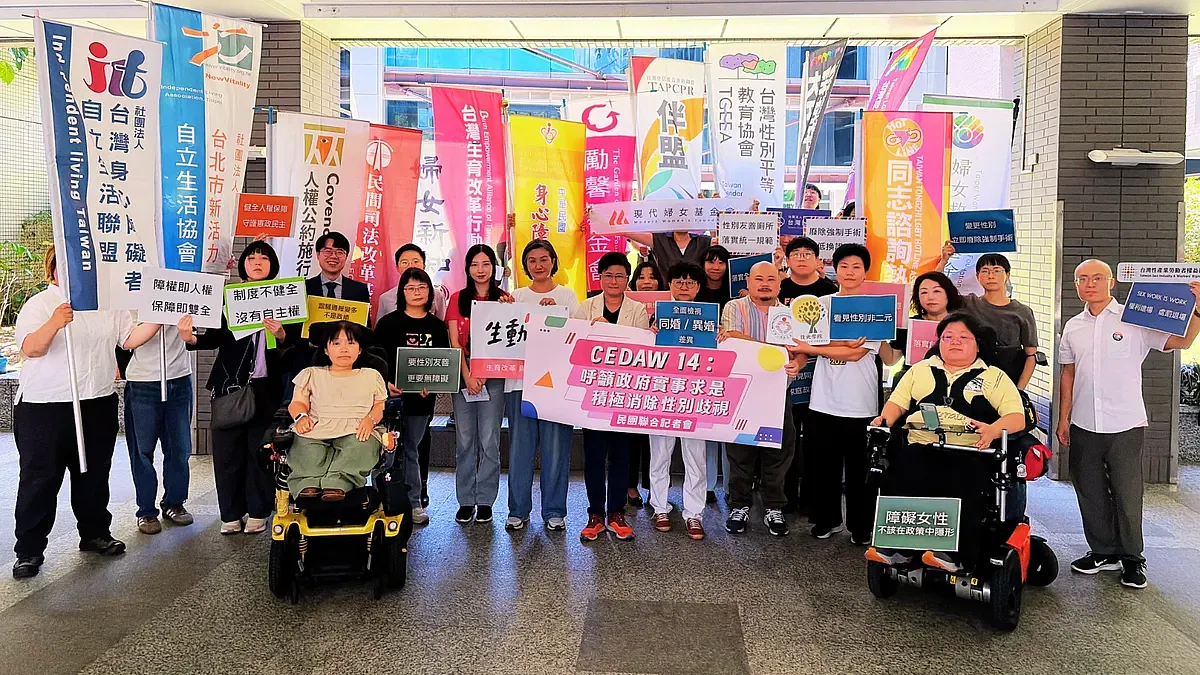
Post-Review Press Release | CEDAW 14: Civil Society Groups Call on the Government to Be Pragmatic and Actively Eliminate Gender Discrimination | Post-CEDAW International Review Civil Society Press Conference
Last edited: 2026-08-28
►Time: July 17, 2026, 11:15 AM
►Location: Entrance of the Civil Service Development Institute (No. 30, Sec. 3, Hsinsheng S. Rd., Da'an Dist., Taipei City)
►Livestream: https://www.facebook.com/share/v/18xfHuCrU4/
The concluding observations of the 5th national report review under the Convention on the Elimination of All Forms of Discrimination Against Women (CEDAW) were released this morning (July 17). Twenty-two women's, gender, human rights, disability rights, legal, and sex industry groups in Taiwan jointly held a press conference, urging that "CEDAW has spoken, reform requires action, and reform is needed now." They shared observations and responses regarding the concluding observations and the two-day review process, and put forward policy recommendations.
Establish Inter-branch and Multi-level Accountability Mechanisms to Promptly Close Legislative Gaps

Wang Xiao-han, Secretary-General of the Awakening Foundation, stated that the organization has long participated in international reviews and monitored the implementation of the Convention. She urged the government to establish inter-branch and multi-level accountability mechanisms for implementing the Convention and to proactively respond to review recommendations to advance substantive reform. Implementing the Convention is the responsibility of the government as a whole; its execution and tracking should not focus solely on the Executive Yuan and its subordinate ministries, but must extend deeply to local governments to confront implementation disparities across regions. Units such as the Legislative Yuan, the Judicial Yuan, and the Control Yuan also bear unshirkable duties, so as to unite central and local administrative departments in advancing women's rights across legislative quality, judicial procedures, and other dimensions.
In addition, delays in numerous crucial legislative amendments have created gaps in rights protection. Revisions concerning alimony, the division of occupational pensions upon divorce, ancestral worship property (chi-ssu kung-yeh), and the spousal consent requirement for termination of pregnancy were explicitly pointed out in both the previous and current reviews. The government must not defer its responsibilities through administrative procedures, but should instead put forward clear and effective reform plans to confront the disadvantaged situations of women and vulnerable groups.
Improve Gender-Based Violence Prevention and Strengthen Victim Safety Protection

Wang Chiu-lan, Senior Researcher at the Modern Women's Foundation—an organization that has long focused on the prevention of domestic violence, sexual violence, and stalking and harassment—expressed strong agreement with paragraph 33 of the concluding observations and recommendations, which places special emphasis on safety measures for domestic violence divorce mediation and the need to enhance the gender sensitivity of mediators. However, improper mediations or restorative justice practices continue to occur in criminal cases involving domestic violence and sexual assault. She called on the government to prohibit mediations or settlements that risk infringing upon the rights, safety, or social life of the parties concerned, and to respect a party's decision to refuse mediation.
Furthermore, in the face of pervasive digital gender-based violence, the state must propose a comprehensive "digital governance policy" and an inter-ministerial integrated response mechanism. It must confront the harms of digital stalking and harassment through legislative amendments, increase and enforce the civil and criminal liabilities of venue managers for systematic covert filming, and penalize the possession or payment of consideration to view "illegal adult sexual imagery" under criminal law.
Confront Wartime Gender-Based Violence and Historical Justice

Having participated in successive CEDAW international reviews, Tu Ying-qiu, CEO of the Taipei Women's Rescue Foundation (TWRF), stated that in response to potential gender-based violence against women in the event of war, the government is urged to implement CEDAW General Recommendations Nos. 30 and 40. Although this was not explicitly debated, parts of it were incorporated into the concluding observations.
We have continually reminded the government that the issue of "comfort women" / military sexual slaves is a historical event representing collective trauma for Taiwanese women and a violation of women's human rights; it should be preserved in the National Museum of Women's/Gender Human Rights and integrated into school curricula. We thank the CEDAW international committee members for recognizing the importance of this issue and incorporating it into the concluding observations.
Additionally, placing great emphasis on gender-based violence and responding to committee members' calls to overturn gender stereotypes, TWRF emphasized the necessity of implementing universal gender equality education, fostering a gender-friendly judiciary, and enhancing equal and inclusive representation in political and public decision-making by cultivating more women to enter grassroots politics to achieve equal participation. At the same time, safeguarding women's reproductive autonomy—such as eliminating the spousal consent requirement for abortion, decoupling emergency contraception and the Assisted Reproduction Act from surrogate motherhood—along with the occupational transition needs of sex workers, were all highlighted. TWRF thanks the committee members for recognizing the importance of these issues and calls on the government to monitor and implement the concluding observations step by step.
Strengthen Sexual Violence Prevention and Women's Bodily Autonomy

Focusing on sexual violence, domestic violence, women's bodily autonomy, and the rights of children and youths, Cao Yi-zhen, Director of the R&D Division at the Garden of Hope Foundation, proposed four key recommendations: 1. Sexual Violence Prevention: Although Article 80 of the Criminal Code of the Republic of China was recently amended so that the statutory limitations period for underage victims begins at age 20, the Garden of Hope recommends completely abolishing limitations periods for all sexual violence offenses. 2. Domestic Violence Prevention:
The judicial system still lacks sufficient gender awareness, the implementation of perpetrator treatment programs remains limited, and urban-rural resource disparities persist. 3. Women's Bodily Autonomy: The state must fully recognize and respect the equal physical and mental agency of both married and unmarried women, granting them complete and exclusive reproductive decision-making power. 4. Rights of Children and Youths: The Garden of Hope will continue to advocate for a child-care worker certification mechanism to ensure that individuals working with children have no prior convictions for sexual violence, thereby preventing children from coming into contact with sex offenders.
Promote an Integrated Prevention System and Implement Institutional Reform for Gender-Based Violence

Liao Shu-wen, Secretary-General of the Taiwan Coalition Against Violence, stated that following five days of intensive review, the CEDAW Committee has officially issued its concluding observations, affirming Taiwan's progress in gender-based violence prevention while pointing out that the next stage cannot simply rely on increasing laws or remaining at the level of advocacy. Instead, through a national action plan, a comprehensive, trauma-informed, and sustainable prevention system must be established.
These recommendations highly align with the Coalition's long-standing advocacy, including strengthening cross-departmental governance, implementing trauma-informed investigations and judicial procedures, addressing the structural root causes of gender-based violence, and responding to technology-facilitated gender-based violence, digital governance, and the local implementation of CEDAW.
We urge the government to accelerate its efforts in translating review recommendations into policies, budgets, systems, and actions, ensuring that every victim can attain safety, dignity, and support within the system.
Establish a Monitoring System for Obstetric Violence

Xu Shu-hui, Chairperson of the Association for Reform of Birth Practices (ARBP), stated that women in Taiwan continue to face varying degrees of obstetric violence during pregnancy and childbirth, yet the government has yet to establish a monitoring system for obstetric violence or systematically collect vital data such as non-medically indicated cesarean sections, episiotomies, and informed consent. Without data, there is no monitoring; without monitoring, there is no prevention, leaving obstetric violence continuously overlooked by the system.
Today's CEDAW concluding observations report points out that obstetric violence is not currently recognized in Taiwanese law as a form of gender-based violence, which is concerning. The report explicitly recommends that the state incorporate obstetric violence into legislation as a form of gender-based violence and establish disciplinary procedures for perpetrators to reduce such occurrences and prevent re-victimization.
We call on the government to be pragmatic, confront the obstetric violence experienced by women during pregnancy and childbirth, follow the spirit of CEDAW, establish a national monitoring system for "respectful maternity care," and genuinely involve women's organizations in policymaking so that every woman can give birth safely with autonomy, informed consent, and dignity.
Amend the Stalking and Harassment Prevention Act to Perfect Victim Protection Mechanisms

Zhang Kai-yu, pro bono lawyer for the Gender Legal Reform Committee of the Judicial Reform Foundation (JRF), emphasized that at the inception of the Stalking and Harassment Prevention Act, we issued a solemn warning: the requirement of being "related to sex or gender" would prevent many actual victims from receiving timely protection. Four years of implementation have borne this out: in reality, many victims who are followed home, subjected to online retaliation, plagued by silent phone harassment, or monitored through technology find themselves without recourse because their harassment is "unrelated to gender" or difficult to prove as connected to sex or gender. The international committee members' concluding observations specifically recommend that our government heed the systemic issue wherein victims whose rights are violated fail to receive protection under relevant laws. Therefore, we once again call on the government to promptly delete the "related to sex or gender" requirement.
Secondly, regarding point 16 of the List of Issues, the committee asked: Does the increase in reported cases reflect improved mechanisms or insufficient prevention? We are well aware—the increase in reports stems from the legal amendment imposing mandatory reporting obligations, rather than victims feeling safer or more confident to file complaints. While the amendment strengthens public authority oversight through mandatory reporting, it fails to resolve the substantive core issue of how to enable victims to seek help with peace of mind. In this regard, the committee specifically pointed out that whether the "three gender equality acts" can provide victims with comprehensive complaint mechanisms and protective measures remains unclear. The government should not treat figures as achievements, because the system clearly lags behind in constructing an environment where victims can truly feel secure in seeking help.
Improve the Alimony System to Safeguard the Rights and Interests of Divorced Spouses

Hong Wan-heng, Chairperson of the Gender Equality Committee of the Taipei Bar Association, stated that in response to the Constitutional Court Judgment No. 4 of 2023, the Ministry of Justice proposed a draft amendment concerning divorced spouses' right to claim alimony, yet added the requirement that "the right shall be extinguished upon remarriage." However, the Taiwan Bar Association and the Taipei Bar Association specifically pointed out that alimony should not be viewed simply as a claim for maintenance, but rather as "substantive compensation and transitional support" for a spouse's past undertaking of housework and accumulation of joint assets during the marriage. Consequently, retaining the provision that alimony is "extinguished upon remarriage" is inappropriate. In the concluding observations, the committee positively responded to the aforesaid argument, explicitly stating that the direction of the amendment should be relaxed as much as possible to ensure that the right to claim alimony is not extinguished upon remarriage.
Uphold Constitutional Operations and Improve National Human Rights Protection Mechanisms

Jiang Meng-zhen, Office Director at Covenants Watch (C-Watch), stated that the abolition or retention of the Control Yuan is a constitutional-level issue that warrants prudent discussion and should not be used to impact the operation of constitutional organs through boycotting personnel reviews or cutting budgets in the absence of thorough societal communication and comprehensive institutional planning. C-Watch called on the Legislative Yuan to review human rights commissioner appointments in accordance with the law to ensure the continued operation of national human rights protection mechanisms, while examining the possibility of legalizing the National Human Rights Commission into a truly independent body. Furthermore, it was recommended that the Office of the President restart the "Presidential Human Rights Advisory Committee" to provide human rights recommendations to the President, ensuring that governance aligns with international human rights standards and building democratic resilience upon a foundation of human rights.
Confront Intersectional Discrimination Against Women with Disabilities

Lin Jun-jie, Secretary-General of the Taiwan Alliance for Promoting Independent Living of Persons with Disabilities, pointed out that during this review, international committee members stated: "The cost of inequality is extremely high." However, our alliance believes that the government continues to evade the core of the problem. Women with disabilities face not only gender discrimination, but human rights issues shaped by the intersection of disability, gender, and multiple social roles. In the absence of community support, personal assistant services, barrier-free environments, psychological support, and reasonable accommodation, women with disabilities are more susceptible to violence, poverty, and exclusion from public participation. We call on the government to establish a social support system compliant with the Convention on the Rights of Persons with Disabilities (CRPD) and to incorporate the failure to provide reasonable accommodation as a form of discrimination into the amendments of the People with Disabilities Rights Protection Act.
The concluding observations also noted that women's participation in decision-making should reach 50:50. Given that current amendments to Taiwan's People with Disabilities Rights Protection Act move toward ensuring one-half participation by persons with disabilities in decision-making, gender equality policies should not fall below this standard and should guarantee the full and substantive participation of diverse women, including women with disabilities, in public policymaking.
Safeguard the Right to Health and Economic Security of Women with Disabilities

Duan Ke-wei, a social worker at the Taipei New Vitality Independent Living Association, pointed out that many women with disabilities in Taiwan still cannot genuinely enjoy equal rights to health and economic security. Due to a lack of barrier-free facilities, reasonable accommodation, and communication support in medical environments, they find it difficult to undergo gynecological screenings. At the same time, insufficient support services such as personal assistants, long-term care, and childcare affect employment, income, and retirement security. Furthermore, restricted by educational and employment opportunities, women with disabilities are at a higher risk of poverty. We call on the government to strengthen barrier-free medical care and reasonable accommodation, improve community support services and caregivers' labor security, and establish intersectional statistical and policy monitoring mechanisms for women with disabilities so that they may truly enjoy the right to health and economic security. Regarding the accessibility and approachability of healthcare and medical services, which was incorporated into the concluding observations by international committee members, we also urge the government to improve relevant policies.
Establish a Social Support System in the Spirit of the CRPD

Zhou Qian-ru, Executive Board Member of the Taiwan Disabled Women Association, argued that the state lacks "gender × disability" intersectional analyses, making it impossible to understand the situation of women in comparison to the population as a whole. These concluding observations mention that gender-based violence statistics concerning women and girls must incorporate disability. In terms of health, the committee recommended ensuring the meaningful participation of diverse groups of women and civil society in health policymaking, and developing disaggregated health statistics based on disability, age, and other relevant characteristics to address inequalities in medical care. We call on the state to establish comprehensive "gender × disability" intersectional analyses, put forward policies to bridge the gaps, and enable diverse groups of women to meaningfully participate in health policymaking.
Incorporate Disability Perspectives into Gender-Based Violence Prevention to Safeguard Personal Safety of Female Persons with Disabilities

Zhang Zhe-cheng, R&D Specialist at the National Union of the Mentally and Physically Disabled, R.O.C., pointed out that regarding point 31 of the concluding observations on the 5th national report under CEDAW, international committee members recommended that the government adopt cross-departmental policies to prevent and eliminate gender-based violence, while strengthening access to justice and professional training. However, female persons with disabilities face heightened risks of gender-based violence due to varying disability characteristics, yet current prevention measures still lack a disability perspective. Taking commercially available self-defense assistive devices such as personal alarms and pepper spray as examples, most fail to consider the physical conditions and operational needs of women with different disabilities, which affects their usability in critical moments. The union calls on the government to incorporate the needs of female persons with disabilities into gender-based violence prevention policies, integrate disability perspectives across prevention, support, and rescue mechanisms, and promote the research, development, and subsidy of self-defense assistive devices tailored to different disability needs to ensure that female persons with disabilities receive prompt and effective assistance when facing violence risks.
The Government Should Incorporate Mental Health into Gender Equality Policies

Li Bo-han, Board Member of the Mental Health Association of Taiwan, pointed out that the marginalization of mental health issues remained visible during the national report review process. While we affirm that the committee mentioned expanding mental health services and psychological support for violence survivors in the concluding observations, unfortunately, the coverage remains limited and fails to adequately respond to the needs of women and gender-diverse individuals throughout their life courses. Psychological distress is often intertwined with caregiving burdens, gender stereotypes, gender-based violence, poverty, exclusion from the workplace, and social stigma; it should not be viewed merely as a medical problem. The government should incorporate mental health into gender equality policies, and genuinely achieve health equity through community recovery, peer work for psychosocially disabled individuals, and trauma-informed services.
Condemn Gaffe by Cabinet Members Leading Systemic Discrimination; Comprehensively Review Differences Between Same-Sex and Opposite-Sex Marriages

Jian Zhi-jie, Secretary-General of the Taiwan Alliance to Promote Civil Partnership Rights (TAPCPR), stated that same-sex marriage has been legalized in Taiwan for seven years! During this CEDAW review, even international committee members were perplexed: why does Taiwan, having legalized same-sex marriage, still face such strong resistance on the path against discrimination? The answer is simple: because our officials' mentalities have completely failed to keep pace! This week, during the CEDAW deliberations, two cabinet members set the worst possible examples.
The first was Minister of Health and Welfare Shih Chung-liang, who yesterday during legislative deliberations on the Assisted Reproduction Act astonishingly claimed that same-sex relationships "are not called spouses, they are called unions." The second was Minister without Portfolio Lin Ming-hsin, who oversees the CEDAW review, and who blurted out during the review session that same-sex families are "special families." TAPCPR emphasized that it is precisely this discriminatory mindset that prevents Taiwan from achieving equality with opposite-sex marriage in same-sex rights to this day!
This CEDAW review incorporated artificial reproduction, gender-friendly restrooms, and an anti-discrimination act into its observations, serving as a reminder to the government that the cabinet's egalitarian awareness must keep pace with CEDAW.
Implement Comprehensive Sexuality Education and Teacher Support

Han Yi-zhen, Secretary-General of the Taiwan Gender Equity Education Association (TGEEA), stated that during the review sessions, conservative groups continuously attacked teaching materials developed by the Ministry of Education to implement comprehensive sexuality education by taking them out of context. We are delighted that the committee was not misled by these views. The committee continued to focus on women's sexual and reproductive health rights in its concluding observations. Therefore, TGEEA once again calls on the Ministry of Education to strengthen teacher training in comprehensive sexuality education, accelerate the development of teaching resources, and comprehensively re-examine sexuality education curricula under the framework of comprehensive sexuality education during the next curriculum guideline revision.
Achieve Substantive Equality for Rainbow Families

Liao Si-wei, a researcher at Taiwan LGBT Family Rights Advocacy, pointed out that the government should implement substantive equality for rainbow families. First, the CEDAW concluding observations explicitly noted that the exclusion of married same-sex couples and single women from the current Assisted Reproduction Act constitutes discrimination, and the government should complete legislative amendments as soon as possible. Second, the predicament wherein rainbow families are excluded from the Civil Code's "presumption of legitimacy" must be rectified, and the lengthy "stepchild adoption" process required for same-sex spouses to establish legal parent-child relationships must be resolved to ensure comprehensive rights protection for children. Third, the government should no longer formulate family policies based on "heterosexual presets" and should strengthen education and training for government and judicial personnel to enhance their understanding of diverse sexual orientations and families.
Li Lingwei, Initiative Group Leader of the Taiwan Non-Binary Queer Clan, stated that during the national report review, committee members explicitly pointed out that the government should establish systems to protect non-binary individuals, including studying a third legal gender. The Non-Binary Queer Clan calls for non-binary inclusion not only in identity documents, but also across government statistical data, education and learning, medical care, employment and entrepreneurship, political participation, and everyday public living spaces. Incorporating non-binary individuals into the CEDAW framework does not dilute women's rights; rather, it puts into practice the intersectionality and substantive equality spirit of the Convention. Of course, the government is also urged to promptly amend the legal gender recognition act. We look forward to the day when the rigid "female/male" binary system can be relaxed, allowing everyone—whether male, female, or non-binary—to become free and equal individuals.
Establish Institutional Protection for Non-Binary Genders

Li Ling-wei, Initiative Group Leader of the Taiwan Non-Binary Queer Clan, stated that during the national report review, committee members explicitly pointed out that the government should establish systems to protect non-binary individuals, including studying a third legal gender. The Non-Binary Queer Clan calls for non-binary inclusion not only in identity documents, but also across government statistical data, education and learning, medical care, employment and entrepreneurship, political participation, and everyday public living spaces. Incorporating non-binary individuals into the CEDAW framework does not dilute women's rights; rather, it puts into practice the intersectionality and substantive equality spirit of the Convention. Of course, the government is also urged to promptly amend the legal gender recognition act. We look forward to the day when the rigid "female/male" binary system can be relaxed, allowing everyone—whether male, female, or non-binary—to become free and equal individuals.
Lower the Threshold for Gender Marker Modification and Confront the Needs of the LBTI Community

Tsai Ying-chih, Policy Advocacy Director at the Taiwan Tongzhi Hotline Association, made three calls to the Taiwan government: First, the government should follow international conventions and court judgments by abolishing the requirement for "forced surgery" for legal gender modification, lowering the threshold for marker changes, and safeguarding transgender dignity. Second, regarding gender-friendly restrooms, the central government should swiftly establish nationwide uniform standards to resolve the current situation of fragmented and inconsistent local standards. Third, the Taiwan government should recognize the diverse and intersectional identities of women in terms of sexual orientation and gender identity, actively planning for and responding to the needs of disadvantaged LBTI groups in data collection, various national policies (such as health, employment, caregiving, and gender-based violence), social education to eliminate gender stereotypes, and the legislative promotion of an anti-discrimination act.
Stop Delaying Reform Under the Guise of Designated Sex Industry Zones

Chang Chun-tai, Secretary-General of the Taiwan Sex Workers Rights Association (TSWRA), stated that Taiwan's sex work policy remains trapped in stalled designated sex industry zones and a police-governance framework. Although 15 years have passed since the designated zone system was established without making progress, and government-commissioned studies have proposed enacting special legislation and decriminalization, authorities continue to stall reform under the pretexts of "lack of social consensus" and "land use zoning." That 70% of those penalized under Article 80 of the Social Order Maintenance Act are women demonstrates that the system is not gender-neutral. TSWRA demands that the government designate a responsible authority and set a timeline for legislative amendments, cease penalizing consenting adult sex work, distinguish sex work from human trafficking and exploitation, and integrate labor, health, social security, and access to justice into policy. Sex workers are not targets awaiting crackdowns, but rights-holders who should participate in reform.
Strengthen Substantive Legal Application Training on CEDAW

Lawyer Hsu Hsiu-wen, Chairperson of the Gender Equality Committee of the Taiwan Bar Association, stated that although the Judicial Yuan has compiled 289 statistical entries on judgments across all court levels citing CEDAW, a close inspection of the judgments reveals that such citations of CEDAW are highly formalistic and mechanical, and many judicial personnel still harbor severe gender stereotypes. Consequently, the international committee also requested that the Judicial Yuan comprehensively review and evaluate the application of CEDAW in judgments and continuously deepen training and education for judicial personnel in applying CEDAW.
Co-organizing Groups: Taiwan Alliance to Promote Civil Partnership Rights, Judicial Reform Foundation, Taiwan Bar Association, Taipei Bar Association, Awakening Foundation, Modern Women's Foundation, Taipei Women's Rescue Foundation, Taiwan Coalition Against Violence, Garden of Hope Foundation, Association for Reform of Birth Practices, Covenants Watch, Taiwan Alliance for Promoting Independent Living of Persons with Disabilities, Taipei New Vitality Independent Living Association, Taiwan Disabled Women Association, National Union of the Mentally and Physically Disabled, R.O.C., Mental Health Association of Taiwan, Taiwan Equality Campaign, Taiwan Gender Equity Education Association, Taiwan LGBT Family Rights Advocacy, Taiwan Non-Binary Queer Clan, Taiwan Tongzhi Hotline Association, Taiwan Sex Workers Rights Association
►Press Contacts:
Li Bo-han | Board Member, Mental Health Association of Taiwan
Zhang Zhe-cheng | National Union of the Mentally and Physically Disabled, R.O.C.
Tu Ying-qiu | CEO, Taipei Women's Rescue Foundation
Jian Zhi-jie | Secretary-General, Taiwan Alliance to Promote Civil Partnership Rights
Lin Jun-jie | Secretary-General, Taiwan Alliance for Promoting Independent Living of Persons with Disabilities
Liao Shu-wen | Secretary-General, Taiwan Coalition Against Violence
Chang Chun-tai | Secretary-General, Taiwan Sex Workers Rights Association
Li Ling-wei | Initiative Group Leader, Taiwan Non-Binary Queer Clan
Zhou Qian-ru | Executive Board Member, Taiwan Disabled Women Association
Zhang Kai-yu | Pro Bono Lawyer, Gender Legal Reform Committee, Judicial Reform Foundation
Wang Qiu-lan | Senior Researcher, Modern Women's Foundation
Cao Yi-zhen | Director of the R&D Division, Garden of Hope Foundation
This article is an AI-generated translation of the original Chinese text. In the event of any discrepancy, the Chinese version shall prevail.