
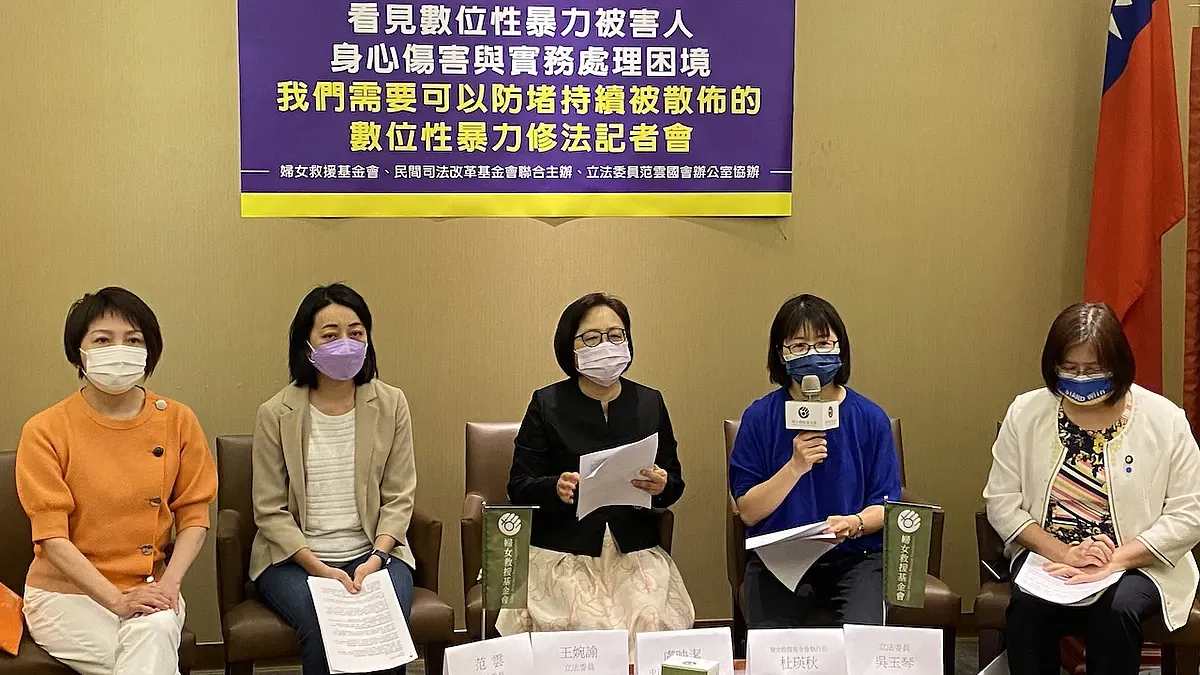
Press Conference | Recognizing the Physical and Psychological Harm to Victims of Digital Sexual Violence and the Practical Difficulties of Handling It: We Need Amendments That Can Stop Digital Sexual Violence from Being Continuously Disseminated
Last edited: 2026-08-18
In 2021, a number of digital sexual violence cases occurred domestically, and in 2022 the government proposed amendments to four main related laws, including the amendment of the chapter on offenses against sexual privacy and synthetic sexual videos in the Criminal Code and Articles 319-1 through 319-6, the amendment of Article 35 of the Crime Victim Rights Protection Act to add a protective-order system, the Sexual Assault Crime Prevention Act, and the Child and Youth Sexual Exploitation Prevention Act. That the government recognized the seriousness of digital sexual violence and was able to swiftly propose the relevant amendments in this session, and that it incorporated into the amendments the practical difficulties faced in investigation or in social workers’ services to victims, is worthy of affirmation and high praise.
However, in practice a victim’s intimate sexual images are obtained by the perpetrator, who then uses them for threats, extortion and sexual blackmail; and after they are disseminated, they are disseminated again or the victim is further harassed and threatened. This is not only a chain of events but may also be a recurring cycle—for the victim and their family and friends, a nightmare and trauma that can never be shaken off.
For this reason, the Taipei Women’s Rescue Foundation and the Judicial Reform Foundation jointly hosted a press conference, inviting Legislator Fan Yun, Legislator Claire Wang, Legislator Wu Yu-chin, and Professor Lu Ying-chieh of the Department of Law at National Chung Cheng University to attend. They explored the inadequacy of protections for victims of digital sexual violence, as well as the difficulties in the current legal framework and its enforcement, and put forward amendment proposals, in the hope that the government will take frontline practical experience into account and fully protect victims’ rights and interests.
Recognizing the physical and psychological harm to victims of digital sexual violence and the practical difficulties of handling it
From 2015 to 2021 the Taipei Women’s Rescue Foundation assisted a total of 655 victims of digital sexual violence seeking help; in the first four months of 2022 alone there were more than 70 cases seeking help. Over a long period of assisting victims, it has encountered the following difficulties:
- Ms. A’s friend called to report that Ms. A’s intimate sexual images had been disseminated five years earlier, had never been retrieved, and are still being forwarded online to this day. As a result Ms. A developed depression, and her friend is now searching online for the videos and requesting their removal; facing the constant viewing, the friend found her own physical and mental health affected.
- Ms. B and others reported that they went to a police station to file a report, telling the police that images had been disseminated on Facebook and who had disseminated them. The police told the Ms. B group that this was an overseas website, and that even if the case were accepted no one could be found, so they could only file it on record and went home. A social worker accompanied Ms. B to another police station to file a report, telling the police that they hoped the perpetrator’s phone with the intimate images would be seized; the police said this was very difficult, and later called and notified the perpetrator to come to the station to make a statement, but the perpetrator refused.
- Ms. C called for help two days after reporting to the police. An online acquaintance had disseminated her intimate images together with her personal data on a Taiwanese website. She reported it and demanded removal, but the site administrator required an official document from the police. A few days after reporting to the police, Ms. C asked the officer about it, and he replied that the process was still ongoing—but by then she had no idea how many times her intimate images had already been viewed.
- Ms. D was threatened by her ex-boyfriend with sexual images and demanded to meet on-site to negotiate; upon arriving, Ms. D was nearly sexually assaulted. Ms. D called the police, who upon arriving merely separated the two. When Ms. D asked the police to retrieve her intimate images, they said they could not.
- Ms. E filed a complaint against Mr. P for threats and intimidation. At a hearing at the district prosecutors’ office, Ms. E told the prosecutor that Mr. P’s phone contained her intimate photos. The prosecutor asked Mr. P to leave the phone, but Mr. P refused and nothing could be done. Ms. E already knew that Mr. P had stored the photos elsewhere.
- Ms. F’s intimate images were disseminated on a domestic website. After the police cracked the case and caught the perpetrator, she thought the intimate images would no longer circulate—but unexpectedly, not long after, she received a message that her private photos had been posted on an overseas website.
These are not merely individual cases; behind them lies a whole group of victims in the same situation. What they hope for is not only that perpetrators be brought to justice and the intimate images taken down, but, more importantly, that the images be swiftly retrieved and prohibited from continued dissemination.
Legislator Claire Wang pointed out that although the Executive Yuan’s draft amendments to the Sexual Assault Crime Prevention Act and the Child and Youth Sexual Exploitation Prevention Act add a basis for “removing intimate sexual images,” the wording of certain provisions is unclear. For example, Article 13 of the Sexual Assault Crime Prevention Act states that “the internet content protection institution, the competent authority, or other agencies may require platform operators to take down or restrict viewing.” This appears to expand the number of agencies involved in preventing the spread of intimate images, but without clearly designating the primary responsible authority, it may lead to different agencies demanding different content controls, creating difficulties in enforcement. Taking the “restrict viewing” order as another example, the degree of the obligation imposed on operators varies enormously—ranging from a single specific image to matching all identical files across the internet (which may involve multiple operators and matching technology)—so much more detailed rules are needed. Legislator Claire Wang believes the government should, from the perspective of internet governance, establish patterns of interaction with experts, scholars and platform operators of the online world, and draft provisions and mechanisms suited to the online world in a much more detailed way.
In addition, Legislator Claire Wang pointed out that, beyond building mechanisms, dedicated personnel for investigating intimate-image cases are also badly needed. She stated that both in her general interpellations and in this amendment review she had demanded that intimate-image incidents be handled by dedicated personnel by applying, mutatis mutandis, the Sexual Assault Crime Prevention Act, hoping that every case can have timely investigative capacity dispatched, and that expertise and experience in technological investigation be strengthened and accumulated.
Legislator Fan Yun has long focused on “preventing the infringement of intimate sexual images,” and has proposed dedicated legislation—dedicated legislation that also covers deepfakes—together with a companion draft amendment to the Child and Youth Sexual Exploitation Prevention Act, striving to fully protect victims. Fan Yun pointed out that the Executive Yuan’s current amendment approach of simultaneously amending four laws to strengthen victim protection is not without merit, but whether through dedicated legislation or amending existing law, victim protection must not be compromised!
Fan Yun analyzed that the Executive Yuan’s four draft bills have at least the following four shortcomings: first, they do not set a time limit for internet operators to take down images; second, they do not require the police to actively assist in taking down and retrieving disseminated sexual images; third, the substance and scope of prevention education are not comprehensive enough; and fourth, victims cannot apply directly to the court for a protective order. Fan Yun stated that during the Legislature’s subsequent review of the bills she will do her utmost to have the demands of women’s groups and victims incorporated!
Legislator Wu Yu-chin believes that the assistance victims most need is the immediate removal of intimate sexual images from the internet, yet the Executive Yuan’s draft Sexual Assault Crime Prevention Act lacks provisions requiring operators to match, remove or take down images. Therefore, during the committee review, Wu Yu-chin proposed an amendment motion requiring that internet operators, where technically feasible, match, remove or take down victims’ intimate sexual images.
As for the Crime Victim Rights Protection Act under review by the Judiciary and Organic Laws and Statutes Committee, Legislator Wu Yu-chin paid particular attention to whether the threshold for applying for a crime-victim protective order is appropriate, and whether it creates restrictions that cause practical difficulties—especially whether protective orders can be expanded from the original scope of protecting personal safety to also stopping digital images from continuing to harm victims. Regarding the various problems currently faced by crime victims, Wu Yu-chin stated that she would require the executive branch to propose solutions and countermeasures, so as to truly implement the protection of crime victims’ rights and interests.
Combining the practical experience of civil-society groups with the legislators’ and experts’ analyses of the current amendments, they hope the government will consider their suggestions and propose amendments or dedicated legislation best suited to the current situation. They also put forward five major demands, in the hope that everyone will work together to build a safer and friendlier social environment:
- Recognize the needs of digital-violence victims and squarely face the difficulties frontline practitioners encounter.
- When a victim reports a related case, there should be a system enabling the police to order the perpetrator to hand over images, or to ensure timely evidence-preservation measures within criminal procedure law.
- For images on overseas websites that cannot be taken down through our country’s compulsory measures, the relevant rules should ensure a mechanism to order the perpetrator to take them down.
- Perpetrators who commit sexual violence by disseminating intimate sexual images should be subject to a mechanism ordering them to undergo cognitive counseling.
- The content of a protective order should explicitly include prohibiting the reproduction, dissemination, broadcasting, delivery, public display, or provision by other means for others to view of the victim’s sexual images.
How can we amend the law to truly stop digital sexual violence from being continuously disseminated?
The current official amendment approach is to add offenses such as disseminating intimate sexual images to the Criminal Code, and to add procedural rules for operator takedowns and protection networks in the Sexual Assault Crime Prevention Act. But a method that can truly and swiftly prevent images from being disseminated is entirely lacking. From actual assistance experience, even with additional Criminal Code provisions, without the correct procedural companion measures there is simply no way to respond to the real practical difficulties and victims’ needs.
To meet the need to resolve practical difficulties, the Taipei Women’s Rescue Foundation and the Judicial Reform Foundation put forward their own draft version, hoping to truly solve the problem of intimate sexual images being disseminated, as explained below (see the attachment for details):
- Add Article 13 of the Sexual Assault Crime Prevention Act
The official provision currently contains no time limit for takedown. Considering the immediacy with which digital information spreads, the civil-society version suggests it should be clearly stipulated that takedown be carried out within twenty-four hours.
An internet platform provider, internet application service provider, or internet access service provider that discovers, or learns through the internet content protection institution, the competent authority or other agencies, of a suspected sexual assault crime, shall within twenty-four hours first restrict viewing of or remove the web-page data related to the crime, and notify the police authority. -
Add Article 13-1 of the Sexual Assault Crime Prevention Act
(1) According to the 655 digital sexual violence help-seeking cases the Taipei Women’s Rescue Foundation served from 2015 to 2021, among situations where perpetrators threatened to disseminate intimate sexual images, as high as 29% involved threats where dissemination had not yet occurred; the next highest proportion, 28%, involved direct dissemination without a threat; and third, 14% involved threats where dissemination had already occurred. From this we know that the most immediate and fundamental way to address the dissemination of digital images is, while the original poster has not yet disseminated them and is still at the threatening stage, to have rules ordering them to hand over the images in their possession. Therefore the perpetrator should be placed under an obligation to hand over the images, with clearly stipulated penalties for violations. In particular, the takedown of overseas images cannot be directly ordered through our criminal procedure law, so imposing an obligation on the perpetrator to hand them over is currently the more feasible way to prevent the circulation of intimate sexual images.
(2) If, after a victim reports to the police, all of the victim’s intimate sexual images (hidden in the perpetrator’s phone, flash drive, computer, or cloud) can be seized as quickly as possible, this can curb the dissemination of intimate images, reduce the victim’s physical and psychological trauma, and reduce judicial litigation. However, because search and seizure is a compulsory measure under criminal procedure law, in the Taipei Women’s Rescue Foundation’s assistance experience prosecutors often, out of considerations such as the principle of proportionality, do not initiate it promptly. If the initial spread of intimate images is not handled promptly, subsequent harm may expand; therefore the system should in principle strive for speed, but with subsequent court review to avoid excessively harming the perpetrator’s legal rights. Hence paragraphs 3 and 4 add remedy provisions.
Sexual Assault Crime Prevention Act (civil-society draft) Article 13-1- Where a police authority, prosecutor or judge learns of a suspected sexual assault and the victim’s sexual images have been or are at risk of being disseminated, they shall actively assist the victim in retrieving their sexual images, or, upon the victim’s request, order the criminal suspect or defendant to hand over their sexual images. For a victim’s sexual images that have already been disseminated on the domestic or overseas internet, the police authority, prosecutor or judge may, upon the victim’s request, within twenty-four hours of receiving the request, order the criminal suspect or defendant to remove them, or notify an internet platform provider, internet application service provider, internet access service provider or telecommunications operator to remove them.
- Where the criminal suspect or defendant of the preceding paragraph, having been ordered to hand over or remove, fails to hand over or remove, a fine of up to NT$100,000 may be imposed, and it may be imposed consecutively.
- The disposition imposing a fine under paragraph 2 shall be ruled upon by the court. Where a police authority or prosecutor issues the order, they shall apply to the competent court for a ruling.
- An appeal may be lodged against the ruling under paragraph 3.
-
The content of protective orders for victims of intimate-sexual-image crimes should be more specific
(1) Under the currently designed official “crime-victim protective order,” only the court, ex officio or upon a prosecutor’s application, may issue it; the victim cannot apply on their own. The civil-society version suggests that victims should be allowed to apply on their own, so as to strengthen the timely-protection function.
(2) Although the official draft adds a “chapter on offenses against sexual privacy and synthetic sexual videos” (the new Chapter 28-1 of the Criminal Code) that applies, mutatis mutandis, the relevant provisions on the “crime-victim protective order,” it lacks what victims most need—requiring the relevant videos to be taken down as part of the protective order. The civil-society version suggests it should be clearly stipulated that victims of offenses against sexual privacy and non-consensual sexual images can obtain protective-order content ensuring their sexual images are no longer reproduced or disseminated and requiring the relevant internet platforms to take them down.
Crime Victim Rights Protection Act Article 35 (civil-society draft)
- Where the court permits the cessation of detention of a defendant in a case of an intentional criminal act causing death or serious injury, or of infringement of the right to sexual autonomy, and, after weighing the balance between the protection of human rights and the public interest, deems it necessary, it may, ex officio or upon the application of a prosecutor or the victim, set an appropriate period of up to two years and order the defendant to comply with the following:
1. Prohibition from endangering the body or property of the crime victim or their family.
2. Prohibition from intimidating, harassing, contacting or stalking the crime victim or their family.
3. Prohibition, without justifiable reason, from approaching within a specified distance of the residence, school, workplace or other specific places frequented by the crime victim or their family.
4. Prohibition from other matters endangering the crime victim or their family. - The provisions of the preceding paragraph may be modified, extended or revoked upon application or ex officio. Each extension shall not exceed one year.
- A person who violates the matters the court has ordered them to comply with under paragraph 1 may be summarily arrested.
- After the cessation of detention, where the defendant violates one of the matters the court has ordered them to comply with under paragraph 1, detention may be ordered to be executed again.
- Where the court, in a case involving an offense under Chapter 28-1 of the Criminal Code, after weighing the balance between the protection of human rights and the public interest, deems it necessary, it may, ex officio or upon the application of a prosecutor or the victim, set an appropriate period of up to two years and order the defendant to comply with or perform the following:
1. The matters in subparagraphs 1 to 3 of the preceding paragraph.
2. Prohibition from reproducing, disseminating, broadcasting, delivering, publicly displaying, or by other means providing for others to view the victim’s sexual images.
3. Delivering the victim’s sexual images in their possession to the victim.
4. Deleting the victim’s sexual images in their possession.
5. Removing, or applying to internet platform providers, internet application service providers and telecommunications enterprises to delete, the victim’s sexual images leaked by the respondent.
6. The procedures for the application for and issuance of protective orders shall apply, mutatis mutandis, the provisions of this chapter.
Article 41
A person who, without justifiable reason, violates the matters they were ordered to comply with under subparagraphs 1 to 3 of paragraph 1 of Article 35 as ordered by the court, a judge or a prosecutor under Articles 35 or 36, or who fails to perform the matters in subparagraphs 1 to 5 of paragraph 5, shall be sentenced to imprisonment of up to three years, short-term detention, or a fine of up to NT$300,000, or both.
- Where the court permits the cessation of detention of a defendant in a case of an intentional criminal act causing death or serious injury, or of infringement of the right to sexual autonomy, and, after weighing the balance between the protection of human rights and the public interest, deems it necessary, it may, ex officio or upon the application of a prosecutor or the victim, set an appropriate period of up to two years and order the defendant to comply with the following:
Attachment
Full comparison table of the civil-society draft provisions
Attendees
Tu Ying-chiu, Chief Executive Officer, Taipei Women’s Rescue Foundation
Lu Ying-chieh, Professor, Department of Law, National Chung Cheng University
Civil Alliance for the Protection of Crime Victims’ Rights
Fan Yun, Legislator
Claire Wang, Legislator
Wu Yu-chin, Legislator
This article is an AI-generated translation of the original Chinese text. In the event of any discrepancy, the Chinese version shall prevail.