
JRF Newsletter: February 2025
To Forget Is to Be Complicit, To Remember Is to Resist
Last edited: 2026-10-24
2025 Taipei International Book Festival
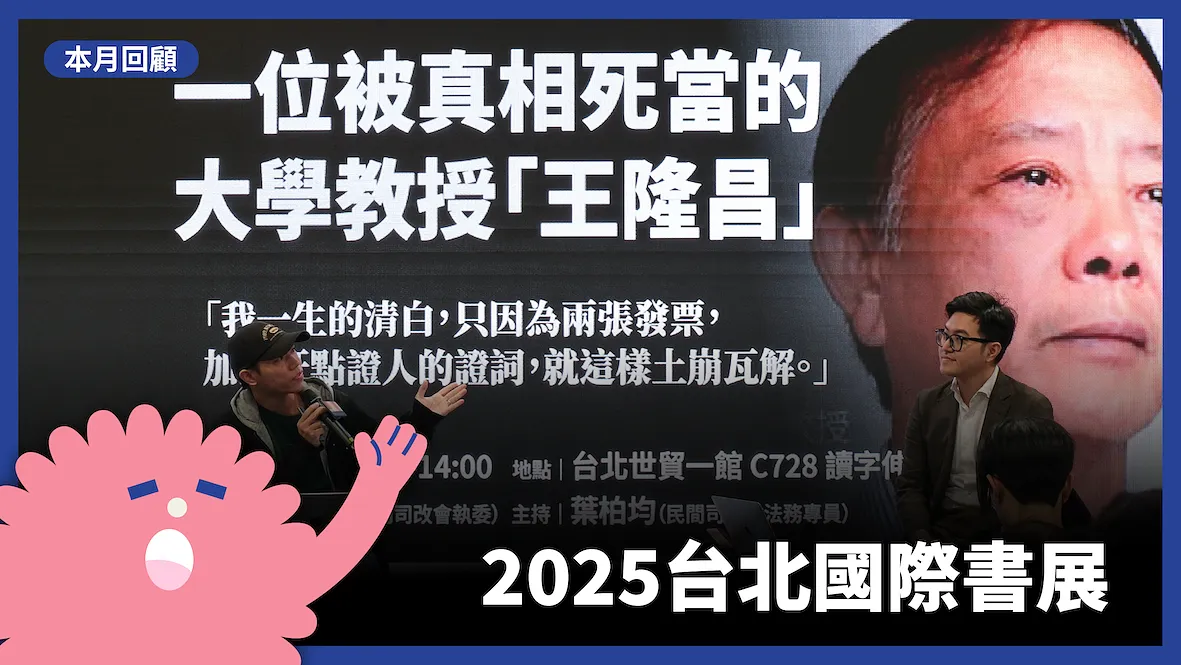
After the Lunar New Year holiday, the Taipei International Book Festival got under way. JRF held two talks on wrongful convictions in the "Reading Citizens" book area. In the first, JRF executive committee member and attorney Lo Kai, who assisted with the Wang Lung-chang case, shared the full story of the case, the many difficulties encountered during the rescue effort, and why he still chose to see it through and speak up for the innocent. In the second, exoneree and JRF Development Resources Manager Su Chien-ho shared the plight of victims of wrongful conviction, why he devoted himself to judicial reform after his exoneration, and how he has come to view his own life and move forward again, carrying love with him.
Session note | From professor to prisoner? Reflections behind the Wang Lung-chang case — Peng Shih-han, Department of Law, Ming Chuan University; JRF intern. "A single verdict, like a sudden storm, destroyed this scholar’s life in an instant. His friends and family were stunned, his students could not believe it, and even those who had been involved in the case were puzzled. How could an innocent professor be sent to prison without any solid evidence? His family endured endless suffering and society’s reproach; his students lost the guiding light that had once shown them their future; and the colleagues who had worked alongside him could only watch helplessly as he walked into the abyss."
Session note | Su Chien-ho on judicial human rights and me — Chang Hsin-jung, Department of Law, National Cheng Kung University; JRF intern. "After Su Chien-ho’s acquittal was finalized in 2012, he was barred from leaving the country in 2014 because his criminal record had not been expunged, and he had to apply to have it removed himself. During 21 years of litigation, his father passed away and the family fell deep into debt from the costs of pursuing the case, while his own health suffered from the torture he endured in prison. Chillingly, on the day he was released, the tax authority still phoned to demand NT$170,000 in taxes owed during the litigation period. Fortunately, the Humanistic Education Foundation raised NT$200,000 to help him through. Yet money was not the only challenge. After his release, Su Chien-ho had to face not only the difficulty of making a living but also society’s strange looks. Some people hold prejudices against victims of wrongful convictions, believing that even after exoneration they cannot fully escape suspicion. This labeling made it even harder for him to reconnect with society."
228: A Memorial Action for the 78th Anniversary
On 22 February, more than 70 groups jointly launched the "228 · 0 Memorial Action," and over 600 people took to the streets to mourn the 228 Incident and call for deepening transitional justice. The march set out from Jihsin Elementary School, calling out and mourning the victims by name along the way. It passed through several historic sites before finally arriving at the Executive Yuan, where activists delivered a declaration in Truku, Taiwanese, Hakka, and Mandarin, emphasizing historical memory and democratic values.
The 228 Incident is one of the deepest collective traumas in Taiwan’s history. It not only took countless Taiwanese lives but also shaped the social development and political system of the decades that followed. Yet the memory of this tragedy is being diluted by some politicians’ calls to "let go of hatred," marginalized amid the joy of long holidays and the frustration of highway traffic jams, and made distant and blurred by the honking of motorcycles along the march route. Without memory and reflection, we leave open the possibility that history will repeat itself. Seventy-eight years on, with the truth of 228 still unclear, we will keep talking about 228. Collective memory is an important foundation of national identity; if we cannot understand the history of 228 together, it will be hard to build an identification with our own country. Only when 228 becomes a shared memory of the Taiwanese people can it be transformed into the motivation to defend democracy and human rights, so that society does not repeat its mistakes. To commemorate 228 is not only to mourn the victims of the past, but to ensure that we never let Taiwan sink once more into the darkness of authoritarian rule.
RightsCon Global Digital Rights Summit Comes to Taiwan: Civil Society Puts Nine Demands to the Government
Since JRF took part in litigation over the digital ID card in 2020, we have continued to demand that the government handle and use people’s personal data and digital footprints in the least intrusive way. When the government promoted the Digital Intermediary Services Act in 2022, we actively joined the discussion and thought deeply about how to balance freedom of expression with platform order. In recent years, we also set up a "Digital Rule-of-Law Group" to study and draft a "Digital Basic Act" to meet today’s rapidly evolving digital challenges. On 24 February this year, RightsCon — the global digital rights summit hosted by the international organization Access Now — came to Taiwan for the first time, held over four days at the Taipei International Convention Center. Civil-society groups, government agencies, and tech companies including Meta, from more than a hundred countries, gathered to discuss the human-rights impacts of technologies such as artificial intelligence, digital platforms, and data security. Taiwanese groups concerned with digital rights put forward nine core demands at the summit, calling on the government to adopt more comprehensive laws and policies. The nine demands — raised by local civil-society groups including JRF, the Open Culture Foundation, the Taiwan Association for Human Rights, and Amnesty International Taiwan — cover digital rights, personal-data protection, internet access, digital platforms, artificial intelligence, human-rights due diligence, and open source.
Four Years Since the Judges Act Reform: Diverse Judicial Accountability — Panel Series, Part 1
JRF has long been concerned with oversight of unfit judges and prosecutors. To build a shared understanding and improvement goals for judicial professional ethics — in terms of who is involved, what is addressed, and how — we co-hosted with the Judicial Reform Committee of the Taiwan Bar Association the panel series "Four Years Since the Judges Act Reform: Diverse Judicial Accountability," examining both the oversight mechanisms for unfit judges and prosecutors and lawyers’ self-discipline and external discipline.
First half, moderated by attorney Chiang Jung-hsiang, chair of the Judicial Reform Committee of the Taiwan Bar Association. On whether case-by-case evaluation helps with oversight of unfit judges and prosecutors: we expect judges to adjudicate fairly and independently according to law, but fairness and independence do not mean a judge should be entirely unconstrained in or out of the courtroom; that restraint should come from a judge’s own competence and self-discipline.
Report by attorney Li Ming-ju, JRF Deputy CEO. At the panel, JRF released its "Civil-Society Annual Observation Report on Four Years of the New Judges Act," pointing to three familiar problems: cases requested by the public are still hard to establish; the reasons for declining to evaluate are mostly "requesting evaluation over a point of law" and "manifestly groundless," and most of those declined are reported by whistleblowers; and the anonymity mechanism in the resolution documents is essentially useless.
Report by specialist Li Hung-yi, investigation specialist at the Control Yuan. Returning to the original intent: the purpose of evaluation and discipline, citing the legislative reasoning of the Judges Act, is not to assess or censure each of a judge’s individual breaches one by one, but to evaluate the character revealed by the totality of a judge’s breaches, in order to determine the responsibility the judge should bear.
Discussant: Professor Chiang Shih-ming, College of Law, National Chengchi University. Taking US standards as an example, a Californian judge’s legal error may exceptionally be reviewed — for instance, repeated error; others, such as abuse of authority, contempt for fundamental rights, intentional and malicious attempts to break the law, and any conduct for purposes other than the faithful performance of judicial duties, must all be uncovered and stopped.
Discussant: attorney Chien Chien-jung, former Supreme Court judge. The current channels for evaluation are very unfriendly to the public, and they have removed the civil-society groups that understand it best and are most capable, barring them from being applicants; removing JRF shrinks evaluation to serve the aims of senior Judicial Yuan officials. A dual-track referral system should be adopted. At present most referrals come from the Judicial Yuan itself to the evaluation committee, but in fact it could simply refer cases to the Control Yuan or the discipline court; because it dares not decide to refer cases to the personnel review committee itself, that committee has become the most important initiating body, and the matter of referral bodies needs review.
Second half, moderated by attorney Huang Hsu-tien, JRF Chair. From the outset JRF proposed a draft calling for comprehensive evaluation but did not win official support; at one point there was an assessment, but it worked poorly too. Before the Judges Act reform there was case-by-case evaluation and something resembling comprehensive evaluation, but officially comprehensive evaluation no longer exists. The invited speakers have worked in bodies that had some form of comprehensive evaluation, so their sharing is especially worth hearing.
Report by attorney Huang Sheng-fen, chair of the Judicial Reform Committee of the Taichung Bar Association. The association publishes only the top five performers in each agency; among those evaluated, the lower-scoring ones do have some real problems, which shows that underperforming judges and prosecutors can be highlighted through evaluation, especially when the sample size is sufficient. Notably, some lower-scoring evaluees also serve as division-chief or presiding judges, showing that courts’ selection for such roles is disconnected from evaluation.
Report by attorney Liang Chih-wei, guest of the Judicial Reform Committee of the Kaohsiung Bar Association. Kaohsiung carried out an evaluation in 2017, with results released in 2019, followed by the Judges Act reform; it now hopes to drive transformation and has launched an app, currently in testing, hoping the national bar federation will take the lead in promoting digitalized evaluation.
Report by attorney Cheng Chia-hui, chair of the Judicial Reform Committee of the Tainan Bar Association. To encourage more lawyers to take part, the incentive payment — originally issued once a year — was changed to once in each half of the year, but it turned out the same people still participated, which is the current difficulty. Evaluation results are not published comprehensively; only the top performers are posted online, while lower scorers are not, though the evaluation report is taken to the courts and prosecutors’ offices during visits.
Discussant: attorney Lin Yung-sung, JRF Standing Director. With public trust in the judiciary currently low in Taiwan, members of the public directly request case-by-case evaluation, yet not a single case has been referred to the disciplinary court; performance evaluations lack objective and fair assessment, the quality gap in judges’ service performance is too large, and there is no mechanism to weed out unfit judges. Taiwan does indeed need a comprehensive judicial evaluation or assessment system.
Upcoming Events in March
Here are some of our March events — everyone is welcome to sign up.
Taichung exhibition and talks. "Becoming an Ordinary Person: the JRF 30th Anniversary Special Exhibition in Taichung" opens officially on 3/7. Booking required; dates: Friday 7 March to Tuesday 17 June 2025; hours: Tue–Fri 13:30–20:00 and Sat 11:00–17:00; venue: JRF Taichung Office, 10F-2, No. 4-33, Sec. 1, Shuangshi Rd., East District, Taichung City.
The Extraordinary Everyday: the Vulnerable Situation of Female Migrant Workers. Saturday 8 March 2025, 14:00–16:00, at the JRF Taichung Office — online or in person, with in-person capacity limited to 50 and a livestream link sent to those on the waiting list. Moderator: attorney Liu Ching-yun, member of JRF’s Gender and Judicial Reform Group. Speaker: Sung Yi-hsin, JRF Standing Executive Committee member and convener of the Gender and Judicial Reform Group.
Academic symposium — When the Judiciary Meets Politics: Constitutional Controversies and Institutional Prospects of the Amendment to the Constitutional Court Procedure Act. Saturday 22 March 2025, 09:20–17:30, at Room 1301, 3F, Lin-Tse Hall, College of Law, National Taiwan University, Da’an District, Taipei.
Support Our Work
If this work matters to you, please consider supporting the Judicial Reform Foundation with a regular or one-time gift, so that we can keep standing with the people and pressing for a judiciary worthy of their trust.
This article is an AI-generated translation of the original Chinese text. In the event of any discrepancy, the Chinese version shall prevail.