
JRF Newsletter: March 2025
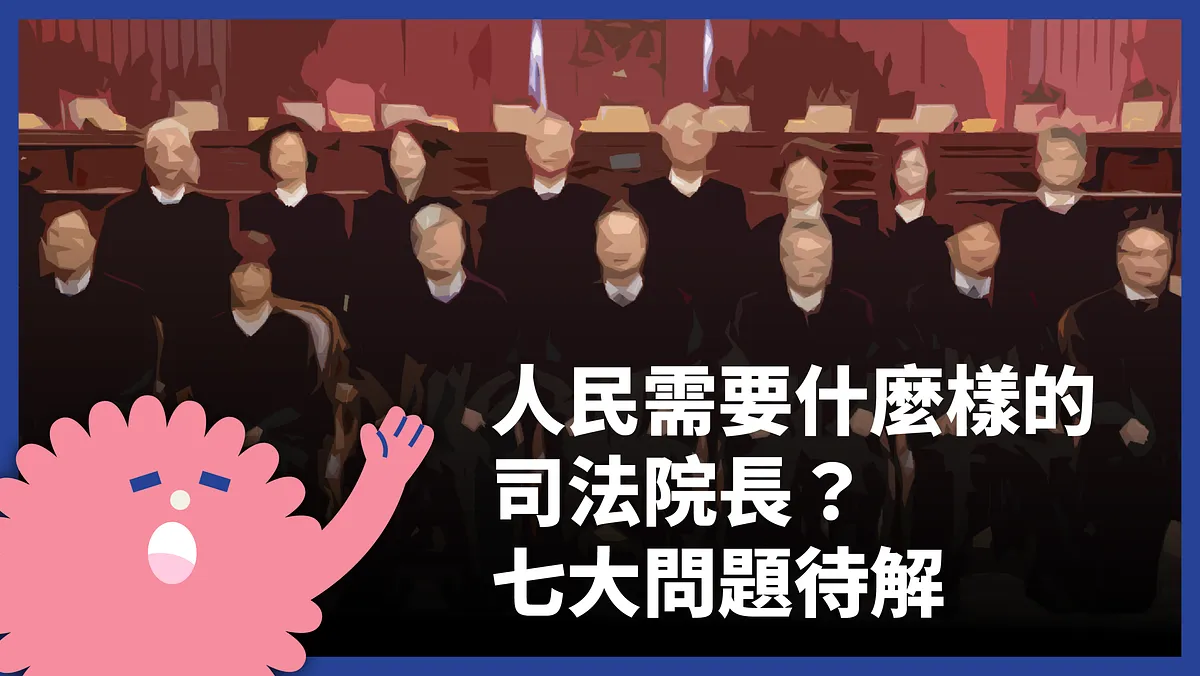
What Kind of Judicial Yuan President Do the People Need?
Last edited: 2026-10-24
Statement: JRF Puts Seven Questions to the Nominees for President and Vice President of the Judicial Yuan
Yesterday the Presidential Office announced the nominees for President and Vice President of the Judicial Yuan and for Grand Justices. The nomination of Tsai Chiu-ming — who comes from the prosecutorial system — as President has drawn public attention. The President of the Judicial Yuan bears heavy responsibility for judicial reform, and how to advance major issues such as easing the judiciary’s workload, strengthening technological investigation, and reforming the Citizen Judges system is a focus of concern across society. For a long time, the pace of judicial reform has been slow and public trust in the judiciary has been low. The head of the judiciary not only presides over the Constitutional Court but also oversees court administration and supervises judicial agencies, shaping the direction of judicial policy. We call on the Legislative Yuan to scrutinize the nominees strictly, to ensure they have a firm will to reform, and to allow a free vote so that the choice is not bound by party lines. The nominees should also clearly explain to society their concrete positions and action plans on judicial reform. The President and Vice President of the Judicial Yuan are not merely administrative posts; they are key figures shaping the development of the judicial system. We hope the nominees will publicly respond to the following seven questions:
1. What do you think are the reasons for low public trust in the judiciary, and what concrete measures would you take to improve it?
2. How would you promote dialogue and exchange among the public, judges, civil-society groups, the Ministry of Justice, and other bodies, to resolve internal differences of opinion within the judicial system?
3. Is the current government’s investment of resources in judicial adjudication sufficient? What are your views and concrete plans on the judicial budget, including any increases?
4. When the Judicial Yuan proposes major draft amendments in future, will you commit to carrying out a "policy and human-rights impact assessment" at the same time, so that society can fully understand the effects of reform?
5. How would you reasonably ease the judiciary’s workload while safeguarding people’s rights? What concrete solutions do you have for judges’ overwork and excessive caseloads?
6. What is your view on the current operation of the Citizen Judges system? Do you support further criminal-procedure reform, such as the non-transfer-of-dossier system?
7. What is your view on reform of the military trial system? Do you have a concrete direction for reform?
Taiwan’s judicial reform is still under way, and we will continue to monitor it to ensure that the judicial system truly responds to people’s needs.
The 318 Movement Archive
On 17 March 2014, the convener of the Legislative Yuan’s Internal Administration Committee forcibly declared the review of the Cross-Strait Service Trade Agreement complete, violating the cross-party negotiation process and sparking protests by students and civil-society groups. In the early hours of the next day, members of the public stormed into the Legislative Yuan and occupied the chamber, and the 318 Movement formally began. At the protest site, with tensions rising and the possibility of mass arrests of participants, JRF helped set up a volunteer lawyers’ team on 19 March to provide legal advice, accompany those being questioned, and assist with subsequent litigation. The movement not only changed Taiwan’s political landscape but also left many marks on legal and democratic development. Over the past decade, through private prosecutions, state-compensation claims, and defense work, JRF has continued to advance the rule of law and democracy, and has held symposia, panels, and a seventh-anniversary special exhibition on the 324 incident. We have kept written and visual records of every event and published themed newsletters. Eleven years on from the 318 Movement, we have gathered the records, large and small, of this decade into an archive, and we invite you to look back at the changes the movement brought and to reflect on the challenges and unfinished work of democracy and the rule of law.
Annual Planning Meeting
This year marks JRF’s 30th anniversary, and on 15 March the secretariat held its annual planning meeting — the first since relocating to the new Taipei office on Minsheng West Road late last year. We specially invited directors and supervisors, standing executive committee members, and volunteer lawyers from the specialist groups to attend and to get to know the new home of the JRF Taipei office. Senior lawyers, mid-career lawyers, and newly joined lawyer partners came together to focus on the next generation’s "blueprint for judicial reform." Divided into thematic groups, the discussions covered the lawyer system, gender and judicial reform, digital rule of law, the judge system, judicial organization, the prosecution-police system, alternative dispute resolution, criminal procedure, administrative litigation, civil procedure, prison reform, and relief for wrongful convictions. Partners rotated among groups to exchange and spark ideas, and a preliminary consensus was reached. With the planning done, the next step is to refine the content and gradually put the blueprint into practice. At the end of the meeting, Chair Huang Hsu-tien joked: "JRF has worked for 30 years, and today’s meeting created the goals for the next 30 years of effort!" We plan to formally release the "Third-Generation Judicial Reform Blueprint" this August as our guide for action in the years ahead.
Rule-of-Law Education Project
JRF’s rule-of-law education runs all year round, working to bring legal knowledge closer to everyone’s life. This month we went into a school and a community with two talks in different fields: at Washington High School, we discussed with students how lawyers can use their expertise to make a social impact; and at the Shuanghu community in Miaoli, we shared practical knowledge on real estate and estate planning with older residents. We hope that, through lawyers’ translation of the law, legal rules become not something cold and distant but a tool of daily life that people can use to protect their own rights when needed.
Campus talk | How can lawyers change society? Sharing a public-interest legal career, at Washington High School. Thanks to Washington High School for the invitation to arrange for attorney Wang Chen-han to share the diverse career paths of a lawyer with the eleventh-grade bilingual experimental class in the social-studies track. The lawyer noted that he did not set out from the start to pursue law, but gradually found the kind of person he wanted to become through taking part in various activities. Many people’s impression of lawyers comes from courtroom battles in film and TV, but a legal career has many other facets — community legal consultations, talks of various kinds, and all sorts of legal-literacy outreach in direct dialogue with the public are all important applications of legal expertise. He also shared cases that left a deep impression on him, talking about how to build trust with clients, how to steady himself when questioned by victims’ families, and how, walking among the crowds of a social movement, he came to a profound awareness of the importance of legal work.
Community talk | Learning practical legal knowledge from small stories: real estate, estate planning, and wills, at the Shuanghu Community Development Association in Miaoli. At the invitation of the Shuanghu Community Development Association in Miaoli, JRF arranged for attorney Li Jui-jen to visit the community and discuss practical topics such as real estate, estate planning, and wills with older residents. Starting from news cases and combining the speaker’s practical experience, the talk explained the importance of wills and estate planning in plain terms. Through interactive questions and answers, the speaker approached, in a conversational way, the questions the elders truly cared about: can I still live in the house after transferring it; what if my children are unfilial; what arrangement truly protects me? The talk also introduced the legal forms of wills and reminded everyone to note the protection of the statutory reserved portion, so that overlooking this rule does not affect the distribution of property.
⭐ If you are interested, we welcome collaboration. We offer schools, clubs, and institutions opportunities for "campus mock trials" and "campus themed talks," and we open applications to borrow space at our Taichung office — let’s keep working for rule-of-law education together.
Highlights from the Exhibition Opening
On 7 March, "Becoming an Ordinary Person: the JRF 30th Anniversary Special Exhibition in Taichung" opened successfully. We thank JRF Chair Huang Hsu-tien, Taichung Bar Association President Wu Shao-kuei, Changhua Bar Association President Hsu Fu-hsiung, and Nantou Bar Association President Hung Chu-wen for attending in person and speaking at the opening, sharing their insights and hopes for judicial reform. We also sincerely thank Li Shan-chih, Director-General of the Taichung Legal Affairs Bureau, along with JRF standing executive committee members and volunteer lawyers, for coming to show their support and witness this exhibition of both retrospection and vision.
Chair Huang Hsu-tien said: Ten years ago, with the support of friends in the central Taiwan legal community, the Taichung office was established as an extension of our judicial-reform work. Last year, as it happened, the office moved to its current site, near Taichung Station and Taichung Park — a location that symbolizes our close connection with society. We hope to use this as a base to open up deeper dialogue on judicial reform. This exhibition, "Becoming an Ordinary Person," is therefore our first major action in Taichung. I have always believed that Taiwan’s development cannot rely on TSMC alone, nor can it be enough for Taipei alone to prosper. Judicial reform, likewise, cannot be promoted only in Taipei; it should let people across Taiwan join the discussion. In Taichung we may not see the Judicial Yuan or the Ministry of Justice every day, but we meet people who need justice every day. So we hope to build this into a center of knowledge on social science, democracy, the rule of law, and human rights for central Taiwan, so that more people can understand judicial reform and take part in the conversation. Looking back over the past 30 years, we keep asking ourselves: if we want a better future, we must understand what happened in the past and examine the present. At the same time, judicial reform is not only a matter of history but an ongoing present. Today we can freely express our views, yet some people still suffer injustice and cannot speak. This is not only a historical progression in time but a parallel reality among different groups in society — we should cherish all that we have, but we cannot be satisfied with the status quo, because many people still cannot "become an ordinary person." This exhibition is not only a retrospective but an invitation to everyone to take part in reform. We need more support; of course, driving reform is not only about asking everyone for donations, but about helping society understand what we do and, in turn, be willing to get involved. We hope you will invite friends and family to visit and give us feedback, so that this exhibition becomes an important starting point for judicial reform in Taichung.
Upcoming Events in April
Here are some of our April events — everyone is welcome to sign up.
Taichung exhibition and talks. "Becoming an Ordinary Person: the JRF 30th Anniversary Special Exhibition in Taichung" opened on 3/7. Booking required; dates: Friday 7 March to Tuesday 17 June 2025; hours: Tue–Fri 13:30–20:00 and Sat 11:00–17:00; venue: JRF Taichung Office, 10F-2, No. 4-33, Sec. 1, Shuangshi Rd., East District, Taichung City.
When the Law Enters the Classroom: How Does JRF Promote Rule-of-Law Education? Saturday 26 April 2025, 14:00–16:00, at the JRF Taichung Office — online or in person, with in-person capacity limited to 50 and a livestream link sent to those on the waiting list. Moderator: attorney Chen Yu-hua, member of JRF’s rescue group. Speaker: Lin Tzu-cheng, JRF Standing Executive Committee member.
JRF Cup Debate Competition — the 2025 National High School JRF Cup Debate. 26–27 July 2025. For students in grades one to three of senior high and vocational high schools nationwide. Preliminaries and quarterfinals on 26 July at Taichung Municipal Taichung Girls’ Senior High School; semifinals and final on 27 July at the Taichung Bar Association.
Support Our Work
If this work matters to you, please consider supporting the Judicial Reform Foundation with a regular or one-time gift, so that we can keep standing with the people and pressing for a judiciary worthy of their trust.
This article is an AI-generated translation of the original Chinese text. In the event of any discrepancy, the Chinese version shall prevail.