
JRF Newsletter: May 2025
After Speaking Out, How Do #MeToo Survivors Face the Burns of the System?
Last edited: 2026-11-04
On the eve of the Dragon Boat Festival long weekend, we mark the second anniversary of Taiwan’s #MeToo movement and enter an important month for gender equality. This issue focuses on the judicial difficulties and the voices of resistance in the "post-#MeToo era," in the hope of bringing support and solidarity to all who have bravely spoken out — you and us alike.
Foreword
In early summer 2023, Taiwan’s #MeToo movement erupted, and much long-suppressed pain finally surfaced. We witnessed together those brave and heartbreaking moments of speaking out — but two years on, do we still remember their voices? While a handful of perpetrators entered judicial proceedings, many more continued unobstructed in their fields; and the survivors who stood up were forced, after telling the truth, to face another grueling battle. Because of limits such as the statute of limitations and the difficulty of producing evidence, many victims cannot obtain justice through formal legal channels. Disclosing one’s experience of harm is already exhausting, and survivors often must also endure public opinion — and even "judicial retaliation" from perpetrators in the name of defamation or injury to reputation. This phenomenon is a concrete manifestation, in the gender context, of the Strategic Lawsuit Against Public Participation, or SLAPP: perpetrators use litigation to impose heavy legal costs and psychological pressure on the people involved, creating a chilling effect in society. Even though we have pushed for legal amendments, the system still cannot fully bear this unfolding reality. JRF has therefore produced a self-help handbook, "Reporting #MeToo and Then Sued for Defamation: What Can You Do?", compiling legal analysis and practical experience, in the hope that those going through retaliatory litigation need not fight alone. We also continue to track the SLAPP phenomenon in Taiwan’s gender movement, reminding society and the judicial system that the system must not become a tool of oppression, and that this crisis of using lawsuits to silence people cannot be ignored. This issue focuses on the real situation of survivors and the current state of the judiciary in the post-#MeToo era, as well as possible paths to self-help and support. We hope to bring a little warmth and strength to everyone who has spoken out, is speaking out, or is still struggling.
The Gap Outside the System: Huang Chi-yu and the Unfinished Dialogue with #MeToo
Text by Hua Ching-ho; photos by Hsieh Chia-chen and Li Chao-yen. In 2014, Huang Chi-yu was verbally and physically harassed by attorney Li Huai-nung. Years later, in the #MeToo wave, she chose to bravely disclose it in public and filed a complaint with the Taipei Bar Association. Yet this led the perpetrator to sue her for injury to reputation, and the victim had to bear the tedious judicial process and psychological pressure alone. Chi-yu’s story not only highlights the limits and gaps of current law in dealing with gender cases, but also shows us that when the system cannot respond to real trauma and injustice, those who dare to speak out about their experiences often have to bear, alone, the heavy pressure that the whole structure imposes.
From Speaking Out to Being Sued: Li Tzu-tung and the Institutional Collision Behind #MeToo
Text by Chao Min; photos by Li Chao-yen. In the #MeToo wave, many stories were heard, but some people fell into judicial difficulty after speaking out. Tzu-tung is not a victim; she is a witness, yet because she disclosed a sexual-harassment incident on social media, she was sued for injury to reputation by the perpetrator and became one of seven defendants. In the lengthy litigation, she faced not only the difficulty of producing evidence but also, firsthand, the prosecutor’s doubt and belittlement. This experience made her realize that when people try to speak of things that go unseen, the system is not always ready to catch them.
Does the Law Stand on the Side of the Egg? A Domestic and International Study of SLAPP
Text by Chuang Tzu-hsuan, Lin Cheng-ching, and Chou Yu-hsiu; editing by Li Ming-ju; photos by Hsieh Chia-chen and Miffy Jiang. SLAPP, the Strategic Lawsuit Against Public Participation, refers to using litigation as a tool to suppress public participation and freedom of expression, silencing critics through the high cost and pressure of lawsuits. This practice has long had precedents in environmental, labor, and social-movement circles; after the #MeToo movement, cases of sexual violence also became a front line of abusive litigation. Starting from domestic and international experience, this article explores the impact of SLAPP on Taiwan’s public discourse and gender movement, and asks whether current law truly has the capacity to respond to society’s changes and trauma.
Self-Help Handbook: Reporting #MeToo and Then Sued for Defamation — What Can You Do?
Compiled by JRF’s Gender and Judicial Reform Group. The #MeToo movement lifted the lid on the dark corners of sexual violence, but it also plunged survivors into the abyss of judicial backlash. When an accusation exposing sexual harassment is twisted into a charge of "defamation," the law not only fails to bring justice to victims but becomes a weapon of the perpetrator’s power. More than thirty percent of #MeToo complainants have been sued by perpetrators for criminal defamation or civil damages, forced to prove their wounds over and over amid the difficulty of producing evidence. We produced this handbook in the hope of giving those involved an initial sense of direction — to understand the basic legal elements and judicial process, and to ease a little of the anxiety this process brings.
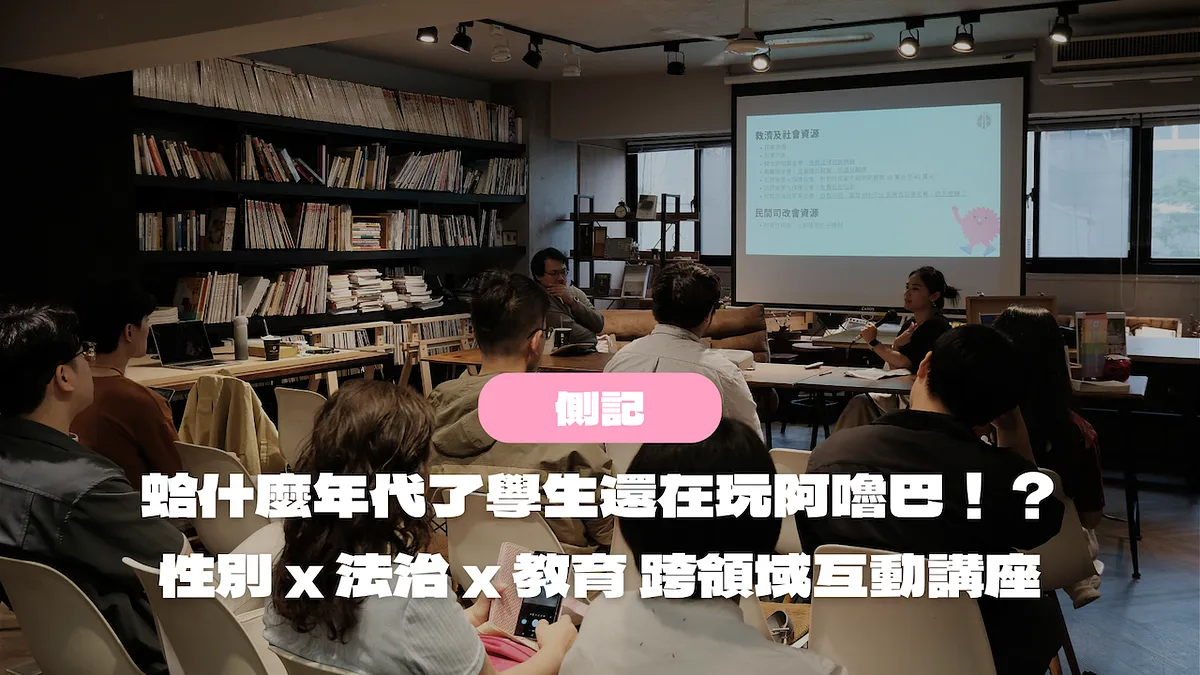
Sidelights: What Era Is This, and Students Are Still Playing "Aruba"?! A Cross-Disciplinary Talk on Gender, the Rule of Law, and Education
Text by Hung Yu-ting; Wu Nien-chen, a New York State attorney and pro bono volunteer; and Li Ming-ju, JRF Deputy CEO. During the 2021 amendments on private intimate images, JRF’s gender group was formally established; after the #MeToo movement erupted in 2023, we actively monitored the government’s gender-equality mechanisms and assisted individual victims. In recent years, however, the proportion of exposed child and youth sexual-exploitation cases has risen and the age of victims of digital sexual violence has fallen, so we hope to start from education, bringing gender issues into schools so that prevention is better than cure. This talk combined frontline observations from teachers and lawyers, sharing the real difficulties educators face and the frustrations victims meet in seeking judicial relief, and stressing the importance of bringing gender education into schools. In the second half of 2025, JRF will also develop a gender-equality mock-trial script, hoping that through practical simulation we can cultivate correct gender awareness in students and put down roots for gender justice in Taiwan.
Upcoming Events
Rally — Resist Transnational Repression, Oppose the Expansion of Totalitarianism: the 36th Anniversary Memorial Evening for the June Fourth Massacre. Wednesday 4 June 2025, 15:00, at Liberty Square’s Democracy Boulevard, No. 21, Zhongshan S. Rd., Zhongzheng District, Taipei. Programme: 15:00 the mourning pavilion opens and the democracy market begins; 19:00 the evening event begins; 20:09 memorial ceremony.
Courtroom observation — the "Taiwan’s Cambodia" state-compensation case, third preparatory hearing. Wednesday 25 June 2025, 10:30, at the Summary Division, Courtroom 1, Kaohsiung District Court, No. 188, Hedong Rd., Qianjin District, Kaohsiung City.
Support Our Work
If this work matters to you, please consider supporting the Judicial Reform Foundation with a regular or one-time gift, so that we can keep standing with the people and pressing for a judiciary worthy of their trust.
This article is an AI-generated translation of the original Chinese text. In the event of any discrepancy, the Chinese version shall prevail.