
JRF Newsletter: October 2025
Who Lives in the Shadow of Extreme Sentencing for Drug Crimes?
Last edited: 2026-10-24
Foreword
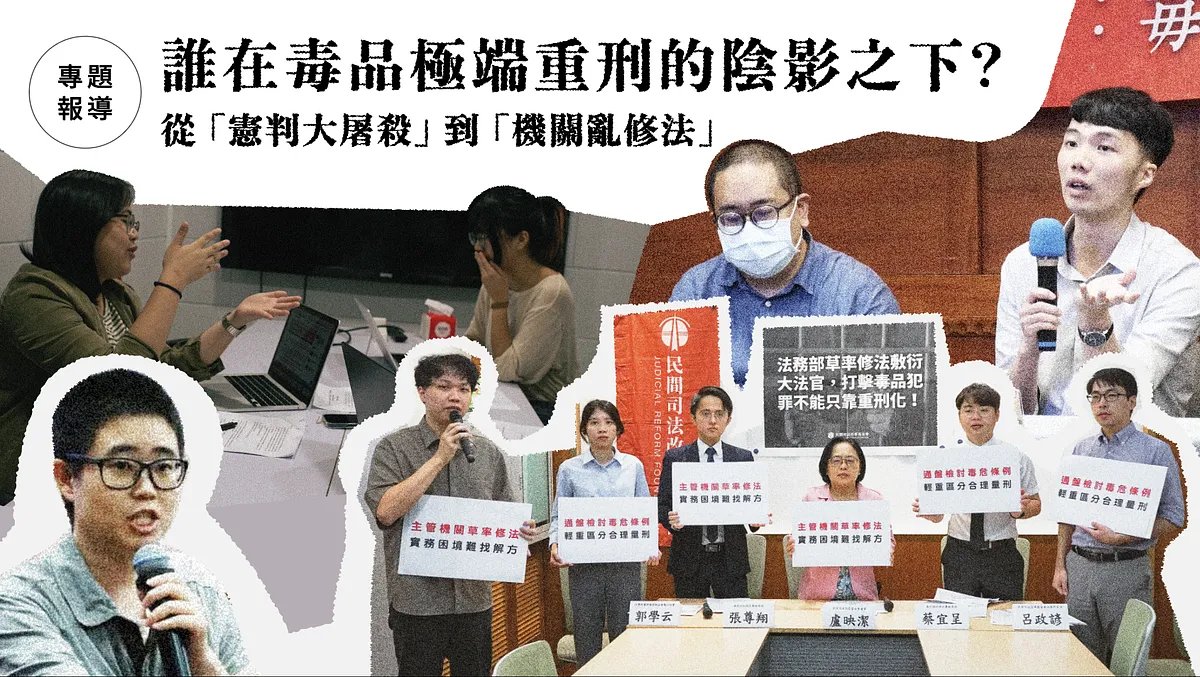
"Such a peculiar outcome amounts to a massacre of petitions rarely seen in our history of constitutional interpretation." This was the comment left by Justice Huang Chao-yuan in his dissenting opinion to Constitutional Judgment 112-Hsien-Pan-13. Yet the warning in those words plainly failed to move the Ministry of Justice’s lopsided drug policy. Last July, in response to that judgment, the Ministry of Justice proposed amendments to the Narcotics Hazard Prevention Act; this October, JRF put forward a civil-society draft, hoping to ease the problem of "light offense, heavy penalty" caused by an extreme, sentencing-heavy drug-control policy — and right after our civil-society draft press conference, the Ministry issued a statement firing back. What looks like a recent flurry of debate is in fact an old judicial-reform issue, and looking back at past discussion and advocacy we realize a full decade has slipped by. Whenever JRF raises a related issue on social media, there is always someone who, perhaps without reading the draft or the statement, asks: "So does JRF support decriminalizing drugs?" or "Shouldn’t drug crimes just carry the death penalty?" — which not only completely misreads our position but, we firmly believe, does nothing to help with the real difficulties the justice system faces in drug cases. Through this issue we hope to let everyone see, through the stories of those few petitioners whose cases were accepted in 112-Hsien-Pan-13, the real lives behind the law; and to look back on JRF’s decade of successive efforts across different cases, responding as best we could, with limited staff, to the flood of letters from prisons, and, after the judgment, restarting our drug-law group and completing two civil-society drafts — presenting the fair and reasonable direction for drug legislation that our volunteer lawyers and scholars hope to advocate together.
Part One: "The one who actually dealt the drugs was my ex-boyfriend — so why was I sentenced to 15 years, heavier than him?"
The story of one of the eight petitioners accepted in Constitutional Judgment 112-Hsien-Pan-13. Text by Mido; editing by Lo Li-han; photos by Li Chao-yen.
"Such a peculiar outcome amounts to a massacre of petitions rarely seen in our history of constitutional interpretation." This was the comment Justice Huang Chao-yuan left in his dissent to Constitutional Judgment 112-Hsien-Pan-13. The criticism is no exaggeration: more than 2,500 petitioners sought constitutional review, arguing that Article 4, Paragraph 1 of the Narcotics Hazard Prevention Act — the offense of manufacturing, selling, or transporting first-grade narcotics, which carries a statutory penalty of only death or life imprisonment — violates the principle of proportionality. Faced with such a huge number of petitioners, the Constitutional Court accepted only 8 of the cases; the remaining 99 percent and more were all declined, all but closing off the public’s avenue of relief through constitutional litigation.
The story of Lin Shu-hui, a pseudonym, who was "chosen" by the Constitutional Court as one of the few accepted petitioners, is especially ironic. Only 19 years old, she was found by the court to have "jointly sold drugs" with her boyfriend on three occasions, and was sentenced to 15 years and 3 months in prison.
On those three occasions she merely answered the phone on her boyfriend’s instructions and handed a package to whoever came to collect it. The payment she received was just NT$1,000 the first time and NT$2,000 each of the other two. She said she was only helping to pass things along, did not know what was inside, and was not the one running the deals. Her role was plainly minor and her gains limited. Yet in the end she was sentenced more heavily than the main dealer — her ex-boyfriend, whose sentence was 11 years.
"I just never imagined that, in the end, the one sentenced most heavily would be me."
Recalling the day it happened, her boyfriend was in the shower when the phone rang and she picked it up. The person on the other end said: "I’m here, bring the stuff down." Lin Shu-hui did so, without asking a single question. Then, one day in 2008, as she and her boyfriend returned to Pingtung from Taipei, officers from the Kaohsiung City Criminal Investigation Corps came to arrest them. Although she was released without bail that day, her life from then on felt as if someone had pressed pause.
It was not until 2014, six years after the incident, that she received the indictment. By then her life was completely different — she had long since broken up with her ex-boyfriend, remarried, and had a child only a little over a year old. When the indictment from the Pingtung District Prosecutors Office arrived, she was stunned. "I was truly shocked. I thought, my child has already been born, why is there still this charge? Why not indict earlier, why wait all these years?"
She recalled that in the past she had asked her then-boyfriend many times: "How are you so rich?" He would always say lightly: "Don’t ask so much; this is to protect you. If something ever happens one day, you won’t know anything." With a bitter smile she said: "Indeed, I knew nothing. I just never imagined that, in the end, the one sentenced most heavily would be me."
Photo: On the day of the interview, we visited Lin Shu-hui in her hometown.
"The days of waiting for the case to end were long and agonizing; every day was lived in dread."
Lin Shu-hui felt she could not escape judicial punishment, and worried that her children were still so young — that if she went in to serve her sentence, they might be bullied at school or gossiped about by relatives and friends. She also thought of her parents, fearing she would become a heavy burden on the family. Over the three years from the start of the case to its end, her family understood the situation throughout. Though the sentence was heavy, her family, knowing she had not touched drugs or sold them, showed understanding and support.
Later, she gave birth to another child. Believing her children had a right to know, from the time the case began she told them, like "giving them a vaccination," that one day Mommy might have to go away to work for a long time. Her daughter would ask: "Where are you going to work?" And she would answer honestly: "Mommy did something wrong and made bad friends; in the future, don’t be like me." She believed that, rather than deceive her children, it was better to let them understand the truth early.
After the case concluded in 2017 with a confirmed sentence of 15 years and 3 months, Lin Shu-hui, in the week before entering prison, arranged with her father and aunt to take the children on a brief two-day trip to Kenting. When the trip ended she packed her bags and reported to the Pingtung District Prosecutors Office. Her heart was heavy and sorrowful; she first returned to her parents’ home to have a meal with her grandparents and asked them to take care of their health. Then her family rode along, following her all the way to the prosecutors office. She declined her friends’ wish to see her off together, and temporarily shut down her social media, unwilling to let the outside world know where she had gone.
"JRF’s official letter reached into the prison like a rope, bringing a sliver of hope for constitutional review."
"I have no criminal record, did not finish high school, and this is the only criminal case in my life. The year I was involved, I was only 19. Simply because my cohabiting boyfriend was a major dealer, I failed to notice and answered his phone… and was sentenced to 15 years and 3 months, cut off from society, with my child still an infant…" — from Lin Shu-hui’s petition for constitutional review of the law and the judgment.
On her first day in prison, when her cellmates asked about her sentence, she answered: "15 years and 3 months." In those days she spent almost all her time staring blankly. In the prison, a space of about two ping held six or seven people living together. Later she was assigned to work in a workshop doing simple processing, such as packaging erasers and paper bags. Within just two months she was named a small-group leader.
Lin Shu-hui recalled that in May 2022 the prison received an official letter from JRF — the details of JRF’s action can be found in Part Three of this newsletter. The letter said that eligible inmates could file petitions for constitutional review, with a deadline of 15 July, less than two months from when the letter was issued. This notice caused quite a stir: at the time about 80 percent of the inmates were drug offenders, and drug sentences are usually very long. For everyone, this letter was like a rope reaching into the cage, offering a glimpse of hope to grasp.
"I immediately took the sample to my cellmate, a music teacher with a higher level of education, and asked her to help me see how to write it." After reading it, the cellmate said: "Hey, 0353" — Lin Shu-hui’s number — "is your case file still here? I’ll help you petition." After reading Lin’s case materials, she quickly grasped the situation and helped her write the petition.
Although this cellmate’s own case did not qualify for this review, she still warmly helped Lin write and check the petition. And because JRF’s letter came with a sample attached, everyone began writing, setting off a butterfly effect — petition forms sold out, and even the kraft paper ran out of stock.
On 11 August 2023 the music-teacher cellmate saw in the newspaper that parts of the Narcotics Hazard Prevention Act had been ruled unconstitutional, and excitedly told Lin Shu-hui: "We did it! Even if your case isn’t directly affected, it will indirectly prompt amendment. Under the rules, an unconstitutional provision must be amended within two years." The newspaper reported that, nationwide, only 8 petitioners would obtain relief, 3 of them referred by courts and the other 5 petitioned by inmates themselves. Lin recalled: "When I saw it was only 5, I felt there was probably no hope."
"There were about 12 people in our workshop, 10 of them drug offenders, with sentences mostly of 20 or 30 years. Although everyone was happy to hear the unconstitutionality news, as rejection after rejection of their petitions arrived, disappointment followed." Lin Shu-hui was the first in the workshop to complete her petition. As others who had also filed received news one after another, hers still had not come. The music-teacher cellmate could only comfort her: "No news is good news."
When the Constitutional Court’s judgment came out, Lin saw her own name among the petitioners. Holding the judgment, she sat and read it through three times and still could not understand it — until the music-teacher cellmate returned to the workshop, when she nervously handed over the file and asked her to explain what the judgment meant.
After reading it, the music teacher wept with joy. She said: "This constitutional review succeeded; from nothing to something, I helped you complete it step by step. For me it was like raising a child." The good news quickly spread through the workshop, and everyone was overjoyed at this hard-won judgment. Thanks to the music-teacher cellmate’s help, Lin Shu-hui came to know JRF specialist Lin Wei-ting.
"Whenever an inmate wrote with a question, she would always write back and help provide answers. No other organization is as diligent as you," she said. If a petition is not filed in the proper written format, officials often ignore it — but that threshold is very high for people in prison, and not everyone knows how to write such a document. And so the saying "for anything, go to JRF" began to spread in the prison.
"First you sentenced me heavily, now you grant me relief — is there any real fairness in that?"
Looking back on the whole thing, Lin said: "You got it wrong, and you owe me justice." But she also knew none of it was so easy. On the day of the interview she said indignantly: "But how do you give it back? I’ve already been locked up for six years and five months. I’m a girl — I was locked up at 27, and I’m back at 34." She went on: "Luckily I didn’t lose that bond with family, but I’m still behind everyone else. When others were taking off, what was I doing?"
Dejected, she said: "First you sentenced me heavily, now you grant me relief — so is there any real fairness in that? It’s simply an asymmetry."
After the constitutional judgment, Lin was resentenced to 9 years and 6 months by the Kaohsiung branch of the district court, and was released on parole this January. Now she runs a papaya orchard in Pingtung with friends, rebuilding her own life. Though she has regained her freedom, Lin still often returns to the Kaohsiung Women’s Prison to visit old friends and check on how they are doing. She has found that many friends who leave prison hit wall after wall when looking for work, and that the path back into society is especially hard. This made her realize that reintegration for former inmates is not easy — "but as long as there’s something you want to do in your heart, you have to do it bravely, no matter how long it takes." This is what Lin often tells herself after years of long hardship.
Part Two: The Long Decade of Judicial Reform on Drug-Law "Light Offense, Heavy Penalty"
The story of those beyond the eight accepted in Constitutional Judgment 112-Hsien-Pan-13. Text by Tsai Shang-heng; editing by Li Ming-ju; photos by Li Chao-yen.
Last July, in response to Constitutional Judgment 112-Hsien-Pan-13, the Ministry of Justice proposed amendments to the Narcotics Hazard Prevention Act; this October, JRF put forward a civil-society draft, hoping to ease the "light offense, heavy penalty" problem caused by an extreme, sentencing-heavy drug policy — and right after our civil-society draft press conference, the Ministry issued a statement firing back.
What looks like a recent flurry of debate is in fact an old judicial-reform issue. Looking back at past discussion and advocacy, we realize a full decade has slipped by. This piece traces JRF’s decade of advocacy on amending the Narcotics Hazard Prevention Act, so that together we can see the bumpy road of drug-law reform.
The first attempt at constitutional review: the Chou Tsang-chi case
"When we talk about JRF’s advocacy on drug policy, we cannot skip Chou Tsang-chi."
In 2006, prosecutors alleged that Chou Tsang-chi had sold heroin, a first-grade narcotic, on three occasions — twice selling 0.28 grams for NT$800 and 0.26 grams for NT$1,000, and once selling an unknown amount for NT$500. In the first instance the Kaohsiung District Court, lacking solid evidence, found him not guilty, but prosecutors appealed; in the second instance the High Court found that he had sold heroin twice, and, weighing aggravation for recidivism and statutory grounds for mitigation, ultimately sentenced him to 15 years and 2 months on each of the two counts, for a combined term of 18 years.
JRF Deputy CEO, attorney Li Ming-ju, recalls that in 2016 JRF’s drug project group began to notice that the Narcotics Hazard Prevention Act drew no distinction based on the amount sold — the statutory penalty was the same regardless — in violation of the principle of proportionality, and so it planned to petition the Grand Justices for constitutional review. The Chou Tsang-chi case involved a very small quantity sold and a very small sum received, yet the total sentence was very heavy. From among many cases, the group singled it out as an indicator case.
In 2018, with the help of constitutional-review group attorney Chang Ching-kai, JRF filed for review of the relationship between the circumstances of drug dealing and the sentence, using the cases of Chou Tsang-chi and Hsu Hung-chang — who sold heroin once, in 3 small packets of net weight 0.038, 0.035, and 0.143 grams, and was sentenced to 18 years.
Regrettably, on 19 June 2020 the Grand Justices issued a decision declining to accept the case. They held that although the relevant provisions treat manufacturing, transporting, and selling first-grade narcotics as serious crimes, where the statutory requirements are met the court should reduce or waive the penalty, and so they found that the petition had failed to explain clearly why the provisions did not conform to the principle that punishment should fit the crime, or to the principle of equality.
Table — the circumstances and sentences of the petitioners in the Chou Tsang-chi constitutional case. Chou Tsang-chi: two acts, each the completed sale of heroin of net weight 0.073 and 0.023 grams; sentenced to 15 years 2 months on each. Hsu Hung-chang: one act, the completed sale of three small packets of heroin of net weight 0.038, 0.035, and 0.143 grams; sentenced to 18 years. Source: the dissenting opinion of former Justice Huang Hung-hsia to the decisions declining the petitions.
Although former Justice Huang Hung-hsia issued a dissent to the decision — agreeing that JRF had specifically explained that the minimum statutory penalty for all cases under the provision was life imprisonment, with no distinction drawn by the gravity of the offense, and that many criminal-law scholars had raised doubts, so that the dispute had constitutional value and should be accepted — this wave of effort nonetheless ended with the non-acceptance.
A hectic summer: 2,500 petitions for constitutional review
After the failure of the first review, JRF’s constitutional-review group met again on 17 August 2020 to discuss a second petition, deciding to wait until the next cohort of Grand Justices took office, adjust the grounds of the petition, and try again.
Interestingly, while JRF’s lawyers were preparing the second petition, on 23 December 2021 the Constitutional Court agreed to accept the dispute over the constitutionality of Article 4, Paragraph 1 of the Narcotics Hazard Prevention Act. At the same time, the new constitutional-litigation system took effect in 2022, opening the chance to try "review of an individual judgment." Cases whose final judgments became final only after the new system took effect on 4 January 2022 had to file for constitutional review by 4 July 2022.
In these circumstances, to help the greatest possible number of "light offense, heavy penalty" drug defendants seek relief, JRF proactively provided a "guide and sample petition for constitutional litigation" and asked the Agency of Corrections to help pass the information on to inmates. The official letter asked the Agency to notify its prisons so that inmates could protect their constitutional rights, explaining the deadlines and legal basis, and noting that those convicted under the same provision who had not petitioned would have no later chance of relief.
As the Agency of Corrections helped forward the information to the prisons, JRF began receiving a flood of petitions. JRF staff, together with interns, formed a drug-law reply team, classifying cases by the defendant’s situation and writing case summaries based on their Supreme Court criminal judgments — for example, a petitioner found by the Taichung branch of the High Court to have sold first-grade heroin nine times for a profit of NT$11,500, given a combined term of 8 years, with the appeal dismissed by the Supreme Court, held in Penghu Prison; and a petitioner found by the High Court to have jointly sold second-grade methamphetamine twice for a profit of NT$24,000, given a combined term of 11 years 6 months, with the appeal dismissed, held in Taoyuan Prison. Completed petition drafts and explanatory statements were then sent back to the defendants.
Photo: Before the judgment was announced, JRF interns help handle replies to defendants.
During June and July 2022, JRF estimates it sent out some 550 sample drafts, and again helped Chou Tsang-chi file. In the end, the Constitutional Court is estimated to have received 2,500 petitions. On 8 June 2023, JRF further filed an amicus-curiae brief on the unconstitutionality of Article 4, Paragraph 1 under the new system’s amicus mechanism; but on 11 August 2023 the Constitutional Court ruled, declining to permit JRF’s amicus filing.
The Constitutional Court’s Judgment 112-Hsien-Pan-13 ultimately accepted the cases of 8 petitioners; Chou Tsang-chi was once again turned away. Observing the accepted cases, JRF Deputy CEO Li Ming-ju noted that all 8 had no criminal record and simply presented "light offense, heavy penalty" circumstances, while Chou Tsang-chi may have been excluded because of a prior drug-use record.
That this collective review yielded only a few successes also prompted JRF to reflect: the Constitutional Court, facing an overwhelming flood of petitions, did not open the door as widely as hoped, perhaps because it struggled to handle such a huge caseload and feared that sweeping change to drug cases would shake the existing judicial order, leading it to lean conservative.
Photo: On the day the judgment was announced, the Legal Policy Department and interns watch the Constitutional Court’s live broadcast together.
JRF restarts its drug-law reform group, hoping for legislative change on the basis of the judgment
Judgment 112-Hsien-Pan-13 held that Article 4, Paragraph 1 of the Narcotics Hazard Prevention Act, even when Article 59 of the Criminal Code is applied to reduce the sentence, still leads to "light offense, heavy penalty" situations, and required the Ministry of Justice to amend the law.
But in response, the Ministry’s draft merely added Article 17-1, stating that where the circumstances of selling first-grade narcotics are minor and the penalty remains too heavy after reduction, a further reduction may be granted — but this does not apply to those with a prior record. The Ministry thus overrode the judgment, unilaterally setting a "no prior record" threshold for further reduction. Moreover, the current Act bases statutory penalties on "drug grade" — selling a first-grade drug carries death or life imprisonment, while selling a fourth-grade drug carries 5 to 12 years — without considering the quantity sold, which is plainly unfair.
To respond to the official amendment’s slow and blinkered pace, JRF established a "Narcotics Act Reform Group" in 2024 as an engine for ongoing oversight and reform. From 2016 to 2024, JRF has followed drug-law reform for nearly a decade, and beyond the early lawyer teams has begun to draw in a younger generation of volunteer lawyers.
To show JRF’s long-term commitment and continued effort, we interviewed reform-group member attorney Chang Tsun-hsiang, exploring what motivates young lawyers to take up the drug issue and the challenges they face.
Photo: Chang Tsun-hsiang, a volunteer lawyer in the drug-law reform group, attends JRF meetings after finishing his own legal work.
Attorney Chang’s encounter with the drug issue came through a teacher’s guidance in his student days. Professor Lin Wan-shan, then serving as an expert witness for a petitioner at the High Court, invited Chang to help sort through the case, and so he plunged into stacks of Supreme Court judgments, tallying up one by one the situations violating Article 4, Paragraph 1. As he dug deeper, the statistics showed him that this was a legal question hard to avoid:
"For example, between 7 years 6 months and 9 years, or between 7 years 6 months and 8 years, and between 15 and 17 years, or 15 and 18 years — these two ranges account for almost all defendants’ sentences, forming a very distorted curve with only two peaks. That’s strange, because a normal sentencing range should be a spectrum: if something is more serious, we sentence more heavily; if it’s lighter, more lightly — so how can there be only two points? The reason is simply the difference between one reduction and two: life imprisonment reduced once is 15 years, and 15 years reduced again is 7 years 6 months. The ranges appear because, say, three counts of drug dealing are each sentenced to 7 years 6 months and combined to 8 years 1 month; and the 15-to-17 or 15-to-18 range might be five counts each at 15 years combined to 16 years. There’s no smoothness at all, only two points, almost all at 7 years 6 months and 15 years 1 or 2 months — which I find quite absurd. And what is their standard of judgment? ‘Manifestly deserving of compassion.’ But that phrase has no standard whatsoever; almost every case uses it — statistically, the Supreme Court uses it in more than 80 percent."
Carrying this reflection, attorney Chang, after entering practice, set aside his off-work hours to join JRF’s drug-law group, hoping that the power of oversight would make more people aware of the problem.
Facing the hard road of drug-law reform, attorney Chang affirms Judgment 112-Hsien-Pan-13, but believes that how the relevant agencies craft more progressive policies that better protect people’s rights remains a direction that must be continually studied and advocated. Walking the long road of reform, JRF strives to bring society legal change with greater fairness and human-rights protection.
Part Three: Drug — No Antidote? On the Drug-Law Reform Group
Text by Liao Wei-cheng.
A lingering poison
In early 2024, JRF’s Narcotics Hazard Prevention Act Reform Group — the drug-law group — was formed, holding its first dedicated meeting in March.
The group was formed because, in August 2023, the Constitutional Court announced Judgment 112-Hsien-Pan-13 on the sale of first-grade narcotics. The judgment held that the current penalty of "death or life imprisonment" for selling first-grade narcotics was too harsh and needed amendment.
Because of concern that the competent authority, the Ministry of Justice, often goes through the motions on amendments, JRF has always, on important issues, put forward its own civil-society draft as a counter-proposal, so that later advocacy has a clearer demand. After this judgment, to amend the Act, we gathered a group of scholars and lawyers together with JRF secretariat colleagues, and began, meeting after meeting, to research, discuss, and gradually complete this draft.
Photo: JRF has long cared about the drug issue; JRF researcher Lin Wei-ting attended the 2018 "Human Rights Plus" talk discussing the severe criminalization of drugs and drug policy. Provided by the Taiwan Association for Human Rights; photo by Shih Yi-hsiang.
It’s not that simple
At the first group meeting, the tough and stubborn members reached a consensus: we would comprehensively review all the provisions on the supply side of drugs in the Act — the "drug-use side," being less relevant to this judgment, was set aside for now — because we all agreed that "this isn’t a problem that can be solved by amending a single provision."
That everyone could so readily reach this consensus is perhaps no surprise. In its earlier research, the secretariat had combed through many practical controversies in the Act. For example, in the view of most courts in Taiwan, even a loss-making sale that earns no money may still constitute "selling drugs." Or someone who orders drugs online for their own use may, simply because they bought from a foreign website, be found guilty of "transporting drugs" even though they never touched the drugs from start to finish. Or mixing drugs with juice powder, producing no new chemical substance, may still constitute "manufacturing drugs" — and the penalties for transporting and manufacturing drugs are just as severe as for selling them.
These many practical controversies later became, one after another, items of discussion in the group. From these discussions we continually wrote our draft, trying to find solutions.
Talking toxicity without dose is just posturing
Among these, the group considered that the most central flaw of the Act is that its provisions lack an effective standard to distinguish the "big kingpin" from the "small addict." Take "selling drugs": because the current dividing line for sentencing is based only on drug grade — selling a first-grade drug being most serious and a fourth-grade drug the lightest — a defendant who merely sells drugs to fellow users at cost faces a heavier statutory penalty than a big kingpin who specializes in selling third-grade drugs, which is plainly unreasonable.
After research and discussion, we concluded that the best way to make the Act’s sentencing more reasonable is to add the factor of "drug weight" as one basis for the sentencing divide. There is such thinking in foreign legislation: in the United Kingdom, for instance.
In the UK, assessing "the harm caused by drugs" first divides cases into four categories, which can be understood as four tiers. In Category 1, the highest harm tier, because heroin is more harmful, only 5 kilograms is needed to reach the Category 1 standard, whereas for the weaker amphetamine, 20 kilograms is required. Looking across, for the same heroin, reaching 5 kilograms, or only 1 kilogram, 150 grams, or 5 grams, respectively reaches the harm of Categories 1, 2, 3, and 4. Their sentencing basis also follows the "harm category" as the main factor.
Observing the UK system — whether vertically, seeing how different drugs weighed by quantity are assessed as equal harm, or horizontally, seeing how the same drug weighed by quantity is classified into different harm tiers — gave us some inspiration. And so, following the "harm tier" thinking and observing the practical drug situation in Taiwan, the group created "Grade A harm," "Grade B harm," "Grade C harm," and "below Grade C harm" as a sentencing basis to amend the Act. In our draft there would be no legislation reading "selling a first-grade drug, punishable by X," but rather "selling drugs reaching Grade A harm, punishable by X," hoping to break the institutional flaw that "only the drug’s grade is considered important."
This is what we want
Yet, as varied as the drug issue itself, the opinions of the group members were just as many. In fact, we often arrived at nearly opposite positions. For example, when discussing "just what the maximum penalty should be for possessing a Grade-C-harm quantity of drugs," some members thought even 3 years too heavy, while others thought even 7 years too light. Or a member might wonder: Taiwan is so humid, is manufacturing drugs really that easy here?
As the secretariat executive in charge of research, what I could do was help everyone understand and discuss things in a way closer to the facts. Where certain facts or statistics were recorded in official documents, these could usually be given to members directly as reference. But more often the answers had to be sought with effort. For example, I once compared several hundred judgments and consulted a pharmacist friend before understanding that cold medicine for treating sinusitis contains the raw material for making methamphetamine — and only then understood why some courts find people who collect large amounts of cold medicine to be "accomplices to manufacturing drugs." Or, when we did not understand certain details of how drugs are investigated in practice, we could only ask a friend who worked in customs how it actually worked.
Our drug-law group accumulated our opinions through such research and discussion, meeting by meeting, gradually working out our draft.
Our sincere work
Photo: On 1 October 2025 JRF held a press conference and released its civil-society draft.
We would not claim that the draft we have put forward is necessarily perfect. But we will proudly say that our attempt to think differently, and to make a comprehensive challenge to the problems of the whole Act, is exactly what this "bad law" most needs.
Because people often harbor fear and myth toward what they do not understand — and fear and myth are often the greatest enemies of reason. The current public dread of "drugs" is reflected directly in the government’s repeated raising of penalties under the Act and its listing of more and more substances as controlled drugs.
We know this is not easy. But so that people have a chance to understand what we see and what we argue, we offer here, to a society that still has much "misunderstanding" waiting to be understood, the sincere work of more than a year by our group, in the form of a draft amendment.
Support Our Work
If this work matters to you, please consider supporting the Judicial Reform Foundation with a regular or one-time gift, so that we can keep standing with the people and pressing for a judiciary worthy of their trust.
This article is an AI-generated translation of the original Chinese text. In the event of any discrepancy, the Chinese version shall prevail.