
JRF Newsletter: December 2025
On the Road to the Ordinary, a 30th Anniversary Profile Special
Last edited: 2026-11-03
"On the Road to the Ordinary" — the Judicial Reform Foundation’s 30th Anniversary Profile Special. This is a condensed English edition of a book-length commemorative issue: the preface, editor’s note, and thirty-year chronology are given in full, and each profile interview is presented as a faithful summary.
Preface — by Chair Huang Hsu-tien
This year marks my thirtieth year with JRF, and my third as Chair. Over these three years people have often asked, "Isn’t JRF meddling in too much?" — while in another corner someone asks anxiously, "Why does JRF say nothing?" As a group that takes no government subsidy and runs solely on private donations, our resources are always limited, and we cannot be involved in everything. But thirty years has taught me that what matters most is knowing how, within limited resources, to pick out what is truly important and devote our greatest attention and action to it, to make a meaningful impact.
Beyond our daily work — case rescue, monitoring and advocacy on legislation, and rule-of-law education across Taiwan — we also strive to respond when new issues arise: how should court proceedings be broadcast? How should society monitor and protect children in the face of grave child sexual-abuse cases? How should personal-data protection be realized and kept up to date? Over the past year we faced a constitutional crisis as the Constitutional Court was paralyzed and then restarted, and the presidency of the Judicial Yuan sat long vacant; we held symposia, filed amicus briefs, and worked with the alliance monitoring Grand Justice nominees, holding press conferences and issuing statements, all to hold the last line of the constitutional order in a turbulent political moment. Next year, on Judicial Day, JRF will release a new generation’s blueprint for judicial reform, continuing as a civic force sounding its "cry against injustice" to defend Taiwan’s democracy and the rule of law.
"Becoming an Ordinary Person," the title of JRF’s 30th-anniversary special exhibition, emphasizes that over thirty years JRF has gathered the strength of many from the bottom up, turning a once-extraordinary picture of justice into today’s ordinary normality, and watching to ensure that the rights most people now take for granted are realized for every single person. During the exhibition, more than 1,700 people visited in Taipei and Taichung, with over 30 volunteer lawyers giving talks and tours. This profile collection was recorded while preparing the exhibition by senior staff member Su Chien-ho — who jokes that a wrongful conviction "forced him into the trade" — who, with younger colleagues, visited JRF’s senior volunteers, including Professor Chiu Hai-yuan and attorneys Lin Feng-cheng, Kao Yung-cheng, and Huang Jui-ming, and also includes the 25th-anniversary interview with attorney Chen Chuan-yueh. As we compiled these texts, we learned that our beloved former Chair, attorney Kao Jui-cheng, had passed away; we thank him for a lifetime of contribution to JRF, to judicial reform, and to Taiwanese society, and extend our condolences to his family.
Editor’s Note
JRF began preparations in 1995 and was formally registered in 1997. Through a succession of chairs, CEOs, and deputy CEOs, it has kept its reform energy across generations. Most of this special issue is drawn from interviews conducted while preparing the exhibition; under time constraints, only some of our seniors could be interviewed, for which we ask the reader’s understanding. Because the interviews focus on the historical memory of early participants, the past five years — in which JRF, responding to younger lawyers and current events, drove a major reform of crime-victim protection and built its gender and digital rule-of-law groups into those with the most volunteer lawyers, while becoming more active internationally — are regrettably not fully represented here; interested friends are welcome to follow our ongoing updates online. We have kept the interviews largely intact and so have chosen electronic publication. At this thirtieth-anniversary moment we also deeply feel the importance of preserving records, and are building an internal archive so that the young generation of the next thirty years can feel these memories of reform through words and images.
Chairs: Lin Min-sheng (1997.5–1997.9); Chen Chuan-yueh (1997.9–1998.3); Kao Jui-cheng (1998.3–2000.11); Chen Chuan-yueh (2000.11–2007.2); Huang Jui-ming (2007.2–2010.2); Ku Li-hsiung (2010.2–2011.2); Chiu Hai-yuan (2011.2–2015.2); Lin Yung-sung (2015.2–2022.12); Huang Hsu-tien (2023.1–present). CEOs: Chan Wen-kai (1995.9); Lin Yung-sung (1996.5–1998); Wang Shih-ssu (1998–2002.5); Lin Ching-ping (2002.5–2004.7); Kao Yung-cheng (2004.7–2007.1); Lin Feng-cheng (2007.1–2013.12); Kao Jung-chih (2014.1–2017.12); Chen Yu-fan (2018.1–2019.3).
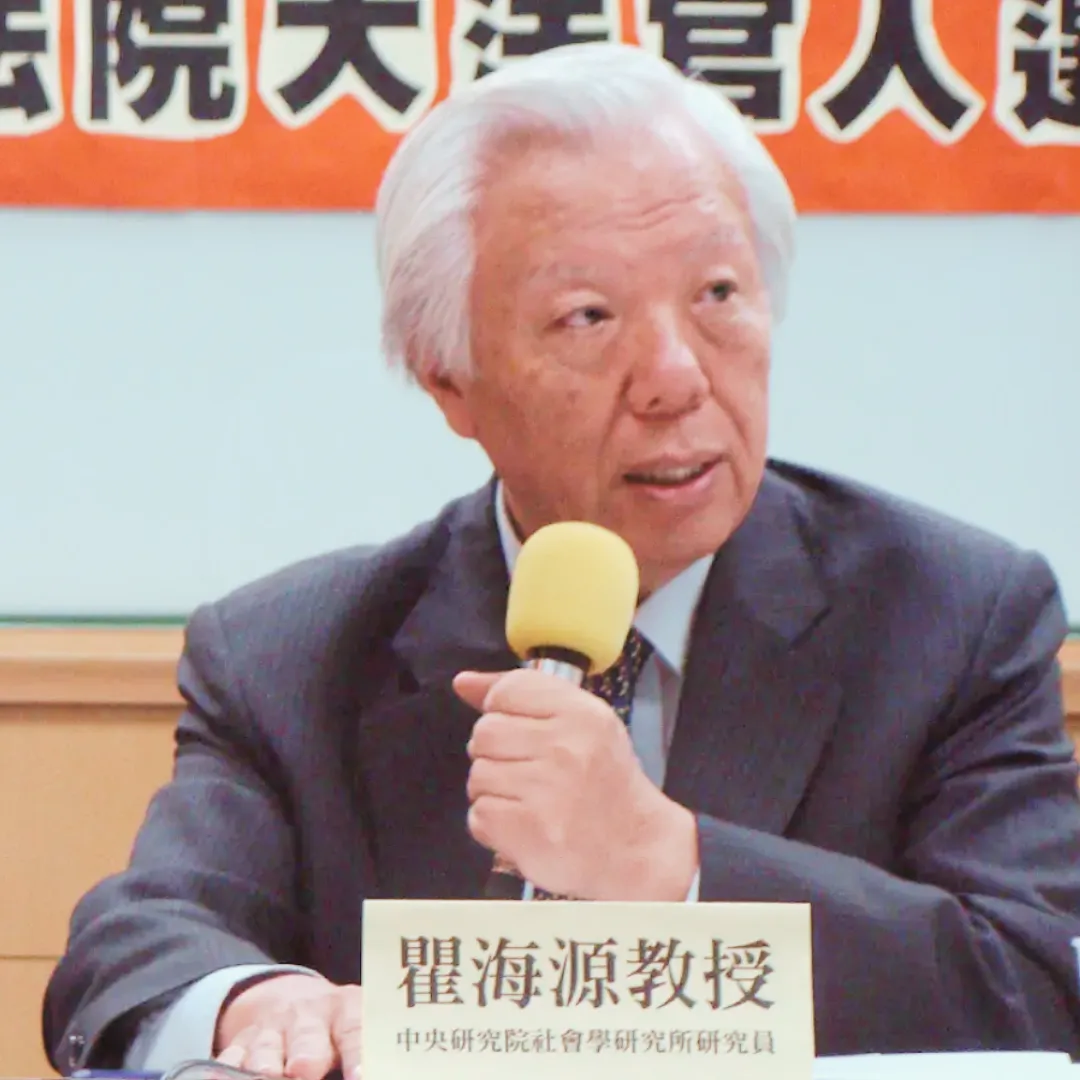
Professor Chiu Hai-yuan — "Wherever society has a problem, there you’ll be."
Professor Chiu Hai-yuan, a renowned Taiwanese sociologist, devoted his life to Taiwan’s democratic development, and his figure is not absent from the history of judicial reform. As JRF’s only Chair without a legal background, he brought his sociological expertise and deep public standing to the organization. A disciple of Professor Yang Kuo-shu and a founding member of the Taipei Society, Chiu joined JRF and became a key convener for its coalitions — on the "three judicial-reform laws," the abolition of the death penalty, and reform of the Grand Justices system. Colleagues praised how efficiently he chaired meetings, integrating differing views and driving decisions. He recalls the arduous push for the Judges Act and the Judicial Yuan Organization Act against resistance from across the political spectrum; the difficulty of advocating death-penalty abolition in a hostile public climate, including meetings with Presidents Chen Shui-bian and Ma Ying-jeou; and the civil-society alliance monitoring Grand Justice nominees. He recalls attorney Lin Yung-sung once joking, "Wherever society has a problem, there you’ll be," to which Chiu replied, "I see you there too" — a reflection of how those who care about society "meet again and again" in its fractures.
Attorney Chen Chuan-yueh — "Twenty-five years on, keep going"
From the 25th-anniversary interview. Attorney Chen Chuan-yueh, who accompanied JRF through its storms, reflected slowly and carefully: "Twenty-five years is no short time. JRF is now very stable, its foundations built, its work recognized by society — a comfort, and the result of everyone’s shared effort for judicial reform." Asked for his hopes, he said gently: "Judicial reform is many-sided and complex work. Though our two-plus decades of effort have borne some fruit, we must not be complacent; we should let these small results encourage us, unite, and continue. Every contribution, large or small, is meaningful."
Attorney Huang Hsu-tien — "Doing judicial reform makes me feel I’m alive alongside others."
Thirty years ago, a young lawyer three years into practice, Huang Hsu-tien felt unease at a judiciary that had not truly democratized after martial law’s end. A chance street meeting with attorney Lin Yung-sung — "Attorney Huang, we have a civil judicial-reform foundation, won’t you join?" — opened the door. Joining JRF gave him a space to voice his dissatisfaction and, he says, let him live and move forward alongside others rather than as a lone, powerless individual. His starting point was courtroom injustice: he recalls a prosecutor berating him merely for quietly explaining a question to a victim’s family. JRF’s court-observation program, with trained student volunteers recording judges’ conduct, improved courtroom behavior and became a form of rule-of-law education. Rule-of-law education is where Huang invested the most over thirty years: from the 1999 education group, through international exchanges with the United States and Japan, to adopting the "Foundations of Democracy" curriculum, which in 2011 spun off into a separate foundation. As Chair, he stresses that research and, above all, action are JRF’s core value: "Many people, as their knowledge grows, lose the courage to act." Looking ahead, he points to rationalizing the litigation system and reforming the selection and removal of judges, and asks why a country that excels in so much still struggles to earn public trust in its judiciary.
Attorney Lin Yung-sung — "I just want to ask: is this all Taiwan can be?"
For thirty years attorney Lin Yung-sung has walked beside JRF, starting from the people’s position to push reform forward. Drawn in by senior lawyers in 1994 to a staff group under the official reform committee, he and others, frustrated by the government’s empty gestures, helped found JRF — "civil" meaning rooted in what the people need. He led the 1997 "Walk for the Resurrection of Justice" march, the first time Taiwan’s lawyers took to the streets for the people’s rights, which helped bring about the 1999 National Judicial Reform Conference; the push for the Legal Aid Act, realized in 2003 to 2004; and the 2003 reform of the Code of Criminal Procedure, introducing cross-examination so judges no longer "played both player and referee." "The tears of those I represent are my motivation," he says. He recounts the wrongful-conviction cases that marked him — the execution of Lu Cheng despite grave doubts, which struck him deeply; the Taipower coal-purchase case he fought for over a decade; the RCA occupational-injury case, where novel arguments on causation and the "piercing the corporate veil" principle won partial victory; and his decade-plus helping credit-card debt victims organize and speak for themselves. He believes judicial fairness depends on whether ordinary people, especially the vulnerable, can feel the justice system protecting their rights.
Attorney Lin Feng-cheng — "To truly find the problem, go to the most painful place to fix it."
Before JRF, attorney Lin Feng-cheng worked at the Taiwan Association for Human Rights, where his involvement in the Su Chien-ho case connected him to JRF. He became CEO in 2007. He recalls the long push for the Judges Act and judge evaluation, finally passed in 2011 after two decades; the founding of the complaint center, turning individual grievances into evidence of structural problems and a basis for advocacy; the "pursuing bad prosecutors" project, using investigation recordings to expose misconduct and laying the ground for prosecutor evaluation; and the "lawyers can’t even protect themselves" case, after an investigator assaulted a lawyer. He highlights wrongful-conviction cases that changed institutions: the Chiang Kuo-ching case behind the Criminal Compensation Act; the Su Chien-ho case behind full audio-video recording of investigations, which greatly reduced torture; and the Hsu Tzu-chiang case behind the Criminal Speedy Trial Act. He stresses that JRF’s greatest asset is people and its hard-won credibility, and that reform should move from "treatment" to "prevention" — stopping new wrongful convictions before they happen.
Attorney Kao Yung-cheng — "Judicial reform is for ordinary people!"
Attorney Kao Yung-cheng recalls a "dark era" when judges openly berated lawyers and defendants. He came to JRF through the rule-of-law education group and "stepped in" as CEO after his predecessor fell ill. He shares memorable events: the Kingston donation that funded Taiwan’s first public-interest trust, which JRF administered as a model of selfless public benefit; the Cheng Chung-mo affair, on which he later reflected that private conduct should not be the main ground for questioning fitness for office; Interpretation No. 603 on the national fingerprint database, where JRF and others resisted a measure violating proportionality and privacy; Interpretation No. 582 in the Hsu Tzu-chiang case, which set limits on using co-defendants’ statements as evidence; and the ongoing advocacy on investigation confidentiality and media ethics, tied to the presumption of innocence. Now a Control Yuan member, he hopes that one day Taiwan will no longer need judicial reform — an advocacy group’s ultimate goal being "to abolish itself."
Attorney Huang Jui-ming — "It is because we live in a relatively free and democratic country that we can struggle together!"
A friend of JRF’s founders, attorney Huang Jui-ming deepened his involvement as Taipei Bar Association president and became Chair in 2007. He recalls the "three judicial-reform laws" coalition and the unfinished questions of whether the Judicial Yuan should become a true court and merge with the Supreme Court; the defense of lawyers’ rights — "if lawyers’ rights fall, criminal human rights fall" — some of which he later handled as a Grand Justice; and the need to raise standards for lawyer ethics and discipline. He also speaks of self-care in a donation-funded, high-pressure organization, recalling the "climb Yushan" fundraising activity he launched and his own long habit of running, including the Taipei Marathon at 64. He sees JRF as a vital asset of Taiwan, hoping it will keep its momentum, healthy and active, into the future.
Thirty Years of Judicial Reform: A Chronology
Founded in 1995, JRF was a key force behind the 1999 and 2017 National Judicial Reform Conferences, creating change from the bottom up through action. Its history runs through four phases. In the pioneering years from 1995 to 1999, it pursued case rescue, judge evaluation, and court observation, issued a reform blueprint, and led the 1019 "Walk for the Resurrection of Justice" march that helped convene the 1999 conference. In the deepening-reform years from 2000 to 2011 came the acquittal of Su Chien-ho and his two co-defendants — the first exoneration from a death sentence — the Legal Aid Act, and, after a long impasse, the Judges Act in 2011. In the expanding-influence years from 2012 to 2023, active participation in social movements helped bring about the 2017 reform conference. Looking ahead from 2024, new volunteer groups work on crime-victim protection, easing the judiciary’s workload, digital rule of law, and gender, alongside advocacy for a standing judicial-reform committee with civic participation.
Selected milestones: judicial-budget independence written into the Constitution in 1997; the acquittal and release of Su Chien-ho, Liu Bing-lang, and Chuang Lin-xun in 2003, after nearly 12 years in detention; the new Code of Criminal Procedure with cross-examination in 2003; the Legal Aid Act in 2003; Interpretation No. 582 in the Hsu Tzu-chiang case in 2004; Interpretation No. 670 behind the Criminal Compensation Act in 2010; the Judges Act and the founding of the complaint center in 2011; the retrial acquittal in the Chiang Kuo-ching case in 2011; Hsu Tzu-chiang’s release under the Criminal Speedy Trial Act in 2012 and final acquittal in 2016; the 318 Movement volunteer-lawyer platform in 2014; the amendment of Article 420 of the Code of Criminal Procedure easing retrial limits in 2015; the new investigation-confidentiality rules in 2019; amendment of the Prison Act and Detention Act in 2020; Interpretation No. 796 in 2020; the Citizen Judges Act taking effect in 2023; the major amendment of the Crime Victim Rights Protection Act in 2023; and the strategic litigation that paused the eID digital ID-card policy in 2023.
Support Our Work
If this work matters to you, please consider supporting the Judicial Reform Foundation with a regular or one-time gift, so that we can keep standing with the people and pressing for a judiciary worthy of their trust.
This article is an AI-generated translation of the original Chinese text. In the event of any discrepancy, the Chinese version shall prevail.