
JRF Newsletter: June 2023
REST — the Kao Chung-ming Hong Kong Photography Exhibition
Last edited: 2026-10-24
Foreword
In recent years, many advocacy groups have begun to tell their issues through exhibitions. Curating is itself a profession, and many groups choose to work with curatorial companies. For its first few exhibitions, JRF did everything in-house with no outsourcing at all; only with "REST — the Kao Chung-ming Photography Exhibition" did we first work with an outside curatorial team, while still actively keeping room to arrange our own accompanying events during the show. In the process we came to feel that curating is itself a movement: drawing people in, reshaping and communicating values internally, and the flexibility and energy of capacity-building and translation are all gains. Through the three perspectives of curator, teacher, and a Hong Konger living in Taiwan, this issue takes us from a social movement to an exhibition, to the educational front line, and back to the movement itself. "REST" is not merely one more exhibition JRF has held; its aftertaste will take root in our hearts, and though its meaning may not show at this moment, one day we will embody the value it conveys and keep telling it to ever more distant places — until we meet Hong Kong again.
Part One: Making an Exhibition the Beginning and Continuation of a Movement — JRF Taichung’s Curatorial Method
Text by Hsieh Chia-chen; photos by Li Chao-yen and Hsieh Chia-chen.
At first, exhibitions were just one of our tools for advocacy, but as the number and variety of shows grew, we came to feel that curating is itself a movement, and that drawing people in, reshaping values, and building capacity are all gains.
Step zero: building consensus. When JRF plans an exhibition, it differs greatly from art-centered curating: the theme must extend from the issues JRF cares about. Past shows — "Light of the Sea and Sky: Chiou Ho-shun’s Forgotten 32 Years, Taichung Special"; "No Such Person: the 7th-anniversary exhibition on the 324 Executive Yuan violent eviction"; "Grandma’s House in Taichung: a peace and women’s human-rights special," made with the Garden of Hope Foundation; the then-current "Challengers in a Nation of Fraud"; and this issue’s "REST" — are all tightly tied to our issues. For "REST," building consensus meant long internal discussion: Why exhibit a Hong Kong issue? Do we share Kao Chung-ming’s stance? Will our audience accept it? Three years on from the movement, does anyone still care? These questions have no absolute answers, but JRF had one clear direction: to keep paying attention to and advocating for Hong Kong’s human rights. The consensus stage was the most laborious, demanding constant communication across department, full-staff, and standing-committee meetings.
Step one: advance planning. Once the theme is set, planning accelerates: the overall schedule, budget, partners, and the core idea to convey. JRF now runs exhibitions in roughly half-year seasons, which gives visitors more freedom to choose when to come, spreads out attendance, and keeps the workload manageable for the Taichung office’s three staff. Scheduling also covers installation, publicity, and the talk series; the budget covers venue painting and carpentry, props and printing, transport and insurance, and later speaker and travel fees. Partnerships gave each show a synergy — local groups and schools for "Light of the Sea and Sky," a lawyer-led core team for "No Such Person," and the Garden of Hope’s exhibits for "Grandma’s House." For "REST," besides photographer Kao Chung-ming, we invited film-art designer Li Tien-chueh to co-curate; combining their visual interpretation with JRF’s venue and issues produced a show unlike any before, with little text but the strongest impact, letting the works speak for themselves.
Step two: execution and accompanying plans. Turning JRF’s issues into an exhibition takes at least half a year of gathering and translating material. In the Taichung office, Hsu Tzu-chiang — whom everyone calls Brother Chiang — is vital to every build: fixing partitions, rewiring, and complex carpentry, from the mock visiting room and mock prison in "Light of the Sea and Sky" to the water cannon in "No Such Person" and the mock courtroom and ATM in "Challengers in a Nation of Fraud." For "REST," Li Tien-chueh’s design was matched to Kao Chung-ming’s photographs across the four-story venue: the first floor’s "A Revolution of Our Times" used bold wall colors; the basement’s "Hong Kong Wounds" used light and black lines for an abstract expression of the predicament and redemption of the Hong Kong issue; and the fourth floor used two rooms to extend the "illusion of home" and to show the streets of Hong Kong. Most memorable was the second-floor smoke experience, simulating the tear gas of the protests: as the smoke thickened, the faint yellow light turned orange, the works blurred, and visitors lost their sense of direction, feeling the fear we hoped to convey.
Step three: after opening. Beyond the opening press event, publicity is essential — social media, printed materials, trailers, and cooperation with friendly groups and shops. We also use the electronic document system to send the latest news to schools nationwide, especially senior-high, vocational, and tertiary schools in central Taiwan, mailing posters to teachers who bring their classes. Since the 108 curriculum, teachers have more flexibility to build exhibition visits into their courses. A complete exhibition is no easy feat, needing much labor and time; but as the shows multiplied and participation grew, they became a bridge for conveying issues, helping local residents begin to understand the field of justice. As JRF, we bear a social responsibility to give Taiwan a judiciary worthy of the people’s trust; beyond policy and institutional change, rule-of-law education and advocacy matter just as much.
Part Two: Condensation and Rebirth — A Hong Konger in Taiwan Views "REST"
Text by Tsai Shang-heng; photos by Li Chao-yen.
"Farewell to Hong Kong — the phrase holds so much: a true farewell, or the hope of meeting again." Four years after the anti-extradition movement, many Hong Kongers have long since left home to live elsewhere, their new lives layered over old memories. In "REST," Kao Chung-ming uses his lens to ask: after the Hong Kong National Security Law, what became of those who left? How do they look back on the 2019 movement? Light, a pseudonym, took part in the 2019 street protests, suffered violence and arrest by the Hong Kong police, and later moved to Taiwan. Before the rain-soaked 34th-anniversary memorial for June Fourth, we met Light at a corner of Liberty Square to talk about how Kao’s lens mirrors Light’s memories of Hong Kong’s wounds.
On home, and the longing and pain of Hong Kong. The exhibition opens with a "home" setting — sofas, a tea table, and portraits of Hong Kongers in Taiwan. Light said the portraits are like a window: outside is a beautiful view, yet the person within sits alone, their face blurred. "Our home is Hong Kong. It looks comfortable, the view outside is lovely, but the people inside are not — they are still there in pain." After the movement and the security law, Hong Kong returned to the world’s eyes in a prosperous guise, yet its people seem frozen in the suffering of 2019. Longing for home is hard to put down, but with the political situation changed, home can no longer be returned to, only compressed into words and imagination.
Wounds woven into body and mind. Downstairs, in a dark space, tangled cords bind photographs of injured bodies. "The harm was not only psychological; there was physical, bodily harm too." Light explained that tear-gas rounds are not mere smoke but chemicals at 300 to 400 degrees that rot the skin; water-cannon fluid sticks clothing to the skin and corrodes it, leaving scars; batons drew blood; rubber bullets lodged in flesh and shattered bone. Seeing the tangled web, Light felt it linked "everyone’s wounds" from 2019 — Hong Kong’s wounds are the collective pain-memory of a whole society.
Violent trauma re-staged in smoke. "I lasted maybe ten-odd seconds, then gave up — the emotion rose too fast. Even just the smell of the smoke machine, without the tear gas, was too heavy for me, visually and aurally." On the second floor, the simulated protest smoke returned Light to the scene. "Leaving" was the only instinct. The heavy emotion recalled the tension of the protest and the pain of police attack. Light said that at the scene "there was never a moment to relax — you never knew when the plainclothes officer beside you would seize you." The trauma did not vanish with the movement but seeped into daily life: "When I wait at a crossing and the light turns red with that beeping, I grow tense." As a line from the film "Detention" puts it, "Have you forgotten, or are you afraid to remember?" Light said: "I’m just afraid to remember it — but I will not forget."
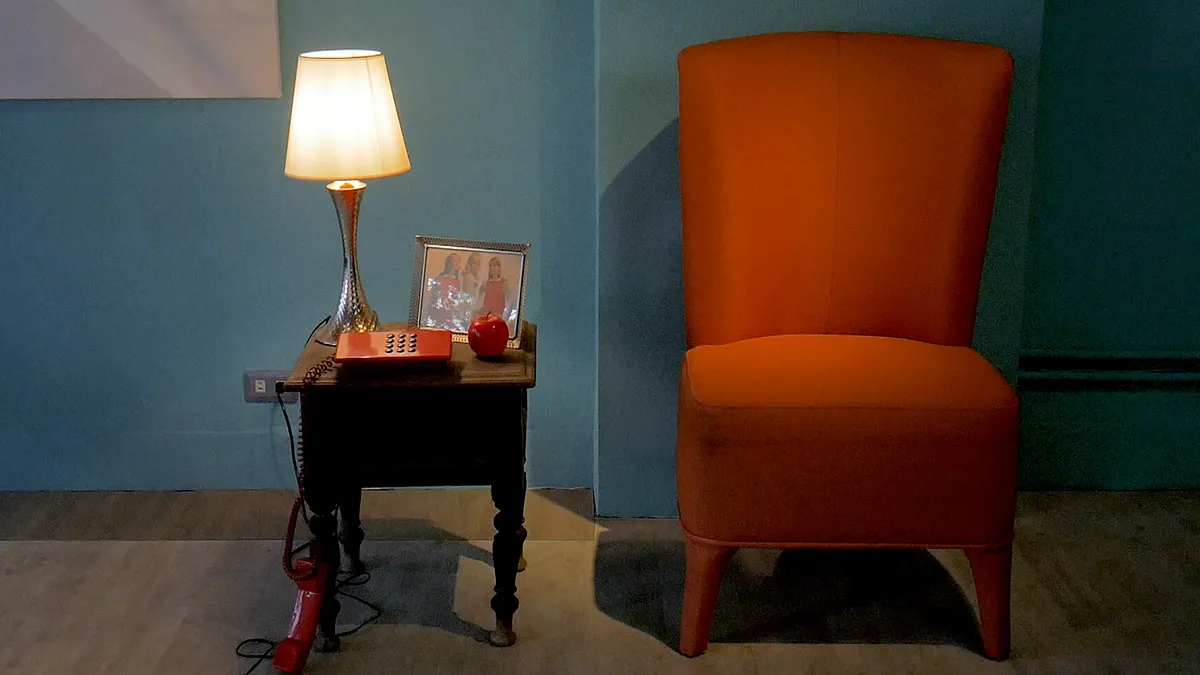
A Revolution of Our Times — what became of everyday Hong Kong? On the fourth floor stand the bed frames found in every Hong Kong home, holding everyday objects all in "China red," with red apples scattered on the floor — Light’s favorite area, showing how China has filled all of Hong Kong, the apples like blood across the ground, echoing the vanished Apple Daily. In another dark room, "Chronic Hong Kong Wounds," black-and-white photos of Hong Kong and Taiwan cover the walls around a single bed, evoking the feelings of Hong Kongers seeking refuge in Taiwan. Through a small hole left in the darkness, light enters — and the view beyond turns out to be Taiwan’s "Zhonggang Road," the knot of Taiwan, Hong Kong, and China that these exiles cannot untie.
Condensation and rebirth: meeting Hong Kong again. The 2020 pandemic froze Hong Kong’s social life in an instant, and the protests faded with it, while the pain condensed in people’s bodies and minds. Four years on, the wounds are not healed, yet in Light we see Hong Kongers, in their separate lives, still rich in courage and faith in freedom, reborn — hoping to meet Hong Kong again.
Part Three: Letting the Exhibition Become My Classroom — an Interview with Teacher Lai Wen-chi
Interviewee: Lai Wen-chi, civics teacher at Wenhua High School. Text by Hsieh Chia-chen; photos by Li Pei-chen and Hsieh Chia-chen.
Lai Wen-chi teaches an eleventh-grade elective on refugees, "Movement and Flux under Globalization." Her own spouse is a Tibetan in exile, so she has many personal views on refugee issues, and this year she wanted to deepen students’ understanding of Hong Kong. She learned of "REST" through Facebook and a fellow teacher close to JRF, and attended the opening, where she heard photographer Kao Chung-ming speak.
She brought students out of the classroom because a photography exhibition has strong impact — she could not take them to Hong Kong, and the show was more vivid than text or online material. Transport was easy, close to school by metro, needing only two class periods and no leave, and students enjoy the chance to step outside on a weekday. On whether the exhibition’s themes — state violence, defending freedom and democracy — were too controversial for high-schoolers, she said that in class she does not rebut students but guides their thinking. Many recalled that, as ninth-graders, they had felt anger at how the government treated Hong Kongers, and the exhibition and related course answered the questions they had not understood; visiting in person and talking with real witnesses resonated far more than online information.
The exhibit that struck her most was the third floor’s "Chronic Hong Kong Wounds" — a small room that felt oppressive and isolating, with almost no people in the photos, leaving a sense of emptiness. She said that, were it not for the course, she might never attend such an exhibition again — a measure of its power. As for what she hoped students would gain: some began with little interest but, through the course, grew interested in the Hong Kong issue, and several final-project teams chose Hong Kong-related topics, from tear-gas weapons to the use of technology in the movement, some asking how they could take part in further action.
On her role as a teacher, Lai said an educator can plan and guide discussion of issues, and that teachers are moved by issues they care about; weaving them into courses, especially history, strengthens teaching. As someone with a hearing impairment, she has higher-than-average observation and empathy. In the classroom, she believes caring for students’ lives matters most: "Let them first be a person, and only then their other identities — just as I am first a person, and then a teacher."
Support Our Work
If this work matters to you, please consider supporting the Judicial Reform Foundation with a regular or one-time gift, so that we can keep standing with the people and pressing for a judiciary worthy of their trust.
This article is an AI-generated translation of the original Chinese text. In the event of any discrepancy, the Chinese version shall prevail.