
Press Release | As China’s Transnational Repression Escalates, Lawmakers and Government Urged to Introduce Foreign Agent Legislation and Strengthen Taiwan’s Anti-Infiltration Framework
Last edited: 2026-11-03
Comedian Huang Yi-hao has performed xiangsheng, a traditional form of Chinese comic dialogue, satirising Chinese President Xi Jinping. In May 2026, Taipei’s Comedy Club was attacked with faeces and paint. In September, Huang was struck and injured by a vehicle before a performance.
On October 21, the New Taipei District Prosecutors’ Office announced that it had indicted five people on charges including attempted infliction of serious physical injury and violations of the Personal Data Protection Act. Prosecutors alleged that, in an act of transnational repression, individuals linked to the Chinese Communist Party (CCP) had financed and directed people in Taiwan to lie in wait, conduct surveillance and deliberately drive into Huang, disguising the attack as a traffic accident to prevent him from performing.
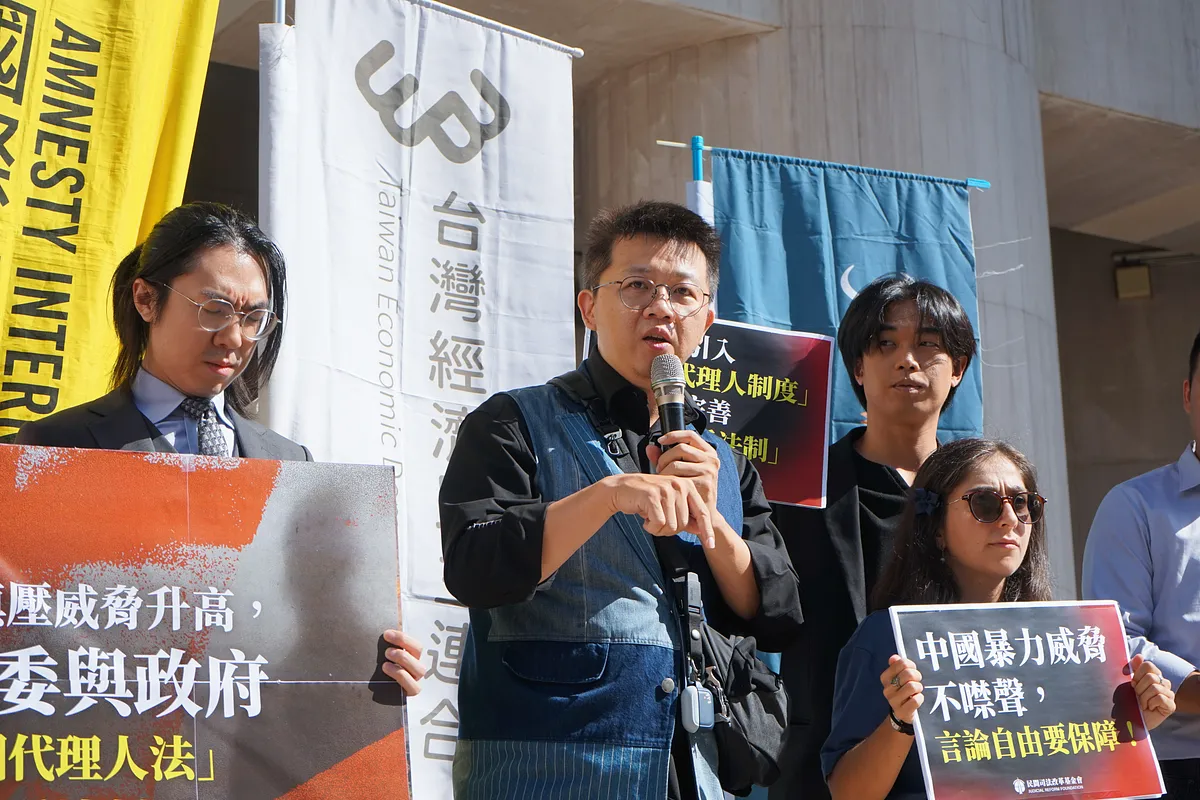
On October 30, the Judicial Reform Foundation (JRF) held a press conference with Huang, legislators Chen Chao-tzu and Huang Jie, and representatives of the Human Rights Network for Tibet and Taiwan, the New School for Democracy, Amnesty International Taiwan and the Economic Democracy Union.
Participants urged the government to confront transnational repression by amending the Anti-Infiltration Act to cover acts of repression that violate individual rights, considering a foreign agent registration system, and strengthening protection and support for targeted communities.
“Transnational repression is more than a national security or political issue. It is a human rights issue,” said JRF Executive Director Lee Ming-ju.
A Growing Pattern of Repression, with an Expanding Range of Targets
From the attack on Akio Yaita and the surveillance and filming of legislator Puma Shen to the vehicle attack on Huang Yi-hao, cases of China’s transnational repression in Taiwan are multiplying.
Legislator Huang Jie said these cases followed the same pattern: foreign actors commissioning violence, surveillance and harassment against critics in another country. “And the tactics are escalating,” she said.
The threats extend beyond Taiwanese citizens to Hongkongers and Tibetans living in Taiwan.
Ivan Choi, a Hong Kong activist and project manager at the New School for Democracy, said that even after arriving in Taiwan, he had been followed and covertly photographed, and his personal information had been leaked. The organisation’s events had also been subjected to covert filming and surveillance, and it had received bomb threats.
Tashi Tsering, secretary-general of the Human Rights Network for Tibet and Taiwan, said the CCP had long threatened Tibetans by invoking the safety of their families. This year, the Central Tibetan Administration’s representative office in South Africa had also faced petrol-bomb threats and an arson attack.
Sandrine Fontaine, China Research and Policy Officer at Amnesty International Taiwan, noted that Amnesty’s 2024 research had documented how the Chinese and Hong Kong governments repress individuals and communities abroad, particularly Chinese and Hong Kong students at universities in Europe and North America.
Similar incidents have emerged in Taiwan in recent years: paint and excrement thrown at the Comedy Club; two red-paint attacks on the Muay Thai gym run by Hong Kong activist Fu Tong; and the physical attack on Huang Yi-hao. These cases demonstrate that transnational repression is a reality within Taiwanese society.
“Transnational repression cannot be treated solely as a national security issue. It is, first and foremost, a human rights issue,” Fontaine said. Its chilling effect, she warned, constricts the space for civil society as a whole.
Gaps in Existing Law Hinder Proactive Investigations and Accountability for Those Behind the Attacks
Huang Yi-hao said he initially believed he had been involved in an ordinary traffic accident.
“If I had not filed a criminal complaint, the police would have had little scope to act,” he said, pointing to the lack of a legal basis for proactive police intervention and investigation of the financial trail.
Huang Jie added that, had the National Police Agency not recognised the unusual circumstances, the case might have been treated as an ordinary traffic accident and resolved through a settlement.
“We do not want the identification of future cases of transnational repression to depend on luck or an individual officer’s vigilance,” she said.
Lawyer Sung Yi-hsiu, a member of JRF’s research project on transnational repression, explained that ordinary criminal offences—including bodily injury, intimidation and unlawful collection of personal data—are designed to punish individual criminal conduct. They do not adequately capture the character of human rights violations orchestrated by another state. The Stalking and Harassment Prevention Act likewise does not address harassment unrelated to sex or gender.
A narrow legal framework can also prevent investigators from recognising the transnational repression behind an apparently isolated incident.
More fundamentally, punishing the people who carry out an attack often does little to resolve the underlying threat.
“To an authoritarian state, people are expendable,” Sung said. “It can send one person to carry out an attack today and another tomorrow.”
These institutional gaps can leave people at heightened risk living in constant fear.
Chen You-wei, deputy secretary-general of the Economic Democracy Union, said tracing cross-border financial flows through multiple layers designed to obscure their origins requires considerable time. Yet, for performance assessment purposes, such an investigation counts as just “one case,” no differently from an ordinary traffic accident. This can encourage investigations to stop with low-level perpetrators rather than pursue those directing them.
The Economic Democracy Union therefore recommended that the Ministry of Justice give transnational repression cases greater weight in prosecutors’ performance assessments, allowing prosecutors more scope to trace responsibility up the chain.
Because these assessment rules fall within the ministry’s administrative authority, the change could be implemented without waiting for legislative amendments. It could also encourage chief prosecutors to mobilise resources across their offices for such investigations.
As methods of repression become increasingly violent and reliant on organised crime, the group also recommended providing security assistance, where necessary, to judges hearing transnational repression and Anti-Infiltration Act cases, ensuring institutional support for judicial personnel on the front line.
Legislative Delays Must End—and Protection Must Put Victims First
Legislator Chen Chao-tzu said proposed amendments to the National Security Act and the Anti-Infiltration Act had been stalled in the Internal Administration Committee for approximately six months and ten months, respectively. She urged the committee’s conveners to schedule their consideration without delay.
Chen had also scheduled a special report on transnational repression before the Judiciary and Organic Laws and Statutes Committee for the following Thursday, November 5.
Huang Jie said her proposed amendments to the Anti-Infiltration Act already covered surveillance, harassment, bodily injury and violence. She called for swift action to close the gaps in the law.
She also urged the Ministry of the Interior to strengthen safeguards at the point of entry. Given the CCP’s practice of commissioning Hong Kong gang members to enter Taiwan, carry out an assignment and leave quickly, she called for preventive measures directed at individuals presenting a high risk.
On protection, Sung stressed the need to begin with victims’ experiences: establish accessible channels for seeking help, reporting mechanisms and support through cooperation between public authorities and civil society, while strengthening training for frontline police officers.
Choi cautioned that protection must actually reach those under threat, including people who have not yet acquired citizenship. Risk assessments must also rest on concrete evidence.
“Being from Hong Kong cannot, in itself, be treated as evidence that someone poses a danger,” he said.
Fontaine noted that the Executive Yuan, Mainland Affairs Council and Ministry of Justice had all indicated that response measures would be established. Nevertheless, the existing framework—centred on national security and relying primarily on criminal punishment—remained insufficient to protect potential victims or ensure that everyone in Taiwan could safely exercise their freedoms of expression, assembly and association.
She called for a victim-centred reporting and support system, sustained by adequate resources and professional expertise. Cooperation between government, civil society and academic institutions should enable the collection and analysis of case data, the early identification of risks, and meaningful input from civil society and victims themselves.
Strengthen the Anti-Infiltration Framework and Make Taiwan a Safe Haven for Those Facing Repression
JRF urges lawmakers and the government to advance the necessary legislative amendments and preventive measures without delay:
- Amend the Anti-Infiltration Act to cover acts of repression that violate individual rights, and consider introducing a foreign agent registration system.
- Strengthen protection and support for targeted communities through effective reporting mechanisms, coordinated resources, personnel training and cooperation between public authorities and civil society.
JRF emphasises that transnational repression is both a national security concern and a serious violation of human rights. Only by placing freedom, democracy and human rights at the centre of its response can Taiwan become a true safe haven for those facing repression, rather than a place where China’s authoritarian apparatus can extend its reach and intimidate people.
Press Conference
Date and time: Friday, October 30, 2026, at 9:30 a.m.
Venue: Qunxian Building, No. 1, Section 1, Jinan Road, Xingfu Village, Zhongzheng District, Taipei
Speakers, in Order of Remarks
- Lee Ming-ju — Executive Director, Judicial Reform Foundation
- Huang Yi-hao — Xiangsheng performer
- Chen Chao-tzu — Legislator
- Tashi Tsering — Secretary-General, Human Rights Network for Tibet and Taiwan
- Ivan Choi — Hong Kong activist; Project Manager, New School for Democracy
- Huang Jie — Legislator
- Sung Yi-hsiu — Lawyer; member of JRF’s research project on transnational repression
- Sandrine Fontaine — China Research and Policy Officer, Amnesty International Taiwan
- Chen You-wei — Deputy Secretary-General, Economic Democracy Union
Media Contact
Tsai Meng-chu (Mido)
Advocacy Officer, Judicial Reform Foundation
Tel: 02-2523-1178, ext. 29
Email: mido@jrf.org.tw
Video link
This article is an AI-generated translation of the original Chinese text. In the event of any discrepancy, the Chinese version shall prevail.
TNR