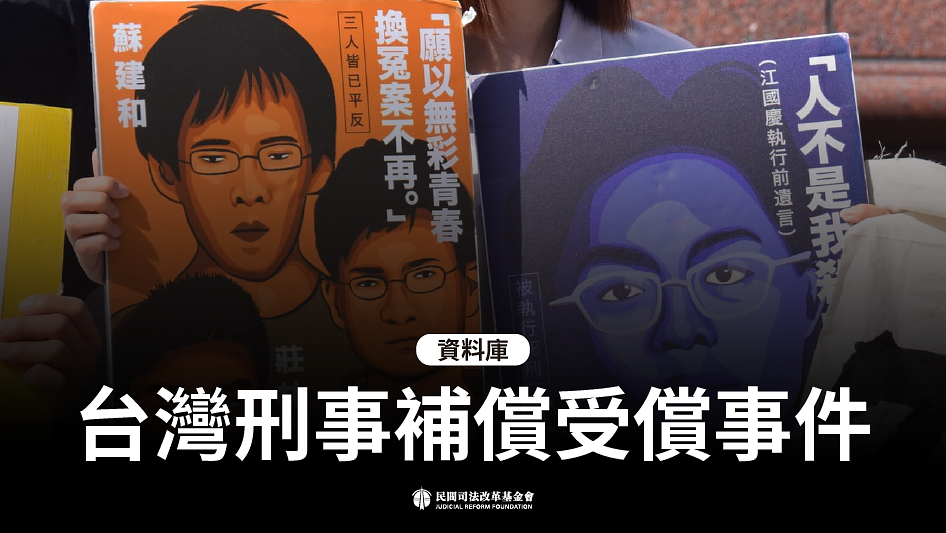
Taiwan Criminal Compensation Database
Taiwan Criminal Compensation Recipients Database
The Criminal Compensation Act is a law designed to remedy innocent victims of criminal proceedings. Over the past 12 years, how many cases have the courts compensated, how many victims were there, and how much budget was spent on wrongful imprisonment compensation? This database compiles all compensation-granted cases from 2011 to 2023, making the answers clear at a glance.
What is the Criminal Compensation Act?
The Criminal Compensation Act (named the Law of Compensation for Wrongful Detention prior to the 2011 amendment) is a law designed to remedy innocent victims of criminal prosecution. Pursuant to Articles 1, 2, and 6 of the Criminal Compensation Act, victims who suffered wrongful detention during criminal prosecution may petition the state for compensation. In principle, for every day of detention suffered, NT$3,000 to NT$5,000 in compensation may be awarded.
However, over the past decade or so, pursuant to Article 7 of the former Criminal Compensation Act (effective period: September 1, 2011 to December 16, 2018, now deleted), when a victim was deemed to have an "attributable cause" and the original compensation standard was evidently excessive, the daily compensation was accordingly reduced to NT$1,000 to NT$3,000.
In practice judgments, the so-called "attributable cause" frequently manifested in incomprehensible situations. For instance, during interrogation, if someone had confessed, the court might use "confessing to the offense" or "inconsistent statements" as an "attributable cause" to reduce compensation, while completely ignoring the possibility that the victim's "confession" was the result of torture. These circumstances often caused secondary victimization to the victims.
Taking the widely known Su Chien-ho Case as an example, the court disregarded the fact that Su Chien-ho and the other two defendants confessed due to "torture," and instead used their confessions as a reason to reduce their daily compensation to NT$1,200 and NT$1,300. There could be no greater humiliation by the state toward victims of wrongful convictions. (This controversy was dismissed by Constitutional Court Ruling No. 149 of 2023.)
Fortunately, the aforementioned provision was deleted in the 2024 amendment to the Criminal Compensation Act. However, this amendment failed to address the injustice suffered by victims whose compensation was reduced under this provision over the past decade or so.
To understand the true circumstances of compensation received by victims of wrongful convictions, our Foundation collaborated with journalist Meng Chia-mei to build the "Taiwan Criminal Compensation Recipients Database", compiling all compensation-granted cases during the effective period of the former Criminal Compensation Act (September 1, 2011 to December 16, 2023).
Overview of Wrongful Conviction Compensation
Statistical Period: September 1, 2011 to December 16, 2023 (12 years and 105 days)
Ordinary Courts
Accepted a total of 3,610 cases during the statistical period; 1,273 cases were dismissed; total compensation disbursed amounted to over NT$524.78 million.
Querying the judgment retrieval system, compensated cases totaled 1,220 persons (compared to Judicial Yuan statistics, 81 persons' decision documents were not published; 38 persons petitioned during the old law period and were thus excluded from Judicial Yuan statistics).
Among publicly queried cases, a total of 289 persons (approx. 22%) had their compensation reduced due to an "attributable cause" under Article 7 of the former law.
Military Courts and Military Prosecutor's Offices
Excluding 13 cases transferred to other agencies, there were 102 cases in total during the statistical period; total compensation disbursed amounted to over NT$119.55 million.
Among the 17 victims, 10 had their compensation reduced (accounting for 59%).
Prosecutors' Offices
Data is incomplete (decision documents were not fully published, and some agencies such as the Taipei and Taichung District Prosecutors' Offices have no data. However, the remarks column of decisions rendered by the Criminal Compensation Division of the Judicial Yuan shows that the subject matters of their review events were criminal compensation decisions rendered by the Taipei and Taichung Prosecutors' Offices, but these were not published).
Among the 26 victims, 19 had their compensation reduced (accounting for 73%); total compensation disbursed amounted to NT$3,401,000.
Distribution of Original Case Causes (Top Three)
| Rank | Cause of Action | Number of Persons | Percentage |
|---|---|---|---|
| 1st | Corruption | 343 persons | 27.1% |
| 2nd | Drugs | 294 persons | 23.2% |
| 3rd | Fraud | 130 persons | 10.2% |
The 2024 amendment failed to address the injustice suffered by victims whose compensation was reduced under the "attributable cause" provision over the past decade or so.
── Judicial Reform FoundationData Sources and Retrieval Methods
For a detailed description of the retrieval methods for this database, please refer to the attached explanatory document.
Ordinary Courts
- Judicial Yuan Judgment System (Courts: 1,254 cases; Prosecutors' Offices: 3 cases)
- District Court Criminal Compensation Cases Receipt, Settlement, and Conclusion Table
- High Court Criminal Compensation Cases Receipt, Settlement, and Conclusion Table
- Supreme Court Criminal Compensation Cases Conclusion Table
Military Courts, Military Prosecutor's Offices, and Prosecutors' Offices
- Executive Yuan Gazette Information Net (Military Courts and Military Prosecutor's Offices: 17 cases; Prosecutors' Offices: 23 cases)
- Ministry of National Defense Criminal Compensation Cases Inventory for Military Courts and Prosecutor's Offices at all levels (provided by the Legal Affairs Directorate of the Ministry of National Defense)
- Database Retrieval Period Scope: September 1, 2011 to December 16, 2023 (i.e., the effective period prior to the amendment of the Criminal Compensation Act). After the President promulgated the amended provisions on December 15, 2023, Article 7 was deleted. See the Judicial Yuan Press Release for details.
- Regarding Missing Prosecutors' Office Data: Since prosecutors' office decisions are not included in the Judicial Yuan Judgment System, searches were conducted using the Executive Yuan Gazette Information Net; however, as it did not publish all events, some data from the prosecutors' offices is missing (e.g., decisions from the Taipei and Taichung District Prosecutors' Offices were not found).
- Counting Method: Since a single event may involve compensation for more than two victims, and the circumstances of different victims may vary, this database uses the number of victims as the counting unit, totaling 1,263 persons (Ordinary Courts 1,220 persons + Military Courts and Military Prosecutor's Offices 17 persons + Prosecutors' Offices 26 persons).
- Numbering Logic: Ordered by the deciding agency, followed by the case number characters; decisions across different instances are regarded as the same event, but their decision contents are placed separately in the "Remarks" column.
- For other special circumstances, please refer to the remarks column in the database.
Author: Meng Chia-mei
Database Contributors: Liao Wei-cheng, Lü Cheng-yen, Ch'en You-chia, Yeh Yu-jou, Hsieh Hsin-hua, Huang Yu-chieh, Wang Ruo-chin
Acknowledgements: Special thanks to the Judicial Yuan and the Legal Affairs Directorate of the Ministry of National Defense for taking the time to assist in providing data for statistical purposes.
Unfinished Business in the Reform of the Criminal Compensation Act
A database is not merely a presentation of numbers, but also the starting point for judicial reform. Below are four reform recommendations proposed by our Foundation regarding the Criminal Compensation Act:
Remedy Those Whose Compensation Was Improperly Reduced in the Past
The December 2023 amendment deleting Article 7 was well-intentioned, but it lacked remedial measures for individuals whose compensation was reduced in the past, causing secondary victimization. Our Foundation recommends adding grounds for retrial in future amendments to provide relief.
Add Compensation Grounds for Non-Personal Liberty Deprivations
Other criminal compensation grounds not involving the restriction of personal liberty (involving major losses to personality legal interests other than personal liberty) were not passed in this amendment. Our Foundation calls for promptly restarting amendments to protect the full rights of persons innocent of criminal prosecution.
Decision Documents Should Be Published and a Retrieval System Built
Our Foundation recommends that criminal compensation decisions rendered by various prosecutors' offices, military courts, and military prosecutor's offices be published, and a retrieval system be established mirroring ordinary court judgments to implement transparency and accountability.
Implement Investigations into Causes of Criminal Miscarriages of Justice
Article 27-1, passed in the December 2023 amendment, requires the Judicial Yuan to conduct investigations and analyses into the causes of miscarriages of justice after compensation is finalized. Our Foundation calls on the Judicial Yuan to implement this provision and regularly publish investigation and research reports.
Further Reading and Acknowledgements
Special thanks to journalist Meng Chia-mei for her dedication and attention to this issue, independently organizing most of the content of this database and providing raw data to assist our Foundation in completing the database.
In-depth reports written by Meng Chia-mei in The Reporter:
〈12 Years of Criminal Compensation Act Amendments (Part 1): Judicial Miscarriages—How Is Deprived Freedom Priced in Money?〉
〈12 Years of Criminal Compensation Act Amendments (Part 2): "Innocence Is No Longer Possible"—Inside the Cage of Trauma, Wrongful Conviction Survivors Await Judicial Empathy〉
These two reports provide a profound depiction of the judicial harshness caused by the reduction of compensation based on attributable causes within the criminal compensation system, and members of this project were deeply inspired during their research on this issue.
We also sincerely thank the Judicial Yuan and the Legal Affairs Directorate of the Ministry of National Defense for taking the time to assist in providing data for statistical purposes.