
Judicial and Prosecutorial Authorities Must Bear the Responsibility of Self-Supervision! A Manual on Institutional Supervision under the Judges Act
Last edited: 2026-08-25
A Judge Calls to Consult on How to Rule During a Hearing, Leaving Parties Flabbergasted!
On August 29, 2012, the Judge Evaluation Commission adopted Resolution No. 3 (2012), referring a judge surnamed Li to the Control Yuan through the Judicial Yuan for review, and recommending a six-month suspension from office. This case arose after a party published an open letter to the media in protest, prompting the Judicial Self-Governance Committee of the New Taipei District Court to conduct an investigation. It found that this judge had made a phone call during a court hearing to her husband (who also served as a judge) to ask how the case should be decided, and made sarcastic remarks to the party, thereby violating litigation regulations and judicial ethics. Consequently, the Judicial Yuan submitted a request for evaluation against Judge Li.
Live Proceeding Excerpts Listed in the Evaluation Request Form
- 00 min 44 sec
- "How long are you people going to drag out a tiny lease case."
- 03 min 12 sec
- "As a matter of law, you are not to speak."
- 08 min 33 sec
- "You people don't understand the law yourselves."
- 08 min 54 sec
- "We are talking about the law. If you don't understand, please shut your mouths."
- 10 min 51 sec
- "Stop talking! I understand! How many times do we have to repeat the same thing!"
- 11 min 12 sec
- "My husband is more capable, let's try again."
- 12 min 02 sec
- "(Talking on the phone with Judge Hsieh [omitted] during the hearing) So your case regarding the payment of rent will be established, and will my case regarding the return of the security deposit be established? Right here, the plaintiff's claim is dismissed, so your side will rule in favor of the plaintiff."
- 19 min 50 sec
- "Did you stipulate it in the contract? That contract of yours is really written very poorly, you didn't even write down a one-month penalty, humph."
- 21 min 52 sec
- "Otherwise, let Judge Jen-compartment handle it again, he is more capable than me."
The remarks made by the judge under evaluation during the hearing were at times high-pitched and at times flippant. During the proceedings, when the plaintiff in this case felt aggrieved and began to sob, the judge under evaluation, at 10 minutes and 39 seconds of the hearing recording, mocked the tone of the aggrieved party by saying: "Now the main point is stuck on you... stuck on you not returning the keys."
Statutory Duty of Self-Supervision by Judicial Authorities
Judicial authorities bear the responsibility of self-supervision regarding incompetent judges. The court to which an incompetent judge belongs, as well as its superior authority, has the competence to submit a request for individual evaluation against said judge (Article 35 of the Judges Act). Furthermore, the president of the court to which the judge belongs also has the competence to exercise official supervision over them (Articles 19 to 22 of the Judges Act); the Judicial Self-Governance Committee of that court may also investigate and deliberate upon them (refer to the Implementation Measures for Judicial Self-Governance in Courts at All Levels). Therefore, aside from reporting incompetent individuals to their affiliated courts, members of the public may also report them directly to the Judicial Yuan.
However, some citizens have reported to the JRF that when they directly reported incompetent judges to the Judicial Yuan, their cases were summarily dismissed on procedural grounds. Upon our understanding, we found this might be because the format of the reports submitted by the citizens was incorrect, leading the Judicial Yuan to directly distribute the relevant reporting documents to the Judge Evaluation Commission for handling during internal case allocation. Because members of the public cannot directly submit evaluation requests to the Judge Evaluation Commission, such reports are directly dismissed on procedural grounds and closed. The way to avoid the aforementioned situation is to download the "Petition for Individual Evaluation of Judges" template provided by the Judicial Yuan, fill it out according to the template, attach the relevant evidence, and mail it to the Judicial Yuan.
Prosecutor Loses Emotional Control: Who Defends the Defendant's Rights?
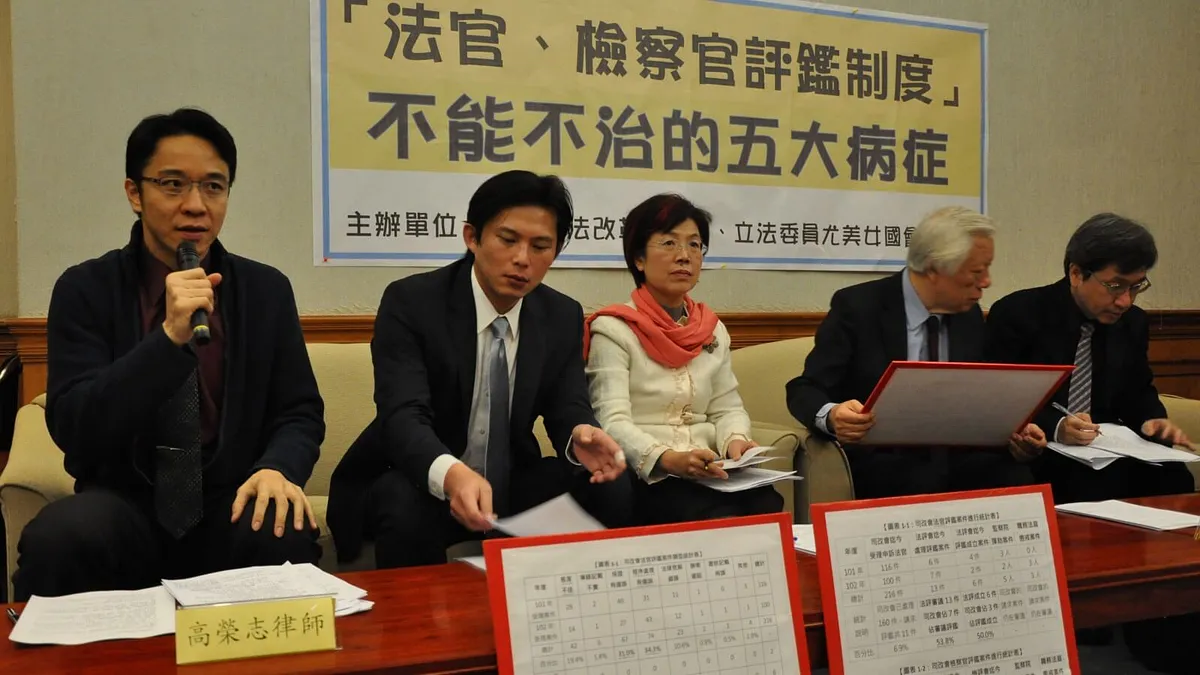
On April 17, 2012, the JRF held a press conference titled "Angry Bird Prosecutor? Idiots All of Us! Arrogant and Domineering Prosecutors," making public the audio and video records of an investigative hearing, accusing a prosecutor surnamed Lin of extremely abysmal conduct during the hearing, and submitting an evaluation request against said prosecutor. That very evening, the Taipei District Prosecutor's Office convened its Performance Evaluation Committee and resolved to petition the Ministry of Justice to impose a disciplinary reprimand. Subsequently, other members of the public filed complaints with the Taipei District Prosecutor's Office regarding Prosecutor Lin's conduct during hearings. After retrieving the audio and video recordings of the hearings and confirming the facts, the Ministry of Justice successively submitted two more requests for evaluation against the said prosecutor.
Excerpts of Arrogant Words and Deeds of the Angry Bird Prosecutor
This was merely a very ordinary traffic collision case. The defendant was accused of brushing past the victim's motorcycle while driving, causing the victim to fall and sustain an arm injury. Because the defendant did not feel any collision at the time and subsequently failed to reach a settlement with the victim, the case ultimately landed in the hands of the prosecutor. Inside the closed doors of the investigative hearing room, the prosecutor brandished the umbrella of "non-disclosure of investigation," "putting on official airs," and not only casually lectured the victim, but also made wild remarks to the defendant.
At the very outset, because the defendant failed to receive the notice and delayed attendance at a hearing once, the prosecutor scolded him, telling him to "carry your mailbox on your back." Afterwards, the prosecutor threatened the defendant, saying "I just think you are a bad person," "I really want to lock you up," "I am going to fight you to the finish," "Let's duel in the courtroom," and so on. The degree of absurdity was breathtaking. This cannot help but make us wonder: how many such prosecutors are hiding in non-public corners and harming the people?
Statutory Duty of Self-Supervision by Prosecutorial Authorities
The performance of a prosecutor within their service agency should be best understood by that agency, which logically ought to bear the responsibility of self-supervision. Regarding incompetent prosecutors, the prosecutors office to which the prosecutor belongs, as well as its superior authority, has the competence to submit a request for individual evaluation against them (Article 89 of the Judges Act applying mutatis mutandis Article 35 of the Judges Act). Moreover, the Chief Prosecutor of the prosecutors office to which the prosecutor belongs and the Prosecutor-General also have the competence to exercise directive supervision and administrative supervision over them (Articles 92 to 95 of the Judges Act). Therefore, members of the public can report incompetent prosecutors to their affiliated prosecutors office or the Ministry of Justice, and can also lodge complaints through the Chief Prosecutor's mailbox.
It must likewise be noted that if you submit a report on an incompetent prosecutor to the Ministry of Justice, please be sure to fill it out in accordance with the "Referral Form for Petitioning Prosecutor Evaluation" template, so as to avoid having your case summarily dismissed on procedural grounds.
Important Tips for Submitting Reports to Official Channels: A Breakthrough at a Single Point Outweighs an All-Out War!
Aside from filing reports in accordance with the formats provided by official authorities, there is one key point we wish to remind citizens making appeals to the authorities: rather than writing a massive amount of content to make accusations, it is better to clearly write down one obvious flaw committed by the judge or prosecutor, and demand that the competent supervisory authority investigate and handle this specific point. Because many citizens come to seek assistance from the JRF after failing to find a way to lodge complaints with the authorities, we read the complaint letters written by citizens to the authorities, and communicate with them to understand what grievances they actually encountered during the litigation process. We have found that some of the content complained about by citizens is indeed reasonable and ought to be addressed; however, because the written content is excessively lengthy and intermingled with much emotional language and speculative suspicion, it interferes with those contents that genuinely stand a chance of being addressed and acted upon. Consequently, the authorities often provide generalized responses to messy or difficult-to-successfully-report contents, or refute that the reports are utterly groundless.
Conclusion
Grassroots evaluation request units suffer from a shortage of personnel and, under current provisions of the Judges Act, do not possess the right to information-sharing; thus, the power of supervision always has its limitations. Judicial and prosecutorial authorities must shoulder the responsibility of self-supervision. Furthermore, in addition to bearing the responsibility of self-supervision, they should also be subject to the supervision of civil society regarding the conditions of their self-supervision. Unfortunately, because the data that citizens can obtain and provide to the JRF is limited, it is often difficult for us to judge whether official channels handle citizen reports appropriately. In addition, pursuant to the provisions of the Judges Act, the Judicial Yuan and the Ministry of Justice shall complete a "comprehensive evaluation" at least once every three years to comprehensively review the performance of every judge and prosecutor. However, due to resistance from official representatives during the legislative process, comprehensive evaluations and their results are not made public by law. As a result, it is also difficult for civil society to supervise the operation of self-supervision by official institutions. We look forward to future amendments to the Judges Act that will further enable the public to examine the operation of official self-supervision and compel authorities to shoulder the responsibilities they ought to fulfill.
Complaint Channels of Various Supervisory Authorities
Channels for complaining against judges
- Go to the Judicial Yuan website and click on "Judicial Mailbox" to file a complaint
- Download the "Petition for Individual Evaluation of Judges" and mail it to the Judicial Yuan at "No. 124, Sec. 1, Chungking S. Rd., Jhongjheng Dist., Taipei City 10048, Taiwan"
- Call the "Department of Judicial Administration": 02-23618577 ext. 284
Channels for complaining against prosecutors
- Please go to the website of each prosecutors office and click on the "Chief Prosecutor's Mailbox" to file a complaint
- Download the "Referral Form for Petitioning Prosecutor Evaluation" and mail it to the Ministry of Justice at "No. 130, Sec. 1, Chungking S. Rd., Taipei City 10048, Taiwan"
- Call the "Department of Prosecutorial Affairs, Ministry of Justice": 02-21910189 ext. 2321
This article is an AI-generated translation of the original Chinese text. In the event of any discrepancy, the Chinese version shall prevail.