
FAQ for Payment Order Victims
Last edited: 2026-07-27
Introduction
Under the old law, quite a few people bore debts they did not originally need to shoulder because they failed to file an objection to a payment order in a timely manner. Although these payment order victims could seek relief from the courts, the strict interpretation of retrial grounds by judicial practice in Taiwan narrowed the threshold for relief, leaving only a minority of payment order victims who ultimately succeeded in obtaining relief.
This article aims to provide payment order victims with an introduction to the protections and relief channels offered by the new law. It allows victims to understand existing avenues for relief through a brief overview, helping them choose the most appropriate way to resolve their issues after consulting and seeking assistance from attorneys or the Legal Aid Foundation.
This article was written on a short schedule; if any errors or deficiencies are found, we kindly ask all sectors to offer corrections without hesitation, and we will promptly revise and supplement it.
Overview Section
If, before July 1, 2015, you incurred a debt you did not originally need to shoulder because you did not file an objection to a payment order, causing that payment order to become final by July 2, 2015, then you are a payment order victim. If you actually had preexisting debts and the payment order corresponds to the debt amount, then you are not a payment order victim. If your payment order became final only on or after July 3, 2015, please refer to the article "Things You Must Know About the New Payment Order Law", which provides a comprehensive introduction to the new payment order law.
If you can present evidence proving that the evidence used to apply for the original final payment order was forged or altered, or proving that you can receive a more favorable judgment, you may file an action for retrial and request the judge to set aside the original final payment order. For example, providing genuine signature samples so that the signature on the negotiable instrument used to apply for the payment order is appraised as not having been made by you itself. Or, for example: presenting remittance documents to prove that the debt on the payment order has been fully or partially settled.
Although the new payment order law requires creditors to make a prima facie showing to the court regarding the factual cause and basis of their claims so that the court forms a degree of mental conviction generally believing in the existence of the claim, the standard for court review of payment orders still differs from general civil litigation trial procedures. Under the faster and simpler payment order system, it is still possible to mistakenly issue payment orders to persons who bear no debt. Therefore, if members of the public receive official court documents, they must still open and read them carefully. If they have any questions, they must seek assistance from professional attorneys or the Legal Aid Foundation.
Both payment orders and retrials are regulated in the Code of Civil Procedure. Payment orders are regulated in the chapter on urging procedures from Article 508 to Article 521 of the Code of Civil Procedure, while retrial procedures are regulated in the chapter on retrial procedures from Article 496 to Article 507-5 of the Code of Civil Procedure. This time, a special retrial provision for payment orders finalized under the old law was added to Article 4-4 of the Enforcement Act of the Code of Civil Procedure. However, operating these provisions presents difficulties for ordinary citizens. It is recommended that payment order victims, after conducting their own research, still seek professional assistance from attorneys or the Legal Aid Foundation.
Victim Relief Section
If you genuinely receive a series of payment orders applied for by fake creditors and suspect you are being targeted by a fraud ring, you may first confirm with the court and division indicated on the payment order whether it is a genuine court document. If it is, you should promptly file a written objection with that court, specifying the payment order case number and division. Afterward, you can use these payment orders to file a criminal complaint for fraud and other offenses with police and prosecutorial authorities, enabling investigative agencies to investigate and prosecute the fraud ring.
This amendment concerning payment orders does not modify the original relief system; it merely adds independent grounds for retrial and regulations on retrial time limits specifically for payment orders finalized under the old law within the original relief system. If your payment order became final on or before July 2, 2015, you have the following ways to seek relief.
- File for a retrial pursuant to the items in paragraph 1 of Article 496 of the Code of Civil Procedure within 30 days after the payment order becomes final, after the grounds for retrial arise or are known. However, a retrial may no longer be filed if five years have elapsed since the payment order became final.
- File for a retrial before July 2, 2017, based on one of the two grounds stipulated in paragraph 3 of Article 4-4 of the Enforcement Act of the Code of Civil Procedure: "the debtor has evidence that the evidence submitted by the creditor in the urging procedure was forged or altered" or "the debtor submits evidence capable of receiving a more favorable judgment".
※ Sample Civil Retrial Complaint:
The original Code of Civil Procedure placed numerous restrictions on retrials, and past judicial practice in Taiwan also interpreted grounds for retrial in a way that raised the retrial threshold. This legislative amendment reforms this aspect by adding special retrial provisions for payment orders finalized under the old law, moderately lowering the threshold for payment order retrials. Therefore, citizens whose previous retrial applications were dismissed can seize the opportunity of this legislative amendment to select appropriate retrial grounds and file an action for retrial to protect their rights.
Pursuant to the newly enacted provisions of Article 4-4 of the Enforcement Act of the Code of Civil Procedure, debtors of payment orders finalized before the new law took effect may simply file an action for retrial with the "court that originally issued the payment order".
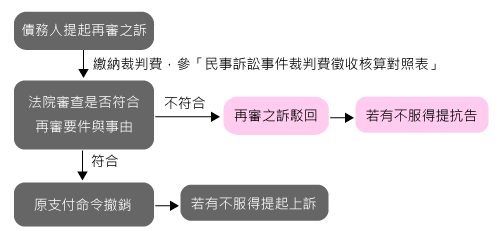
Court fees must be paid for a payment order retrial. Most courts calculate litigation costs based on standard subject matters of litigation; please refer to the Comparison Table for the Collection and Calculation of Court Fees in Civil Litigation Cases.
The JRF advocates that paragraph 2 of Article 521 of the Code of Civil Procedure has been amended and deleted, and payment order retrials should revert to paragraph 2 of Article 77-17 of the Code of Civil Procedure, requiring only a payment of NT$1,000, so as to prevent those without financial resources from finding it difficult to afford and improperly raising the retrial threshold. Currently, only the Kaohsiung District Court's 2015 Civil Ruling (104年度雄補字第1210號) supports the JRF's view. For details, please refer to 〈Payment Order Retrials Should Not Incur Exorbitant Court Fees〉.
Criminal and civil cases operate independently. Even if the criminal portion ultimately results in a final conviction, the debt borne due to a payment order finalized before the new law took effect is not automatically extinguished; it still needs to be handled through retrial procedures. Filing for a retrial is the only way to permanently invalidate a previously finalized payment order. Filing a complaint with a prosecutor so that the prosecutor investigates whether the creditor engaged in fraud or other circumstances can deter crime, but it cannot resolve civil debt problems.
Retrial actions involve more specialized legal analysis and application, and the circumstances of each payment order case also differ. It is recommended to find a professional attorney to help or seek assistance from local branches of the Legal Aid Foundation to accomplish everything in one decisive effort.
The newly amended law was promulgated on July 1, 2015, and entered into force on July 3 of the same year. Debtors must file an action for retrial with the court no later than July 2, 2017.
Yes, you can. If you were still a minor when you originally received the payment order, you may file an action for retrial from the entry into force of the new law until within two years after reaching adulthood.
After filing for a retrial, if the court indeed considers the previously issued payment order unreasonable, it will subsequently convert the payment order into appropriate litigation procedures based on the creditor's claim amount. At this point, the applicant for the payment order will be converted into the plaintiff in civil litigation. The court will calculate litigation costs based on the amount of the brought action, and after the creditor (i.e., the plaintiff) pays the litigation costs, the litigation procedure will commence. The court will conduct a detailed and complete review and judgment on whether this debt exists during the litigation procedure based on the evidence submitted by both parties.
The portion that debtors have already settled with creditors previously cannot be subjected to retrial applications under the provisions of the new law; this portion can only seek relief using the regulations prior to the amendment. Because the specific details vary depending on individual case facts, it is recommended to request assistance from an attorney or the Legal Aid Foundation.
If the creditor applied to the court for compulsory execution based on a payment order finalized before July 2, 2015, the debtor should promptly file an action for retrial against that payment order and apply to the court to provide a security bond in order to stay the execution after filing the retrial action. (Cf. paragraph 2 of Article 18 of the Compulsory Execution Act)
Section on Grounds for Retrial
No. Under the old law, if a creditor applied for a payment order holding forged or altered debt certification documents, even if the debtor could prove that the debt certification documents were forged or altered after the payment order became final, they still had to wait until the person who forged or altered the documents received a final criminal conviction before filing for a retrial. However, the new law does not have such a requirement; it only requires proof that the documents initially submitted by the creditor were forged or altered in order to file an action for retrial.
If such evidence can prove that your debt does not exist at all, or that the debt has been extinguished, you may use this as a reason to file an action for retrial. Below are simple examples:
- Evidence proving that the debt does not exist, such as: a final judgment confirming the non-existence of a claim.
- Evidence proving that the debt has been extinguished, such as: remittance slips for debt repayment, repayment documents, settlement agreements, debt release instruments, court deposits, evidence of debt set-off, or merger.
This article is an AI-generated translation of the original Chinese text. In the event of any discrepancy, the Chinese version shall prevail.