
The Payment Order That Should Have Been Amended 15 Years Ago
Last edited: 2026-08-28
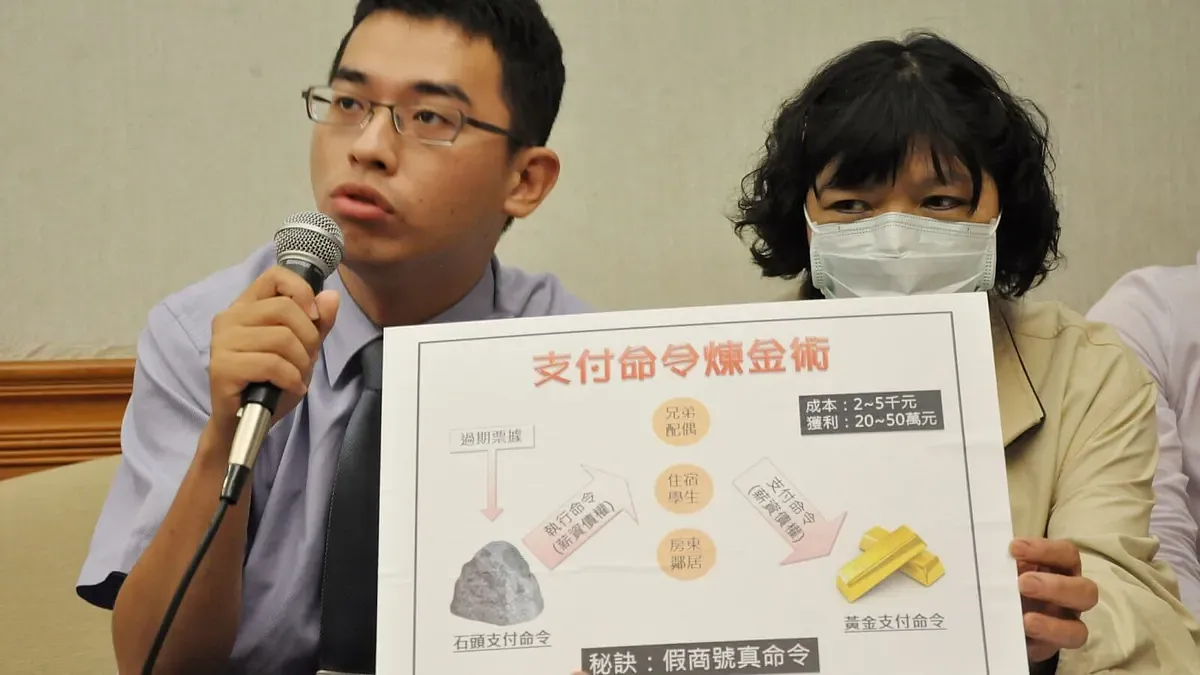
One day, Mr. Chen suddenly received a "payment order" from the court, ordering him to pay NT$100,000 to a bank within a specified time limit. He hurriedly contacted the bank to clarify, only to discover that his name had been used fraudulently to apply for a credit card, accumulating a large amount of credit card debt. After he reported the incident to the police, an officer comforted him by saying that the payment order would automatically become void once the prosecutor indicted the perpetrator. Unexpectedly, a few days later, Mr. Chen received an official court document notifying him that his assets had been attached. It turned out that Mr. Chen had failed to file an "objection" within the time limit, causing the "payment order" to become final, and the bank had legally applied to the court to attach his property.
Once a payment order becomes final, it carries the same legal effect as a final court judgment. Mr. Chen's only recourse was to file a "retrial," and the success rate for doing so from 2009 to the present has been a mere "5.3 in one million"!
Many citizens do not owe any debts at all; simply because they do not understand the law, and because payment orders are issued solely upon written review by "judicial affairs officers"—thereby depriving citizens of the opportunity to explain their situation to a judge in person—they are forced into perpetual debt. Being reckless and easy to issue, yet difficult to obtain relief from once finalized, Mr. Chen's story has become just the tip of the iceberg regarding the numerous tragedies caused by payment orders.
In fact, as early as the 713th meeting of the Civil Procedure Code Amendment Committee in 2000, the Judicial Yuan resolved that if payment orders were to be issued in large quantities by judicial affairs officers using computerized, unified formats, corresponding rigorous procedural designs must be instituted as complementary measures, and whether they should possess res judicata effect must be considered. While committee members such as Professor Chiu Lien-Kung, Professor Sun Sen-Yen, and Professor Chen Jung-Tsung demonstrated great foresight at the meeting, the Judicial Yuan long failed to review and improve the system, tolerating the occurrence of tragedies.
A few days ago (on the 13th), the Judicial Reform Foundation and cross-party legislators held a press conference on the draft amendments to the payment order provisions in the Code of Civil Procedure and the Enforcement Act of the Code of Civil Procedure at the Legislative Yuan, hoping that through this legislative amendment, debtors under payment orders would be provided with avenues for relief, including lawsuits to confirm the non-existence of claims and lawsuits of debtor objection. Furthermore, the scope would be expanded so that retrial relief could also be sought for payment orders issued prior to the amendment. Unexpectedly, on the 15th, the Judicial Yuan issued a press release stating that the nongovernmental legislative amendments were "not quite appropriate." As for what makes them inappropriate, or how citizens' problems are to be resolved, there was no explanation whatsoever.
While payment orders may have the advantage of swiftly settling disputes, the flaw and disaster inherent in the fact that "if a debtor fails to file an objection within the time limit after receiving a payment order, it is tantamount to having no recourse for relief" are endless, and the comprehensive review and amendment of this system should no longer be delayed. Since the Judicial Yuan was already aware 15 years ago that payment orders needed to be amended, it has all the more reason not to reject this prime opportunity for legislative reform!
This article is an AI-generated translation of the original Chinese text. In the event of any discrepancy, the Chinese version shall prevail.