
JRF Newsletter
Preventing the Next "Payment Order Injustice Case"
Last edited: 2026-07-27
Dear Friends,
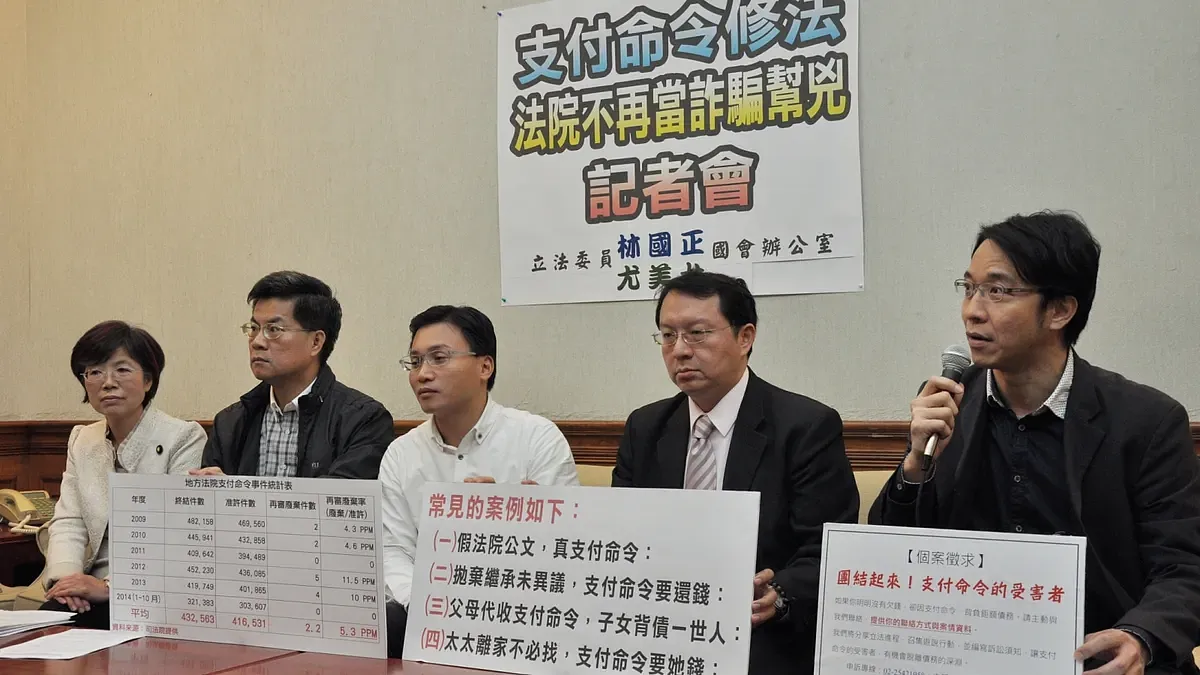
Due to lenient issuance standards, payment orders have been widely abused in recent years, affecting numerous victims. Last week, we held a press conference on the amendment of payment order regulations and solicited victimized cases, hoping to gather public opinion to promote institutional reforms and prevent the occurrence of another "payment order injustice case."
This issue of the e-newsletter features Attorney Lin I-chih explaining what a payment order is and the various problems inherent in the current system. Beyond supporting institutional reform, learn how to protect your own rights.
What is a Payment Order?
Before explaining why we initiated this amendment of the payment order system, allow me to explain what a payment order entails.
A payment order is a mechanism under the Code of Civil Procedure for the swift realization of claims. Under current regulations, a creditor can fill out a written form detailing the amount owed and the reason for the debt, and without providing evidence, apply to the court for the issuance of a payment order. Upon receiving the application, the court does not need to verify whether the creditor's statements are true, nor does it need to hear the debtor's defense, and can directly issue a payment order to the debtor.
If the debtor fails to file an objection with the court within 20 days of receiving the payment order, the payment order takes on the effect of a final and binding judgment. In other words, the matter of "the debtor owes money" is finalized as if it had gone through a three-tier court system! At this point, if the debtor disputes that they owe any money, the only legal recourse available is a retrial. However, if a debtor files for a retrial of a payment order, regardless of how justified the grounds or how sufficient the evidence, success is virtually impossible. In other words, once a payment order is received and the objection period lapses, even if the debtor does not owe any money at all, they are still legally required to repay the creditor.
You might wonder why a retrial of a payment order cannot succeed. The primary reason lies in the incompatibility between payment orders and our retrial system. Taiwan's retrial system is specifically designed for court judgments, meaning judicial trial proceedings. Although a payment order can produce the effect of a final judgment through three tiers of courts, it is ultimately not a judgment, and incompatibility is an inevitable consequence. The current reality of payment orders and the retrial system is as absurd as a law stating that "patients have the right to see a doctor, but can only see a veterinarian." Statutory grounds for retrial cannot actually provide relief against payment orders.
To resolve this dilemma, the simplest method is to amend the law so that payment orders no longer carry the effect of a final judgment, but merely possess executory force, thereby slightly balancing the rights between debtors and creditors. When payment orders do not carry the effect of a final judgment, debtors will not be restricted to retrials as their sole remedy; instead, even if the debtor fails to object within the time limit, the creditor may still use the payment order to apply for the attachment of the debtor's property, while the debtor may initiate a lawsuit to confirm the non-existence of the debt prior to the creditor's property attachment as a form of relief. This exact concept forms the legislative amendment direction pursued by our payment order amendment legal team this time.
Preventing the Next "Payment Order Injustice Case"
The initial motivation for launching this legislative amendment action arose from encountering many debtors who did not owe money but, due to a lack of legal understanding, failed to file objections within the time limit and subsequently had their property attached by creditors. I refer to this phenomenon as a "payment order injustice case." Here, I will briefly share two cases I have encountered.
An office worker around 30 years old. When he was 9 years old, his mother took out a bank loan. The bank required the mother to list all her minor children (including this office worker) as joint and several guarantors as a condition for granting the loan.
Under economic pressure, the mother had no choice but to comply. However, the bank did not spare these children; it immediately applied for payment orders against both the mother and the children, while lying to the mother: "A payment order is a court-certified proof of debt; just leave it alone after you receive it." Not understanding the law, the mother believed the bank's assertion. Years later, after the children reached adulthood, this office worker—who had just stepped into the workforce—had his salary attached upon the bank's application...
A middle-aged man around 50 years old whose father left behind massive debts before passing away. He promptly filed for a waiver of inheritance upon his father's death.
A few days later, upon learning of his father's death, the bank claimed that he had inherited his father's debts and applied to the court for a payment order. Believing that he had already completed the waiver of inheritance and that objecting was unnecessary, he simply ignored the payment order upon receipt.
To everyone's surprise, the bank used that payment order to attach his real estate. By the time he realized the gravity of the situation, it was already too late.
In these two cases, had the banks pursued recovery through civil litigation, the banks would have undoubtedly lost under Taiwan's Civil Code. Yet, in payment order proceedings, the outcome was entirely the opposite. Such a paradoxical situation further highlights the problems of payment orders: the current payment system completely ignores the law and facts, denies debtors any opportunity to rebut, and—without the debtor ever seeing a judge—forces an individual to shoulder a debt "finalized through three court tiers" simply because the "debtor failed to file an objection with the court within 20 days."
Furthermore, because the general public does not understand the law, they mistakenly attribute the problems arising from payment orders to the notion that "judges have been bought off by banks!" This further compounds the crisis for a judicial system that is already lacking in public trust.
Payment Order Amendments Need Your Support
To resolve the various problems of the current payment order system, the Judicial Reform Foundation established the Payment Order Amendment Legal Team.
After a year of intensive meetings and discussions, the draft amendments for payment orders were finally completed, and a press conference was held at the Legislative Yuan on January 13 of this year. However, two days later, the Judicial Yuan expressed via a press release that the amendments were not yet appropriate, thereby indirectly expressing its refusal. From the perspective of increased court workload following the amendments, the Judicial Yuan's stance is not surprising, but it is deeply regrettable.
In fact, as early as July 18, 2000, during the 713th meeting of the Civil Code Amendment Committee, the Judicial Yuan had already discussed the issue of abolishing the res judicata effect of payment orders. It adopted a supplementary resolution stating: "As long as payment orders are issued by judicial affairs officers using a computerized single format, there are grounds to further amend the regulations and alter the rule that payment orders possess res judicata effect." In reality, payment orders have been issued by judicial affairs officers using a computerized single format for several years now, yet the Judicial Yuan has completely forgotten this resolution and rejected this legislative amendment, leaving people speechless at this reversal of position.
Although the path of legal reform is long, please continue to support us as we walk it. Reforming the payment order system is not merely about amending a law; it is about ensuring that a systemic legal problem—one that should have been resolved 15 years ago—does not continue to plague the next 15 years. This is not only an issue of fairness and justice, but also of generational justice.
This article is an AI-generated translation of the original Chinese text. In the event of any discrepancy, the Chinese version shall prevail.