
JRF Newsletter
Invisible, Only Because You Blindfolded Yourself...
Last edited: 2026-07-27
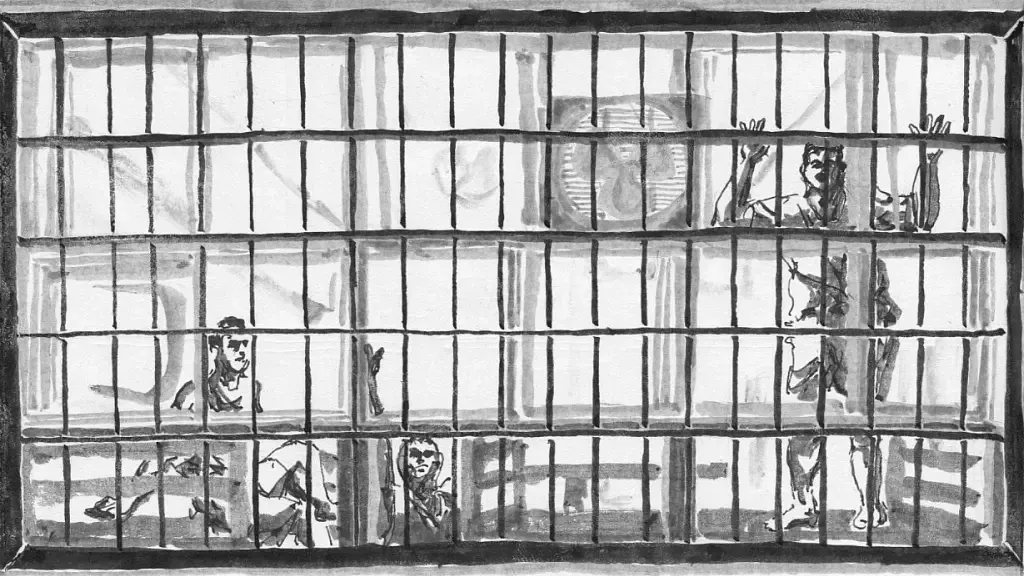
Image / Lin Wen-wei Ewam Lin
When a correctional officer painfully tells you they once witnessed an inmate being raped by another inmate, but were too terrified to do anything or report it, would you believe it? When a correctional officer half-jokingly tells you that if senior staff dislike an inmate with no visiting family, they will beat the inmate in a camera blind spot during escort, would you believe it?
Well, leaving aside what correctional officers say: when a former inmate tells you they had their limbs bound and immobilized in an isolation cell following a conflict with correctional officers, and the prolonged immobilization caused them so much pain they urinated on themselves and had to wear a diaper. Yet, because so much time has passed, they have no idea how to prove to you that such an incident actually occurred.
Well, these are all hearsay, rumors, and impossible to prove as "true." Until Lin Wei-hsiao died at the Taipei Prison, we began to see "why it cannot be proven" true. Lin Wei-hsiao was deemed by prison authorities to have disrupted order, was subjected to restraints and prolonged immobilization, and subsequently died suddenly. Yet by law, the application of restraints and protective immobilization must be recorded at the time with signatures from relevant personnel—none of which was done. Had Lin Wei-hsiao not died and instead gritted his teeth and survived, and upon release sought to accuse correctional officers of torturing him, would there be any evidence left? Would anyone confess?
Always Destined to Remain Just Stories
Earlier this year, correctional officer Lin Wen-wei illustrated an incident where an inmate was tasered by guards for disobedience, for which he received two reprimands on the grounds of "citing unsubstantiated rumors, misleading readers into believing the described disciplinary methods are true, damaging the reputation of correctional institutions, and improper conduct and speech." In fact, anyone with a slight understanding of prison conditions would know that the content of his artwork can probably neither be proven true nor false. Relevant personnel will not necessarily confess, and victims may not dare to speak out. Even if a victim does speak out, can that be proven true? Over time, surveillance footage is lost, and even if the violence indeed occurred in a blind spot, surveillance footage might not reveal anything conclusive.
Because correctional institutions lack transparency, and because of the power dynamics within them, many heartbreaking stories are destined to remain mere stories forever. These stories are countless—you can even find them simply by searching online. I wonder if prison authorities have ever seen them?
Facing the Issues Within the Stories
From the perspective of prison authorities, these stories damage the reputation of correctional institutions. But in my view, in the long run, it is precisely the circulation of these stories that truly safeguards the reputation of correctional institutions. Admittedly, these stories may not necessarily be proven true, but they all touch upon critical issues of prison reform: solitary confinement, torture, potential violence within camera blind spots, the management of stun batons, and the dilemmas faced by frontline correctional staff...
I want to particularly highlight the dilemmas faced by frontline correctional staff. Prison officials stated that because they intend to punish the correctional officer who illegally used a stun baton, they demanded Lin Wen-wei reveal the identity of this person. But can punishment truly solve the problem? Shouldn't we instead consider whether frontline correctional staff are facing dilemmas, whether they are under excessive pressure, and whether changing certain frontline operational practices could better assist both staff and inmates? Is punishment merely attributing all systemic problems to individuals, subjecting them to even greater, unbearable pressure?
If we can directly confront the issues highlighted in these stories, properly resolve them, and let the public understand why things cannot be as described in the stories, then naturally these stories will no longer have room to circulate. Only then can prisons improve, and their reputation will naturally grow better day by day.
You Cannot Wake Someone Pretending to Sleep
Yet, prison authorities simply do not see it that way. Despite the abundance of heartbreaking stories, they choose to blindfold themselves and silence those who tell the stories.
Correctional officer Lin Wen-wei filed an appeal with the prison regarding the two reprimands. The appeal was rejected, and a re-appeal is currently underway. Lin Wen-wei's lawyer spent a significant portion of the appeal arguments explaining why issuing two reprimands is problematic based on freedom of speech, yet the prison completely failed to respond to this point. We worry that the outcome of the re-appeal will be the same: completely ignoring how crucial storytelling itself is to prison reform and how urgently such freedom of speech needs protection, while continuing to focus entirely on whether Lin Wen-wei can prove the content of his illustrations is true.
Therefore, the Judicial Reform Foundation, the Taiwan Association for Human Rights, the Taiwan Association for Prisoners' Rights, and the Public Interest and Legal Scholarship Center of National Taiwan University are jointly organizing a forum: "Judicial Review Standards for Disciplinary Actions Against Civil Servants: Focusing on Civil Servants' Freedom of Speech—Starting from the Lin Wen-wei Case." We sincerely invite everyone to participate and care about this issue, allowing Lin Wen-wei, and whistleblowers within the system like him, greater possibilities to tell stories of reform!
Judicial Review Standards for Disciplinary Actions Against Civil Servants
Focusing on Civil Servants' Freedom of Speech—Starting from the Lin Wen-wei Case
 Image / Lin Wen-wei Ewam Lin
This article is an AI-generated translation of the original Chinese text. In the event of any discrepancy, the Chinese version shall prevail.