
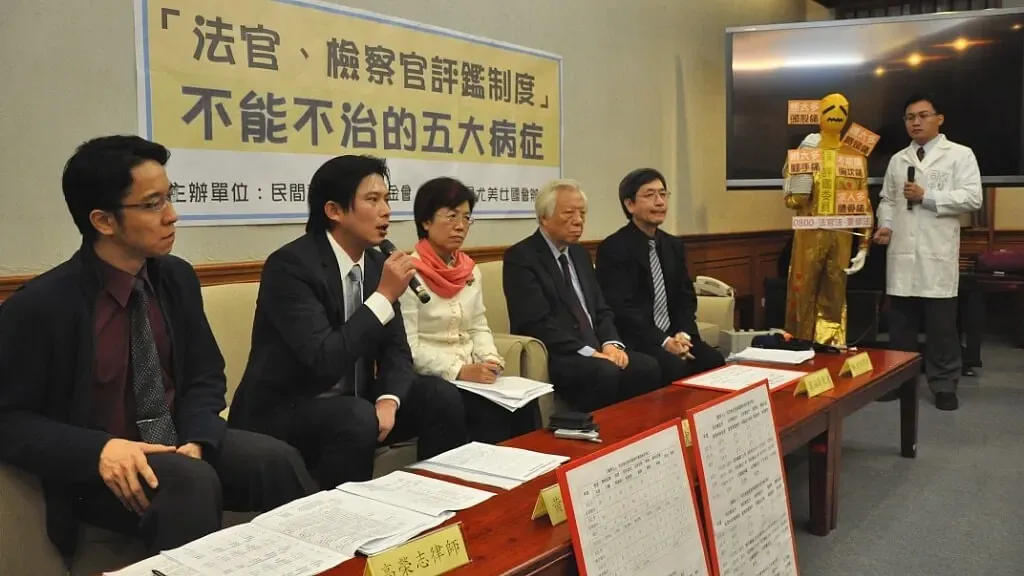
Reforming the Judges Evaluation System brooks no delay
Last edited: 2026-08-28
In July of last year, the JRF filed a request with the Judges Evaluation Committee (JEC) to evaluate Judge Tseng Pu-lun. Early this year, the JEC resolved only to submit Judge Tseng to the Judicial Personnel Review Committee for review, rather than referring him to the Control Yuan for investigation.
The JEC's "leniency" toward an incompetent judge is baffling. According to the facts investigated by the JEC itself, during the court session that day, Judge Tseng "clearly knew" that the 86-year-old party to the lawsuit was elderly and suffered from dementia, making them entirely incapable of clearly making legal or factual assertions. He first demanded that the agent accompanying the party to the hearing wait outside the courtroom. Without explaining to the party the severe consequences of withdrawing the lawsuit (in this case, once the party withdrew the lawsuit, they would never again be able to file an action), he actually guided the party into signing a withdrawal petition on the spot. Given such circumstances, the JEC surprisingly decided only to subject Tseng Pu-lun to the Judicial Yuan's own internal processing procedure, namely review by the Personnel Review Committee.
And facts have proven that the Personnel Review Committee cannot be relied upon either. Yesterday, the resolution of the Personnel Review Committee was to issue a reprimand of "Attention." What is "Attention"? According to the Liberty Times, "Attention" means reducing Judge Tseng's year-end bonus by NT$100,000. Can "Attention" possibly make up for the judicial trust trampled upon by such a judge? And what about the damages suffered by the party?
Regarding the Personnel Review Committee, the Judicial Yuan has long insisted on judicial self-governance and self-discipline. According to the provisions of Article 4 of the current Judges Act, there are a total of 27 members on the Personnel Review Committee, among whom only 3 are scholars and experts, while the rest hold the status of judges. Furthermore, although the so-called scholars and experts are nominated respectively by the Ministry of Justice and the Taiwan Bar Association, the final decision is still made by the President of the Judicial Yuan.
When the JRF and civil society organizations originally promoted the Judges Act, we opposed having the Personnel Review Committee consist entirely of judges. During internal discussions, we even advocated that non-judge external members should account for no less than one-third of the Personnel Review Committee's composition. Unfortunately, under the intense lobbying of the Judicial Yuan and the protection of the ruling party's legislators, today's version was passed.
As for the Evaluation Commission, as early as the beginning of this year (2015), the conclusion of the report published by the JRF targeting the three-year anniversary of the implementation of the evaluation system under the Judges Act was that the operation of the Judges Evaluation Commission has been ineffective.
Yesterday, Tseng Pu-lun's case once again reminded us just how severe the dysfunction of the Evaluation Commission and the leniency of the Personnel Review Committee truly are. The Judicial Yuan's mechanisms are unable to weed out incompetent judges, and what is sacrificed is always the rights of ordinary citizens. Reform of the judges evaluation mechanism can no longer be delayed. We call upon legislators to keep the pain of the people in mind during this legislative session, swiftly reform the Judges Evaluation Commission, and pass the amendments to the Judges Act!
This article is an AI-generated translation of the original Chinese text. In the event of any discrepancy, the Chinese version shall prevail.