
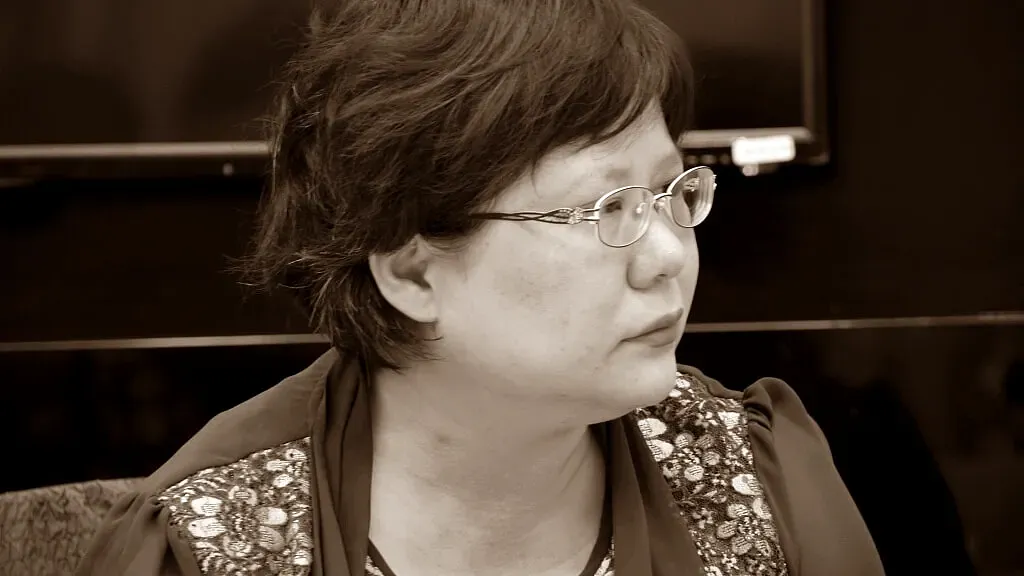
Open Letter from Kuo Mei-lan's Brother: On the Long and Winding Road of Judicial Reform, Our Sister Kuo Mei-lan Will Never Be Absent
Last edited: 2026-07-27
I am Kuo Mei-lan's brother. Since holding her funeral before the Lunar New Year, our family has still been busy with various trivial public and private matters, making it impossible for us to attend this press conference. I am writing this letter to express our utmost gratitude to the JRF for caring about Mei-lan, and to officially declare our support for the JRF's continued efforts on this issue.
Due to frequent business trips abroad for work, the place I have been least familiar with over the past 20 years is actually Taiwan; I am not naive enough to believe that absolute justice and fairness exist anywhere in this world, but after experiencing business and management in many countries, I have come to realize even more profoundly how backward Taiwan is in terms of human rights and the rule of law. There is an absurd coincidence between the fates of Mei-lan and our grandfather: our grandfather was executed during the White Terror era, and after a so-called traitorous offender verdict rendered by unknown persons for unknown reasons, the family only received a notice afterward to claim his remains. Mei-lan's experience of course cannot be compared to that, but the essence of improper public authority harming the people is exactly the same. In modern Taiwan, which boasts of being free and democratic, such cases still exist and are accepted as a matter of course. The degree to which human rights awareness is lagging behind is truly terrifying; even though there have been many calls for reform over the years, and many official and unofficial forces have continued to push for it, judging from many cases, progress remains slow with no end in sight.
Back then, I took my son, who was then a second-year junior high school student, to a sit-in protest expressing injustice over Hung Chung-chiu, allowing him to experience the feeling of civic participation. He asked me: under a democratic political system, aren't problems like this supposed to be solved by an elected government? Why do people need to take to the streets? Now a second-year senior high school student, if he looks back, he would probably smile wryly at his initial naivety; however, this problem might not even be relevant to him, because he is very fortunate—we have the ability to give him the option not to live in Taiwan for the long term....
I was not in Taiwan on the day the incident happened. If it were not about an immediate family member, news of this sort would at most be glanced at on the return flight while reading the next day's newspaper and immediately forgotten. Because politics, the judiciary, and the media are so distant and impractical to our daily lives, because we are not foolish enough to believe we have any capacity to influence them, and because I was trained since childhood to take our grandfather as a warning and stay away from politics, I never had any desire to participate in issues of this kind. Having traveled through 40 countries and hundreds of cities worldwide, Taiwan is the land I hold closest and dearest, but I never expected any chance of change in this backward state of the rule of law and human rights, and thus I always maintained a safe distance where these matters had nothing to do with me. Until now, only to speak on behalf of Mei-lan have I publicly expressed these feelings.
Mei-lan was persistently hopeful of finding answers; all her previous efforts were simply hoping that someone would apologize to our mother. Our father passed away from illness at an early age, and our mother retired after teaching for decades at a rural elementary school in Taichung County. To her—an extremely simple and conservative person—this matter is an inescapable shadow, and also the deepest remorse in Mei-lan's heart. When Mei-lan left, all the support and voices of injustice, although unable to reverse anything, at least made our mother feel comforted and at ease. We had also thought this matter would gradually fade out of the family's life as she departed.
Mei-lan was very naive, believing that the state would protect its people, believing that the judiciary should safeguard human rights. What is even more saddening is that the profession she loved so dearly—the media—ended up becoming the greatest accomplice to harming her. Therefore, before she left, her heart must have been filled with questions and resentment. Her experience serves as a reminder to everyone of the importance of judicial reform and media ethics. Yet, expecting morality in a commercial society is an unrealistic fantasy, so we can only pin our hopes on the judicial system acting as the bottom line to protect the people. Although this is a basic human right taught to us in civics education, reality is not so: if the people's problems are actually caused by the government, if public power is improperly misused for selfish reasons, there ought to be a legal system to regulate it and checks-and-balances mechanisms to provide remedy, rather than being left with nowhere to turn for help like Mei-lan was.
A former supervisor of Mei-lan from her newspaper days came to visit, and he mentioned hoping that there would be no more victims after Mei-lan. I replied to him that throughout history and across cultures, in all political games, there are always countless victims, and the process of interest-trading always requires someone to be sacrificed as a bargaining chip—it is merely a matter of the degree of civilization or barbarism in the rules of the game. When friends from the JRF contacted me, I began to think that Mei-lan's personality would never allow her to watch such a situation exist without speaking out; when our state system still tacitly condones public authority continuing to harm the next innocent person, she certainly would not want her family to simply remain silent.
In the end, I chose to continue participating in this matter on her behalf—not to clear her name or seek vindication, not to hold the masterminds accountable, and even less to care at all about any compensation (if a human life can be assigned a price, let's see who is willing to put a price on selling their own loved one...).
If there is a chance to contribute even a little bit to the promotion of institutional establishment, let it be seen as a way for us to remember Mei-lan.
Kuo Ying-cheng 2018/03/07
Related Articles
This article is an AI-generated translation of the original Chinese text. In the event of any discrepancy, the Chinese version shall prevail.