
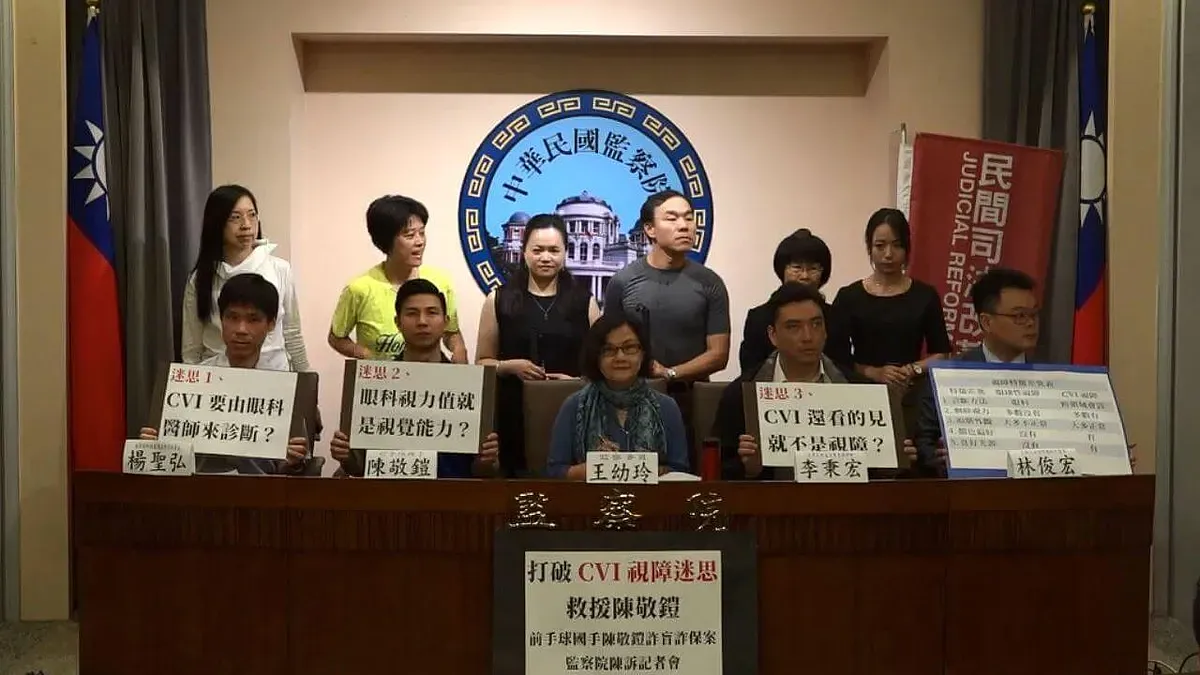
Breaking CVI Vision Myths and Rescuing Ch'en Ching-k'ai: Press Conference for the Control Yuan Petition in the Ch'en Ching-k'ai Feigned Blindness and Insurance Fraud Case
Last edited: 2026-07-27
In addition to common ocular visual impairments, blindness can also stem from brain damage, known as Cortical Visual Impairment (CVI). Before this type of visual impairment was widely understood, patients were frequently mislabeled as malingerers or psychiatric patients! As medical research, diagnosis, and treatment for CVI are still in their infancy in Taiwan, a lack of widespread understanding—even among professional ophthalmologists—often causes patients to miss crucial rehabilitation windows and even leads to them being falsely accused of faking blindness. The case of former handball national athlete Ch'en Ching-k'ai is the most unfortunate example.
On February 14 this year, the Criminal Judgment No. 574 (103rd Year, Appeal, Yi) of the Taiwan High Court Kaohsiung Branch Court found former handball national athlete Ch'en Ching-k'ai guilty of feigning blindness to commit insurance fraud, sentencing him to 1 year and 2 months of imprisonment with finality. The controversy lies in the fact that while the court acknowledged Ch'en Ching-k'ai as a CVI patient, it refused to accept the explanations of scholars and experts that CVI patients still possess residual vision. With the aid of residual light perception and color block perception, as well as previously acquired visual comprehension and memory, Ch'en Ching-k'ai could still perform many actions—including reading and writing test papers and catching and throwing frisbees! The judges believed these experts had been deceived by Ch'en Ching-k'ai, insisting that severely visually impaired individuals could never accomplish such tasks! The court's attitude highlights three major social myths regarding CVI visual impairment:
-
Myth 1 CVI must be diagnosed by an ophthalmologist
CVI, also known as cerebral visual impairment, is a disruption of the brain's visual processing center and visual pathways, unlike ocular damage where issues with the eye and optic nerve structure impair visual function. The hallmark of CVI patients is normal ophthalmological examinations or examinations that fail to explain severe visual function deficits. Therefore, the diagnosis of CVI must involve a team composed of neurologists, pediatricians, visual scientists, visual impairment education scholars, occupational therapists, and orientation and mobility specialists to conduct identification and evaluation in order to effectively assist CVI patients. (See Appendix I)
-
Myth 2 Ophthalmological visual acuity values equal visual capability
The visual acuity charts used by ophthalmologists (the Landolt C chart or the Snellen E chart) target static visual acuity in the central visual field, measuring visual sharpness at a fixed distance for seeing a designated object. As for peripheral visual fields or residual visual capacities—such as light perception, color perception, hand-eye coordination, visual memory, complex background recognition, and comprehension and operational abilities—these fall outside the evaluation scope of visual acuity charts. Therefore, ophthalmological visual acuity values do not represent all visual capabilities, nor do they reflect how visually impaired individuals actually use vision in daily life.
-
Myth 3 If a CVI patient can still see, they are not visually impaired
The defining characteristic of CVI visually impaired individuals is that the majority still retain residual vision. However, because ocularly visually impaired individuals are more numerous and the proportion of complete vision loss is high, most people—and even professional physicians—base their understanding of a visually impaired person's life capabilities on impressions of ocular visual impairments. Consequently, when seeing CVI visually impaired individuals use residual vision to act, it is very easy to mistakenly believe that CVI individuals can still see and are not visually impaired. In reality, the function of residual vision is extremely limited, and CVI patients still belong to the category of visual impairments.
Table of Differences in Visual Impairment Characteristics Characteristic Differences Ocular Visual Impairment CVI Visual Impairment Diagnostic Method Ophthalmology Interdisciplinary Consultation Residual Vision Mostly none Mostly present Eye Appearance Mostly abnormal Mostly normal Color Preference None Present Light Preference None Present
With careful observation, one can distinguish the characteristic differences between the two categories of visual impairment: ocular and CVI (see table above). Although both belong to visual impairments, they must never be lumped together. Ch'en Ching-k'ai's false accusation of feigning blindness and insurance fraud began with hospital diagnoses that failed to comply with CVI identification standards; subsequent insurance payouts and investigations also disregarded CVI differences; and finally, based on stereotypes regarding the life capabilities of ocularly visually impaired persons, the court delivered a discriminatory judgment against a CVI visually impaired individual. Because these three major myths remain deeply rooted in people's minds to this day, groups advocating for Ch'en Ching-k'ai came to the Control Yuan today to petition, calling on Control Yuan members to comprehensively review the government's shortcomings in inadequately protecting CVI visually impaired persons, to rescue Ch'en Ching-k'ai, and to hope to prevent the next Ch'en Ching-k'ai case from happening.
Appendix
"The Fortunes and Sorrows of Persons with Cerebral Visual Impairment" by Teacher Hsieh Man-li
Attendees
Wang Yu-ling / Control Yuan Member
Ch'en Ching-k'ai / Litigant
Yang Sheng-hung / Former Secretary-General, Accessible Technology Development Association
Hsieh Man-li / Project Leader for Holistic Rehabilitation of the Visually Impaired, National Teachers' Association
Yeh Chao-ling / Taiwan Non-Visual Sports Culture Development Association, Taiwan Blind Baseball Organization
Yang Cheng-hua / Convener of the Pro Bono Lawyer Team
Li Ping-hung / Legal Aid Foundation Lawyer
Lin Chun-hung / Standing Executive Member, Judicial Reform Foundation
Ch'en Yen-huan / Staff Lawyer, Judicial Reform Foundation
Wang Chun-chiai / Fully Blind Piano Poet
Li Hsin-yi / Eden Praise Duet
賴智傑 / Piano Tuner, Supervisor of the Taiwan Non-Visual Sports Culture Development Association
This article is an AI-generated translation of the original Chinese text. In the event of any discrepancy, the Chinese version shall prevail.