
Implementing Judicial Reform Resolutions, Forensic Experts No Longer Behind the Scenes: Press Conference on Reforming the Criminal Procedure Forensic Expert System
Last edited: 2026-07-27
Post-Meeting Press Release
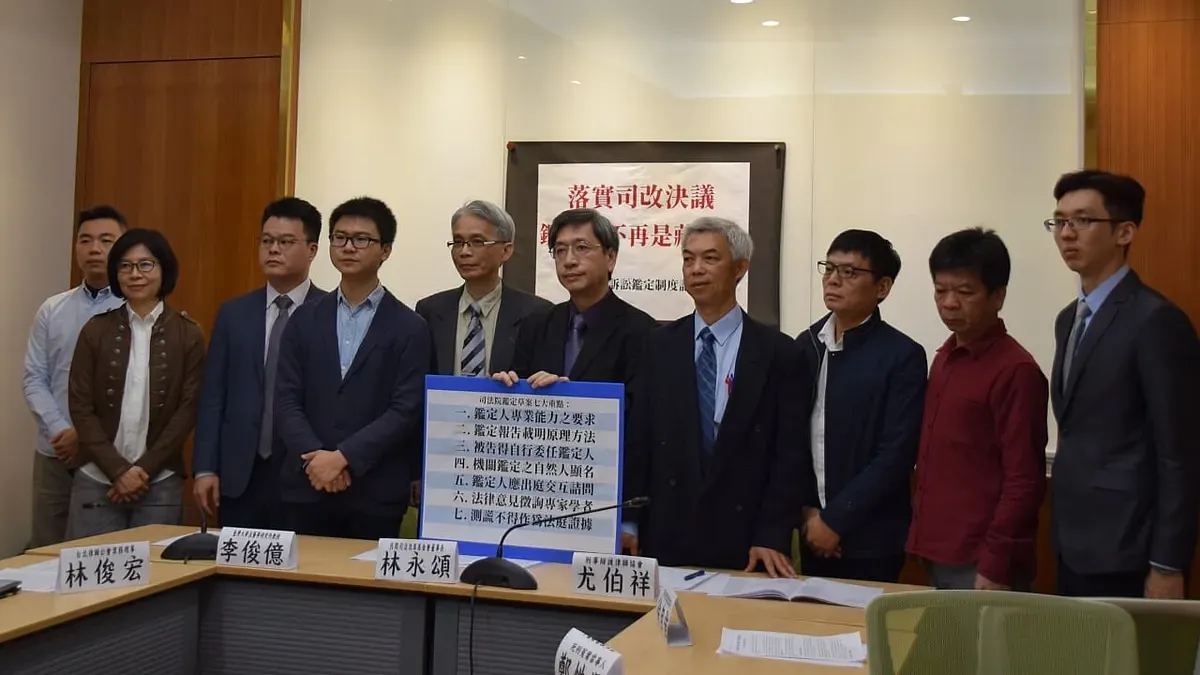
JRF Chairperson Lin Yung-sung, Taiwan Association for Criminal Defense Chairperson Yu Po-hsiang, Taiwan Innocence Project Executive Director Lo Shih-hsiang, Taipei Bar Association Standing Director Lin Chun-hung, death row wrongful conviction exonerees Hsu Tzu-chiang and Cheng Hsing-tse, National Taiwan University Institute of Forensic Medicine Professor Li Chun-yi, Taiwan Society of Questioned Documents Chairperson Chang Yun-chih and Secretary-General Ch'en Chien-t'ung held a press conference today (the 27th) at the Legislative Yuan. They issued a statement regarding the initial draft of the "Draft Amendments to Certain Provisions of the Code of Criminal Procedure Concerning Forensic Examination" published by the Judicial Yuan at a public hearing on February 20, calling on the Judicial Yuan to ensure the inclusion of provisions in the Code of Criminal Procedure that strengthen the quality of forensic examinations to enhance public trust in forensics and prevent wrongful convictions.
Yu Po-hsiang, Chairperson of the Taiwan Association for Criminal Defense, stated that the current flaws in the forensic system are: unfairness, lack of professionalism, and irresponsibility, which lead to low-quality forensic examinations and a proliferation of wrongful convictions. Yu Po-hsiang emphasized that an expert should not be synonymous with someone who "specifically harms others." The amendment draft proposed by the Judicial Yuan addresses these three directions: 1. Fairness: The defendant may independently select forensic experts. 2. Professionalism: Forensic experts must possess professional competence and present verifiable methods to prove the grounds for the admissibility of their forensic results. 3. Responsibility: Forensic experts must appear in court to explain their findings for the forensic report to have evidentiary capacity.
Death row wrongful conviction exonerees Hsu Tzu-chiang and Cheng Hsing-tse also attended to share their personal experiences, pointing out that the cross-examination of forensic experts in court had a major impact on their cases. Hsu Tzu-chiang stated that during the trial proceedings, an unqualified forensic expert merely determined whether a body had been burned or splashed with sulfuric acid based on photographs, thereby misleading the case. Fortunately, during the retrial, the forensic expert appeared in court for cross-examination and was rendered speechless by the defense counsel's questions. Hsu Tzu-chiang believes that forensic experts should assist the court in clarifying facts; otherwise, they are merely perpetrators who create wrongful convictions.
Lin Yung-sung, Chairperson of the Judicial Reform Foundation and former defense counsel for Hsu Tzu-chiang, added that the forensic report originally issued by the forensic personnel was only about ten lines long, and its contents were based on hypothetical phrasing. However, the judges adopted this forensic report to sentence Hsu Tzu-chiang to death. Fortunately, during the retrial (the seventh remands), the court instead invited Professor Wu Mu-jung from National Taiwan University to issue a professional opinion, pointing out that whether sulfuric acid had been splashed could only be determined based on histopathological testing, thereby overturning the previous forensic conclusion.
Another death row wrongful conviction exoneree, Cheng Hsing-tse, stated that had it not been for Professor Li Chun-yi submitting a forensic report before the retrial and appearing in court to explain the forensic results and process to provide the judge with the correct judgment, his wrongful conviction could not have been exonerated. At the same time, Cheng Hsing-tse shared that a forensic expert specializing in forensic autopsy actually provided ballistic opinions for his case, leading the judge to adopt unprofessional forensic evidence to sentence him to death. Cheng Hsing-tse said that he was extremely fortunate to have encountered Professor Li Chun-yi back then, which allowed his case to be exonerated and highlighted the importance of implementing forensic procedures.
Lo Shih-hsiang, Executive Director of the Taiwan Innocence Project who has long assisted Cheng Hsing-tse, stated that the turnaround in Cheng Hsing-tse's case occurred because, in addition to summoning Professor Li Chun-yi as a forensic expert during the retrial, another forensic expert holding a different view was also invited to jointly appear in court for debate, ultimately uncovering the truth and exonerating the wrongful conviction. Lo Shih-hsiang also mentioned that forensic experts often note on forensic reports "do not go to court," and the court often directly uses the forensic report as the basis for its adjudication—such as lie detection (polygraph tests), the scientific validity of which is controversial and often deviates from the facts. Therefore, the Judicial Yuan's current draft is also proceeding with amendments to exclude polygraphs.
Frontline expert scholars engaged in forensic work also expressed support for this legislative amendment. National Taiwan University Institute of Forensic Medicine Professor Li Chun-yi stated that solving cases and exonerating wrongful convictions should not rely merely on luck, and systematic reforms must be made. Li Chun-yi proposed three major reform priorities: 1. Equality of arms: Defendants should have the opportunity to select forensic experts as their weapon. 2. Verification: The misfortunes in the cases of Hsu Tzu-chiang and Cheng Hsing-tse stemmed precisely from the lack of verification by other experts. 3. Verifiability: The Chiang Kuo-ch'ing case resulted in a wrongful conviction based on an erroneous and unverifiable polygraph forensic report. Finally, Li Chun-yi believes that state compensation should be provided for wrongful convictions caused by erroneous forensic examinations, and forensic institutions should be held accountable.
Ch'en Chien-t'ung, Secretary-General of the Taiwan Society of Questioned Documents, shared a case involving a altered scratch card to illustrate the importance of forensic experts appearing in court. The court wanted to know whether the defendant had intentionally scratched out the "28" on the scratch card to turn it into a "20," and asked the forensic expert via official letter "whether it had been deliberately erased or altered." However, forensic examinations can only address objective facts and cannot infer subjective psychological intent. If forensic results can be discussed and rationally expressed in a rational courtroom, it might be more appropriate. Chang Yun-chih, Chairperson of the Taiwan Society of Questioned Documents, added that in addition to requiring forensic experts to submit professional reports, forensic reports must not be interpreted by unqualified individuals, nor should forensic experts be allowed to refuse court appearances for cross-examination.
Finally, Taipei Bar Association Standing Director Lin Chun-hung also expressed affirmation of the draft, noting that forensic reports are not only unfair to the defendant but also unfair to the victim, because when a wrongful conviction is overturned, it is difficult to find the actual perpetrator, leaving the victim unable to accept the outcome. If prosecutors know that forensic reports must be open to challenge by the defense, prosecutors will consider the quality of the forensics, which is fairer to victims. Lin Chun-hung also mentioned that the current draft still has deficiencies regarding how to handle evidence custody and the loss of evidence, as well as the legal effects thereof, and hopes these two parts can also be incorporated to complete the scientific forensic system.
The White Paper on Judicial Reform resolutions required "studying, formulating, and improving the expert witness system, while reviewing the functional deficiencies of the current forensic system and the question of its abolition or retention," and "establishing a national-level forensic science committee that independently exercises its powers."
In response, the Judicial Yuan announced the "Draft Amendments to Certain Provisions of the Code of Criminal Procedure Concerning Forensic Examination" on February 20 this year, which features seven key points: 1. Requiring forensic experts to possess professional competence. 2. Requiring forensic reports to state sufficient foundations, reliable principles, and methods. 3. Allowing defendants to appoint their own forensic experts. 4. Requiring the personnel conducting institutional forensic examinations to sign their names on the written report. 5. Requiring forensic experts to appear in court for cross-examination. 6. Permitting courts to appoint expert scholars to state opinions on legal matters. 7. Excluding polygraph results lacking reproducibility from being used as court evidence. Among these, excluding polygraph examinations—which have long been criticized by the public—is the most effective way to reform current flaws and catch up with the evidentiary admission standards of advanced nations.
In addition, the Ministry of Justice held the "Preparatory Meeting for the Study Committee on the Forensic Science System" on February 26 to discuss the direction of institutional reorganization. These official actions are commendable, but a careful review of the proposed drafts and plans reveals that they still fail to strictly comply with the White Paper on Judicial Reform resolutions, lacking forward-looking vision and failing to respond to public expectations. This Foundation makes three appeals:
-
Improve the Expert Witness System to Prevent Wrongful Convictions
The current forensic system has caused many wrongful convictions due to a lack of requirements for forensic quality. For instance, in the Chiang Kuo-ch'ing case, polygraph examinations, fingerprint examinations, DNA testing, knife examinations, bloodstain pattern analysis, and crime scene reconstruction were all erroneous, causing the court to sentence Chiang Kuo-ch'ing to death based on flawed forensic evidence. This not only wrongfully killed an innocent life, but also cost the state over NT$100 million in compensation.
Water can carry a boat, but it can also capsize it. Hsu Tzu-chiang and Cheng Hsing-tse, who were also victims of death row wrongful convictions, were fortunate enough to encounter professional and conscientious forensic experts such as Wu Mu-jung and Li Chun-yi, who accepted appointments from the defense to act as expert witnesses, thereby overturning erroneous forensic conclusions and restoring the truth of the facts. This proves that the best way to exonerate and prevent wrongful convictions is to break the official monopoly on expert witnesses.
The current Judicial Yuan draft allows defendants to independently appoint expert witnesses to contend with prosecutors, thereby implementing the principle of equality of arms, which is commendable. However, if the state lacks long-term planning for training private expert witnesses, even if defendants are permitted to make their own appointments, the problem of being unable to find expert witnesses will persist, making it impossible to rival the official expert witnesses within the police, prosecutorial, and investigative systems. Therefore, the government must also propose complementary measures to encourage scholars and experts to engage in private forensic work; only then will it constitute a reform policy that improves the expert witness system.
-
Forensic Experts Must Appear in Court for Cross-Examination, Ending the Practice of Hiding Behind the Scenes
In the past, many exonerated wrongful conviction cases brought the truth to light precisely through the cross-examination of forensic experts in court. For example, the official forensic expert in the Hsu Tzu-chiang case used a self-made experiment to prove that "skin still remains intact after being soaked in concentrated sulfuric acid for two hours," making an unreasonable inference. Fortunately, the court summoned the forensic expert for cross-examination and also summoned expert witness Professor Wu Mu-jung of the National Taiwan University Department of Medicine to testify that such forensic methods violated scientific principles, thereby leading the judge to reject that forensic report. Similarly, after the retrial of the Cheng Hsing-tse case was initiated, summoning Professor Li Chun-yi to court as an expert witness proved that Cheng Hsing-tse could not have moved to Lo Wu-hsiung's seat to shoot and kill the police officer, resulting in Cheng Hsing-tse's acquittal.
In trial practice, it has become commonplace for forensic experts to hide behind the scenes and refuse to appear in court. The Judicial Yuan's current draft establishes the principle that forensic experts must appear in court, which is legislatively necessary. However, laws cannot enforce themselves. If the Judicial Yuan maintains its current meager standards for forensic, travel, and court appearance fees, forensic experts will still have no incentive to testify in court. Once the new law is implemented, experts who were originally willing to help with forensic work will instead become unwilling to participate. Therefore, the government must also propose complementary measures to encourage scholars and experts to appear in court to testify; only then will it constitute a reform policy that improves the expert witness system.
-
Implement Judicial Reform Resolutions and Establish a National-Level Forensic Science Commission
Improving the expert witness system involves cross-agency and cross-ministerial institutional reorganization, which cannot be independently accomplished by the Judicial Yuan or the Ministry of Justice, but is instead the responsibility of the government as a whole. Therefore, the White Paper on Judicial Reform resolved to establish a national-level Forensic Science Commission dedicated to this matter, with the hope of establishing more rigorous forensic standards and standard operating procedures across various forensic fields, strengthening forensic qualifications and training, and centrally resolving related complementary measures and supervisory mechanisms.
However, the administrative planning level of the "Preparatory Meeting for the Study Committee on the Forensic Science System" convened by the Ministry of Justice in February was too low and its functions insufficient, rendering it incapable of shouldering the heavy responsibilities anticipated by the White Paper on Judicial Reform resolutions. By nature, this preparatory meeting should be convened by the Executive Yuan with personnel from across various agencies and ministries participating, in order to meet the specifications of a national-level committee and suffice to promote this judicial reform policy most anticipated by the forensic science community, thereby fulfilling President Tsai Ing-wen's judicial reform promise to the entire citizenry.
Attachments
- Comparison Table of the Judicial Yuan Forensic Draft
- Joint Statement on the Judicial Yuan Forensic Public Hearing on February 20
Attendees
Hsu Tzu-chiang / Death row wrongful conviction exoneree
Cheng Hsing-tse / Death row wrongful conviction exoneree
Li Chun-yi / Professor, Institute of Forensic Medicine, National Taiwan University
Chang Yun-chih / Chairperson, Taiwan Society of Questioned Documents
Ch'en Chien-t'ung / Secretary-General, Taiwan Society of Questioned Documents
Yu Po-hsiang / Chairperson, Taiwan Association for Criminal Defense
Lo Shih-hsiang / Executive Director, Taiwan Innocence Project
Lin Chun-hung / Standing Director, Taipei Bar Association
Lin Yung-sung / Chairperson, Judicial Reform Foundation
Ch'en Yen-huan / Staff Attorney, Judicial Reform Foundation
Press Contacts
Judicial Reform Foundation Staff Attorney Ch'en Yen-huan (02)2523-1178
This article is an AI-generated translation of the original Chinese text. In the event of any discrepancy, the Chinese version shall prevail.