
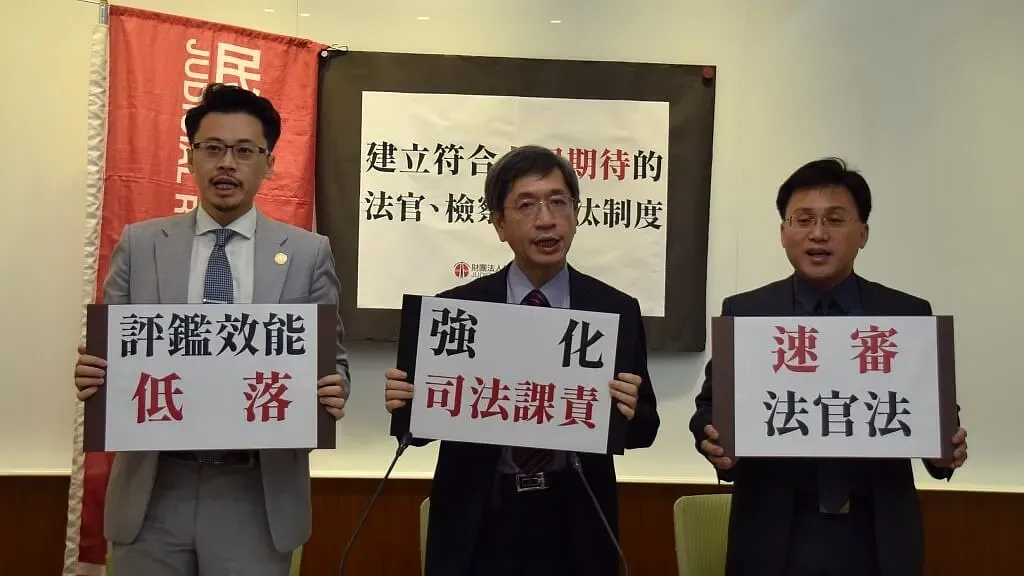
Establishing a System to Eliminate Unfit Judges and Prosecutors That Meets Public Expectations: Press Conference Calling on the Legislative Yuan to Support the NGO Draft Judges Act
Last edited: 2026-07-27
According to Judicial Yuan statistics, in 2000 Taiwan had 1,464 judges, 4,569,114 newly received cases for the year, and 4,191 petitions regarding public dissatisfaction with the judiciary. By 2017, the number of judges in Taiwan rose to 2,113, case intake dropped to 3,353,319, but public petitions surged drastically to 8,011. (See figure below and Attachment 1) These figures show that following the 1999 National Judicial Reform Conference, although the judicial system has made progress, it has failed to meet public expectations, leading to unremitting growth in public grievances.
The Legislative Yuan passed the Judges Act in 2011, establishing a "Review Commission" responsible for removing unfit judges and prosecutors. However, since its implementation, the number of disciplined judges and prosecutors has decreased significantly, and disciplinary penalties have been substantially mitigated. (See table below) The Judges Act has resulted in the failure to eliminate unfit personnel, which is reflected in the results of various recent polls showing that public trust in judges and prosecutors has hit record lows, and that the public's highest expectation for judicial reform is the strengthening of the removal mechanism for unfit judges and prosecutors.
Figure: Statistical Table of Petitions Received by the Judicial Yuan from the Public

| Degree of Discipline | Subtotal (Persons) | Annual Average (Persons) | Percentage | |
| Before Judges Act 1996–2008 |
Discipline (Penalty) of Admonition or Above | 142 | 11.8 | 67% |
| Discipline (Penalty) Below Admonition | 70 | 5.8 | 33% | |
| Total (Persons) | 212 | 17.6 | 100% | |
| After Judges Act 2012–2018 |
Discipline | 10 | 1.7 | 18% |
| Official Supervision | 47 | 7.8 | 82% | |
| Total (Persons) | 50 | 9.5 | 100% | |
| Source: Control Yuan, Judicial Yuan, Judges Evaluation Commission, Judicial Yuan Judgment Search System | ||||
In practice, resolutions by the Evaluation Commission have also severely deviated from public expectations, exposing the malpractice of officials shielding one another. For example, pursuant to Article 141 of the Statute for the Disposition of Debts, after a court rules that a debtor is not exempt from liability under Article 133 of the same Statute, as long as the debtor repays the remaining balance under Article 133, the court shall grant an exemption from liability, leaving no room for judicial discretion. However, Judge Ch'en Ch'iu-yueh of the Taichung District Court demanded that the debtor repay more money to the bank before granting an exemption. Regarding this point, the Judges Evaluation Commission dismissed the evaluation case against Judge Ch'en Ch'iu-yueh on the grounds that judges inherently have the right to "investigate the requirements for exemption without exceeding reasonable and necessary limits." (See Attachment 2, 2017 Ping-Tzu No. 3) To take two other recent examples: the case of Judge Ho Yü-ch'en of the Taoyuan District Court extorting confessions through detention, and the case of Judge Liu Cheng-chung of the Taichung District Court arbitrarily scheduling court dates. The evidence of illegality in both cases is extremely clear, and the infringement upon human rights extremely severe; yet neither case was referred to the Control Yuan for impeachment or recommended for discipline. (See Attachment 2, 2017 Ping-Tzu No. 5, 2017 Ping-Tzu No. 2) From overall judicial statistics and comprehensive public opinion polls to concrete individual case evaluations, the current Judges Act is in urgent need of amendment. To respond to public sentiment, our Foundation has launched the NGO Draft Judges Act.
The NGO Draft Judges Act references international standards to design an effective elimination mechanism for unfit personnel. Its key points are:
- Allowing the public to directly request evaluations, and extending the statute of limitations.
- Ensuring that non-legal professionals constitute a majority of the evaluation commissioners, and expanding full-time staffing.
- Expanding the authority of the Evaluation Commission to conduct comprehensive evaluations.
- Incorporating "errors in subsumption between facts and law" into the scope of evaluation to supervise judgment quality.
- Requiring the Judicial Yuan to directly refer evaluation resolutions to the Disciplinary Court, thereby streamlining the disciplinary process.
Our Foundation held a press conference on March 26, 2018 to unveil the draft, and we welcome discussion and critique from all sectors of society.
This Monday (the 6th), 11 groups including the ROC Judges Association, along with the Taiwan Bar Association and 15 local bar associations, respectively issued statements regarding the amendment of the Judges Act. Our Foundation hereby provides the following explanations and clarifications regarding the parts of those statements concerning the NGO Draft Judges Act:
-
Referencing International Standards and Supervising Judgment Quality
Article 30, Paragraph 3 of the NGO Draft states: "Mere criticisms pointing out errors in a judge's legal interpretations shall not be subject to individual case evaluation. However, errors in the subsumption between facts and law shall not be subject to this restriction." Various sectors have questioned whether this paragraph targets "legal interpretations" for evaluation, raising concerns of infringing upon judicial independence. However, per the draft's explanatory notes, our Foundation supports the principle that "legal interpretations" must not be subject to evaluation; the proviso was added to clarify the scope of "legal interpretations" and curb the malpractice of frequently using legal interpretations as a shield for poor judgment quality.
According to Article 7-1, Paragraph 3 of the Universal Charter of the Judge, in which the ROC Judges Association participated in amending in 2017: "Unless acted with malice or gross negligence, a judge shall not be subject to disciplinary action for factual determinations, legal interpretations, or evaluation of evidence made in good faith in a judgment." A judge's judgment shall in principle not be subject to discipline, but where "malice or gross negligence" is constituted, they shall exceptionally be subject to discipline; this is an international standard ensuring that judicial independence is not abused.
The NGO Draft complies with the standards proclaimed in the Universal Charter of the Judge, and its legislative explanation clarifies that "errors in the subsumption between facts and law" refers to circumstances where "factual determinations clearly contradict evidence in the case file, issues are misrecognized, or judgments are rendered based on the opposite understanding despite lacking constituent facts prescribed by legal provisions, etc." If various sectors believe that the statutory text concerning "errors in the subsumption between facts and law" is prone to divergence and misunderstanding in interpretation, our Foundation is willing to discuss and revise the text with partners concerned with the amendment of the Judges Act to make it clearer and more explicit—for instance, amending it to "serious violations of the rules of evidence"—and work together toward the goal of meeting international standards and supervising judgment quality.
-
Establishing a Selection System with Non-Legal Professionals Constituting a Majority
Article 34 of the current Judges Act stipulates that representatives of judges, prosecutors, and lawyers on the Evaluation Commission shall be selected through public voting, whereas scholars and prominent figures in society shall be selected and appointed by the President of the Judicial Yuan after "the Ministry of Justice and the Taiwan Bar Association each nominate four persons who are neither prosecutors nor lawyers." The selection and appointment process is neither open nor transparent, and currently all evaluation commissioners are individuals with legal backgrounds.
To reform the current evaluation commissioner selection mechanism dominated entirely by the "Judicial Yuan, Ministry of Justice, and Taiwan Bar Association," as well as the problem of shielding and favoritism within the Evaluation Commission, Articles 33 and 34 of the NGO Draft stipulate that non-legal professionals shall constitute a majority on the Evaluation Commission, with "6 representatives from non-legal academic and social organizations." They shall be selected by a "selection committee composed of 11 to 15 prominent figures in society" nominated by the Legislative Yuan, which will choose candidates at double the required capacity from nominees recommended by social organizations. After opening the pool to public feedback, the selection committee will make the final decision. Finally, the President of the Judicial Yuan shall submit 5 of the 11 selected evaluation commissioners to the President for appointment as full-time commissioners. The NGO Draft aims to resolve current malpractices through an open and transparent selection mechanism.
-
Regulating Conflicts of Interest and Strengthening Evaluation Authority
Both the official draft and the NGO Draft stipulate that representatives of agencies and organizations qualified to request individual case evaluations may not serve as evaluation commissioners—a conflict-of-interest avoidance rule absent from the current Judges Act. The NGO Draft further stipulates that non-legal professionals must constitute a majority of the commissioners on the Evaluation Commission, preventing legal professionals, including our Foundation, from monopolizing the formation of evaluation resolutions.
To effectively eliminate unfit judges and prosecutors, our Foundation advocates strengthening the authority of the Evaluation Commission, including directly accepting public petitions, increasing the authority to conduct comprehensive evaluations, and having the power to directly resolve to refer cases to the Disciplinary Court. Therefore, the NGO Draft plans to add 5 full-time commissioners and dedicated investigative personnel to boost the capacity of the Evaluation Commission to shoulder the aforementioned increased workload. By comparison, Control Members are all full-time, mostly non-legal professionals, and are allocated three tiers of investigators to assist them; thus, the design of the NGO Draft has solid grounding. (See table below)
Table: Comparison Table of Differences Among the Control Yuan, Judicial Yuan Draft, and NGO Draft Control Yuan (Judicial Yuan Draft)
Evaluation Commission(NGO Draft)
Evaluation CommissionComposition 29 persons
Majority are non-legal professionals13 persons
Majority are legal professionals
No ratio prescribed for non-legal professionals11 persons
Non-legal professionals constitute a majorityNature Full-time commissioners Part-time commissioners 5 full-time commissioners, 6 part-time commissioners Assistance 24 to 28 investigators Not prescribed Addition of dedicated investigative personnel Statute of Limitations 10 years 3 years from the date of case conclusion 3 years from the date of judgment finalization Procedure General civil servants
Commission on the Disciplinary Sanctions of Functionaries: one tier, one trialJudges and prosecutors
Disciplinary Court: two tiers, two trialsJudges and prosecutors
Disciplinary Court: one tier, one trialRecently, our Foundation petitioned the Control Yuan to investigate three cases in which the Prosecutor Evaluation Commission found evaluations unfounded or did not proceed with evaluations, and all yielded investigative results calling for official supervision. (See Attachment 3) This demonstrates that "full-time status, non-legal professional makeup, and investigative staffing" are the keys to effectively supervising judges and prosecutors, as well as necessary reform measures.
We trust that the explanations of points two and three above will clarify the criticisms from various sectors alleging that the NGO Draft seeks to "control and monopolize the Judges Evaluation Commission through a standing full-time system and by increasing the quota to a majority." The draft ensures that "legal professionals," including our Foundation, do not control or monopolize the Evaluation Commission, thereby aligning with the public's reform expectations of strengthening the removal of unfit judges and prosecutors.
Finally, we call on the Legislative Yuan to support the NGO Draft Judges Act, strengthen judicial accountability, defend judicial independence, and win back public trust in the judiciary through reform.
Attachments
- Statistical Table of Total Judges, Judicial Case Intake, and Public Petition Cases (1996–2017)
- Overview Table of Recent Contested Resolutions by the Judges Evaluation Commission
- Comparison Table of Prosecutor Evaluation Commission Resolutions and Control Yuan Investigation Results
- Draft Difference Comparison Table
Attending Representatives
Lin Yung-sung / Chairperson, Judicial Reform Foundation
Lü Shao-wei / Pro Bono Attorney, Judicial Reform Foundation
Hsiao I-min / Office Director, Judicial Reform Foundation
Huang Ying-chia / Director of Individual Case Action Department, Judicial Reform Foundation
Press Contact
Director Hsiao I-min, Judicial Reform Foundation (02)2523-1178
This article is an AI-generated translation of the original Chinese text. In the event of any discrepancy, the Chinese version shall prevail.