
[Statement] Responding to Official Report with 25 Recommendations, Holding a 2nd Anniversary Symposium on Judicial Reform in October – Citizen Coalition for Monitoring the Resolutions of the National司改 Conference
Last edited: 2026-11-03
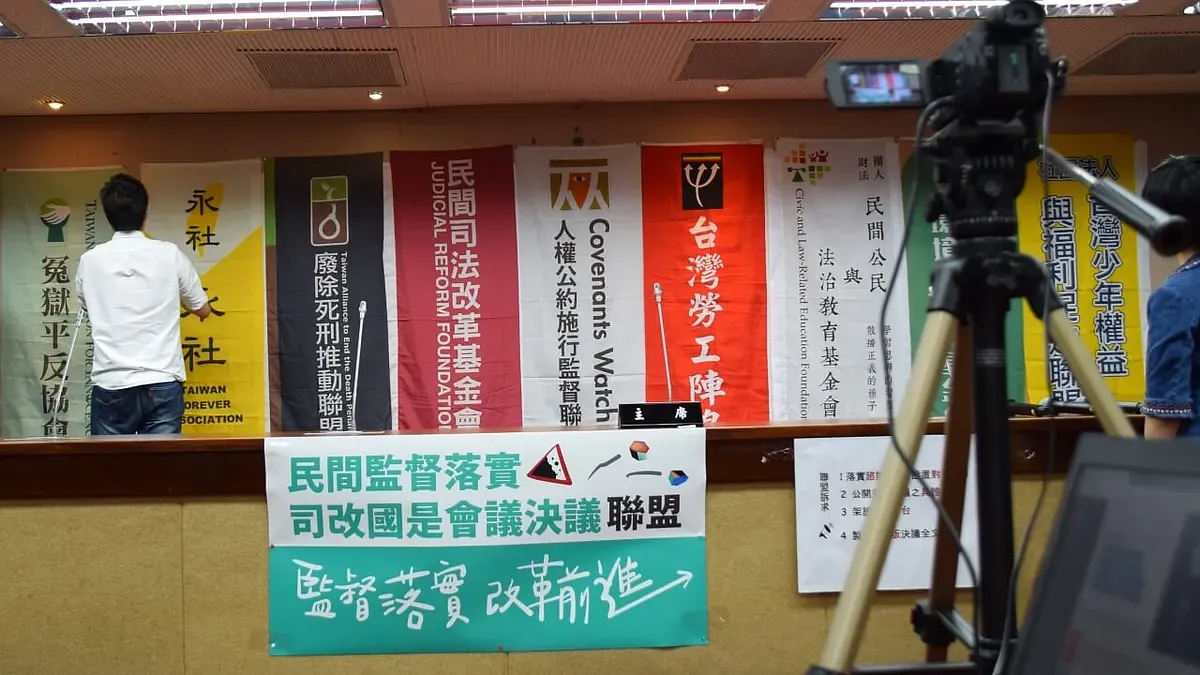
File photo / Oct. 6, 2017 Press Conference on the Establishment of the Citizen Coalition for Monitoring the Resolutions of the National Judicial Reform Conference
Two years have passed since the conclusion of the National Symposium on Judicial Reform in August 2017, and the government held a press conference today (the 26th) to explain the implementation status of the judicial reform resolutions. While the Citizen Coalition for Monitoring the Resolutions of the National Judicial Reform Conference acknowledges certain government policies, overall, the pace of reform remains too slow. As the 2020 presidential election approaches, the government should factor in the likelihood of drastic changes in personnel and policy direction, and promptly adjust its policy direction and progress to fulfill the goals of judicial reform.
In addition, the Coalition will hold the "Symposium on the Second Anniversary of the National Judicial Reform Conference" at the Taipei Bar Association on October 5. The Coalition will invite group conveners and members of the National Judicial Reform Conference, official representatives, and individuals from all walks of life concerned with this issue to participate. The symposium will analyze how judicial reform can enhance public trust, narrow the distance between the judiciary and the people, and review the implementation status of key issues. Through mutual exchange at the symposium, we hope to identify problems and implement the judicial reform resolutions.
Regarding the progress and implementation status of various issues from the National Judicial Reform Conference, the Coalition categorizes them into four major types for explanation: 1. Legislation or amendments to regulations have been enacted; monitoring is required to ensure implementation. 2. Amendment drafts have been submitted but have not yet passed three readings. 3. Laws or administrative orders should be amended, but have not been completed or show no progress. 4. No legislative or administrative order amendments are required, but they have not been effectively implemented.
I. Legislation or amendments to regulations have been enacted; monitoring is required to ensure implementation
-
Affirming the passage of the Constitutional Court Procedure Act, Labor Incident Act, and Code of Criminal Procedure
Regarding the reform of judicial procedures, the Coalition affirms the government's efforts in promoting legislative amendments. It is hoped that the passage of the Constitutional Court Procedure Act and the Labor Incident Act will fulfill the intent of protecting fundamental constitutional rights and workers' rights, and that the additions regarding the right to review files and restrictions on leaving the country or sea in the Code of Criminal Procedure will perfect people's litigation rights and truly enhance public trust in the judiciary.
-
The Judges Act, Directions for the Operation of Non-Disclosure of Investigation, and amendments regarding police handling of cases should play a concrete role
In addition, although the Judges Act has added provisions for people to directly request evaluation and procedural safeguards, the scope of evaluation, as well as the regulations on evaluation committee members and organization, remain too narrow and vague. The Coalition will continue to monitor the operation of the Evaluation Committee after the new law is passed.
The amendment to the Directions for the Operation of Non-Disclosure of Investigation provides clearer regulations on the protection of privacy and the fulfillment of the public's right to know. The Coalition calls on police, prosecutors, and investigative agencies to conduct adequate education and training for relevant personnel to meet the requirements of the new law.
Finally, although the official authorities have adopted measures to prevent miscarriages of justice, such as the "Directions for Police Agencies in Implementing the Identification of Suspects" and the "Improved Model for Police Interrogations in Taiwan," multi-party monitoring must be actively implemented to ensure effective operation, thereby reducing the risk of witnesses being led or misidentifying suspects. Police interrogation procedures must also uphold the presumption of innocence to prevent miscarriages of justice.
-
Prosecutorial authorities leading the handling of major child abuse cases and child death reviews
The Ministry of Justice issued and promulgated the "Workflow for Prosecutorial Agencies in Investigating Major Child Abuse Cases," which was implemented nationwide on May 1, 2019. For death cases of children under the age of 6, the Ministry of Justice will have sole jurisdiction over judicial post-mortems, hoping to reduce the dark figure of child abuse resulting in death. Regarding non-fatal child abuse cases, as long as social workers from family violence prevention centers report suspected child abuse cases, prosecutors will intervene early to strengthen evidence preservation, thereby identifying high-risk families and reducing the number of child abuses.
-
The newly amended Air Pollution Control Act and Toxic and Concerned Chemical Substances Control Act have entered into force; their subsequent effects remain to be monitored
To curb the deterioration of air pollution, the amendments significantly increased criminal and administrative penalties. Administrative fines were raised from NT$1 million to NT$20 million; criminally, the maximum penalty can be life imprisonment, and the upper limit of fines was raised from NT$5 million to NT$30 million. Furthermore, fines for legal entities or natural persons are increased to ten times the current amount. In the future, air quality monitoring data, inspection dispositions, and the utilization of air pollution fees will also be made public on websites for public monitoring and participation.
For those who obtain benefits from violations, the Toxic and Concerned Chemical Substances Control Act mandates the recovery of illicit gains in addition to fines, and introduces reporting bounties and whistleblower systems to encourage the reporting of illegal activities. In addition, factories are required to make licensing and reporting data public for universal oversight.
II. Amendment drafts have been submitted but have not yet passed three readings
-
Bills reviewed and passed by various committees of the Legislative Yuan are hoped to complete deliberation in the final session
Through the efforts of all parties, amendment drafts for some resolutions of the National Judicial Reform Conference have been proposed, taking another step forward on the path of judicial reform. However, the current term of legislators has only one session left. If they fail to pass smoothly, judicial reform will be tantamount to standing still. We expect all agencies to urge the Legislative Yuan to schedule bills for review, especially those that have already been reviewed and passed by various committees of the Legislative Yuan, so that they can quickly complete the second and third reading procedures in the final session.
-
The draft Code of Criminal Procedure and the Attorney Regulation Act should be passed as soon as possible
Most current retrial cases are handled through written review and rarely involve oral arguments. This results in applicants having their retrial applications rejected—leaving them with nowhere to turn for help—even when submitted, because they fail to meet the stringent requirements of the old law regarding "new facts and new evidence." However, the Executive Yuan passed the amendment draft to the Code of Criminal Procedure on June 13, 2019. The draft includes procedural safeguards for retrial applications; grants applicants the right to defense, the right to review files, the right to state opinions, and the right to investigate evidence; and effectively protects the rights and interests of applicants. This draft was submitted to the Legislative Yuan in the first half of this year, and we expect this bill to be passed as soon as possible to uphold judicial justice.
The quality of expert testimony and the admissibility and probative value of expert reports have been the subject of continuous controversy over the years. Following prolonged discussions, the Judicial Yuan passed the amendment draft for the expert testimony chapter of the Code of Criminal Procedure on May 30, 2019. The Coalition hopes it will be passed swiftly to truly practice reform and meet the public's expectations for advancing judicial reform.
After long discussion and compromise, the Attorney Regulation Act was finally passed by the Judiciary and Organic Laws and Statutes Committee of the Legislative Yuan on May 30, 2019. The content of the amendments includes resolutions of the National Judicial Reform Conference, such as individual lawyers being members of the Taiwan Bar Association and incorporating external members into the Lawyer Ethics and Disciplinary Committee, which is worthy of affirmation.
-
The Prison Act and Detention Act should be passed as soon as possible
The normative density of the current Prison Act and Detention Act no longer meets our country's current requirements for a state under the rule of law. In practice, measures such as the establishment of disciplinary cells, the use of restraint equipment and calming rooms, and the implementation of solitary confinement have legal norms that are too brief or lacking, and there is no basis for enacting relevant authorization regulations. In addition, Judicial Yuan Interpretations No. 755 and No. 756 were promulgated on December 1, 2017, ruling that certain provisions of the Prison Act concerning external remedies for communications and complaints are unconstitutional, and according to the intent of the Grand Justices' interpretations, appropriate regulations must be enacted within two years from the date of promulgation.
The Executive Yuan submitted the amendment drafts of the Prison Act and Detention Act to the Legislative Yuan for deliberation on April 12, 2019, and the bills have currently cleared committee review. In addition to comprehensively upgrading the normative density and making relevant amendments and additions to external remedies for communications and complaints, the amendment drafts also add a mechanism for external prison inspections, strengthen the responsibility of the Ministry of Health and Welfare in helping improve medical care in correctional institutions, and broaden the scope of lawyer visits. The Coalition hopes they will be passed swiftly to take an important step forward in correctional institution reform.
-
Legislation should be promptly enacted to protect the right to life of children and youths
Last year, the Health Promotion Administration commissioned Professor Lü Tsung-hsueh of the Institute of Public Health at National Cheng Kung University to conduct a pilot project on child death reviews in Hualien, Taichung, and Kaohsiung for children under 18 years old, the vast majority of whom were under 6. The project concluded in February this year, completing a total of 27 death reviews. This year, the pilot project will be expanded to include more counties and cities, further establish standard operating procedures, and develop a more comprehensive model to reduce the risk of non-natural deaths among children.
Official authorities proposed an amendment draft to the Protection of Children and Youths Welfare and Rights Act, which was submitted to the Legislative Yuan on March 14, 2019, and directly referred for second reading. The main content of the amendment is to incorporate child death reviews for children under 6 into the law and require the regular publication of analysis results. Once codified, it is expected that official authorities will faithfully publish their analysis results to reduce the proportion of non-natural deaths among young children.
-
Articles 48-1 and 71 of the Waste Disposal Act regarding liability for compensation should be promptly amended or repealed
We hope to establish the liability for compensation of environmental polluters so that there is a basis for the costs of restoring the environment. Therefore, Article 48-1 should be passed as soon as possible: compensation costs required for environmental restoration caused by environmental damage should be included in the scope of criminal proceeds, and it should be explicitly stipulated that they may be preserved and seized when necessary.
In addition, the Environmental Protection Administration has currently commissioned the Industrial Technology Research Institute to research and revise Article 71 of the Waste Disposal Act, planning to further amend Article 71 of the Waste Disposal Act so that necessary costs for cleanup, improvement, and derivation can be estimated. We also look forward to seeing this research project propose a draft as early as possible and pass it into legislation.
-
Articles 53 and 56 of the Protection of Children and Youths Welfare and Rights Act, Article 11-1 of the Human Trafficking Prevention Act, and the Personal Data Protection Act should be promptly reviewed and amended
Regarding the "Directions for Reporting, Grading, Classifying, Processing, and Investigating Child and Youth Protection Cases," when there are difficulties in conducting home visits for tier-one child and youth emergency protection and placement events and tier-two category-one placement and assessment events, or when children or youths are missing, and it is necessary to apply for telephone communication records, health insurance, or medical records of the children, reports may be made to prosecutors to retrieve them or applications may be filed with the court for the issuance of a retrieval warrant; and please review and amend Article 131 of the Code of Criminal Procedure to grant judicial police (officers) the feasibility of conducting searches without a warrant when necessary.
III. Laws or administrative orders should be amended, but have not been completed or show no progress
Through our collective efforts, we can see the progress brought by judicial reform. Regrettably, there are still instances of evading the resolutions of the National Judicial Reform Conference, leading to uncompleted and stagnant situations.
-
There is no significant progress in making the Judicial Yuan a judicial adjudication organ, and professionalizing and transparentizing courts
In terms of the judicial system, to solve the problem of the judiciary's "two-headed carriage" and return final trial power to the Judicial Yuan, the Grand Justices made a constitutional interpretation in 2001 proposing "making adjudication an organ." Due to delays in progress, the National Judicial Reform Conference reiterated the necessity of making adjudication an organ. However, the government has done nothing in this regard. Furthermore, the training and establishment of specialized courts and specialized prosecutorial divisions have also progressed slowly. The openness of judicial procedures, the system of non-concomitant transfer of case files and evidence, and more comprehensive mediation and arbitration mechanisms remain a distant prospect.
-
Deliberations on the Citizen Judge system remain stagnant
Although the National Judicial Reform Conference did not reach a resolution on the lay participation system or the jury system, allowing citizen judges to step into the courtroom as soon as possible is a consensus of the conference. However, the Judiciary and Organic Laws and Statutes Committee of the Legislative Yuan only scheduled related bills for review last year and has taken no action this year. Even though controversies surrounding the adoption of a lay participation or jury system persist, the Legislative Yuan, as a representative body of public opinion, should actively face problems and bridge controversies to implement the judicial reform resolutions and meet public expectations.
-
There are no concrete reform measures for police academy internships and the police system
Regarding the persistent problem of the exploitation of police academy internships, the National Conference strives to protect labor rights and salary issues for interns. However, official authorities all argued that interns do not possess police status and therefore cannot apply relevant regulations, allowing such unfair treatment to persist. Moreover, no response has been made regarding the Police Education and Training Committee or the Police Special and Performance Management Committee.
-
Failure to establish a comprehensive evidence custody system and an independent forensic science committee
On the other hand, regarding the clear regulations proposed by the National Judicial Reform Conference for evidence chain of custody and the preservation of evidence after final judgment, as well as the establishment of an independently functioning "Review Mechanism for Final Criminal Cases," official authorities rejected their establishment on the grounds of lack of necessity and differing institutional national conditions. However, the points raised by the National Conference must have their reasons and were proposed with the belief that related systems can bring longer-term progress to our country's judiciary. Whether the official authorities' rejection of the resolutions on simple grounds is too hasty is open to debate.
To reduce the incidence of wrongful convictions, the National Judicial Reform Conference resolved that an independently functioning "Forensic Science Committee" should be established to strengthen the accuracy of judicial fact-finding. However, official authorities have long remained at the stage of studying this part, resulting in delayed progress.
-
Official authorities refuse to establish a child and youth protection office, disregarding the rights and interests of children and youths
Regarding the widely concerned rights and interests of children and youths, the National Conference actively demanded the establishment of a Child and Youth Protection Office, hoping to integrate relevant resources from social welfare, police administration, medical, educational, and prosecutorial systems to assist local governments in handling identification, screening, and counseling mechanisms for child abuse, children without support, juvenile delinquents, and drug-using juveniles. However, official authorities refused to establish a Child and Youth Protection Office on the grounds of responsibility division, and did not assign the items originally intended to be handled by the Child and Youth Protection Office in the resolution to existing organizations.
-
Working conditions and pay for correctional officers should be protected in accordance with the resolutions
Taking correctional institution management as another example, to improve the plight of frontline correctional personnel suffering from overwork and salary deductions, and based on problems such as insufficient manpower, correctional workers must be scheduled for on-call duties during shifts. During this period, workers are in a state of constant alert, which increases working hours, yet their pay is not comparable to active duty, resulting in the problem of unequal pay for equal work. To address this, legislation for the "Regulations on On-Call Duties of Correctional Officers" should be promptly promoted to redefine working hours and pay to resolve the predicament of overwork and salary deductions. However, official authorities have not made a clear response to the regulations nor proposed effective solutions.
-
Official authorities should actively propose solutions and not ignore opinions from all sides
The existence of the National Judicial Reform Conference is precisely to perfect the judicial system and allow the whole society to make greater progress. Official authorities should think more carefully about the content of the resolutions, respect the spirit of the resolutions, and should not ignore the opinions put forward by all sides. Even if they refuse to establish relevant regulations, they should propose corresponding solutions instead of choosing to forget them, leaving the content of the resolutions without progress and stuck at a certain stage, unable to move forward. It is hoped that official authorities can take practical actions or provide other problem-solving methods to bring truly effective reform to our country's judiciary.
-
Review current criminal penalties and reporting regulations related to consensual sexual behavior between "two sweethearts"
This Coalition does not support the complete abolition of Article 227 of the Criminal Code, but only the decriminalization of paragraphs 3 and 4 thereof, concerning sexual intercourse and obscene acts between males and females aged 14 and over but under 16; and suggests amending the Gender Equity Education Act and the Protection of Children and Youths Welfare and Rights Act to replace the Criminal Code, so that current sweetheart cases are no longer handled as sexual assaults, but changed to "minor intimate relationship events," allowing schools or social workers to resolve them through education or counseling. The Taiwan Law and Technology Association has initiated "Research on the Pros and Cons of Decriminalizing Consensual Sexual Intercourse or Obscene Acts Between Minors Under 16."
-
Proposed amendment to Article 9 of the Genetic Health Act to implement women's autonomy
Regarding regulations concerning the decision-making power of minors and married women regarding induced abortions to implement women's autonomy, and appropriately introducing judicial or administrative dispute resolution mechanisms when opinions differ. According to paragraph 2 of Article 9 of the current Genetic Health Act, when a married woman wishes to undergo an induced abortion under subparagraph 6 of paragraph 1 of Article 9 (pregnancy or childbirth affecting her mental health or family life), she must obtain her husband's consent without exception clauses, and without considering at all whether the woman has suffered domestic violence in the marriage or has other reasons for which the marriage cannot be maintained. This forces battered women or women already undergoing divorce proceedings to potentially be unable to undergo induced abortions or suffer other adverse oppressions due to this regulation, which should also be amended together.
It is suggested that exception clauses not requiring the husband's consent should be added, and even in the absence of exceptional circumstances, when a married pregnant woman and her husband disagree on whether they meet the conditions of subparagraph 6, a dispute resolution mechanism by judicial or administrative authorities should be established so that the reproductive autonomy of married pregnant women is protected.
-
Increase the right of sexual assault victims to participate in litigation
To enable sexual assault victims to maintain their judicial subjectivity and fulfill the intent of the Sexual Assault Crime Prevention Act and the newly added provisions in 2015 to protect victims, relevant units are urged to study and design various victim litigation participation systems in all stages of judicial proceedings, including investigation initiation, review of prosecution, court trial, and execution of punishment. Victims are clearly parties throughout the criminal event, yet in judicial proceedings, they are subjected to objectification—that is, becoming merely objects from whom evidence is gathered, while ignoring the fact that they are the true parties. Currently, only court trials have proposed drafts under review in the Legislative Yuan; the remaining stages should also be studied as soon as possible.
-
Need to add legal basis for recovering illicit gains, burden of proof in environmental crime cases, and provisions related to joint and several liability
Among current more important environmental protection regulations, the Soil and Groundwater Pollution Remediation Act and the Marine Pollution Control Act still lack relevant legal bases. Articles 18 and 87 of the Air Pollution Control Act and Articles 47 and 48 of the Toxic and Concerned Chemical Substances Control Act have already been amended. It is hoped that the Soil and Groundwater Pollution Remediation Act and the Marine Pollution Control Act can add relevant legal bases for recovering illicit gains and provisions on environmental restoration or pollution cleanup expenses for the items funded by the marine pollution fund.
Drafts related to the criminal and civil burden of proof in environmental crime cases and the joint and several liability of criminals should be promptly formulated, rather than stopping at exploratory procedures such as seminars; the Environmental Protection Administration should substantively propose drafts or further actions such as legal amendments.
-
Improve the draft "Environmental Dispute Mediation Act"
The current Environmental Dispute Mediation Act has decided to add and amend provisions reversing the burden of proof in environmental dispute cases, and commissioned research work is underway. Although active actions have been taken regarding this law, it is still hoped to add and amend one or several provisions on environmental tort damages that ordinary people can use, because the current provisions on environmental tort damages in Article 191-3 of the Civil Code remain insufficient.
IV. No legislative or administrative order amendments are required, but they have not been effectively implemented
-
The adjustment of the nature of hospital beds for inmates should be implemented immediately
In addition to whether resolutions are executed, the progress of execution is also a focus of public attention, especially content that does not need to be passed through the legislative amendments of other agencies, which should see substantive action. For example, studying the adjustment of the nature of hospital beds by planning certain areas in medical institutions for the use of sentenced prisoners: an official letter was sent to the Ministry of Justice on October 23, 2018, requesting it to study the "Feasibility Assessment on Reclassifying Custodial Hospital Beds for Inmates in Correctional Institutions of the Agency of Corrections, Ministry of Justice." However, to this day, it remains at the study stage without subsequent updates provided. This type of issue does not require legislative amendments to be implemented swiftly to achieve reform results. However, official authorities have handled the matter passively, causing progress to stagnate. The Coalition expects official authorities to truly implement it to meet public expectations.
-
Resources should be injected into judicial interpretation and appointed counsel
How disadvantaged groups are protected by the judiciary has always been a matter of public concern. Interpreters, such as language translators and sign language interpreters, are the most basic conditions for people to enter the judiciary. However, two years after the resolution, problems of insufficient professional training and funding for interpreters have still not been completely improved. In addition, the circumstances under which judges can appoint counsel in the Code of Criminal Procedure are mostly limited to mental disabilities; other intellectual disabilities, such as hearing impairments, also require related assistance. Therefore, we call on the government to actively inject resources to train interpreter talent and increase the types of appointed counsel.
-
Work to improve the quality of expert testimony should be implemented immediately
Forensic science is the cornerstone of judicial justice, but since the resolution, there has been only slight progress. Not only is the progress of forensic science education at zero, but the Ministry of Justice has also failed to plan education, training, and certification systems for expert witnesses, promote laboratory accreditation, establish forensic expert testimony guidelines and standard operating procedures, or review flawed expert testimony. In addition, there are many problems in forensic pathology. Currently, 3 prosecutors' offices in Taiwan have no official forensic pathologists, and 8 prosecutors' offices have only 1 official forensic pathologist. It is recommended that, except for offshore islands, at least two or more official forensic pathologists should be stationed to ensure the quality control mechanism of internal professional reviews.
Attachments
- Written Materials on Judicial Reform Progress Tracking – Garden of Hope Foundation
- Statement on Environmental Judicial Reform – Environmental Jurists Association
- Second Anniversary Statement on the National Judicial Reform Conference – Taiwan Police Labor Rights Promotion Association
- Improving Forensic Science – Professor Li Chun-i
This article is an AI-generated translation of the original Chinese text. In the event of any discrepancy, the Chinese version shall prevail.