
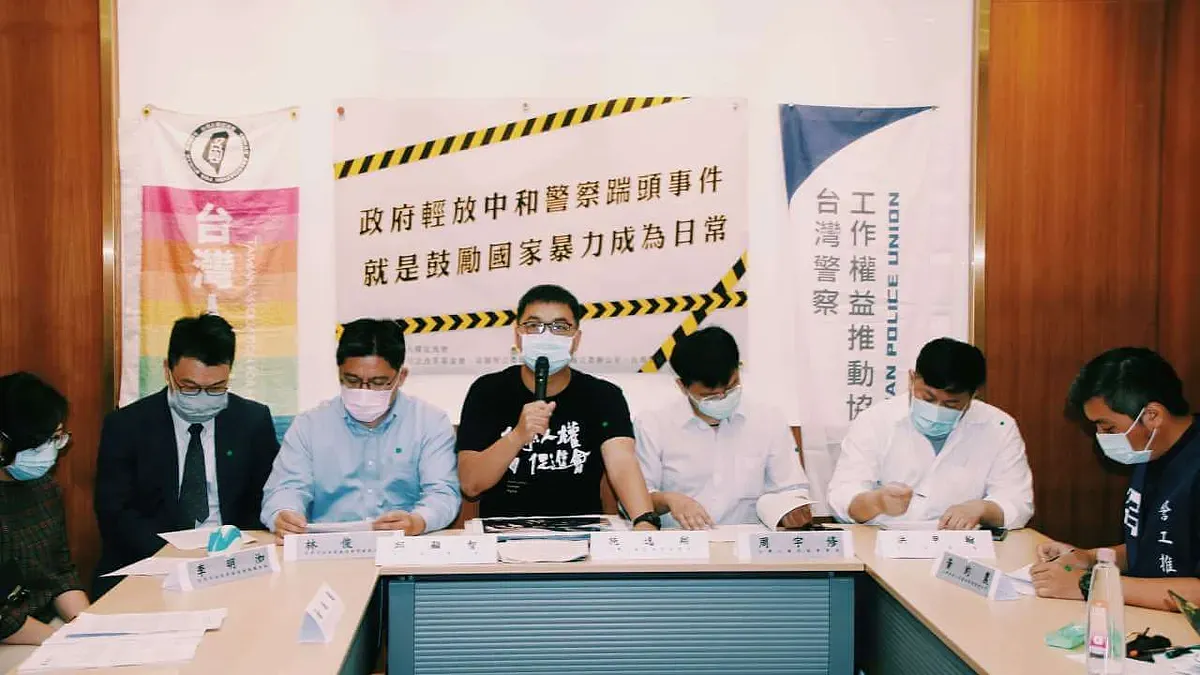
The Government's Lenient Treatment of the Zhonghe Police Head-Kicking Incident Encourages State Violence to Become the Norm
Last edited: 2026-07-27
More than 20 days have passed since the violent head-kicking incident involving officers from the Zhonghe Precinct against a juvenile who refused a police inspection on the midnight of April 7. However, various signs indicate that the government merely wants to brush this police brutality incident aside and is unwilling to properly face the systemic and structural problems of police performance flaws and police training and education. After the head-kicking incident sparked widespread public discussion, the officer involved was given two demerits in disciplinary punishment, but the Zhonghe Precinct simultaneously publicly commended the head-kicking officer, handing out both demerits and merits in an attempt to weather the public relations crisis. Meanwhile, former National Police Agency (NPA) Director-General and incumbent New Taipei City Mayor Hou Yu-ih publicly supported the police's forceful law enforcement, offering only an ambiguous statement that "actions that are not necessary do not need to be done." He deliberately ignored the fact that police officers, as public servants exercising formidable public authority, should strictly adhere to the most basic principles of the rule of law and conduct all actions in accordance with the law, rather than using tactics akin to those of organized crime to deal with people they dislike. The New Taipei City Government Police Department, which ought to have initiated an investigation into the case, merely posted on Facebook on April 16 that the entire case had been handed over to the New Taipei District Prosecutors Office for handling. Currently, the outside world has yet to see relatively complete investigative reports and explanations from the central NPA and the local government police department.
Civil society groups, including the Taiwan Association for Human Rights (TAHR), the Judicial Reform Foundation (JRF), and the Taiwan Police Front, issued statements in strict condemnation following the incident. They not only demanded an apology from the Zhonghe Precinct and a public investigative report from the New Taipei City Police Department regarding this specific incident, but also made concrete institutional recommendations to central and local police agencies. Beyond handing this act of state violence and torture over to third-party judicial authorities, they urged an "proactive deployment" approach to prevent and deter similar incidents from happening again through policy measures. In particular, they called for the proper establishment of basic human rights and rule-of-law education within police training and in-service education, as well as a review of police duty systems that grassroots officers have long been concerned about. However, to date, the Zhonghe Precinct has not issued a public apology, the New Taipei City Police Department has not released a complete public investigative report, and the central NPA has shown no intent to carry out thorough institutional reform.
We believe that this police head-kicking incident constitutes torture as defined under Article 7 of the International Covenant on Civil and Political Rights (ICCPR). Ironically, the NPA is government agency responsible for promoting the Enforcement Act of the UN Convention against Torture, yet it is evident that the police agencies and officers are precisely the government agency and public servants most in need of training on how to prohibit torture. In fact, this head-kicking incident is not an isolated case. The 2017 case of a Vietnamese migrant worker having lost contact who was shot dead nine times by Hsinchu police officers, the head-lacerating and bleeding injuries inflicted by police on protesting citizens and legislators during the March 23 Executive Yuan occupation, the Daguan incident and the Lalaway indigenous settlement case where police excessive use of force was pointed out by Control Yuan Member Kao Yung-ch'eng (高涌誠), as well as many other cases of police abuse of power that have not yet been reported by the media, are all problems that police agencies must properly confront. Without resolving these issues from the fundamental institutional level, not only are similar incidents likely to happen again in the future, but it will also undermine the image the police system seeks to build.
Att. Chou Yu-hsiu, President of the Taiwan Association for Human Rights, stated that in accordance with the resolutions of the 2017 National Conference on Judicial Reform, a "Police Education and Training Committee" and a "Police Projects and Performance Management Committee" should be established under the Ministry of the Interior. However, the NPA only accepted the issues raised but rejected the resolution contents and proposed alternative countermeasures instead. Examining their countermeasures and implementation content, police education and performance management are still largely overseen by experts and scholars originating from police circles. Is there really any difference in actual operations compared to the previous situation where police personnel supervised these matters? Furthermore, according to Judicial Yuan Interpretation No. 785, the health rights of civil servants must be protected. Do grassroots police officers truly suffer from overwork, which in turn leads to poor performance? How can we improve the different cognitive foundations and achieve effective communication between the police and the outside world, as shown by multiple communication experiences? These are all issues that must be faced head-on.
Att. Lin Chün-hung, Standing Executive Committee Member of the Judicial Reform Foundation, reiterated the JRF's statement and demands, pointing out that although the New Taipei City Police Department's Inspectorate Division has given the head-kicking officer two demerits, the systemic causes of this incident still require review. He called on the New Taipei City Police Department to thoroughly review the course and causes of this incident and to make the review report public. Attorney Lin further stated that the pressure and behavioral performance of frontline law enforcement are not merely a matter of improper emotional management by individual officers, but involve issues such as the overall performance system, management culture, and constitutional literacy training. Judging from the experience of the March 24 litigation, is the state condoning violence by public servants? He called on police, prosecutors, and civil society to work together to make this incident an opportunity for thorough review and reform, abandon the law enforcement culture that only seeks results regardless of the process and even breeds violence, and practice law enforcement in accordance with the law.
Legislator Hung Sun-han explained based on his own experience as a protestor during the March 24 incident that when the police enforced the law that day, they did not arrest him, but instead kicked the back of his knees. Why did the police kick the back of his knees? Because the police wanted people to kneel. In this recent incident where the police kicked a citizen's head, why did the police kick the head? Legislator Hung believes that police enforcement violence shares a commonality: it is not just violent beating, but an intent to humiliate you, to trample your dignity into the dirt, and to make you feel terror and fear. When the police intend to humiliate you and make you feel fearful, that kind of fear surges from all aspects into an all-encompassing terror. Consequently, watching the footage of this incident made him feel deeply uncomfortable and heavy-hearted. During the press conference, the legislator also asked the police representatives present—Deputy Director Su of the NPA Education Division, Chief Lin of the Zhonghe Precinct, and Chief Inspector Chan of the New Taipei City Police Department—"Have you ever been beaten and humiliated by the police while on duty?" Their answers were all "No." If the police have no such experience, what right do they have to refuse outsiders from participating in the committee's operations and making demands for reform? This out-of-control violent head-kicking incident by Zhonghe Precinct officers should not be treated as an isolated incident, with individual officers held accountable and the matter closed; such incidents may be happening every day. The NPA should squarely face the entire systematic and institutional problem, introduce the expertise and technology of external experts, and the legislator believes that citizens who have experienced humiliating violence by the police should also be allowed to participate together. This is not meant to make the police feel like children who have done something wrong, but rather through this process of mutual understanding that the police establishment can understand why the current police system needs reform.
Huang Yuo-nung, Supervisor of the Taiwan Police Front, viewed the matter from the perspective of "how the performance system distorts law enforcement consciousness," arguing that police agencies have long suffered from the problem of rule of man prevailing over the rule of law. Illegal, abusive, and high-risk law enforcement methods are frequently employed, and dangerous and illegal enforcement methods are even rewarded within police circles, which over time distorts the law enforcement concepts of police personnel. Supervisor Huang further pointed out that the quasi-military training within police circles is a major obstacle preventing human rights education from entering police education. He concretely suggested eliminating the authoritarian legacies within police education and training and cultivating genuine human rights literacy, which is the proper remedy for reforming police law enforcement culture.
Att. Li Ming-ju, full-time attorney at the Judicial Reform Foundation, stated that following this incident, the question raised by many citizens and grassroots officers was: if citizens do not cooperate with inspections, can we not "enforce the law forcefully"? However, confusing forceful law enforcement with unlawful violence is wrong. In a rule-of-law country, there is no such concept as weak or strong law enforcement; there is only the concept of rule-of-law enforcement, and the purpose and means of all exercises of public authority must correspond. Furthermore, the Standard Operating Procedures (SOPs) for police use of coercive force have always been vague in our country. This is a problem that must be fundamentally recognized and changed by everyone from the top NPA down to local police agencies, whether in rule-making or educational training.
Recently, in the second instance retrial of the March 23 Executive Yuan occupation case, there was a shocking reversal ruling citizens guilty. However, the violent police officers who attacked citizens with force that day have yet to be found. Legislator Hung Sun-han, who also witnessed state violence at the scene of the Executive Yuan in 2014, stated that this out-of-control violent head-kicking incident by Zhonghe Precinct officers should not be regarded as an isolated incident, with individual officers held accountable and the matter closed. Such incidents could potentially happen every day. The NPA must squarely face the entire systemic and institutional problem, implement the two resolutions from the National Conference on Judicial Reform regarding the establishment of a "Police Education and Training Committee" and a "Police Projects and Performance Management Committee," introduce the expertise and technology of external experts, and strengthen police education and training in order to prevent similar incidents from recurring.
Among the representatives of police commanding officers attending this press conference, two responded. Su Chen-lung, Deputy Director of the NPA Education Division, reiterated that officers enforcing the law must abide by the principle of proportionality to avoid excessive enforcement, noting that current police academy curricula also incorporate human rights and rule-of-law education, with 12 out of 18 curriculum committee members being experts and scholars, while the rest are grassroots representatives, and only two are school personnel. Regarding cases of excessive law enforcement, relevant teaching materials will also be produced for educational purposes.
Chan Yung-hua, Chief Inspector of the New Taipei City Government Police Department, stated that flaws are inevitable during the law enforcement process. In this case, the handling after citizens refused inspection indeed violated the principle of proportionality; there will definitely be no cover-up and accountability will be pursued. He also clarified the misunderstanding regarding the commendation, explaining that the leaked condolence photos were merely routine inspections by various units and were not intended to commend the officers' actions in this case. When TAHR Secretary-General Shih Yi-hsiang asked when the inspection unit would make the review report public, Chief Inspector Chan stated that it would not be proactively made public, and citizens who need it may apply through official document procedures.
Attachments
- Statement by the Taiwan Police Front
- Speech Transcript of Legislator Hung Sun-han
- TAHR Statement on the Zhonghe Precinct Police Head-Kicking Incident: "What is Being Trampled is Not Just the Rights of Minors, But the Principle of the Rule of Law and Police Dignity"
- Eliminating the Law Enforcement Environment That Breeds Violence ~ Three Statements by the JRF on the Zhonghe Police Violence Incident
- Clarification by this Foundation Regarding Media Reports on April 15 that "Zhonghe Precinct Chief Lin Ku-ting Played the Video for the JRF to Listen to, Confirming Officer Ch'en Did Not Say 'Eat a Bullet'"
- Statement by the Taiwan Police Front: Resolutely Oppose "Seeking Performance Only, Disregarding the Law"
- Shih Chia-cheng: The Constantly Black-Box NPA
- Wang Lun-yü: Why Are There So Many Controversies in the Zhonghe Precinct?
Attendees
Moderator
Shih Yi-hsiang / Secretary-General, Taiwan Association for Human Rights
Attending Representatives
Ch'iu Hsien-chih / Legislator
Chou Yu-hsiu / President, Taiwan Association for Human Rights
Lin Chün-hung / Standing Executive Committee Member, Judicial Reform Foundation
Hung Sun-han / Legislator
Li Ming-ju / Full-time Attorney, Judicial Reform Foundation
Huang Yuo-nung / Supervisor, Taiwan Police Front
Su Chen-lung / Deputy Director, Education Division, National Police Agency
Chan Yung-hua / Chief Inspector, New Taipei City Government Police Department
Organizer
Taiwan Association for Human Rights
Co-organizers
Judicial Reform Foundation
Legislator Ch'iu Hsien-chih's Office
Legislator Hung Sun-han's Office
Taiwan Police Front
This article is an AI-generated translation of the original Chinese text. In the event of any discrepancy, the Chinese version shall prevail.