
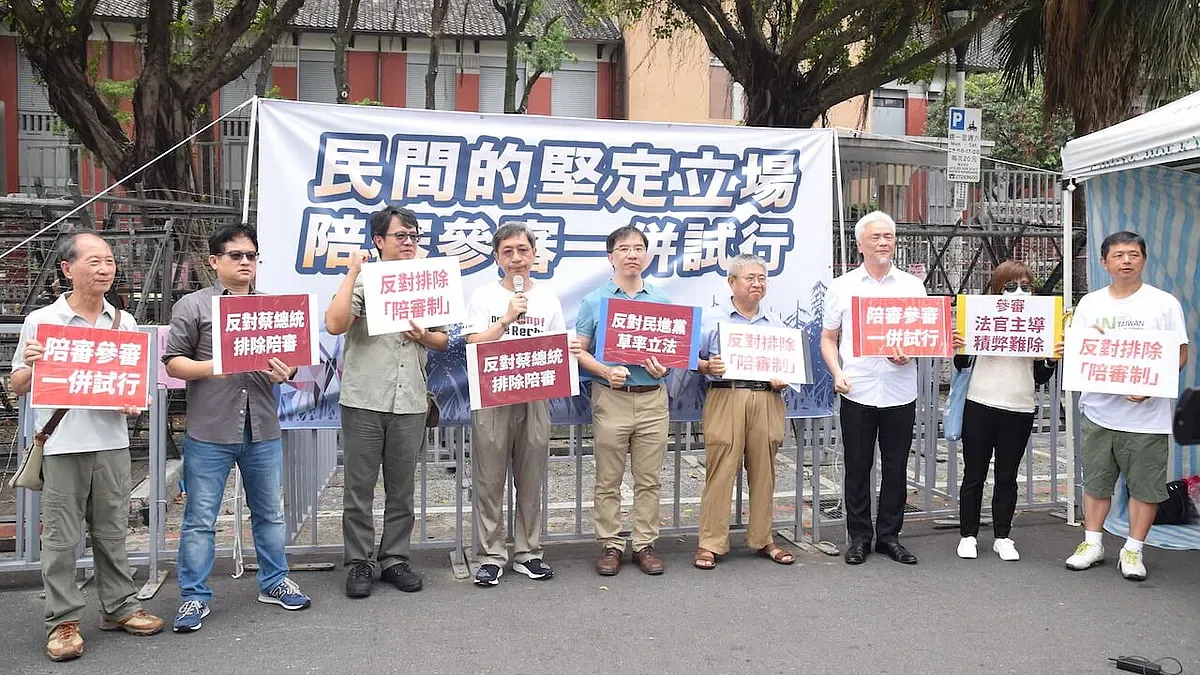
Experts and Scholars Lend Support as Two Systems Cry Out for Assistance ~ Day 17 of the Sit-in Protesting the Inclusion of the Lay Assessor System Bill in the Legislative Yuan's Extraordinary Session
Last edited: 2026-07-27
Formed by civil society groups including the Judicial Reform Foundation and the Taiwan Association for Intervenors in Trial, the "Alliance for Simultaneous Trial and Implementation of Lay Participation Systems" held a press conference titled "Experts and Scholars Lend Support as Two Systems Cry Out for Assistance" at 9:30 a.m. on July 15 in front of the Legislative Yuan's main gate. They invited Professor Yen Ch'üeh-an, Professor Wu Tsung-sheng, Professor Chang Cheng-hsiu, Attorney Ch'en Wei-hsiang, and other representatives from academia and civil society to issue a statement opposing the Democratic Progressive Party's (DPP) hasty legislation and exclusion of the jury system.
Attorney Lin Yung-sung, Chairman of the Judicial Reform Foundation, reported on the Legislative Yuan's agenda to review the lay participation in trials bills from July 20 to 22. He once again urged the DPP not to rush the legislation, explaining that subsequent press conferences will continue to invite groups and individuals to voice their opinions.
Professor Yen Ch'üeh-an of the National Taiwan University College of Law issued a statement in his capacity as a citizen. He first expressed affirmation of the DPP's attitude of "trusting the people and trusting the grassroots." Because the DPP trusts that the Taiwanese people can judge facts without being directed by anyone, its party platform inherited this spirit by explicitly supporting the jury system. All past public discourse and President Tsai's campaign platform supported the jury system; however, it remains unclear why there has now been a sudden shift toward the lay assessor system.
Secondly, although only twenty to thirty scholars have currently signed the statement, to Professor Yen's knowledge, there is virtually no scholar in academia who argues that the lay assessor system is clearly superior to the jury system, nor would such arguments lead to the conclusion that the jury system is unconstitutional. Under the experimentalism of democratic institutions, there is simply no ground to suddenly claim that the lay assessor system is so good that it warrants excluding the jury system, nor to argue that only the lay assessor system should be tested.
Furthermore, Ms. Ch'en Chu—who recently drew intense public attention during the Control Yuan personnel confirmation cases—mentioned liberals such as Lei Chen and Yin Hai-kuang. Professor Yen surmised that in the early days, these liberals expressed deep distrust of the state apparatus controlling the judiciary. If they were living today, with the pros and cons of the long-implemented foreign jury systems being quite clear, they would likely, in the spirit of science, support making the jury system an option to be tested in our country.
Finally, Professor Yen quoted Professor Huang Tung-hsiung: "Procedural law is the law of legal professionals," emphasizing that the forte of legal professionals lies in controlling procedural fairness, not necessarily in having a superior cognitive grasp of factual findings. The core of a democratic system lies in trusting the normal, rational judgment of citizens, and judicial democracy is no different. Looking at the data from the 2020 presidential election—where President Tsai won a high of 8.17 million votes, yet the DPP received less than 5 million party list votes, leading the second-party Kuomintang by fewer than 100,000 votes—it is evident that the message sent by the public was that they trust President Tsai, but do not want the DPP to wield absolute power arbitrarily. Moreover, public opinion is fluid, and a parliamentary majority does not mean that everything legislated by lawmakers during their term is supported by the public. The 318 Student Movement, triggered by the Kuomintang which held a parliamentary majority in 2014, is a case in point; the DPP, which dispatched personnel to the scene during the student movement, should be well aware of this. By contrast, standing at the very same gates of the Legislative Yuan where the parliamentary majority has now shifted to the DPP—which has witnessed the backlash of public opinion—everyone today is compelled to hold a press conference and voice their demands outside of massive water-filled barricades (New Jersey barriers) even larger than those in the 318 movement. This is truly regrettable.
Next, Professor Ch'en Li-fu, Vice President of the Taiwan Association of University Professors (TAUP), delivered a statement on behalf of the association. Professor Ch'en first emphasized that any ideological and responsible political party should provide explanations when transforming its fundamental policies or values, allowing the people and groups that have consistently supported them to understand. It is inappropriate for the DPP to suddenly alter its party platform that has long supported the jury system, and to rush to conclude communication within these few weeks in order to switch to the lay assessor system.
Secondly, Professor Ch'en expressed support for the parallel implementation of both systems. He pointed out that current provisions and statements from the Judicial Yuan indicate that the jury system is not entirely excluded; however, since one system cannot be fully evaluated until its trial period ends, implementing both systems concurrently would concentrate the transitional growing pains into the shortest possible period, and could even allow for the simultaneous trial of a third or fourth system. Transitioning through judicial reform will inevitably entail costs and certain backlash; even if the government argues that only an eight-year trial is feasible, the public would likely accept it because people understand that judicial reform requires such a process.
Furthermore, given that civic groups are currently demanding the inclusion of the jury system as an option during the trial period to compete with other systems, the Judicial Yuan has no reason to object. There is also no necessity for the Judicial Yuan's draft bill to be rushed through an extraordinary session called shortly after the inauguration of newly elected legislators—especially since the formulation of the lay participation system lacked extensive discussions with civil society. In particular, citizens without a legal background generally do not understand the controversies between the two systems, meaning the majority of the public neither understands nor can participate in communicating the design of the trial system they will face in the future. Such a policy-making process lacks prudence and democracy.
From an educator's perspective, Professor Ch'en stated that TAUP places the highest importance on transitional justice. The judiciary is an essential mechanism for the authoritarian regime to operate, and judicial reform remains the item with the lowest public satisfaction in the government's administration, yet the government lacks proactive action. In addition, civic education in schools is a vital channel for building the public's foundational understanding of the judiciary; however, whether the curriculum reform of civics guidelines has been effectively implemented remains a major problem. Especially given that society generally supports lowering the age of majority/suffrage to 18, and grassroots versions also support allowing 18-year-olds to participate in trials (while the Judicial Yuan version sets the age at 23), students' civic education stops at senior high school and vocational schools. Furthermore, textbooks do not dwell much on the lay assessor or jury systems, and many civics teachers originating from the authoritarian era neither support nor understand lay participation systems. Such civic education is insufficient to cultivate citizens into good jurors.
Professor Ch'en concluded by emphasizing that rushing to pass any single system while ignoring the realities of other societal dimensions is overly hasty and rash. The current term of the legislators is still long, and such a core political decision does not need to be rushed through next week. He hoped for more discussions—not by setting a deadline, but by establishing a procedural framework with reasonable communication frequency and intensity. Only after thorough communication can final deliberations proceed, which would be a better approach for contemporary society and a more responsible attitude.
Former Kainan University Department of Law Professor Chang Cheng-hsiu stated that he strongly agrees with Professor Yen's point that academia contains no scholars arguing that the lay assessor system is clearly superior to the jury system. Moreover, the history of the jury system's implementation across the world is longer than that of the lay assessor system, and in cases worldwide, no grounds can be found to exclude it during a trial period. Additionally, Professor Chang pointed out that intellectuals should act based on professionalism and integrity. President Hsu Tsung-li is a heavyweight public law scholar in the country. Now, in his capacity as the President of the Judicial Yuan and representing the institution, if he insists on implementing a lay assessor system—which no one in academia considers clearly superior—while excluding the jury system, he not only hijacks President Tsai but also fails to meet the societal expectations placed upon intellectuals. Finally, he emphasized that legislation must never go against public opinion.
Professor Wu Tsung-sheng of the Department of Sociology at Fu Jen Catholic University stated that although he is a layman in legal matters, after searching for a vast amount of information online, he believes that the controversy surrounding the system remains substantial and that there is no need to hastily pass a bill whose effects are still unknown during a rushed extraordinary session. Furthermore, from ordinary lay logic, if a large-scale social experiment is conducted on only one system without a control group, one will naturally arrive at the answer that this system is effective, but it also defeats the very purpose of an experiment. Moreover, if lay participation in trials is intended to promote judicial democracy and enhance legal education, it mirrors the historical development of democratic systems: just as people a century or decades ago did not believe that women or specific ethnic groups had the right to vote, ruling elites often invoke professional expertise and judgment as grounds to refuse opening up broader participation. These doubts were only answered through extensive discursive communication and open trial implementation. For the ruling party to now suddenly use its parliamentary majority to hastily pass legislation during an extraordinary session, delivering the lay assessor system as the optimal answer, is something he logically cannot fathom as a legal layman.
Attorney Ch'en Wei-hsiang, Director of the Taiwan Association for Assessor Systems (Taiwan Jury Association), stated that he could hardly imagine standing outside the halls of parliament—standing before the most massive array of barricades in his memory—to defend a system supported by the ruling party's own party platform. It is even harder to imagine that the ruling party is unwilling to even trial-run the very system it has long championed. Analyzing the reasons put forward by the DPP since taking power—such as "the public's quality is not high enough," "the judicial costs of the jury system are too high," and "the required changes for complementary measures are too drastic"—he believes that the lay assessor system brings almost no changes to the existing system, leaving the powers and roles of judicial officials largely unaffected. Perhaps the DPP has been hijacked by judicial officials, leading to the exclusion of the jury system. Therefore, Attorney Ch'en called upon the ruling party: unless this is merely a simple misunderstanding, it should avoid purely formal reforms, reclaim the progressive values within its party platform, and avoid deceiving the people who believed in their past advocacy and platform.
Attachments
Attending Representatives
Attorney Lin Yung-sung / Chairman, Judicial Reform Foundation (Convener)
Professor Yen Ch'üeh-an / Distinguished Professor, National Taiwan University College of Law
Professor Ch'en Li-fu / Vice President, Taiwan Association of University Professors
Professor Wu Tsung-sheng / Vice Dean of the College of Social Sciences and Associate Professor of Sociology, Fu Jen Catholic University
Professor Chang Cheng-hsiu / Adjunct Associate Professor, Department of Law, Kainan University
Attorney Ch'en Wei-hsiang / Director, Taiwan Association for Assessor Systems
Press Contacts
Judicial Reform Foundation / Director Hsiao I-min
Taiwan Association for Assessor Systems / Deputy Secretary-General Lin Ping-ch'üan
This article is an AI-generated translation of the original Chinese text. In the event of any discrepancy, the Chinese version shall prevail.