
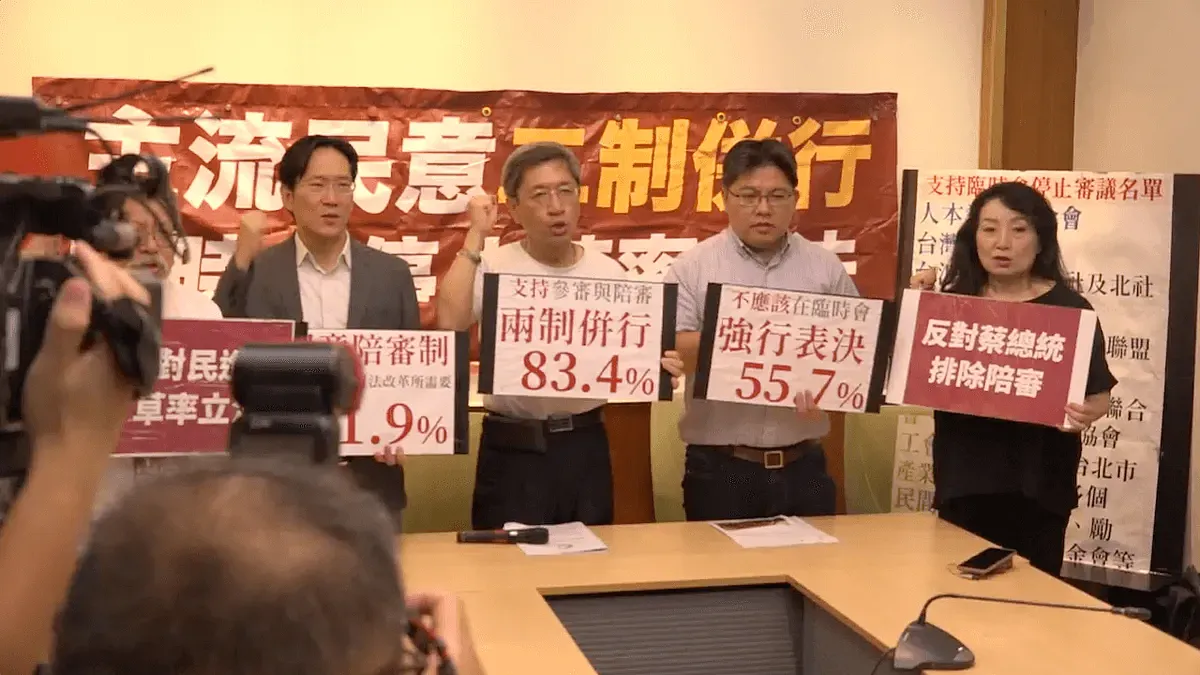
Civil Society Supports Cross-Generational Appeal with 80% Public Backing for Both Systems ~ Day 22 of Sit-in Protest Against Legislative Yuan Extraordinary Session Including the Citizen Judges Act
Last edited: 2026-07-27
The Alliance for Promoting the Parallel Trial of Lay Participation and Jury Systems, composed of civil society organizations such as the Judicial Reform Foundation and the Taiwan Association for Parliamentarianism, held a press conference at 9:00 AM on July 22 at the main entrance of the Legislative Yuan. Titled "Civil Society Supports Cross-Generational Appeal, 80% Public Backing for Both Systems, Say No to Voting on Fake Judicial Reform," the event invited opposition parties including the Kuomintang, the Taiwan People's Party, and the New Power Party to jointly urge the Democratic Progressive Party to halt the passage of the Judicial Yuan's pilot bill on citizen judges through a vote in the extraordinary session.
Attorney Lin Yung-sung, Chairperson of the Judicial Reform Foundation, first announced that Judicial Yuan President Hsu Tsung-li would attend a press conference on the Judicial Yuan's latest public opinion poll at 10:00 AM, and that the Alliance would respond to that press conference at 2:00 PM. Attorney Lin then raised two questions for the Judicial Yuan: First, why did the Judicial Yuan previously negotiate provisions for the parallel trial of both systems with civil society, yet now execute a policy U-turn to exclusively advocate for lay participation? Second, how much public funds has the Judicial Yuan spent on media placement marketing?
Next, Attorney Lin again cited the public opinion poll from July 18, explaining that the poll commissioned by the JRF and conducted by Professor You Ying-lung showed that only 8.2% of the public knew about the citizen judge system promoted by the Judicial Yuan. In other words, over 90% of citizens were unaware of this bill about to be voted on and passed in the Legislative Yuan. Regarding the lay participation and jury systems themselves, 67.8% of the public had heard of the jury system, while only 6.6% had heard of the lay participation system, which is similar to the citizen judge system. After a brief explanation, when asked again, the poll results showing agreement with the jury system (81.9%) were higher than those for the lay participation system (63.2%), and support for the parallel trial of both systems during the pilot phase stood at 83.4%. Furthermore, 55.7% of the public believed that the citizen participation bill should not be forced through a vote in the current extraordinary session. Referring back to the statements made by various sectors of society and youth groups in press conferences over the previous days—that they were unclear about the status of the bill—it can be concluded that mainstream public opinion supports the jury system and the parallel trial of both systems, and therefore the ruling party should not force through the lay participation system.
Furthermore, Attorney Lin responded to the Democratic Progressive Party's attacks on the poll. The DPP and the Judicial Yuan pointed out that the JRF's poll was nitpicking, yet the DPP failed to publish its own questions, failing to produce even a single point of criticism of its own while instead taking things out of context. Without looking at the complete explanation of the questions, they criticized specific wording in the JRF poll questions as inappropriate, such as "Anglo-American 'advanced' countries" and the "DPP 'strongly' pushing the lay participation system." The Judicial Yuan also added criticism that the JRF poll noted the lay participation system as a DPP proposal before the system itself. Attorney Lin responded that it is an objective description of facts that Anglo-American countries are highly developed advanced nations, that this bill was proposed by the DPP, that it entered the extraordinary session for a vote after only one deliberation in committee, and that there is a high probability of it passing directly given the DPP's majority, constituting a strong push. Moreover, the poll provided sufficient explanations for the systems and was entirely appropriate.
Finally, Attorney Lin addressed the doubts raised by the DPP and the Judicial Yuan that "opposition voices from civil society and the opposition are actually not loud." He stated that apart from the poll results, civil society includes numerous pro-Taiwan associations, youth groups, and labor groups, totaling over 170 civil society organizations forming an alliance, along with endorsements from over 20 scholars including Professor Yen Chueh-an of National Taiwan University. In the legislature, all three opposition parties opposed the DPP's hasty legislation; thus, the voice of opposition is naturally very loud. While the DPP indeed holds full governance power, a majority public mandate does not necessarily mean that the people support the ruling party on every single issue. Particularly in this case, the rising tide of civil opposition is blatantly obvious. He called on the DPP to respect public opinion and think twice before forcing a vote.
立法委員 Lin Wei-chou, Convener of the Kuomintang Legislative Caucus, stated that extraordinary sessions should deal with urgent and major bills. Without committees, without public hearings, and with only voting, it is a special resolution procedure within the legislative agenda. Since the DPP took office, it has frequently handled controversial livelihood bills in extraordinary sessions, compressing the time and space for civil society and opposition parties to express their opinions. Because the passage of these bills lacks discussion and deliberation—featuring only the naked majority violence and ruling arrogance of the ruling party—it continually drives the chaotic scenes of lawmakers coming to blows in the parliamentary halls of the extraordinary session.
Legislator Lin further explained the stances of various political parties in the legislature regarding judicial reform. He pointed out that the DPP, which champions progressive values, abandoned the most progressive jury system in its party platform after gaining full governance power, and instead intends to forcefully pass the conservative lay participation system. The more conservative Kuomintang initially proposed only a "modified lay participation system," but after listening to the demands of civil society groups, it also shifted toward the parallel trial of both systems. Other parties, such as the Taiwan People's Party, have proposed the parallel trial of both systems, while the New Power Party has proposed a pure jury system. This shows that the consensus and deliberation in the legislature regarding judicial reform are still insufficient. If the DPP still insists on violating its own party platform and broad public opinion today, the Kuomintang will also adopt countermeasures.
立法委員 Chang Chi-lu of the Taiwan People's Party stated that the TPP also completely finds it unacceptable for the ruling party to use rushed procedures during an extraordinary session to castrate the space for deliberation. Of the 113 articles in the Judicial Yuan's version, 99 were reserved. Aside from the titles of the bill's chapters, there was no cross-party consensus on the substantive content of the bill. The demands of civil society and the opposition parties are very humble; they simply hope that major judicial reform bills can incorporate broader public opinion, give the people more time to understand, and give the ruling parties and opposition more time to deliberate. Yet the DPP has violated its own party platform and progressive values, crushing public opinion with majority violence and ignoring the people who sit in protest daily under the wind and sun in the streets. Legislator Chang criticized the ruling party for "changing their brains once they change their seats." When public opinion polls conflict with the ruling party's claims, the Judicial Yuan still holds press conferences to argue back, which is truly regrettable. Legislator Chang emphasized that the TPP will fulfill its responsibility as an opposition party to supervise the ruling administration during the three-day "voting battle."
立法委員 Chiu Hsien-chih, Convener of the New Power Party Legislative Caucus, stated that the poll issued by the JRF was fully disclosed to the general public from question design to results. Judge Ch'en Szu-fan of the Taipei District Court failed to analyze the choice of systems based on legal professionalism, and instead heavily questioned the poll. If legal professionals view judicial reform issues with such an attitude, it will only worsen the public's distrust of the judiciary. Legislator Chiu questioned whether the Judicial Yuan's version—which is eligible for trial in only a few hundred out of 200,000 criminal cases nationwide in a year—can truly be called letting the people participate in adjudication. From a historical perspective, democratic pioneers such as Mr. Chiang Wei-sui and Dr. Hsu Shih-hsien all advocated for the jury system, showing that the jury system is a century-long pursuit for the Taiwanese people. Yet the DPP has adopted a scheme proposed by judicial bureaucrats that the public does not trust, which can only be described as chaotic and absurd.
Legislator Chiu also pointed out that the legislature, as a hall of deliberation, should pool wisdom and proceed with steady, enduring efforts rather than crudely using majority violence to crush the minority. Citing the JRF poll, he emphasized that 90% of the public does not understand or know about this issue at all, yet the ruling party still insists on forcing it through a vote in the extraordinary session. This is extremely outrageous and unacceptable to the opposition parties, and Legislator Chiu therefore called on the ruling party to rein in before reaching the precipice and halt the vote. Attorney Lin Yung-sung added that reports by the Liberty Times stating that the JRF would respect the ruling party if it passes the Judicial Yuan's version are incorrect. Bills can be passed, and bills can be amended. As a civil society organization, the JRF will continue to work based on public opinion to promote the judicial system that the people want; it will not stop just because a bill passes. He also called on the DPP to accept the admonitions of the three opposition parties and civil society groups and halt its hasty legislation, through which the DPP would earn the respect of the people.
After the meeting, in response to a media question regarding Legislator Cheng Yun-peng's view that allowing defendants the right to choose systems after both are implemented would make judgments unfair, grassroots prosecutors have also pointed out that parallel trials are not only unfair but also operationally difficult. Attorney Lin responded that last year, former Judicial Yuan Secretary-General and current Grand Justice Lu Tai-lang and civil groups negotiated seven times, creating provisions allowing a choice between the two systems, with supplementary regulations for those unable to make a choice. This was not a unilateral opinion of civil society, and a single case would not apply to only one system. This year, officials are using unfairness as a reason to attack the bill they negotiated themselves, going back on their word. Meanwhile, taking American law as an example, defendants also have the right to choose whether to have a jury trial; having a choice itself is not a mistaken thing. Attorney Lin also stated that the civil version does not present fairness issues in its premise, and remains open to all discussions and amendments regarding the details of the choice, as can be seen in the TPP's version.
At the same time, Attorney Lin stated that the Judicial Yuan has repeatedly attacked civil society using repetitive questions that have long been clarified. Therefore, aside from fairness, Attorney Lin also clarified issues such as restrictions on appeals under the jury system and the simplification of judgments (refer to the JRF's press releases responding to the Judicial Yuan on July 10 and July 11). He once again announced in advance that the JRF will continue its sit-in protest and will respond at 2:00 PM at the sit-in venue to the Judicial Yuan's press conference on its latest public opinion poll held at 10:00 AM.
Attending Representatives
Attorney Lin Yung-sung / Chairperson (Convener), Judicial Reform Foundation
Legislator Lin Wei-chou / Convener, Kuomintang Legislative Caucus
Legislator Chang Chi-lu / Member of the Legislative Yuan, Taiwan People's Party
Legislator Chiu Hsien-chih / Convener, New Power Party Legislative Caucus
Press Contacts
Judicial Reform Foundation / Director Hsiao I-min
Taiwan Association for Parliamentarianism / Deputy Secretary-General Lin Ping-ch'üan
This article is an AI-generated translation of the original Chinese text. In the event of any discrepancy, the Chinese version shall prevail.