
Halt the Forced Vote on the Lay Assessor Draft Act: The Alliance's Press Conference in Response to the First Day of Voting Battles
Last edited: 2026-11-03
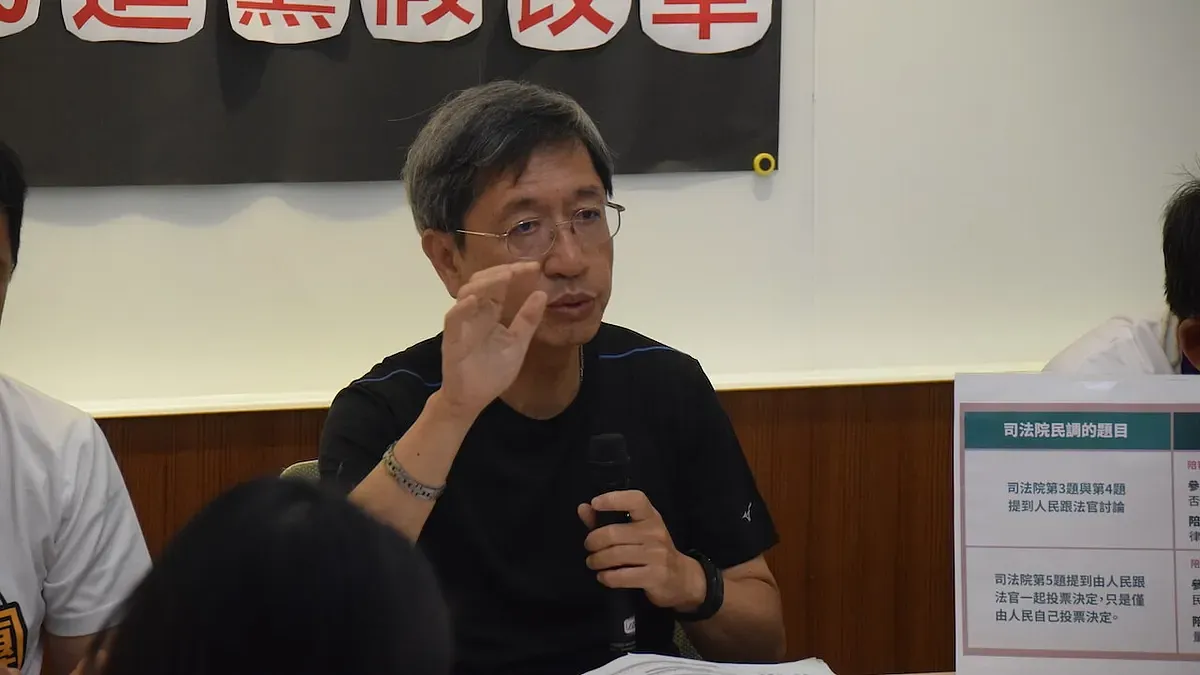
Formed by civil society groups including the Judicial Reform Foundation and the Taiwan Association for Parliamentarian/People's Participation in Trials, the "Alliance for the Joint Trial Implementation of Lay Participation and Jury Systems" held a press conference titled "Halt the Forced Vote on the Draft Citizen Judges Act: The Alliance's Response to the First Day of Voting Battles" at 9:00 a.m. on July 21 in Room 102 of the Legislative Yuan's Chung-hsing Building. They called on the ruling party to halt the voting procedures during the extraordinary session.
Attorney Lin Yung-sung, Chairman of the Judicial Reform Foundation, first reported on the voting situation in the Legislative Yuan. The Legislative Yuan began article-by-article voting on the pilot bill for people's participation in trials at 2:00 p.m. on July 20. However, Attorney Lin stated that normal legislative procedures dictate that a committee should review a bill until only a few contentious articles remain before entering the plenary session for article-by-article discussion and voting. In this instance, the committee hastily rushed through the review in just a single day before entering the extraordinary session to vote on over 90 contentious articles. Furthermore, Democratic Progressive Party (DPP) Legislator Chou Chun-mi stated yesterday that "public opinion polls do not need to be heeded." Attorney Lin urged that the parliament is an institution representing public opinion, and public opinion is subject to change. The majority party cannot so blatantly disregard public opinion; otherwise, there would have been no need for the DPP and the Judicial Yuan to make a grand presentation of new polling results. At the same time, Attorney Lin encouraged the opposition parties for their serious deliberation of the legal provisions, hoping they will continue to uphold the rigor of the legislative process.
Second, addressing the stark contrast between official and civic polling results, Attorney Lin once again analyzed the questions used in the Judicial Yuan's poll, pointing out that the Judicial Yuan used ambiguous wording to insinuate certain points and then interpreted the poll results in its own favor. For instance, "judges and citizens discussing together" is a procedure common to both lay participation and jury systems; the difference between the two systems lies in *what* judges and citizens "discuss," specifically whether there is direct discussion on determining guilt or innocence. Yet, the Judicial Yuan used the results of this question to support its preferred lay assessor system—a tactic of misleading the public rather than facing the issue head-on. Meanwhile, Attorney Lin also refuted one by one the claims that "the jury system does not allow appeals," "the jury system has no judgment writings," and "the hung jury problem where a unanimous verdict cannot be reached," citing Professor Yu Ying-lung's remarks yesterday to clarify and respond to the Judicial Yuan's criticisms of the JRF poll as having "four more's and three none's." (For details, see the JRF press release from the afternoon of July 20).
Attorney Chang Ching, a member of the National Congress on Judicial Reform, harshly criticized that power corrupts, and absolute power corrupts absolutely, but the DPP's attitude has led him to further believe that power makes people arrogant, collapsed, and devoid of rationality. When the halls of parliament are reduced to bare-knuckled majoritarian violence, the space for rational discussion is lost, deeply disappointing the citizens and groups that have supported the DPP. Many of the organizations that have currently joined the petition were formerly loyal supporters of the DPP and had supported the jury system in alignment with the DPP's party platform. The absurdity is that while all three opposition parties now support the DPP's party platform, the DPP itself is forcefully pushing through a lay assessor system that contradicts its own platform.
Attorney Chang went on to state that many of the Judicial Yuan's criticisms of the jury system—such as the lack of judgment writings and the inability to appeal—are fabricated. Regarding the issue of judgment writings, he explained that a judgment writing is merely the vehicle for a judgment; the absence of a judgment writing does not mean the absence of a judgment. The Code of Criminal Procedure also explicitly stipulates that plea bargaining can be documented via transcripts in lieu of a judgment writing, demonstrating that the law does not inherently insist on the current format of judgment writings. Moreover, since jurors are not trained in the law, how could they possibly write dense, convoluted judgment writings blending classical and vernacular Chinese? Attorney Chang also questioned: even for himself, a lawyer of over thirty years, many of his clients who are highly educated intellectuals, as well as fellow lawyers, can barely make sense of judgment writings. If Taiwan's intellectuals cannot understand them, what practical benefit do judgment writings serve?
Attorney Cheng Wen-lung, founding president of the Taiwan Association for Parliamentarian/People's Participation in Trials, stated that the DPP had long cooperated with them in promoting the jury system. However, seeing their remarks yesterday completely contradict their past positions, he could not help but lament the times. He denounced the actions of the DPP caucus as deceitful and untrustworthy, especially noting that caucus whip Ker Chien-ming had supported the jury system until last year—even attending a JRF seminar to express his support for juries and publicly declaring in parliament that he would introduce a jury trial bill—only to ridicule the jury system on the parliamentary floor yesterday. Attorney Cheng criticized that a political figure should not contradict their past self.
Regarding the issue of appeal restrictions, Attorney Cheng echoed Attorney Chang Ching's view: if a defendant is acquitted after trial, the defendant will not appeal, and prosecutors cannot appeal in principle; however, if convicted, defendants retain the right to appeal, while whether the appeal succeeds is another matter. This is the so-called "asymmetric appeal" system, a spirit also introduced into Taiwan's Criminal Speedy Trial Act. Beyond institutional interpretation, Attorney Cheng also questioned whether Caucus Whip Ker Chien-ming, when he supported the jury system back then, understood that the status quo of the Anglo-American jury system is precisely an asymmetric appeal system. Returning to the current controversy over institutional choice, the bill proposed by the Alliance still permits prosecutors to appeal against acquitted defendants, thereby eliminating the scenario claimed by the Judicial Yuan where the jury system precludes appeals.
Aside from individual politicians, Attorney Cheng also criticized the Judicial Yuan's claim of a 30-year pursuit for people's participation in trials as false, because the Citizen Judges Act was a version proposed only this March, not 30 years ago. Furthermore, its scope of application is limited solely to offenses carrying a fixed-term imprisonment of 10 years or more or intentional homicide causing death, which is far too narrow compared to the version previously deliberated together, which covered offenses carrying 7 years or more of imprisonment. In reality, the bill currently being pushed was not even made known to major civil judicial reform organizations; not a single public hearing or explanatory meeting was held, let alone sufficient discussion. He criticized the Judicial Yuan for merely finding a few government-aligned scholars to participate in discussions.
Next, Attorney Cheng analyzed and criticized the articles voted on yesterday:
First, the legislative intent behind Article 1 of the bill is incomplete. The text only mentions the transparency of the judiciary while omitting the democratization of the judiciary, thereby ignoring the most vital spirit of public participation in trials. Furthermore, Article 25, which was passed yesterday, stipulates that the procedure for selecting lay assessors shall not be made public, creating a secret trial—a rarity internationally and a direct contradiction to the legislative intent of transparency. Attorney Cheng criticized this as an international legislative laughingstock.
Second, the age restriction in Article 12 discriminates against young people. Currently, both the DPP and Whip Ker support lowering the age of majority for civic rights to 18 and also plan to set the age of majority in the Civil Code at 18. The New Power Party and the Taiwan People's Party bills both advocate that citizens aged 18 and above should be allowed to participate in trials. Yet, the DPP is now shielding the Judicial Yuan's provision requiring citizens to be 23 years old to serve as lay assessors, which demonstrates a lack of faith in the judgment of young people and constitutes age discrimination.
Third, Article 14 confuses the lay participation and jury systems. Attorney Cheng pointed out that this is a trick question, as this article is a jury system clause designed to prevent the authority effect and is incompatible with the lay participation system. Subparagraphs 5 through 8 exclude legal professionals and legal scholars—such as former judges, prosecutors, lawyers, and public defenders—from serving as jurors (lay assessors) to prevent these legal professionals from using the authority effect to influence the fair deliberation of other jurors. If the DPP and the Judicial Yuan maintain that the lay participation system produces no authority effect, why is there any need to exclude legal professionals from serving as lay assessors? Attorney Cheng criticized the DPP for piecing together incompatible systems without anyone noticing this contradiction even as it passed the vote, further corroborating that power causes people to lose their rationality.
In addition, Attorney Cheng mentioned an important issue raised by Professor Huang Wei-fu in his op-ed for the Liberty Times: the lay participation system currently being forced through by the Legislative Yuan is the one adopted by the Chinese Communist Party (CCP), which has already caused a massive number of miscarriages of justice across the strait. In terms of courtroom seating arrangements, the DPP—which brands itself as "local and native"—surprisingly mirrors the CCP's system identically, aligning Taiwan's trial format with that of China. Professor Huang also cited the Milgram experiment (also known as the obedience-to-authority study), which proved that humans consistently obey authority, yet the DPP's lay participation version still fails to resolve the authority effect demonstrated in the aforementioned experiment. Furthermore, Village Warden Tsai Kun-lung, who attended a previous press conference, shared the authoritarian influence exerted by professional judges that he personally experienced while participating as a simulated lay assessor. The authority effect undeniably exists, yet the DPP remains incapable of addressing this issue.
Regarding the issue of judgment writings, Attorney Cheng finally added two supplementary points and criticisms: First, whether under the lay participation or jury system, trials are now compressed to conclude within a few days—much faster than the months-long proceedings of the past. Such intensive trial proceedings will make it difficult for judges to produce complex and lengthy judgment writings in a timely manner. Attorney Cheng criticized the insistence on current judgment writings as institutional design detached from reality; by contrast, the U.S. jury system does not write grounds for judgment, replacing them instead with written jury instructions and verdicts. Second, a jury system must reach a unanimous verdict, with only a single judge presiding over the proceedings and providing legal instructions to prevent conflicting directions from multiple judges. In contrast, under the lay participation system, the opinions of three judges and six lay assessors may all differ—how can they possibly write the judgment writings that the Judicial Yuan cares about most?
Attending Representatives
Attorney Lin Yung-sung / Chairman, Judicial Reform Foundation (Convener)
Attorney Chang Ching / Member, National Congress on Judicial Reform
Attorney Cheng Wen-lung / Founding President, Taiwan Association for Parliamentarian/People's Participation in Trials (Convener)
Press Contacts
Judicial Reform Foundation / Director Hsiao I-min
Taiwan Association for Parliamentarian/People's Participation in Trials / Deputy Secretary-General Lin Ping-ch'uan
This article is an AI-generated translation of the original Chinese text. In the event of any discrepancy, the Chinese version shall prevail.