
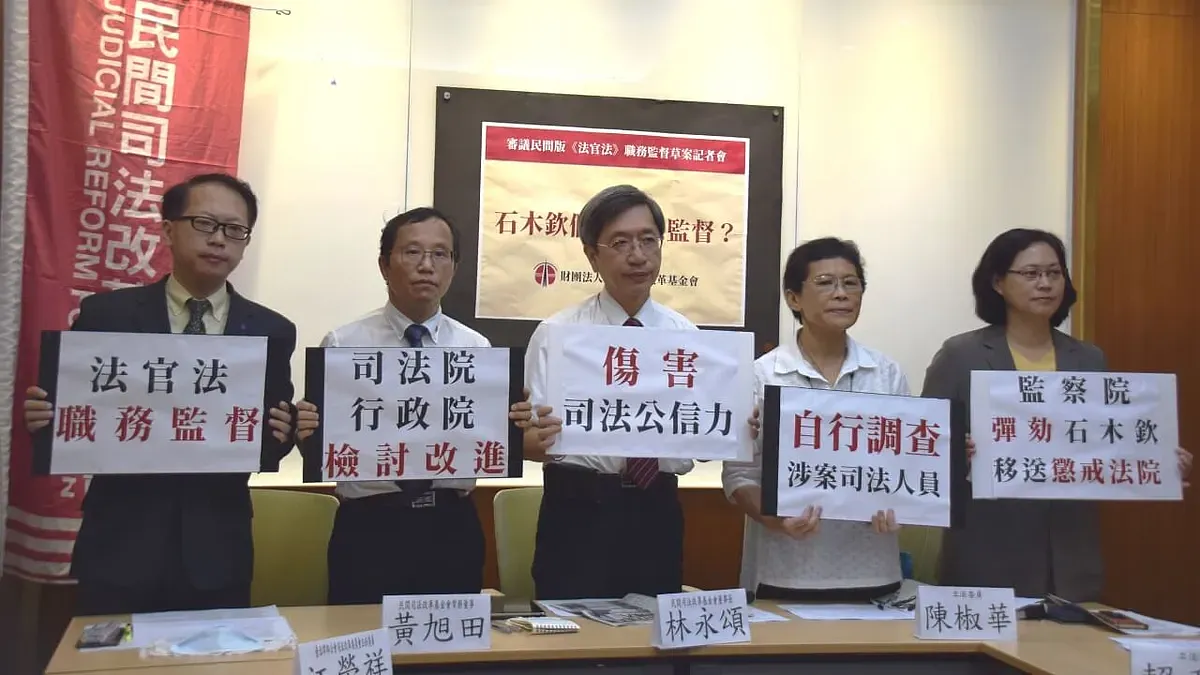
Who Will Supervise the "Shih Mu-chin's"? Press Conference on the Civil Society Draft Amendments to the Judges Act Concerning Official Supervision
Last edited: 2026-11-03
On September 9, the Control Yuan released its investigation report on the Shih Mu-chin case. In addition to Shih Mu-chin, several other judges, prosecutors, police officers, and Investigation Bureau officials were involved in inappropriate contacts, golf outings, banquets, and stock purchases. On September 23 of last year, our Foundation issued a statement regarding the Judicial Yuan's referral of Shih Mu-chin to the Control Yuan (Note 1), calling for a comprehensive investigation into all judicial personnel involved. Our Foundation affirms the Control Yuan's efforts to expand the investigation into unlawful officials.
The investigation report reveals that the unlawful officials became involved at a very early stage in their careers. Taking Shih Mu-chin as an example, starting from when he was assigned as a prosecutor in his twenties, he began establishing good relationships with the wealthy and powerful, maintaining them for over 30 years. Other involved parties also had histories of interaction spanning ten or twenty years. It is evident that the wealthy and powerful are willing to long-term cultivate moles within the judiciary, with tactics comparable to the plot of the Hong Kong film "Infernal Affairs."
-
Young Judicial Officials Unable to Resist Temptation
The Control Yuan's investigation shows that the wealthy Tainan businessman Weng Mou-chung deliberately befriended judicial officials serving in the Tainan area. Taking Shih Mu-chin as an example, after graduating from the Judges and Prosecutors Training Institute in 1978, he was assigned to the Tainan District Prosecutors Office, and in 1982 transferred to the Tainan District Court, serving in Tainan for a total of 12 years, during which time he met Weng Mou-chung. However, Shih's first favor requested by Weng Mou-chung was in 1997, and his first purchase of stocks in Weng's company was in 1998—already more than a decade after they met. This example illustrates that Weng Mou-chung befriended judicial officials starting from their youth, not rushing to utilize them, but waiting until the officials matured through experience and gained power before leveraging them to wield influence. The Control Yuan's investigation shows that judicial officials who met Weng Mou-chung while serving in the Tainan area also included Chief Prosecutor Fang Wan-fu, Prosecutor Chu Hung-yu, and Police Officer Chou You-wei, all of whom maintained continuous interactions for ten or twenty years.
The Control Yuan's investigation shows that Shih Mu-chin and Weng Mou-chung's last meeting was on December 4, 2017. Prior to this meeting, Shih Mu-chin liquidated all the shares he held in Weng Mou-chung's company. Two weeks later (December 20), Shih Mu-chin took the oath of office as President of the Disciplinary Court, holding primary responsibility for the integrity and conduct of civil and military officials. No one else matched Weng Mou-chung's patience and perseverance in cultivating judicial moles. This case highlights that the Judicial Yuan, the Ministry of Justice, the National Police Agency, and the Investigation Bureau urgently need to reform and establish defensive measures against the tactics of using money to corrupt young judicial officials.
-
Guard Against Hypocrites Abusing Judicial Independence
When the Judicial Yuan referred Shih Mu-chin to the Control Yuan last year, Shih Mu-chin declared his absolute innocence, denounced it as a political struggle, and even filed a private prosecution against President Hsu Tsung-li for false accusation. Now that the Control Yuan has brought his wrongdoing and misdeeds to light, society is shocked to find that under the umbrella of judicial independence, such two-faced hypocrites could be nurtured. Former Control Member and Prosecutor Fang Wan-fu is another example. In 1998, while serving as Chief Prosecutor of the Tainan District Prosecutors Office, he utilized investigative techniques to spare Weng Mou-chung from repaying a NT$300 million debt, and then he and handling prosecutor Chu Hung-yu purchased massive amounts of Weng's company stock for profit. When the scandal broke last year, he was also suspected of using his authority as a Control Member to shield Shih Mu-chin and stall the impeachment case. Mutual protection among officials could not be more severe.
Judicial independence is intended to safeguard the space for judges to adjudicate impartially, not to protect judges with a privilege from being supervised. The Commentary on the Bangalore Principles of Judicial Conduct, the international standard for judicial ethics, points out that ensuring the integrity of judges' public and private lives is a fundamental principle for maintaining public trust in the judiciary. The Shih Mu-chin case demonstrates that current oversight of judges' private lives suffers from severe legal loopholes that must be immediately remedied.
-
Comprehensive Review of Integrity Oversight for Judicial Personnel
Last year, when the Shih Mu-chin case was deliberated by the Personnel Review Committee of the Judicial Yuan, half of the members actually supported him, and it ultimately required President Hsu Tsung-li to personally intervene before a decision was made to refer the case to the Control Yuan for investigation. Due to President Hsu Tsung-li's persistence, the Judicial Yuan took action, but the Ministry of Justice, the National Police Agency, and the Investigation Bureau—where personnel were similarly involved—have yet to take action. In response, this Foundation demands an immediate, comprehensive review of integrity oversight for judicial personnel, with the following specific demands:
- The Judicial Yuan, Control Yuan, Executive Yuan and its subordinate Ministry of Justice, National Police Agency, and Investigation Bureau should comprehensively investigate the criminal and administrative responsibilities of the involved personnel, and must not use statutes of limitation as an excuse to avoid investigation. The investigation results should be made public to demonstrate accountability.
- If the investigation results involve wrongful convictions or misjudgments, judicial authorities should actively vindicate the innocent. If they involve letting criminals off unpunished, judicial authorities should file for retrials to secure convictions. If they involve lawyers acting as bribery intermediaries or violating the Attorney Regulation Act and lawyer ethics standards, they should be referred to the bar association or attorneys disciplinary committee for accountability.
- The Legislative Yuan should invite professional judicial associations such as the Taiwan Judges Association, the Taiwan Women Judges Association, and the Taiwan Prosecutors Association to hold public hearings on how to strengthen integrity oversight for judicial personnel. Furthermore, it should deliberate the civil society draft amendments to the Judges Act concerning official oversight (Note 2) as soon as possible to strengthen the internal self-regulation mechanisms of judicial authorities and fundamentally prevent such occurrences.
Attendees
Ch'en Chiao-hua / Legislator, New Power Party
Lai Hsiang-ling / Legislator, Taiwan People's Party
Lin Yung-sung / Chairperson, Judicial Reform Foundation
Huang Hsu-t'ien / Standing Board Director, Judicial Reform Foundation
Chiang Jung-hsiang / Chairperson, Judicial Reform Committee, Taipei Bar Association
Contact Person
Hsiao I-min / Office Director, Judicial Reform Foundation
Notes
Note 1: Judicial Reform Must Begin with Ensuring Judicial Integrity: Statement Regarding the Control Yuan's Investigation into Former Disciplinary Court President Shih Mu-chin
Note 2: Civil Society Draft Amendments to the Judges Act Concerning Official Supervision
This article is an AI-generated translation of the original Chinese text. In the event of any discrepancy, the Chinese version shall prevail.