
Citizen Judges Act Information Platform Launches: Building a Taiwan Version of "Saibanin NET"
Last edited: 2026-08-29
With the Citizen Judges Act scheduled to take effect in 2023, district courts across Taiwan are conducting mock trials, drawing substantial effort and attention from the judiciary, legal profession, and civil society. This is a critical period for shaping Taiwan's trial culture. One important question for judicial reform is how to deepen civil-society participation in the citizen-judge system and bring the public's perspective into the design and operation of the new institution.
Japan's Saibanin NET: Bringing Citizens' Voices into the System
Civil society has played an important role in the development of Japan's saiban-in system. One of the most prominent organizations is Saibanin NET, founded in 2009 and bringing together citizens from a wide range of backgrounds, including attorneys, office workers, and clinical psychologists. It researches and shares information about the system, organizes forums and lectures, creates opportunities for people who have served as saiban-in to share their experiences, arranges speakers to explain the system, organizes court-observation groups, analyzes implementation, and publishes commentary and reports. Through these activities, Saibanin NET conveys citizens' views about the system and uses them as a basis for reform proposals intended to make the institution more responsive to public experience.
Planning Ahead: Starting with Recommendations from Japanese Civil Society
 Image / Statistics from the Supreme Court of Japan; source: Nippon.com
According to statistics from the Supreme Court of Japan, the excusal rate among prospective saiban-in rose from 53.1% in 2009 to 67% in 2018, while attendance at the selection procedure declined from 83.9% to 60% over the same period. The decline in willingness to participate appears to reflect multiple factors, including population aging, economic conditions, and features of the system itself.
Saibanin NET began publishing policy recommendations in 2011. Its latest edition, "The Saiban-In System: Recommendations from Citizens," was released in 2018 with the aim of helping the public understand the system and increasing willingness to participate. Drawing on the practical experience of coalition partners who have taken part in Taiwan's mock trials, and using Saibanin NET's recommendations as a point of comparison, the Coalition offers the following proposals from a citizen-centered perspective.
-
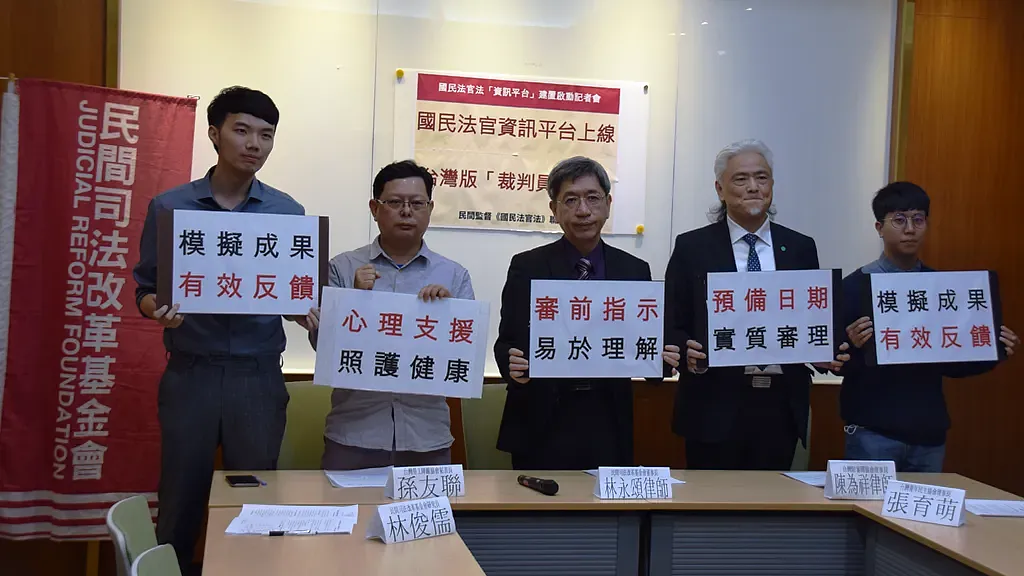
Pretrial Instructions People Can Understand
In the long term, rule-of-law education should help the public understand the principles of adjudication and build the civic foundation needed for citizen participation in trials. In actual courtroom practice, however, pretrial instructions have an immediate and practical importance. How professional judges explain concepts such as the presumption of innocence and evidence-based adjudication will directly affect the quality of citizen participation. The Coalition therefore recommends developing standardized, modular pretrial instructions that explain core trial principles in language citizen judges can understand.
-
Balancing the Burden of Trial with Meaningful Adjudication
To manage the burden on citizen judges and maintain trial efficiency, judges, prosecutors, and defense counsel should fulfill their responsibilities for effective case management and use concentrated proceedings to avoid unnecessary delay beyond the trial schedule. At the same time, citizen judges must be able to express their views and have sufficient time to engage meaningfully with the case. The Coalition recommends building "buffer time" into the schedule so that, after hearing from prosecution and defense and taking citizen judges' views seriously, the court can adjust as necessary. Efficiency should not become time pressure that undermines the quality of citizen adjudication.
-
Protecting Citizen Judges' Mental Health
Citizen judges will hear cases involving offenses punishable by a minimum term of at least ten years' imprisonment or intentional offenses resulting in death. Evidence may include photographs of bodies, wounds, and crime scenes, creating significant psychological burdens. The gravity of deciding matters that affect defendants and others involved in the case can itself create substantial stress. Citizen judges may also worry about personal safety or about whether they can comply with confidentiality obligations. The Coalition therefore recommends establishing psychological-support services early, both to protect citizen judges' mental health and to avoid discouraging future public participation.
-
The Requirements and Scope of Confidentiality
Article 9, Paragraph 3 of the Citizen Judges Act imposes confidentiality obligations on citizen judges, including a duty not to disclose the secrecy of deliberations or other confidential information learned through their duties. The experience of participating in court and a person's own general reflections, however, are not automatically confidential. Defining confidentiality too broadly would make it difficult for participants to share experience and for society to evaluate the system. The Japan Federation of Bar Associations advocated adjustments to saiban-in confidentiality rules as early as 2011, and the House of Representatives has adopted supplementary resolutions calling for periodic review. The Coalition recommends that Taiwan's implementing rules define clearly what is confidential and what citizen judges may discuss, protecting legitimate secrecy without unnecessarily suppressing public conversation.
-
Using Mock-Trial Experience in System Evaluation
When Japan amended its system in 2015, the House of Representatives called for reform discussions to proceed from the public's perspective and to take seriously the experience of saiban-in and the views of crime victims. Saibanin NET likewise called for a "Citizens' Review Committee for the Saiban-In System." Articles 105 and 106 of Taiwan's Citizen Judges Act require establishment of an Evaluation Committee on the Effectiveness of the System of Civil Participation in Criminal Trials and preparation of an evaluation report. The Coalition recommends connecting the experience and public feedback generated by district-court mock trials with the drafting of implementing rules, so that lessons from the front line of the pilots can feed back into institutional design.
Building a "Taiwan Version of Saibanin NET" through the Citizen Judges Act Information Platform
 Image /
Drawing on Japan's experience, the Taiwan Civil Society Coalition for Monitoring Implementation of the Citizen Judges Act will monitor the system according to five principles: openness and transparency, open participation, adequate supporting measures, fair evaluation, and further reform where needed. Its aim is to deepen civil-society participation and bring citizens' perspectives into the system.
To support that work, the Coalition has created the Citizen Judges Act Information Platform. The platform compiles news and commentary, organizes materials from district-court mock trials, and provides court-observation forms for citizen observer groups. Future work will include soliciting articles and analysis, continuing to recruit and operate court-observation groups, organizing training workshops for attorneys, and co-hosting lectures with other civil-society organizations. Alongside analysis and criticism of the Citizen Judges Act, the Coalition also wants to document the experience of people who actually participate. Civil-society capacity is necessarily limited, but the Coalition will use multiple forms of participation to improve the system and welcomes submissions of personal observations, institutional analysis, and recommendations.
| Item | Content |
| Document Collection |
|
| Court Observation |
|
| Publication Platform |
|
| Event Announcements |
|
Attendees
Joseph Lin / Chairperson, Judicial Reform Foundation
Sun Yu-Lien / Secretary-General, Taiwan Labour Front
Chang Yu-Meng / Chairperson, Taiwan Youth Association for Democracy
Chen Wei-Hsiang / Chairperson, Taiwan Jury Association
Chang Cheng-Hsiu / Professor, Department of Law, Kainan University
Lin Chun-Ju / Researcher, Judicial Reform Foundation
Press Contact
Lin Chun-Ju / Attorney and Researcher, Judicial Reform Foundation
This article is an AI-generated translation of the original Chinese text. In the event of any discrepancy, the Chinese version shall prevail.