
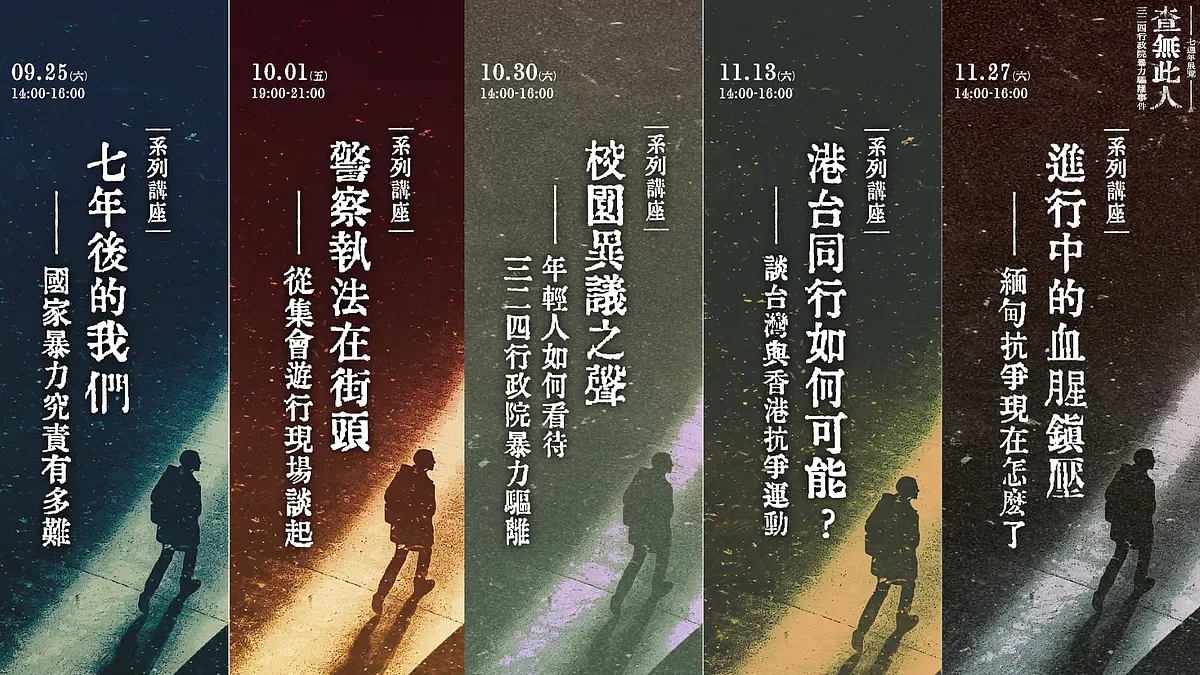
No Such Person | Seventh-Anniversary Exhibition on the March 24 Executive Yuan Violent Eviction in Taichung - Lecture Series
Last edited: 2026-08-29
Seven years earlier, the March 18 movement began with the occupation of the Legislative Yuan and, one week later, the March 23 occupation of the Executive Yuan. One of Taiwan's largest occupation-style protest movements in recent history went on to influence anti-authoritarian movements in Hong Kong, Thailand, and elsewhere in East Asia. The response of Taiwan's civil society-and of its justice system-also drew attention internationally.
The brighter, more celebrated side of the movement has entered public memory. The bloody history of the police violence used during the Executive Yuan eviction late on March 23 and into March 24, however, has gradually faded.
We do not want to forget.
The exhibition has now come to Taichung. Although "No Such Person" centers on the state violence of March 24, the Taichung edition also seeks to tell stories of resistance from Taichung itself, Myanmar, Hong Kong, and Thailand. The people involved lived in different places and historical moments, but the ideas connecting their struggles are closely related. During the exhibition, this lecture series invites everyone to listen to those stories and leave a deeper trace of them in our collective memory.
Lecture Series
09/25 | Seven Years Later: How Difficult Is It to Hold State Violence Accountable?
Many attorneys and people directly involved were present during the March 24 Executive Yuan eviction, and the state violence of that night affected an entire generation of young people in different ways. Seven years later, how are they doing? Has the way they understand the movement-or its effects on their lives-changed?
We have invited Attorneys Li Ling-Wei, Liu Chi-Wei, and Wang Yen, together with litigant Pan Kuan, to discuss the difficulty of holding state violence accountable from the perspectives of both lawyers and people directly involved. Seven years after litigation ended with "no unlawful conduct found," how do they understand that outcome? Did the movement, and the years of litigation that followed, leave behind any lasting meaning?
Young people today may know about protests in Hong Kong, Thailand, and Myanmar while knowing very little about a major protest movement that took place in Taiwan only seven years ago. Through this conversation, we hope to revisit that history, take stock of both the failures and the gains of seeking accountability for state violence, and carefully think together about where to go next.
Li Ling-Wei Attorney
PanelistsLiu Chi-Wei Attorney
Wang Yen Attorney
Pan Kuan Litigant
- Time September 25 (Sat.), 2:00-4:00 p.m.
-
Venue Judicial Reform Foundation Taichung Office
Online or in-person participation available. In-person attendance is limited to 20; waitlisted participants will receive the livestream link.
10/01 | Policing on the Street: Starting with Assemblies and Demonstrations
During the March 18 movement, protesters and police interacted in very different ways at different stages. Crowds collectively thanked exhausted police officers; police protected protesters from gang members who entered the site; and yet the night of March 24 also produced brutal images of officers using batons and shields to strike people and stepping on them with police boots.
Individual police conduct is shaped and constrained by institutional systems. This discussion examines the difficult tensions and boundaries of policing assemblies and demonstrations. JRF legislative researcher Chen Yang, who has long worked on reform of prosecutorial, police, and investigation institutions, will moderate. Police officer Tsou Tsung-Tse will discuss operational considerations and experience in policing public assemblies, while Attorney Tsai Meng-Han of Plain Law Movement will explain the legal framework and problems surrounding Taiwan's Assembly and Parade Act.
Chen Yang Legislative Researcher, Judicial Reform Foundation
PanelistsTsai Meng-Han Attorney, Plain Law Movement
Tsou Tsung-Tse Board Member, Taiwan Police Union
- Time October 1 (Fri.), 7:00-9:00 p.m.
-
Venue Online
A livestream link will be emailed after registration.
10/30 | Dissenting Voices on Campus: How Young People See the March 24 Executive Yuan Violent Eviction
Around 1,200 people attended the seven-day Taipei edition of "No Such Person." Among those who completed feedback forms, more than 60% had not participated in the March 24 events and had been only junior-high or high-school students at the time. The March 18 and March 24 events left a major mark on Taiwan's civil society, including the way students engage with public issues. Student participation today appears more open than in the past, and a wider range of energetic student organizations has emerged.
Yang Hsin-I Longtime Member, NTU Dalun Society; Former City Council Candidate
PanelistsLin Chang-Chih Secretary, Taoyuan City Confederation of Industrial Unions
Lin Kai-Ting Former Convener, Taichung City Youth Affairs Advisory Council
Tsai Ya-Han Former President, NCKU Zero Two Society
- Time October 30 (Sat.), 2:00-4:00 p.m.
-
Venue Online or in-person participation available
In person at the Judicial Reform Foundation Taichung Office; attendance limited to 20. Waitlisted participants will receive the livestream link.
11/13 | How Can Taiwan and Hong Kong Stand Together? Protest Movements in Taiwan and Hong Kong
"No Such Person" presents state violence that actually occurred in Taiwan seven years earlier. The movement has since influenced public action in different forms, while resistance to abuses of state power has continued around the world. Among these movements, Taiwan and Hong Kong have long occupied especially closely connected positions.
Hong Kong's Anti-Extradition Law movement was approaching its second anniversary. In September 2019, civic groups in Taichung organized a march supporting Hong Kong, arguing that Taiwan's democracy and freedom should support Hongkongers pursuing the same values so that Hong Kong would not stand alone. In April 2021, the Good Citizens Cultural Action Association also organized the Freedom Road Arts Festival, using artistic events and lectures to retell courageous stories that could no longer be openly told and to support resistance born from the pursuit of justice and freedom of thought.
How can Taiwan and Hong Kong continue standing together, and what more can be done? Economic Democracy Union researcher Chiang Min-Yen and Lo Yi of the Taiwan Civil Society Support for Hong Kong Association will discuss how they understand protest movements and solidarity across Taiwan and Hong Kong.
Wang Chen-Yun Deputy Director, Judicial Reform Foundation Taichung Office
PanelistsChiang Min-Yen Researcher, Economic Democracy Union
Lo Yi Executive Director, Alliance of Referendum for Taiwan; Secretary-General, Taiwan Civil Society Support for Hong Kong Association
- Time November 13 (Sat.), 2:00-4:00 p.m.
-
Venue Judicial Reform Foundation Taichung Office
Online or in-person participation available. In-person attendance is limited to 20; waitlisted participants will receive the livestream link.
11/27 | Ongoing Bloody Repression: What Is Happening in Myanmar?
"No Such Person" presents state violence that actually occurred in Taiwan seven years earlier. The movement has since influenced public action in different forms, while resistance to abuses of state power has continued around the world. Among the most harrowing recent examples is the protest movement in Myanmar.
After Myanmar's military launched a coup in February, it continued violently suppressing protesters, drawing international concern. On May 2, people took to the streets in as many as 41 cities-including locations in Myanmar, Taipei, and Tokyo-for Global Spring Revolution Day in solidarity with the anti-coup movement.
What happened in Myanmar, and why has the repression become so severe? We invited Professor Chao Chung-Chi of the Department of Southeast Asian Studies at National Chi Nan University and a Myanmar student representative in Taiwan to explain the background and development of the movement. Lin Fang-Ju, Executive Director of the Good Citizens Cultural Action Association, will moderate. Through their discussion, we will ask what Taiwan and the international community can do when confronted with violent repression that may seem geographically distant.
Lin Fang-Ju Executive Director, Good Citizens Cultural Action Association
PanelistsChao Chung-Chi Associate Professor, Department of Southeast Asian Studies, National Chi Nan University
Chang Ju-Ming President, Association of Myanmar Students in Taiwan
- Time November 27 (Sat.), 2:00-4:00 p.m.
-
Venue Online or in-person participation available
In person at the Judicial Reform Foundation Taichung Office; attendance limited to 20. Waitlisted participants will receive the livestream link.
Organizer
Judicial Reform Foundation
Co-organizers
Match Café
Humanistic Education Foundation, Taichung Office
Taiwan Association for Human Rights
Taiwan Youth Association for Democracy
Taiwan Association of University Professors
Taiwan Forever Association
Good Citizens Cultural Action Association
Good Temperature Taiwan Youth Foundation
Taiwan Lily Action
Plain Law Movement
Taiwan GDi Association
This article is an AI-generated translation of the original Chinese text. In the event of any discrepancy, the Chinese version shall prevail.