
March 24 Fourth-Anniversary Paint-Splattering Case
Last edited: 2026-08-30
Why Did the March 24 Fourth-Anniversary Paint-Splattering Case Happen?
More than seven years have passed since the forcible eviction at the Executive Yuan on March 24. Based solely on records in the Ministry of Health and Welfare's emergency medical system, major hospitals made at least 61 ambulance dispatches that night, and more than 200 people received hospital treatment for injuries sustained during the police eviction. On July 16, the Control Yuan released Investigation Report No. 109 Nei-Diao 0077, censuring the National Police Agency and again confirming that police unlawfully used violence to disperse the crowd that night.
Over those seven years, citizens and civil society groups pursued many avenues-including private prosecutions, state-compensation claims, petitions to the Control Yuan, and questioning by elected representatives-to press the police and judicial authorities for accountability. Yet not one officer who used violence against members of the public that night has received administrative discipline or criminal prosecution, and no police commander has been held responsible.
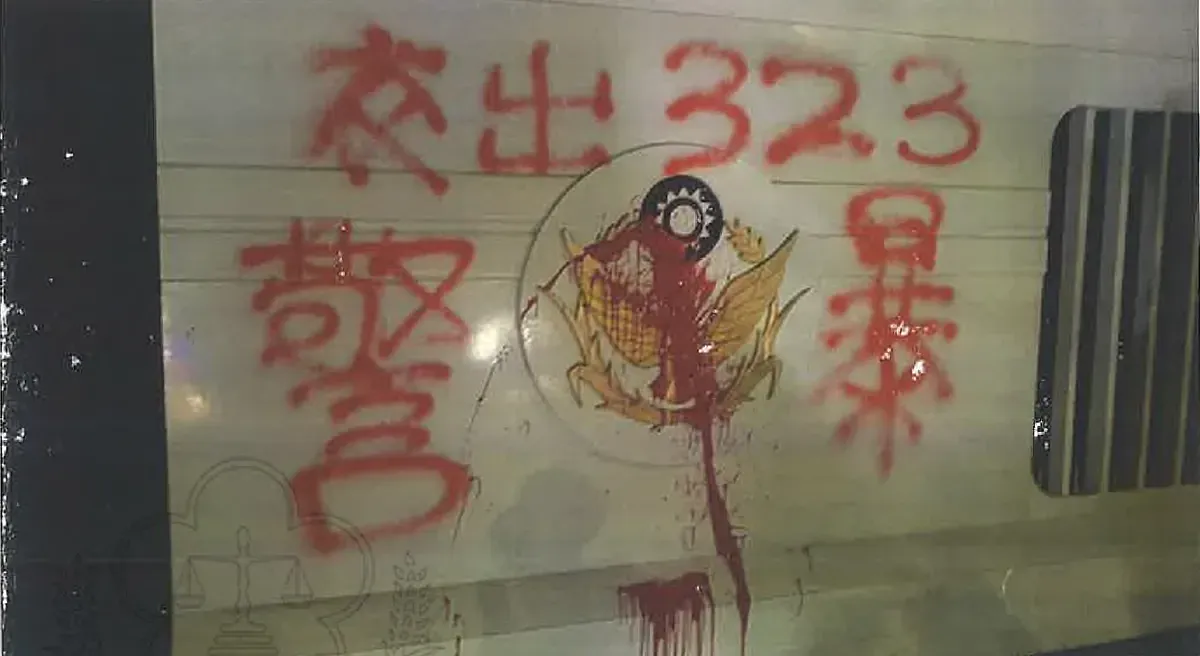
The March 24 Fourth-Anniversary Paint-Splattering Case arose on the fourth anniversary of the March 24 incident. To protest the National Police Agency's failure to investigate the truth and pursue accountability, the defendants splashed paint on the Agency's main gate and walls and wrote slogans including "Hand Over the March 23 Brutal Police Officers" and "Don't Forget March 23." Their actions expressed dissatisfaction with the government's inaction and avoidance of responsibility, but also led to prosecution for damage to property and insulting a public office.
As time passed, the bloodshed caused by state violence on March 24 gradually faded from public memory. The defendants did not want it to be forgotten, yet their symbolic expression intended to press the government for accountability subjected them to criminal prosecution by the state.
Litigation Results in the March 24 Fourth-Anniversary Paint-Splattering Case
[First Instance] Criminal Division of the Taipei District Court: Taiwan Taipei District Court Criminal Judgment 108-Yi-998
- The six defendants were each convicted as joint offenders of damage to property and sentenced to 30 days of short-term imprisonment. They were acquitted of insulting a public office.
- Data obtained from the defendants' mobile phones and most statements taken during police questioning were inadmissible because they resulted from unlawful stops, searches, and seizures. The court nevertheless held that splashing red paint altered the "original appearance" of the National Police Agency's main gate, walls, and barricades; even if the exterior of a government building or public property need not satisfy an aesthetic standard, it should at least be kept clean, and the paint "destroyed cleanliness and hygiene," thereby impairing the utility of those items.
- The phrases written by the defendants such as "Hand over the 323 violent police," "323," and "4th Anniversary," viewed according to common sense, carried no intent of disparagement or defamation and thus did not constitute an insult.
[Second Instance] Criminal Division of the Taiwan High Court: Taiwan High Court Criminal Judgment 109-Shang-Yi-2400
- The first-instance judgment was reversed, and all six defendants were acquitted on all charges.
- Regarding the damage to property charge: The main bodies and shapes of the main gate, walls, and iron roadblocks were neither destroyed nor lost, and they continue to be in use. Although these items were affected in their aesthetic appeal and cleanliness due to being splashed with red paint and having text written on them, the paint can be cleaned and removed using organic solvents such as turpentine, banana oil, toluene, or nail polish remover without damaging the underlying bodies of the objects, having a minimal impact on their aesthetic appeal and cleanliness. Furthermore, the main gate and walls of the National Police Agency serve shielding and regulatory functions and are part of the exterior of a government agency building; they feature no special art or styling design and prioritize sturdiness, differing from the overall aesthetic appearance pursued by ordinary residential buildings. Additionally, iron roadblocks serve to isolate and block, lacking any special art or styling design; it is difficult to maintain that these items possess aesthetic utility or purpose. Therefore, even if their aesthetic appeal was affected by the defendants splashing red paint or writing text, the utility or purpose of these items was not impaired.
- Regarding insulting a public office, the High Court held that the six defendants' conduct did not constitute "insulting" speech and therefore did not satisfy the objective elements of the offense. It was thus unnecessary to reach the constitutionality of the provision or to suspend the trial and seek a constitutional interpretation.
After the Acquittal
The defense team expresses deep appreciation for the High Court's correction of the lower court's view and its decision to uphold fundamental constitutional rights, including freedom of speech. At the same time, the case highlights unfinished work in Taiwan's democratization, and we make the following appeals:
1. Do not use criminal prosecution to intimidate people from exercising freedom of speech and assembly
This case began with the defendants taking action to demand accountability for the large-scale police violence inflicted on the public. Studies of the March 24 Executive Yuan eviction have identified, among the roots of unchecked police violence, a long-standing tendency to treat street protesters as adversaries and an authoritarian legacy of insufficient constraints on police power. During this trial, the court and defense counsel also uncovered unlawful arrests and investigative conduct by police. Against that backdrop, the fact that six defendants had to appear in court merely for expressing political views is particularly ironic. A democratic and pluralistic society should tolerate dissent, yet criminal prosecution is too often used to burden dissenters, suppress opposing views, and chill freedom of speech. The defense team thanks the six defendants for courageously exercising their constitutional right to express their views. We will never know how many others have remained silent because of police abuse of power. We hope today's High Court judgment will encourage people in Taiwan to exercise their constitutionally protected freedom of speech with greater confidence.
2. The Offense of Insulting a Public Office Should Be Decriminalized
The Judicial Reform Foundation held a seminar on July 25, 2020, titled "Authoritarian Criminal Law and Transitional Justice: A Discussion Starting from the Offense of Instigation and the Offense of Insulting a Public Office." According to scholars who presented at the seminar, the offense of insulting a public office can be traced from the Great Qing Criminal Code to the present day. Taiwan has been a democracy for more than 30 years, and the legitimacy of retaining an offense with such authoritarian origins has long been questioned. Its existence and application may not only infringe freedom of speech used to monitor government, but also obstruct social dialogue and conflict with the principle of popular sovereignty. It should therefore be abolished as soon as possible.
When news reports show governments in China, Hong Kong, Singapore, Thailand, Myanmar, and elsewhere using state power to arrest and prosecute social activists, it is striking that Taiwan-priding itself on democracy and freedom-still retains and applies this authoritarian-era offense and allows it to be used to suppress speech. This reveals both the obsolescence of parts of our legal system and the extent to which the culture within state institutions has yet to catch up with contemporary human-rights standards. The defense team calls on those in power, while invoking transitional justice, to examine carefully which rules within the state apparatus should be replaced. Abolishing the offense of insulting a public office would be a good place to start.
3. Police Enforcement Must Comply With Due Process
The first-instance judgment confirmed that all seized mobile-phone and camera data, as well as statements obtained from the defendants during police and prosecutorial questioning, were inadmissible because they resulted from unlawful stops, searches, and seizures. The error-ridden evidence-gathering process, inaccurate investigation reports, and recent controversies arising from arbitrary and unlawful police stops all show the need for stronger legal training and oversight concerning the exercise of police powers-particularly the application of proportionality and the existence of lawful grounds for administrative action.
Related Press Releases for This Case
"If the offense of insulting a public office is not submitted for a constitutional interpretation, more citizens will inevitably be incriminated in the future. I may not be the last person to take action, and this may not be my last action either. Regardless of the judgment outcome, I will not submit to a judgment prosecuted under the offense of insulting a public office. If this law fails to convince me, and this trial has no effect on me, why not terminate a void trial proceeding? I implore the court to terminate the trial and submit the offense of insulting a public office for a constitutional interpretation, allowing an offense that is evidently regressive and contrary to democratic spirit to step into history."
"There has already been much discussion in the legal community regarding whether the offense of insulting a public office is timely and appropriate. As the prosecutor stated in the first paragraph of the indictment, our actions at the time constituted the definition of peaceful, rational, and necessary freedom of speech. In such actions, no one was injured, and we also voiced our demands. If writing articles and holding press conferences were useful, six years later we would not still be in the dark about the identities of the police officers who used violence against citizens on March 23 and 24, 2014. Therefore, we had to use this method to remind the government and the public that the anti-CSSTA movement has not ended, and many movement participants are still embroiled in litigation to this day."
"In philosopher John Stuart Mill's book On Liberty, the boundary of liberty he refers to is conditioned solely on the concurrent preservation of the liberty of others. Mill's concept of liberty serves as the foundation of modern legal philosophy; hence, freedom of speech has never required 'acceptance by others' from its inception. Furthermore, this speech action was rational and peaceful, devoid of any circumstances that would harm public interests, disrupt order, or cause clear and present danger. The prosecutor indicted us under the offense of insulting a public office on the grounds that it was 'unaccepted by others,' which violates the foundation of legal philosophy. In the civil law system, provisions without a philosophical basis lack legitimacy in their legal elements. Therefore, I respectfully request the court to terminate the trial and move for a constitutional interpretation."
"The violence perpetrated by the police on March 24, 2014, is supported by conclusive evidence, yet it has been lightly brushed aside through evasive maneuvers across numerous legal proceedings to this day. Conversely, this case has been subjected to high-intensity judicial prosecution, requiring my client to identify themselves from blurry photographs. The unreasonableness of the investigative intensity is crystal clear. Furthermore, as mentioned above, the offense of insulting a public office is a highly unconstitutional and controversial statutory provision. This trial serves as a touchstone for Taiwan as a democratic society, and I earnestly request Your Honor to make an appropriate ruling in accordance with the law, given that this case clearly does not involve damage to property or insulting a public office and evidently harbors unconstitutional risks."
"When citizens express political speech during protests, it is virtually impossible not to affect the so-called public order. We can see from current practice where half of the offenses of insulting a public office stem from law enforcement disputes that the application of this offense in practice frequently becomes a means for the police to restrict freedom of assembly and freedom of speech. Against this backdrop, I hope Your Honor will carefully consider the defendants' arguments, suspend the trial, and petition for a constitutional interpretation regarding the offense of insulting a public office involved in this case."
"Even if a constitutional interpretation is not petitioned in this case, based on the most fundamental principle of criminal law as a measure of last resort and the ultima ratio nature of criminal punishment, interpreted from the theory of freedom of speech, in the absence of a clear and present danger, the state cannot arbitrarily use the offense of insulting a public office as a means to restrict citizens' political speech. The defendants' actions in this case-splashing paint, tossing masks, and writing words on walls-were not drastic means of violence or coercion. After investigation during the trial, it was also learned that the aforementioned walls, the main gate of the National Police Agency, and the roadblocks suffered no damage in appearance or function, and the defendants' actions did not actually cause concrete harm. Although criticizing government agencies may cause embarrassment to the civil servants belonging thereto, this cannot constitute a clear and present danger arising from the defendants' actions, nor does it affect the execution of official duties by the state. Naturally, the state cannot invoke criminal law against such actions by the defendants to restrict their expression of opinions. Only such an interpretation complies with Judicial Yuan Interpretation No. 509 cited by the prosecutor, which expounds on achieving the purposes of monitoring the government and promoting social dialogue through freedom of speech."
"We would like to begin by discussing the situation in Hong Kong over the past two days. Due to the passage of the Hong Kong National Security Law, Hong Kong has begun restricting citizens' freedom of speech. Over the past two days, many pan-democrat figures have been arrested and subjected to criminal prosecution by the Hong Kong government for criticizing the Hong Kong government and participating in protest actions. This bears considerable similarity to the offense of insulting a public office in our Criminal Code. Because the purpose of the National Security Law in restricting freedom of speech is to maintain the rulers' governance, prohibiting people from criticizing the government and expressing opinions on public affairs, the same holds true for the offense of insulting a public office. The offense of insulting a public office uses the so-called maintenance of public interest and public order as the legal interest protected by the crime to uphold the exercise of state public authority, but the actual consequence behind it is that people cannot freely express opinions on public affairs and criticize government actions. According to scholarly research, this provision has been left over since the late Qing Dynasty. The reason we continue to retain and use such a provision is also due to the government's demand to restrict citizens' freedom of speech under past authoritarian rule. However, Taiwan has now undergone democratic transition and has become a country that guarantees citizens' freedom of speech; the existence of such a provision is obsolete and contradicts our constitutional requirements guaranteeing freedom of speech. As the guardian of the Constitution, the court must counter unlawful acts by the state, and for actions by the executive branch restricting citizens' rights through various administrative acts or legal systems, it should take the Constitution as its foundation, adopt a mindset different from state organs, and express a stance to counter unlawful acts by state organs and guarantee citizens' rights and interests. In the past, our judicial system acted as a thug under authoritarian rule, cooperating with the authoritarian rule of state organs by formally applying laws and assisting the state in infringing upon citizens' rights. Today, our courts should likewise undergo judicial transition rather than cooperating with the state's authoritarian rule by applying inappropriate laws left over from the authoritarian era. If the court still deems there is no necessity to initiate a constitutional interpretation in this case, it should apply Article 140 of the Criminal Code regarding the offense of insulting a public office with maximum narrowness, exclude the symbolic political speech of paint-splattering committed by the defendants from the scope of application of Article 140 of the Criminal Code, and render a judgment of acquittal for the defendants."
"Regarding the part of the indictment stating that defendant Chang Ti-Hao splashed red paint on roadblocks owned by the Taipei City Police Department and thereby committed the offense of damage to property: although defendant Chang Ti-Hao does not deny that he splashed red paint on the roadblocks, this cannot serve as the sole evidence for a guilty verdict. Scanning the case files, the only screenshot from the First Precinct of the Taipei City Police Department that purportedly shows defendant Chang Ti-Hao committing the offense of damage to property fails to show that the person in the photograph is the defendant at all. Regarding the allegation in the indictment that the defendants were co-conspirators in the offenses of damage to property and insulting a public office, a review of the case files reveals that the prosecutor has failed to specifically point out and present positive evidence regarding how he had criminal intent and committed acts in division of labor with the other defendants. Moreover, the prosecutor failed to specifically indicate in today's argument how the defendants' actions obstructed others' freedom or public order so as to exclude them from the protection of freedom of speech. Based on the presumption of innocence, I earnestly request Your Honor to render a verdict of acquittal."
"When state organs make mistakes, they ought to tolerate criticism from the people directed at state organs, no matter how harsh or unrefined, as these are the last and most humble means for the people of a democratic country to monitor the government. Therefore, the application of the aforementioned statutory provision should be subject to the strictest constitutional narrowing. As long as the content of the expression carries political commentary and demands, and does not have insulting state organs as its sole purpose, it should be deemed not to constitute the insulting speech referred to in the offense of insulting a public office under this article. Furthermore, the external property of an agency is not protected by aesthetics; moreover, after the roadblocks in this case were restored, the agency also admitted that it was impossible to distinguish them from other unsplashed roadblocks, and the walls and main gates of the agency were easily restored through simple cleaning, thus failing to impair all or part of the functions of the relevant property, and therefore not constituting the offense of damage to property."
"Although the original judgment mentioned that paint-splattering would affect the aesthetic appeal and cleanliness of objects and thus result in a situation rendering them unusable, main gates, police emblems on main gates, walls, and roadblocks do not possess the utility of aesthetics and cleanliness. Furthermore, whether something is aesthetically pleasing is determined by personal subjective preference; thus, whether paint-splattering affects aesthetic appeal will not yield the same view for everyone. Consequently, whether an object is aesthetically pleasing has no bearing on its utility. In addition, cleanliness utility refers to an object having a cleaning function-for example, the utility of a detergent is cleanliness or cleaning-but it is evident that main gates, police emblems on main gates, walls, and roadblocks do not possess a so-called cleaning function. The original judgment confused the distinction between a clean state and cleanliness utility. ..... I do not know whether Your Honor and everyone present still remember the night of March 23, seven years ago. Whether at the scene or through television broadcasts, those police officers who used shields to shove and police batons to strike the bodies of peacefully sitting citizens caused a large number of people to be injured. This is not hearsay; it is authentically recorded and extant in video footage. However, not a single one of those violent police officers has surfaced since the March 23 eviction operation, nor have they faced any administrative or criminal responsibility. The government has offered no public review or apology for the actions of that day. The defendants before the court chose to splash paint on the National Police Agency on the fourth anniversary of the March 23 eviction operation and wrote words such as 'Hand over the 324 violent police.' The reason is that 'state violence' can neither be tolerated nor forgotten. Therefore, the defendants are actually a group of people helping us remember history. It is precisely because of their actions that we will not forget that the state once committed violence and infringed upon citizens' rights. Accordingly, the defendants' actions protect the 'core values of constitutional democracy,' reminding both the people and the state that we cannot tolerate the state infringing upon citizens' rights. Thus, the defendants' actions are applicable to the defense of civil disobedience precluding illegality and should be exempted from liability."
This article is an AI-generated translation of the original Chinese text. In the event of any discrepancy, the Chinese version shall prevail.