

Seminar Report | Systemic Judicial and Human Rights Issues in Dummy-Account Fraud Cases
Last edited: 2026-08-30
In recent years, disputes arising from fraud cases involving dummy accounts have continued to proliferate. Judicial practice uses broad and inconsistent standards when determining conditional intent to aid fraud, and people who provide dummy accounts are increasingly also being convicted of money laundering, creating further controversy. The Judicial Reform Foundation, Taichung Bar Association, and Changhua Bar Association organized this symposium to call the attention of judicial authorities and the public to these systemic problems.
In the first half of the symposium, speakers present new conviction statistics and analyze recent guilty and not-guilty cases involving people deceived into providing passbooks, mobile-phone numbers, SIM cards, and related materials, focusing on the systemic risk of wrongful conviction behind those cases. In the second half, scholars and legal practitioners consider possible solutions from different perspectives. The organizers hope the discussion will encourage judicial authorities to examine these cases more carefully.
Opening Remarks
Opening remarks were delivered by Lu Yung-Sheng, Chairperson of the Taichung Bar Association; Liu Ya-Chen, Chairperson of the Changhua Bar Association; and Lin Chih-Chung, Board Member of the Judicial Reform Foundation.
Session I What First- and Second-Instance Acquittals Reveal About Dummy-Account Cases
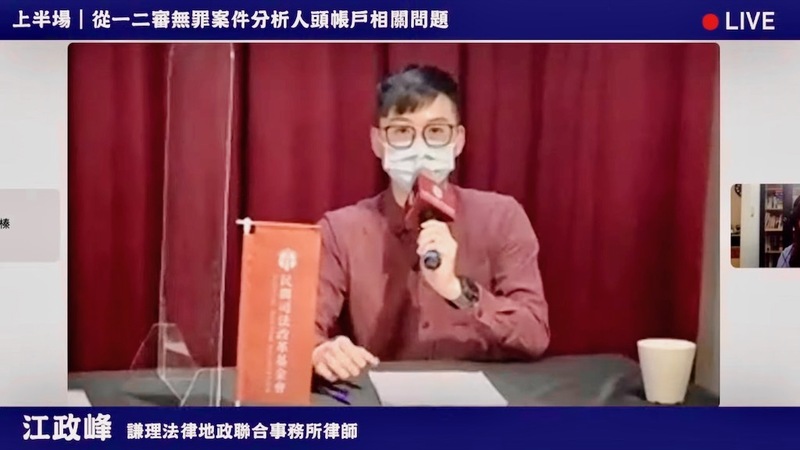
Moderator Chiang Cheng-Feng / Attorney, Chien-Li Law and Land Administration Joint Office
Lawyers, prosecutors, and judges handle large numbers of cases and may therefore develop heightened awareness of common fraud patterns. But should ordinary members of the public be judged by the same level of knowledge and vigilance? That is a question worth examining.
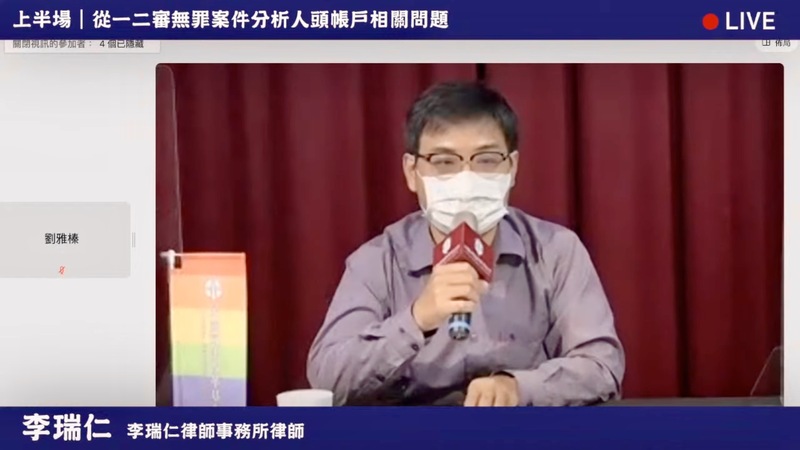
Panelist Li Jui-Jen / Attorney, Li Jui-Jen Law Office
Defendants often feel: "Why are you asking me questions if you have no intention of listening to what I say?" Courts sometimes reason that, as a matter of ordinary experience, people understand that they should safeguard their ATM cards and bankbooks and prevent others from using them freely. But if a defendant's conduct does not fit that assumption about ordinary behavior, does that automatically establish criminal intent?

Panelist Chang Kai-Ting / Attorney, Jih-Hsin Joint Law Offices
Under Supreme Court Criminal Grand Chamber Ruling 108-Tai-Shang-Ta-3101, intent to aid money laundering depends on whether the defendant foresaw that the funds being withdrawn were proceeds of fraud. In current practice, district prosecutors offices do not yet appear to have consistently applied that reasoning when fraud-aiding and money-laundering-aiding charges are bundled together. The Grand Chamber's approach may nevertheless create meaningful room for defense in dummy-account cases.

Panelist Chiang Wan-Chen / Attorney, Sheng-Fang Law Office
Indictments are often filled with references to unidentified persons, even when prosecutors have no evidence that the defendant actually handed a SIM card to a fraud ring. Many defendants were themselves deceived or exploited by fraud rings. If prosecutors file charges simply to give victims an answer, and use state power to impose criminal liability on people without sufficient evidence, that is deeply troubling.
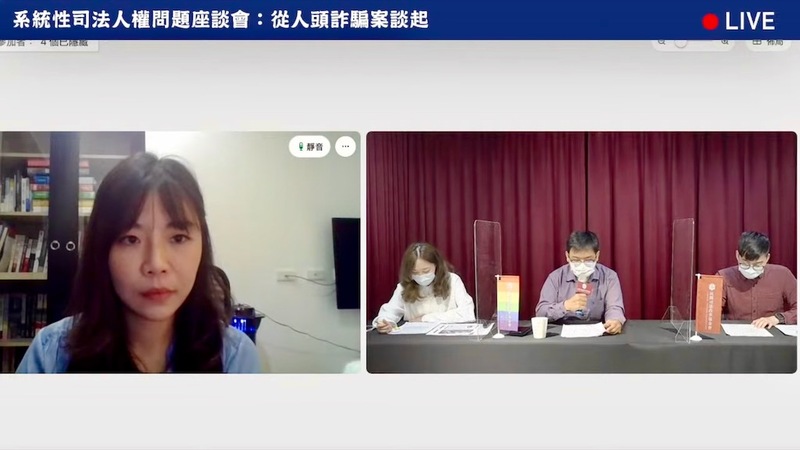
FAQ What First- and Second-Instance Acquittals Reveal About Dummy-Account Cases
- Is fraud, as some theories of criminal psychology suggest, a type of crime that develops as society becomes more advanced and affluent?
- If ninety percent of dummy-account holders allegedly know what they are doing and profit from it, are claims of ignorance simply attempts to avoid liability-and how should that concern be weighed against the interests of fraud victims?
- Prosecutors sometimes appear to expect people to exercise a heightened duty of verification before providing access to a financial account. Is that expectation reasonable, and what is its legal or factual basis?
- Government campaigns repeatedly warn people not to hand their financial accounts to others. Once a defendant has been exposed to those warnings, may that fact be used as a basis for inferring subjective criminal intent?
- What standards do judges use when deciding that the evidence is insufficient to establish a crime?
Session II How Can Systemic Judicial Problems in Dummy-Account Cases Be Improved?

Moderator Lin Chih-Chung / Attorney, Asahi International Law Firm; Board Member, Judicial Reform Foundation
The symposium should remind the public that providing an account can facilitate fraud and that public education remains important. At the same time, prosecutors, police, and courts should listen seriously to defendants' explanations and investigate, as fully as possible, atypical facts that may support the defense rather than assuming that every case follows the ordinary pattern.
Panelist Hsu Wei-Chun / Associate Professor, Department of Financial and Economic Law, Chung Yuan Christian University
Whether we are talking about prosecutors, judges, or the justice system more broadly, prevention and accountability must be kept conceptually distinct. The desire to prevent fraud cannot justify criminalizing everyone who happens to play an objectively useful role somewhere in the transaction chain.
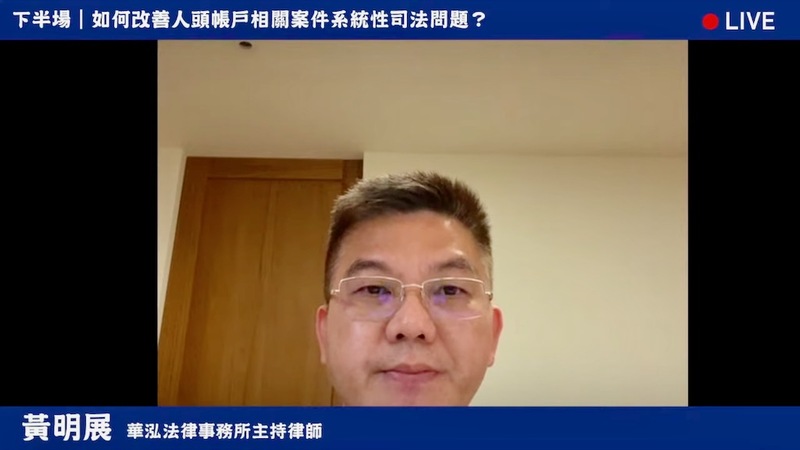
Panelist Huang Ming-Chan / Managing Attorney, Hua-Hong Law Firm
If the presumption of innocence is not meaningfully implemented, guilty judgments may result simply because defendants themselves cannot find enough evidence to convince prosecutors or judges. A more empathetic and open-minded approach to investigation and adjudication may prevent some wrongful convictions.

Panelist Chiang Chang-Chih / Prosecutor, New Taipei District Prosecutors Office; Author of *Seriously, You're Easy to Scam: 27 Dark Truths About Fraud*
Prosecutors do not automatically indict every defendant. The difficulty is determining whether a defendant's explanation is true. The prevalence of nominee vehicle plates, dummy accounts, and mobile-phone numbers registered in other people's names makes it extremely difficult to trace fraud operations upward, creating a major investigative challenge for prosecutors and police.

FAQ How Can Systemic Judicial Problems in Dummy-Account Cases Be Improved?
- What legal responsibility should attach to selling an account, as compared with being deceived into providing an account later used by a fraud ring? Can victims who actually transferred money recover their losses?
- When investigators break up a fraud ring and seize criminal proceeds, where do the funds go after confiscation?
- If police and prosecutors fail to identify accomplices promptly and those accomplices transfer assets or break the evidentiary chain, can victims seek financial relief or government assistance for their losses?
- Would legislative amendments imposing uniformly harsher sentences and penalties help reduce the prevalence of fraud rings?
- May courts impose deprivation of civil rights on members of fraud rings?
- How does current practice define the "same case" when a single dummy-account defendant may be linked to multiple victims in different parts of the country?
- How can prosecutors persuade judges-and how can defense counsel persuade prosecutors and judges-to accept atypical facts? Is it appropriate to infer conditional intent by assuming what would or would not ordinarily happen?
Further Reading
This article is an AI-generated translation of the original Chinese text. In the event of any discrepancy, the Chinese version shall prevail.