
Statement | First Remand Judgment in the March 23 Executive Yuan Occupation Defense Case: Incitement Charges Dismissed, Property-Destruction Convictions Upheld
Last edited: 2026-08-30
Today (October 8), the Criminal Division of the Taiwan High Court delivered its judgment in the first remand proceedings arising from the March 23 occupation of the Executive Yuan. The court dismissed the prosecution on the incitement charges but upheld convictions for destroying property in the custody of public officials.
The Supreme Court had previously held oral argument and adopted a constitutionally narrow interpretation of the incitement offense in order to protect freedom of expression. That was an important and unusual effort. The Taiwan High Court did not continue that constitutional analysis on remand: by dismissing the incitement charges on procedural grounds, it never reached the substantive constitutional issues and missed a rare constitutional moment. The defense team respects the result as an exercise of independent adjudication but nevertheless regrets that outcome.
As to the charge of destroying property in the custody of public officials, the Taiwan High Court failed to give adequate weight to the defendants' exercise of freedom of assembly under Article 14 of the Constitution and freedom of expression under Article 11. J.Y. Interpretation No. 718 explains that freedom of assembly protects peaceful collective expression through which people communicate with society, shape or change public opinion, and influence and supervise the making of policy and law. Grounded in popular sovereignty, that freedom is a fundamental right essential to democratic government, deliberation, respect for difference, and the Constitution's pluralistic spirit.
The defendants acted under urgent circumstances in opposition to the Cross-Strait Service Trade Agreement then before the Legislative Yuan. Their conduct implicated both freedom of assembly and freedom of expression and was undertaken openly and nonviolently to defend the democratic constitutional order. The Supreme Court's remand reasoning recognized that the conduct could satisfy the requirements of civil disobedience and the right of resistance. The Taiwan High Court's judgment did not adequately engage with that analysis. The defense team will assist the defendants in appealing and will continue defending their rights and Taiwan's free and democratic constitutional order.
During the global COVID-19 pandemic, Taiwan was able to restore its economic and legal order at comparatively low cost. Alongside the efforts of government and the public in controlling the pandemic, the defense team also reflected on the significance of the defendants' March 24 actions in blocking the Cross-Strait Service Trade Agreement and preserving greater distance between Taiwan's legal order and China's.
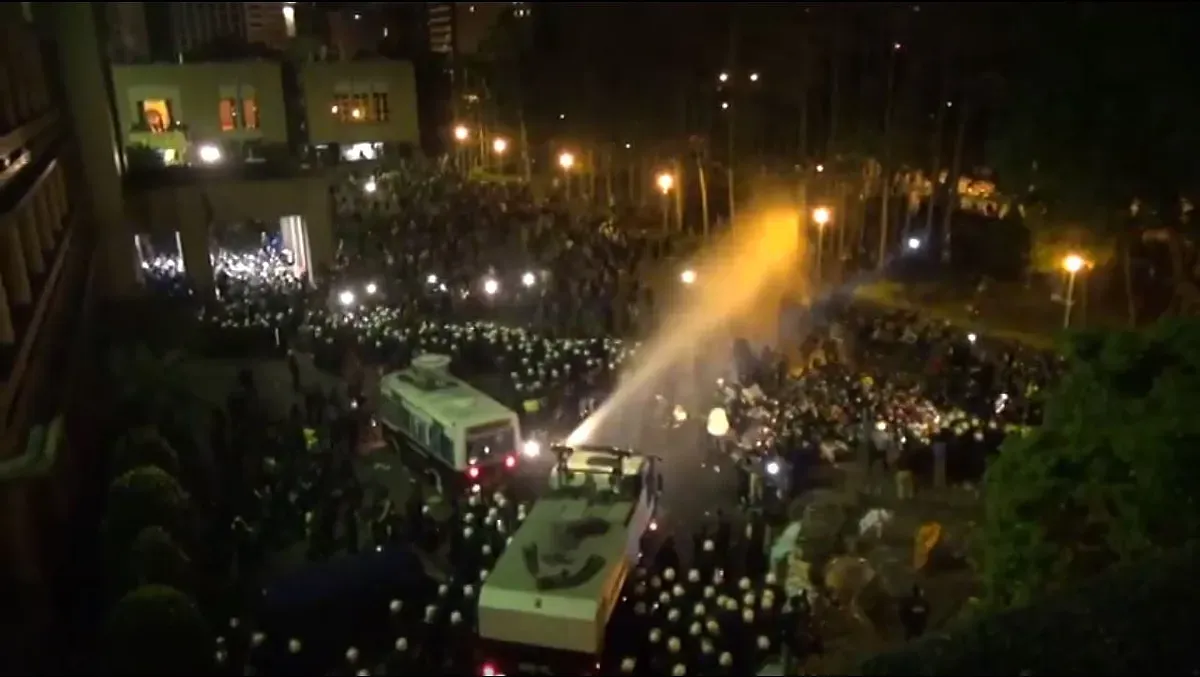
The defendants put their bodies on the line for their convictions on March 23 and 24, 2014. More than seven years later, they had endured not only state violence on the night itself but continuing litigation afterward. The price they paid for the belief that Taiwan's free development should not be constrained by another state deserves recognition. Democracy and freedom are never achieved in a single step. The defense team will continue to stand with the defendants so that the ideals behind their actions can be carried forward rather than suppressed.
Judgment Summary
| Charged Offense | Name | First-Instance Judgment | Second-Instance Judgment | Supreme Court Judgment | Current Judgment |
| Destroying Property in the Custody of a Public Official | Li Kuan-Ling | Four months' imprisonment, commutable to a fine | Appeal dismissed | All judgments set aside and case remanded | Prior judgment upheld |
| Hsu Shun-Chih | Four months' imprisonment, commutable to a fine | Two months' imprisonment for incitement, commutable to a fine; five months in aggregate together with the property-destruction offense | Prior judgment upheld | ||
| Inciting Others to Commit an Offense | Wei Yang | Acquitted | Four months' imprisonment, commutable to a fine | Prosecution dismissed | |
| Chen Ting-Hao | Acquitted | Four months' imprisonment, commutable to a fine | Prosecution dismissed | ||
| Chiang Ping-Lun | Acquitted | Three months' imprisonment, commutable to a fine | Prosecution dismissed | ||
| Liu Ching-Wen | Acquitted | Two months' imprisonment, commutable to a fine | Prosecution dismissed | ||
| Lin Chien-Hsing | Acquitted | Three months' imprisonment, commutable to a fine | Prosecution dismissed | ||
| Ko Ting-Yu | Acquitted | Two months' imprisonment, commutable to a fine | Prosecution dismissed |
Related Materials
- Statement on the Second-Instance Judgment in the March 23 Executive Yuan Occupation Defense Case: 1 Acquitted, 16 Convicted
- Statement on the Supreme Court Judgment in the March 23 Executive Yuan Occupation Defense Case
Press Contact
Attorney Li Ming-Ju / Staff Attorney, Judicial Reform Foundation - (02) 2523-1178 ext. 17
This article is an AI-generated translation of the original Chinese text. In the event of any discrepancy, the Chinese version shall prevail.