
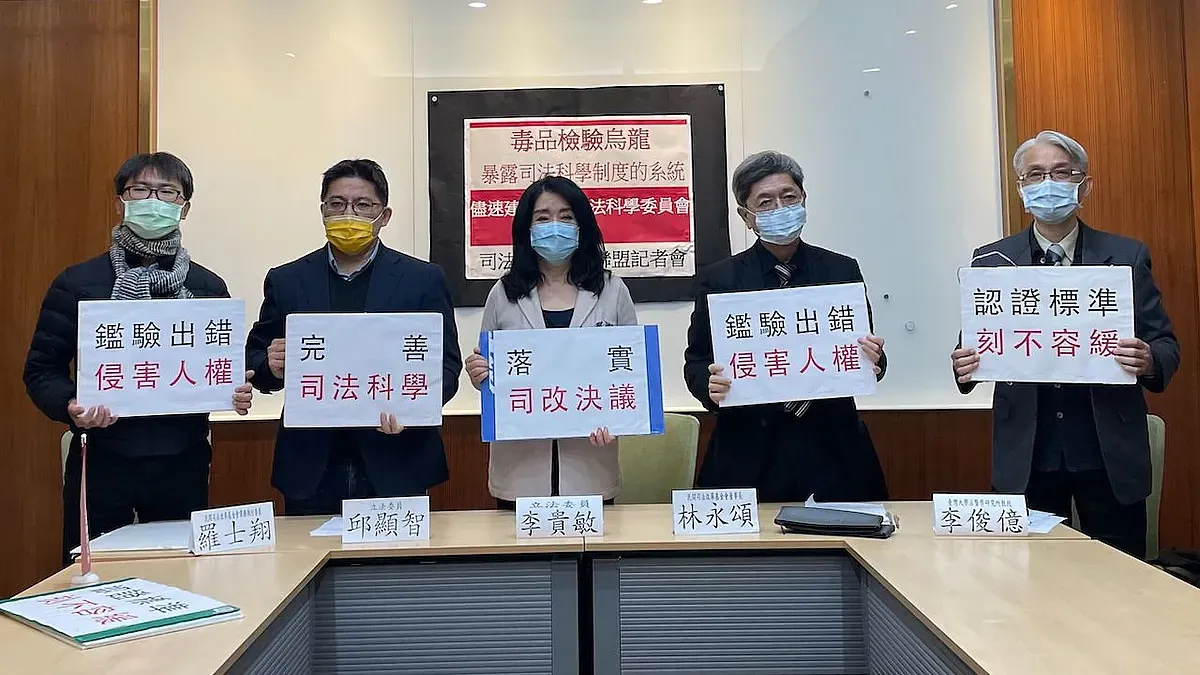
Press Conference | Drug-Testing Error Exposes Systemic Forensic-Science Deficiencies-Establish a National Forensic Science Commission
Last edited: 2026-08-30
Media reports on December 14, 2021 concerning erroneous drug testing at Kaohsiung Medical University exposed serious weaknesses in Taiwan's current drug-testing system and the potential for substantial harm to individual rights. The incident underscores the urgent need to build and comprehensively review institutions governing forensic science.
The 2017 National Conference on Judicial Reform had already resolved that:Taiwan should establish a national Forensic Science Commission that exercises its authority independently, yet no concrete implementation plan has been produced. In light of the failure revealed by this incident, the JRF urges the Ministry of Justice to confront the systemic problem and implement the resolution. The Taiwan Forensic Science Promotion Alliance therefore makes four specific demands:
- When a new psychoactive substance is scheduled, the testing capabilities of relevant laboratories should be verified at the same time.
- All drug-testing institutions should conduct a comprehensive retrospective review for similar identification errors.
- The Ministry of Justice and Ministry of Health and Welfare should establish an accreditation system for drug-testing institutions.
- In accordance with the National Conference on Judicial Reform resolution, the Ministry of Justice should promptly propose a concrete plan for a Forensic Science Commission.
-
Verify Laboratory Testing Capacity When New Psychoactive Substances Are Scheduled
Eutylone, the substance at issue, was scheduled by the Ministry of Justice as a Category 3 controlled drug on February 3, 2020. According to media reports, it was not until August 2020 that the Ministry of Justice and Taiwan Food and Drug Administration asked private laboratories whether they were willing to develop Eutylone testing. Kaohsiung Medical University obtained a Eutylone reference standard and established a testing method only in November.
In other words, for roughly nine months after Eutylone was scheduled, private testing institutions could not reliably distinguish it from Pentylone, a Category 2 controlled drug[1]. Samples nevertheless continued to be submitted, creating a risk of erroneous identification.
The Alliance therefore recommends that whenever the Ministry of Justice schedules a new psychoactive substance, it should immediately notify testing institutions nationwide and determine whether each institution can accurately test for that substance. The results should then be communicated to courts, prosecutors offices, and other agencies that submit samples so they can choose an appropriate laboratory with full knowledge of its capabilities. This would reduce errors caused by information gaps.
-
Conduct a Comprehensive Retrospective Review of Similar Drug-Testing Errors
The incident shows that before November 2020, Kaohsiung Medical University could not reliably distinguish Eutylone from Pentylone. That raises a broader question: even before Eutylone was formally scheduled on February 3, 2020, could samples containing Eutylone have been misidentified as Pentylone, producing convictions for Category 2 drug offenses that the evidence did not support?
The Ministry of Justice should therefore review Pentylone identification results issued by laboratories before November 2020-and, where appropriate, earlier-to determine whether similar errors occurred.

-
Establish an Accreditation System for Drug-Testing Institutions
Current law establishes laboratory standards for urine testing under the Regulations Governing Establishment of Laboratories for Drug Abuse Urine Testing by Government Agencies, but comparable accreditation standards for testing the chemical composition of seized drugs are lacking.
The Alliance recommends establishing accreditation standards for drug-testing institutions by reference to the existing urine-testing framework. Institutions should perform drug identification only after demonstrating compliance with applicable scientific standards and standard operating procedures.
-
Promptly Develop a Plan for a National Forensic Science Commission
Resolution 12-0 of the 2017 National Conference on Judicial Reform states that:Taiwan should establish a national Forensic Science Commission that exercises its authority independently. The Commission should include experts in human rights, psychology, law, medicine, neuroscience, criminal forensics, and related fields and should address policy, education, and accreditation in order to strengthen reliable fact-finding and reduce miscarriages of justice. The resolution specifically called for forensic-science policy, education at all levels, and accreditation and licensing systems for laboratories and experts.
The Ministry of Justice has still not produced an implementation plan. The shortcomings exposed by this incident reflect the longstanding absence of unified and transparent standards for forensic-science work. The Alliance recommends that a Forensic Science Commission's responsibilities include at least:
- Developing forensic-science policy.
- Developing standard operating procedures, report formats, and standardized terminology.
- Establishing accreditation standards for forensic-science laboratories.
- Establishing and maintaining forensic-science reference-material databases.
- Developing competency certification, professional training, and continuing education for forensic-science personnel.
- Establishing forensic-science ethical standards.
- Promoting forensic-science education.
- Providing guidance and oversight for forensic-science agencies and institutions.
The Commission should operate through collective decision-making and include appropriate outside experts and scholars so that forensic-science policy benefits from diverse perspectives and genuine scientific debate.
A reliable forensic-science system is a basic safeguard against wrongful convictions and other miscarriages of justice. Laboratory accreditation, proper custody of physical evidence, and reform of expert-evidence procedures can strengthen fact-finding and improve the justice system's ability to reach accurate results.
The Alliance urges the Ministry of Justice to treat this incident not as an isolated laboratory mistake but as evidence of a systemic problem. Institutional reform should begin now, including a concrete and public plan for implementing the long-delayed resolutions of the National Conference on Judicial Reform.
Note
[1] Eutylone, a Category 3 controlled drug, and Pentylone, a Category 2 controlled drug, are constitutional isomers: they have the same molecular formula but different chemical structures. Without appropriate reference standards for comparison, distinguishing them can be difficult.
Attachments
- Statement | Lo Shih-Hsiang, Executive Director, Taiwan Association for Innocence
- Statement | Legislator Chiu Hsien-Chih
Attendees
Lin Yung-Sung / Attorney; Chairperson, Judicial Reform Foundation
Lo Shih-Hsiang / Attorney; Executive Director, Taiwan Association for Innocence
Li Chun-Yi / Professor, Department and Graduate Institute of Forensic Medicine, National Taiwan University College of Medicine
Chiu Hsien-Chih / Legislator
Priscilla Mei-Ying Lee / Legislator
Press Contact
Lu Cheng-Yen / Attorney; Deputy Director, Legal Policy Department, Judicial Reform Foundation
This article is an AI-generated translation of the original Chinese text. In the event of any discrepancy, the Chinese version shall prevail.