
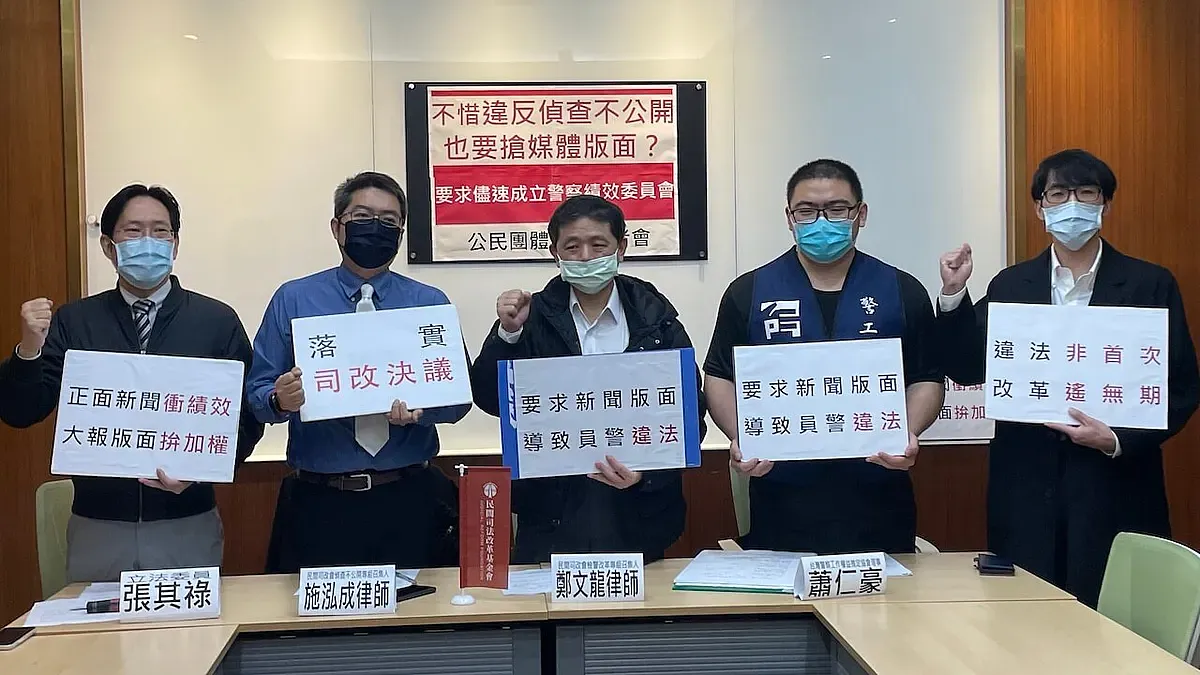
Press Conference | Chasing Headlines Even at the Cost of Violating Non-Disclosure of Investigations? Call for Prompt Establishment of Police Performance Management Committees
Last edited: 2026-08-30
At the end of last year, civil society groups received reports from rank-and-file police officers that the Kaohsiung City Police Department had instructed its precincts and officers to "issue more news releases on newly solved criminal cases." In addition to listing each precinct's "outstanding cases," the department even ranked "positive-news statistics for field units" and assigned scores.
These unreasonable requirements have pushed rank-and-file officers to compete for media coverage in order to satisfy their superiors, resulting in multiple apparent violations of the principle of non-disclosure of investigations. More seriously, the Kaohsiung City Police Department's own review report on non-disclosure of investigations omitted cases that appeared to involve violations, rendering the review ineffective and the report largely a formality.
In fact, flaws in the police performance-evaluation system have long left rank-and-file officers exhausted and have even contributed to unlawful practices. The problem is not limited to Kaohsiung; the JRF has also received reports from officers in other counties and cities. The Taiwan Police Union, the Judicial Reform Foundation, and the Taiwan Jury Association therefore jointly call for the following:
- The Kaohsiung City Police Department should abolish the improper performance requirements described above and thoroughly review both its performance-evaluation system and implementation of the principle of non-disclosure of investigations.
- The National Police Agency should supervise the Kaohsiung City Police Department's handling of these improper performance requirements, review and assess performance requirements issued by county and city governments nationwide, and identify any inappropriate items.
- The Ministry of the Interior should promptly establish a Central Police Performance Management Committee and create a scientific and reasonable performance-evaluation system, thereby implementing the resolutions of the National Conference on Judicial Reform and improving the professionalism and efficiency of police investigations.
- County and city governments should expressly eliminate performance indicators tied to police media exposure, comprehensively review existing performance requirements, and establish local Police Performance Management Committees.
At the same time, rank-and-file police officers anywhere in Taiwan who encounter unreasonable performance requirements are encouraged to report them to the JRF or the Taiwan Police Union. We will help monitor and review such practices in order to improve officers' workplace rights and interests.
-
Positive News for Performance Points; Front-Page Coverage Gets Extra Weight
The Taiwan Police Union recently received reports from rank-and-file officers that the Kaohsiung City Police Department requires officers to produce "positive-news performance." In addition to their core duties of investigating crimes and maintaining public order, officers are therefore expected to compete actively for media exposure. This improperly adds work unrelated to their professional duties and has generated widespread frustration among rank-and-file officers.
Photographs provided by the reporting officers show that the Kaohsiung City Police Department's internal system includes not only "Outstanding Cases in Media and Public-Opinion Response," but also "Positive-News Statistics and Rankings for Field Units." Precincts are ranked, with separate scoring groups A, B, and C-an indication of how much importance supervisors place on these metrics.
 Figure 1: Kaohsiung City Police Department - "Outstanding Cases in Media and Public-Opinion Response"
 Figure 2: Kaohsiung City Police Department - "Positive-News Statistics and Rankings for Field Units"
The JRF also obtained the internal "Kaohsiung City Police Department Plan for Evaluating Press Releases Published by the Media" (Attachment 1) and its "Evaluation Score Sheet" (Attachment 2). The internal rules set out a detailed "weighting method" designed to boost positive media exposure. For example, one online-media report earns one point, while front-page coverage in one of the three major newspapers receives four times the weight.
The Evaluation Plan further shows that, at least since 2015, the Kaohsiung City Police Department has issued formal written directives requiring "media performance" from police. Although the plan contains no express penalty, weekly evaluations, rankings, rewards, and review meetings inevitably create substantial performance pressure for rank-and-file officers. It is therefore concerning that such pressure may create harmful side effects, encouraging officers to pursue "big cases" or think constantly about how to "make the news" while handling investigations.
-
Superiors Demand Media Coverage, Driving Officers to Violate Non-Disclosure of Investigations
The JRF further reviewed the news reports listed as "Outstanding Cases in Media and Public-Opinion Response" in Figure 1 and found multiple apparent violations of the principle of non-disclosure of investigations. Three examples are set out below:
The report includes video from the first-person perspective of the officer who fired the shots. It is clearly footage from the officer's body-worn camera and constitutes material governed by Article 9 of the Regulations Governing Non-Disclosure of Investigations, Paragraph 1, Subparagraph 6, "audio-visual material from an ongoing investigation," and is among the categories that may not be disclosed even under the exceptions.
Couple Found Naked and Asleep After Motel Tryst; Forced Entry Reveals Bags of Drugs on the Floor
The report contains two scene photographs labeled "Provided by Lingya Precinct." It also states: "Upon questioning, the 27-year-old man surnamed Cheng admitted that the substance was amphetamine, a Schedule II narcotic, and said he had simply wanted to 'relax' at a motel with his 26-year-old girlfriend surnamed Tsai, but relaxed so much that he missed the motel front desk's call...." These materials fall within Article 9, Paragraph 1, Subparagraph 6 of the Regulations Governing Non-Disclosure of Investigations ("audio-visual material from an ongoing investigation") and Subparagraph 1 of the same paragraph ("specific statements by the defendant"), categories that may not be disclosed even under the exceptions.
The report includes a subtitled video edited from two segments of police body-worn camera footage, along with two still images taken from that footage. Statements in the report such as "At the scene, the man surnamed Lei claimed that he had not used drugs for a long time..." and "According to information obtained, Lei has a prior drug conviction..." respectively involve "audio-visual material from an ongoing investigation" under Article 9, Paragraph 1, Subparagraph 6 of the Regulations Governing Non-Disclosure of Investigations, "specific statements by the defendant or criminal suspect" under Subparagraph 1, and "criminal-history information of the defendant or criminal suspect" under Subparagraph 7. These are categories that may not be disclosed even under the exceptions.
Beyond the serious and obvious violations above, several other reports listed as "Outstanding Cases in Media and Public-Opinion Response" in Figure 1 also raise concerns about violations of the principle of non-disclosure of investigations.
The police reports described above disclosed statements made by criminal suspects during ongoing investigations and posted body-worn camera footage and other audio-visual materials on official Facebook pages, apparently in an effort to generate positive public opinion toward the police. Much of the footage came from cameras worn by officers on duty. In addition to concerns about non-disclosure of investigations, the acquisition, editing, and release of such footage to news media for public-relations purposes raises a separate question as to whether the police complied with the Directions on the Use of Miniature Cameras and Preservation and Management of Audio-Visual Data by Police Agencies, Points 5 and 6, including the required approval by a precinct chief, an official of equivalent rank or higher, or an authorized person.
In a single week in mid-October 2021, the three news incidents described above already involved apparent violations of non-disclosure of investigations. After checking the units that released the three reports, the JRF found that none had yet published its review report for the second half of 2021. However, the overall review in the Kaohsiung City Police Department Review Report on Non-Disclosure of Investigations for the Second Half of 2021 did not include the incidents described above, showing that the review mechanism failed to function effectively.
In short, the "positive news" evaluation system not only imposes additional work outside officers' professional duties, but may also encourage rank-and-file personnel to violate non-disclosure requirements and infringe individual rights in order to earn points.
-
Not the First Violation; Reform Still Nowhere in Sight
This was not the first time such violations had occurred. On June 3, 2018, the JRF held a press conference titled "When Police, Suspects, and Members of the Public Are Forced to Become Actors: Police Production of 'Love and Iron Blood' Videos Violates Non-Disclosure of Investigations," ranked police departments that had violated the principle of non-disclosure of investigations in this manner, and publicly called on the chiefs of the nation's "top five" departments to respond.
At the time, the Kaohsiung City Police Department also responded and adjusted the content of its videos to focus on "good people and good deeds," after which the "Love and Iron Blood" series gradually disappeared. Now that the Kaohsiung City Police Department routinely demands "positive-news performance statistics" from subordinate units, is this simply the same practice returning in another form?
-
Judicial-Reform Resolution Ignored; Performance-System Problems Persist
For years, unscientific and unreasonable performance requirements in Taiwan's police system have left rank-and-file officers exhausted and have even encouraged some to take risks by enforcing the law unlawfully or engaging in practices like the "Love and Iron Blood" series described above.
To address these problems, the 2017 National Conference on Judicial Reform adopted Resolution No. 69-2, which called for a "Police Projects and Performance Management Committee" to be established under the Ministry of the Interior, with outside members constituting more than half of the committee, in order to build a reasonable performance system-including public disclosure of the standards, methods, and reasons used to calculate performance-management items.
Yet on December 20, 2017, the National Police Agency resolved at a meeting "not to adopt the resolution's proposed approach and to propose an alternative," effectively rejecting the National Conference on Judicial Reform's call to establish a Police Projects and Performance Management Committee. The Kaohsiung City Police Department's current requirement for "positive-news" performance further highlights the disorder in police performance management and the importance of placing relevant principles on a statutory footing. Civil society groups are concerned that, just as Kaohsiung's earlier "Love and Iron Blood" series helped spur police departments elsewhere to release body-worn camera footage, its new "positive-news performance" system may likewise be copied by other local police departments.
Regarding the proposed Police Projects and Performance Management Committee, the JRF and the Taiwan Jury Association held a seminar in October of last year and proposed a civil-society draft amendment to the Police Act.Civil-Society Draft Partial Amendment to the Police Act (Excerpt)
Article 7 (Central and Local Performance Management Committees)
I. A Central Police Performance Management Committee shall be established under the Ministry of the Interior, with the National Police Agency serving as the implementing agency.
II. Police Performance Management Committees shall be established within the police departments of special municipalities, counties, and cities and shall be subject to the direction and supervision of the Central Police Performance Management Committee.
III. The Central Performance Management Committee shall review the following matters in accordance with the principles of lawfulness, reasonableness, and fairness:
1. Performance-evaluation systems.
2. Rules for calculating points.
3. Promotion systems.
4. Local adaptations concerning the matters in the preceding three subparagraphs.
5. Other related matters.
IV. Local Performance Management Committees shall supervise local implementation of the matters in the preceding paragraph and compile and report to the Central Performance Management Committee matters under Subparagraph 4 of the preceding paragraph.
V. In calculating promotion points under Subparagraph 3 of the preceding paragraph, the total points awarded annually for administrative commendations shall not exceed the points assigned to a Grade A performance evaluation.
VI. Central and local Performance Management Committees shall meet at least once each quarter to review the matters under Paragraphs 3 and 4 and shall publish the review results within two months after each meeting.
VII. Personnel and legal-affairs units shall send representatives to attend the meetings described in the preceding paragraph.
VIII. The Ministry of the Interior is authorized to prescribe regulations governing the committees' administrative policies and plans and other matters necessary to facilitate their operation.※ For the full text and legislative reasons, see Attachment 3
Regrettably, however, neither the Ministry of the Interior nor the National Police Agency has yet shown the resolve needed to reform the performance-evaluation system.
In summary, the Taiwan Police Union, the Judicial Reform Foundation, and the Taiwan Jury Association jointly call for the following:
- The Kaohsiung City Police Department should abolish the improper performance requirements described above and thoroughly review both its performance-evaluation system and implementation of the principle of non-disclosure of investigations.
- The National Police Agency should supervise the Kaohsiung City Police Department's handling of these improper performance requirements, review and assess performance requirements issued by county and city governments nationwide, and identify any inappropriate items.
- The Ministry of the Interior should promptly establish a Central Police Performance Management Committee and create a scientific and reasonable performance-evaluation system, thereby implementing the resolutions of the National Conference on Judicial Reform and improving the professionalism and efficiency of police investigations.
- County and city governments should expressly eliminate performance indicators tied to police media exposure, comprehensively review existing performance requirements, and establish local Police Performance Management Committees.
At the same time, rank-and-file police officers anywhere in Taiwan who encounter unreasonable performance requirements are encouraged to report them to the JRF or the Taiwan Police Union. We will help monitor and review such practices in order to improve officers' workplace rights and interests.
Attachments
- Kaohsiung City Police Department Plan for Evaluating Press Releases Published by the Media
- Kaohsiung City Police Department Positive-News Evaluation Score Sheet
- Civil-Society Draft Police Act Amendment (Performance Management Committees)
Attendees
Cheng Wen-Lung / Founding Chair of the Taiwan Jury Association; Convener of the JRF Task Force on Prosecutor and Police System Reform
Hsiao Jen-Hao / Director, Taiwan Police Union
Shih Hung-Cheng / Convener of the JRF Task Force on Oversight of Non-Disclosure of Investigations
Chang Chi-Lu / Legislator
Press Contact
Attorney Lu Cheng-Yen, Deputy Director of the JRF Legal Policy Department
This article is an AI-generated translation of the original Chinese text. In the event of any discrepancy, the Chinese version shall prevail.