
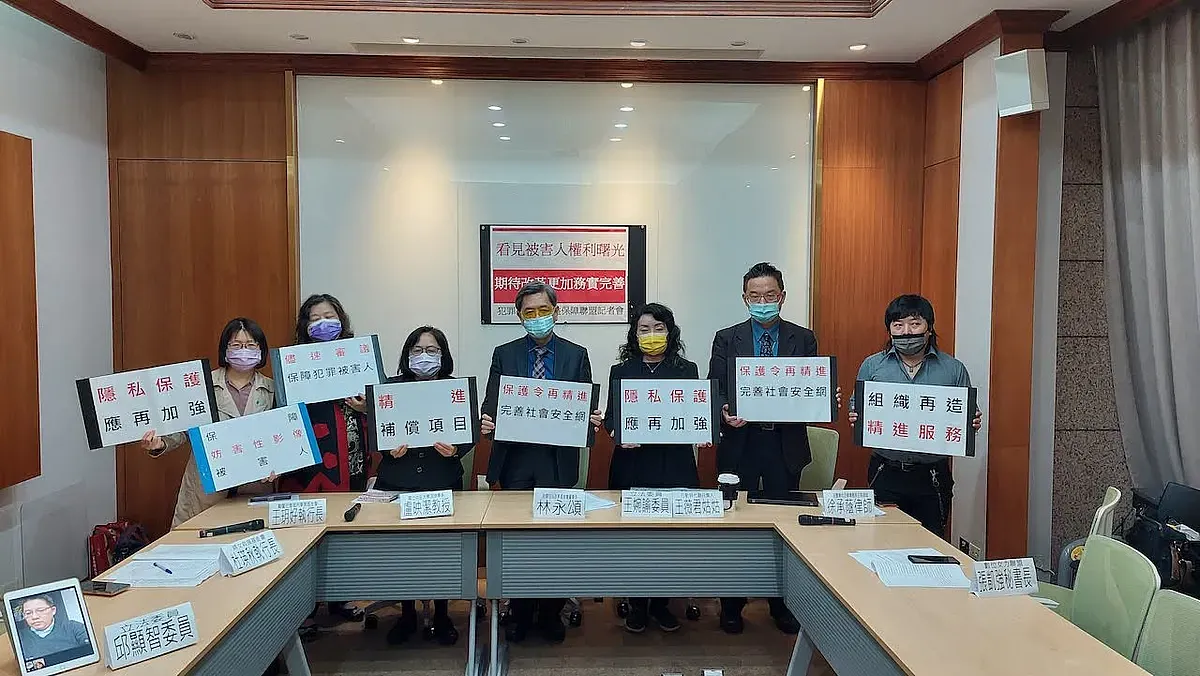
"A Glimpse of Dawn for Crime Victims' Rights, Looking Forward to More Pragmatic and Comprehensive Reforms" - Press Conference by the Alliance for Crime Victims' Rights Protection
Last edited: 2026-08-28
After numerous meetings with civil society organizations, the Executive Yuan officially proposed the amendment draft of the "Crime Victim Rights Protection Act" (hereinafter the "official draft") on March 10, 2022. Compared to the current "Crime Victim Protection Act", the draft introduces significant reforms to victim protection organizations, the scope of protection services, and compensation systems, alongside the newly created crime victim protection order. This demonstrates the government's emphasis on protecting crime victims' rights, which the "Alliance for Crime Victims' Rights Protection" (hereinafter the "Alliance") also affirms. However, the official draft still has certain areas for improvement. Through this press conference, the Alliance hopes to put forth constructive recommendations to make the reform of the crime victims' rights protection system more pragmatic and comprehensive, and looks forward to the Legislative Yuan prioritizing crime victims' rights and fully accelerating the deliberation of this Act.
Crime Victim Protection Orders Should Allow Victims to Apply Independently
Under the "crime victim protective order" designed in the current official draft, only the court may issue such an order ex officio or upon the prosecutor's application; victims are unable to apply on their own. The Alliance suggests that victims should be allowed to apply independently to strengthen the function of immediate protection.
Protection Order Content for Victims of Sexual and Intimate Image Crimes Should Be More Comprehensive
Although the official draft newly adds the "Chapter on Offenses against Sexual Privacy and Synthetic Sexual Videos" (Newly added Chapter 28-1 of the Criminal Code) and applies mutatis mutandis the relevant provisions of the "crime victim protective order," it fails to include the requirement most needed by such victims—namely, demanding the removal of relevant videos—as part of the protection order content. The Alliance recommends explicitly stipulating that victims of offenses against sexual privacy and Synthetic Sexual images can obtain protective order provisions ensuring that their sexual images will not be re-produced or disseminated, and requiring relevant online platforms to take them down.
Loophole-Free and Adequate Compensation Benefits
-
Adding Compensation (Assistance) Items
Regarding compensation (assistance) items, the official draft provides only lump-sum payments, lacking long-term support for victims. The civil society version proposed by the Alliance includes the compensation (assistance) item of "periodic payments for maintaining livelihood" to balance victims' needs and the effective utilization of resources.
-
Deletion of Non-Compensation Provisions and Discretion to Reduce Compensation
The occurrence of a crime signifies a lapse in the state's maintenance of public safety; therefore, granting compensation to crime victims also represents the state's responsibility and apology. Based on this concept, the civil society version deletes provisions denying compensation. Additionally, special protection is granted to underage victims: even if victimization results from their intentional act or gross negligence, the review organization is granted the discretion not to reduce the compensation.
-
Change in the Source of Compensation Funds
Listing prison labor earnings as a source of compensation is unfair to inmates of crimes without victims; moreover, for inmates involved in crimes with victims, their prison labor earnings are originally an item that victims can execute upon when filing civil claims for damages, raising concerns of duplicate "allocation." Furthermore, the current Crime Victim Protection Act as well as the official and civil society draft versions all provide legal aid and related services or subsidies to crime victims, establishing mechanisms to assist in claiming damages from inmates. Therefore, the provision listing prison labor earnings as a source of compensation is deleted.
Refining Organizational Planning and Ensuring Funding to Enhance the Service Quality of the Crime Victims Protection Association
-
Board Size Should Account for Deliberative Efficiency
The official draft plans for the Crime Victims Protection Association to have 5 official representatives and 16 civil society representatives, totaling 21 board members. Since an excessively large number of board members may lead to poor attendance and make meetings difficult to convene, budget evaluation reports for the Crime Victims Protection Association in 2019 and 2020 twice pointed out situations where board attendance was too low, resulting in poor deliberative efficiency and quality. Furthermore, the official draft's contents regarding "two persons recommended from various circles as socially impartial or public-interest-minded individuals" and "two persons recommended from various circles with work experience in crime victim protection and distinguished reputation or contributions" appear to be repetitive. Therefore, the Alliance suggests retaining one of these categories and adjusting the board size to 19 members to balance deliberative efficiency.
-
Deputy CEOs Should Generally Be Full-Time Positions
The official draft provides for one full-time Chief Executive Officer for the Crime Victims Protection Association. Given the current scale of the victim protection organization—with a staffing quota of 70 full-time personnel and 57 frontline full-time personnel directly engaged in victim protection work across 22 branches such as Taipei, totaling 127 people—several full-time Deputy CEOs should be established in terms of organizational scale. Moreover, if Deputy CEOs serve concurrently, not only might they be unable to fully dedicate themselves to association affairs, but different agencies or positions to which they originally belong could also result in an organization with "too many drivers" and unable to operate smoothly. The Alliance suggests that if there is a need for more than one Deputy CEO, all of them should appropriately be full-time positions.
-
Compensation Review Organization Should Return to the Crime Victims Protection Association
The official draft still places the compensation review organization under the prosecutorial system, whereas the civil society version proposed by the Alliance returns the review organization to the Crime Victims Protection Association. Since the compensation review organization in the official draft remains under the jurisdiction of the prosecutorial system, and review committee members are all selected by Chief Prosecutors, it risks the review organization remaining permeated with the colors of the prosecutorial system, giving crime victims a feeling of "coldness." Therefore, the Alliance suggests transferring the compensation review organization to the professional and specialized staff of the victim protection organization.
-
Budgets Should Be Allocated Annually
The official draft merely stipulates that the competent authority shall compile a budget. To ensure that future budgets related to the victim protection organization remain sufficient, the Alliance suggests explicitly stipulating that budgets shall be "compiled annually in accordance with the business needs and development of the Foundation."
Privacy Protection for Victims Should Be Further Strengthened
In this amendment, the official draft stipulates that where the competent authority determines there is a benefit to the public interest, there may be exceptions to publishing victims' private matters, which is inappropriate. Specifically, the official draft stipulates that when the competent authority or target-enterprise competent authority weighs social public welfare and deems reporting necessary, the names, domiciles, residences, or other matters sufficient to identify the victims or their family members may be reported. However, this provision appears to grant overly broad authorization and may negatively impact the rights of victims and their family members; the Alliance suggests deleting it.
Building upon the above, the amendment draft of the "Crime Victim Rights Protection Act" promulgated by the Executive Yuan communicated with civil society organizations multiple times during the drafting period and adopted some civil society recommendations, demonstrating the government's emphasis on crime victims' rights. Furthermore, the Alliance reiterates its affirmation of institutional designs such as the creation of crime victim protection orders and the expansion of protection service scopes. Nevertheless, certain provisions in the current official draft remain imperfect. Consequently, the Alliance has put forward the aforementioned recommendations, hoping that this systemic reform will ensure crime victims no longer weep only in the dark night, but rather have their rights protected in a pragmatic and effective manner.
Attachments
Attendees
Yung-Sung Lin, Attorney at Law / Chairman, Judicial Reform Foundation
Ku-ku Wei-Chun Wang / Deputy Convener, Action Era
Yueh-Hao Wang, CEO / Garden of Hope Foundation
Ying-Chiu Tu, CEO / Women's Rescue Foundation
Ying-Chieh Lu, Professor / Department of Law, National Chung Cheng University
Cheng-Yin Hsu, Attorney at Law / Managing Partner, Tien-Feng Joint Law Firm
Kai-Chiang Chang, Secretary-General / Taiwan Women's Link
Yu-Chin Wu, Legislator
Wan-Yu Wang, Legislator
Kuei-Min Lee(Online), Legislator
Hsien-Chi Chiu(Online), Legislator
Press Contact
Yang Chen / Legislative Researcher, Judicial Reform Foundation
This article is an AI-generated translation of the original Chinese text. In the event of any discrepancy, the Chinese version shall prevail.