
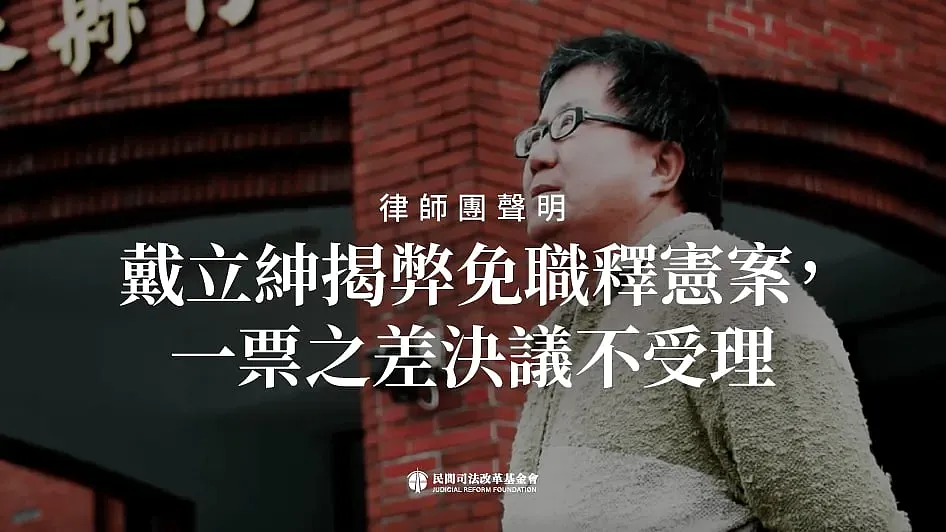
Attorneys' Team Statement | Constitutional Interpretation Case on the Dismissal of Whistleblower Li-Shen Tai Dismissed by a One-Vote Margin
Last edited: 2026-09-03
Between 2005 and 2016, Li-Shen Tai served at the Hsinchu County Livestock Disease Control Center. Discovering that his superiors repeatedly pressured him to falsify accounts and misappropriate public funds, he reported himself to the Agency Against Corruption of the Ministry of Justice through the Government Ethics Office (department of Government Ethics) and submitted compelling evidence to assist prosecutors and the police in their investigation, thereby exposing a corrupt network of accomplices and bringing them to judicial prosecution. The criminal judge presiding over Li-Shen Tai's corruption case found that he bravely reported the crime without yielding to pressure, and thus exempted him from personal criminal liability. However, precisely because of this "judgment of exemption from punishment," the Hsinchu County Government ordered his "dismissal" and "permanent disqualification from employment" in 2016. Li-Shen Tai's courage in blowing the whistle resulted instead in the forfeiture of his civil servant qualifications, which evidently constitutes a severe infringement upon his right to hold public office. Consequently, the Judicial Reform Foundation filed a petition for judicial interpretation on behalf of Li-Shen Tai on January 10, 2018.
Nevertheless, on May 27 of this year (2022), the Constitutional Court dismissed the case by a vote of eight to seven among the Grand Justices, missing a crucial constitutional review opportunity to improve the system for whistleblower protection and provide individual relief. This is deeply regrettable. Upon reviewing Ruling Hsien-Tsai-254 of the Constitutional Court for 2022 and the two dissenting opinions attached thereto, the attorneys' team believes that substantial room for improvement remains regarding whistleblower protection and systemic reform.
The Current Civil Service Employment Act Still Lacks a Mechanism for Protecting Whistleblowers!
The Civil Service Employment Act stipulates that any public servant who has committed corruption in the course of duty and has been convicted shall be dismissed.
Such a systemic design offers whistleblowers only relief from criminal penalties while depriving them of their status as civil servants, which manifestly conflicts with the spirit of the state encouraging civil servants to surrender and expose wrongdoing, violates the principle of proportionality, and inadequately protects the constitutionally guaranteed right of citizens to hold public office. This institutional status quo may result in civil servants refraining from blowing the whistle out of fear of losing their jobs. Regrettably, neither the Civil Service Employment Act nor other legislation (such as the long-delayed draft "Whistleblower Protection Act") has yet accomplished corresponding legislative improvements for this unfair institutional phenomenon.
The Constitutional Court's Reasoning Has Degenerated into Boilerplate, Failing to Truly Address the Grounds for Dismissal!
Ruling Hsien-Tsai-254 of the Constitutional Court for 2022 dismissed the case on two grounds: first, "how the provisions at issue infringe upon the right to hold public office guaranteed by the Constitution has objectively yet to be specifically articulated"; second, "how the provisions at issue—by failing to distinguish among types of criminal convictions for civil servants and by categorically failing to exclude civil servant whistleblowers—run counter to the constitutional principles of proportionality or equality has objectively yet to be specifically articulated.">
However, a comprehensive review of the constitutional interpretation petition in this case reveals that the petition invoked Article 18 of the Constitution, Judicial Yuan Interpretations Nos. 491, 546, 575, 583, 611, and 715, as well as relevant provisions of the United Nations Convention against Corruption, explicitly arguing that the provisions involved in this case have infringed upon citizens' constitutional right to hold public office. Furthermore, the petition deconstructed the relevant legal system and successively cited Judicial Yuan Interpretations Nos. 701, 712, and 732, Grand Justice Yueh-Sheng Weng's concurring opinion on the principle of equality in Interpretation No. 455, and constitutional arguments concerning the principle of proportionality found in Interpretations Nos. 66, 461, 711, 715, and 754, undoubtedly establishing specific articulation of the controversies concerning violations of the principles of equality and proportionality. Regrettably, the majority of Grand Justices did not specifically respond to the arguments presented in the petition, instead issuing a boilerplate, abstract dismissal, thereby missing the opportunity to substantively review the constitutional issues of this case. (Constitutional Interpretation Petition for Li-Shen Tai's Dismissal Case)
The Two Dissenting Opinions from Grand Justices in This Case Further Indicate That the Case Truly Possesses Constitutional Review Value!
Although the case was dismissed by the Constitutional Court by a one-vote margin, it is accompanied by two dissenting opinions (representing a total of five Grand Justices) that are well worth referencing. Both dissenting opinions point out that the case possesses principal constitutional importance and highlight that, pursuant to Judicial Yuan Interpretation No. 66, while exceptions exist allowing individuals placed on probation to hold public office upon completion of their probationary period, applying the uniform consequence of mandatory dismissal without exception to those granted an exemption from punishment is likewise an issue worthy of discussion. Had this case been admitted for review, it could have further advanced relevant legislative progress, which is deeply lamentable.
Our Association will continue striving for legislative advocacy and individual relief concerning whistleblower protection!
Attachments
- Full Text of the Constitutional Court Ruling and Dissenting Opinions
- Constitutional Interpretation Petition for Li-Shen Tai's Dismissal Case
- Chronology of Li-Shen Tai's Dismissal Case
Date
Content
Case Number
2007.07~2011.04
Li-Shen Tai was instructed by his direct superior to falsify accounts and misappropriate public funds
Late 2012
Li-Shen Tai exposed the corruption case to the Department of Civil Service Ethics and surrendered himself
2015.11.25
Hsinchu District Court Judgment—Exemption from Punishment
103-Su-65
2016.01.30
Hsinchu County Government approved the dismissal
Fu-Jen-No. 1050019480
2016.02.23
Li-Shen Tai applied for review to the Civil Service Protection and Training Commission
2016.05.10
Civil Service Protection and Training Commission Review Decision—Dismissed (Rejected)
105th-Gong-Shen-Chueh-0102
2016.07.13
Li-Shen Tai filed an administrative litigation
2017.01.05
Taipei High Administrative Court Judgment—Plaintiff's Action Dismissed
105-Su-1075
2017.03.17
Supreme Administrative Court Ruling—Appeal Dismissed
106-Tsai-295
2018.01.10
Pro bono attorneys' team assisted Li-Shen Tai in petitioning for constitutional interpretation
2018.05.28
Ministry of Justice convened a seminar on the "Legislation of the Whistleblower Protection Act"
2019.05.03
Executive Yuan formally submitted the "Whistleblower Protection Act Draft" to the Legislative Yuan
2019.05.27
The "Whistleblower Protection Act Draft" was sent for party caucus negotiations, but ultimately failed to pass three readings
2021.04.14
Legislative Yuan held a public hearing on "Enacting Whistleblower Protection Regulations is Imperative Following the April 2 Taroko Express Railway Accident"
2021.12.08
Legislative Yuan held a public hearing on "Discussing the Whistleblower Protection System from the Perspective of Fourth Nuclear Power Plant Safety to Realize a Clean Government and Administrative Neutrality"
2022.01.25
Ministry of Justice reported the public-private consolidated version of the "Whistleblower Protection Act Draft" (4th version) to the Executive Yuan for review
2022.05.27
Constitutional Court Ruling—Dismissed (8 to 7)
Ruling Hsien-Tsai-254 of 2022
This article is an AI-generated translation of the original Chinese text. In the event of any discrepancy, the Chinese version shall prevail.