
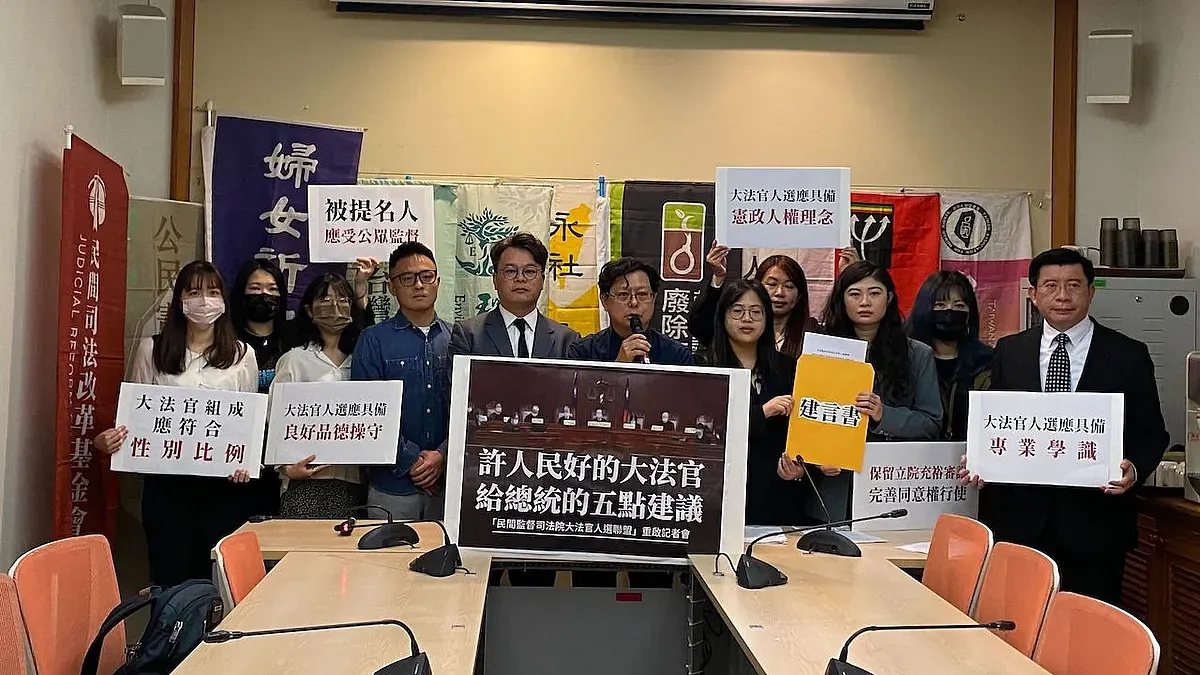
Press Release | Grand Justices Suited to the People: Five Recommendations for the President
Last edited: 2026-07-27
Throughout history, interpretations of the Constitution and laws by the Grand Justices of the Judicial Yuan have guided Taiwan's constitutional development and played pivotal roles in rulings on numerous controversial social issues. The terms of four Grand Justices—Huang Hung-hsia, Wu Ch'en-huan, Tsai Ming-cheng, and Lin Chun-i—will expire at the end of September this year, prompting the Office of the President to initiate the nomination process. As guardians of the Constitution, the selection of Grand Justices must be approached with utmost caution.
To this end, 15 organizations—including the Covenants Watch, Citizen Congress Watch, Citizens' Constitutional Movement Alliance, Taipei Bar Association, Taiwan Association for Human Rights, Taiwan Forever Society, Taiwan Criminal Defense Lawyers Association, Taiwan Law Society, Taiwan Association for Innocence, Taiwan Association for Judicial Reform (TAJR), Taiwan Labour Front, Taiwan Alliance to End the Death Penalty, Judicial Reform Foundation, Awakening Foundation, and Environmental Jurists Association—officially re-launched the "Alliance for Civilian Monitoring of Judicial Yuan Grand Justice Nominees" today. This Alliance will rigorously scrutinize the President's exercise of the nomination power and the Legislative Yuan's exercise of the consent power. Once the President announces the Grand Justice nominees, the Alliance will form an impartial and professional "Grand Justice Nominee Evaluation Committee" to conduct evaluations and publish an evaluation report.
Although the exercise of the nomination and consent powers for Grand Justices is a crucial constitutional matter in our country, it has regrettably lacked statutory provisions defining its content to this day. To remedy this legal shortfall, make the President's procedure for exercising the Grand Justice nomination power more comprehensive, and ensure adequate communication with civil society, the Alliance puts forward the following five appeals to the President:
1. Prior to official nomination, the President should first announce the nominees and the reasons for their nomination to solicit public opinion
On the 7th of this month, the Office of the President established the "Judicial Yuan Grand Justice Nomination Recommendation Review Group" to assist the President in exercising the nomination power. However, apart from referencing the group's opinions, the sources of information and perspectives available to the committee members ultimately have their limits and require supplementation from various sectors of society. In past constitutional practice, situations have arisen where, after the President announced a nominee, differing opinions from society and this Alliance led the nominee to voluntarily withdraw from the nomination.
Furthermore, looking at the current procedure for attorneys transitioning to judges, the Judicial Yuan publishes identifiable educational and professional background information of applicants, inviting the public to provide feedback before proceeding with subsequent selections. The Alliance believes that the nomination procedure for Judicial Yuan Grand Justices must also adopt the same or a higher standard to help build social consensus. We call upon the President to announce the names of the nominees, the reasons for nomination, and other related information prior to official nomination, and to solicit public opinion.
2. Grand Justice candidates should possess sound moral character, professional knowledge, and progressive constitutional and human rights ideals
Given that the rulings of Grand Justices will have a comprehensive and profound impact on the lives of all citizens, we call upon the President to ensure that Grand Justice nominations are fair and objective, without using ethnicity, region, background, or ideology as primary criteria, and to thoroughly examine the following three major traits:
-
Moral Character and Integrity
Nominees must not have stains on their moral character or records inconsistent with the reputation of a Grand Justice, so as not to undermine the credibility of their adjudicative duties. -
Constitutional and Human Rights Ideals
Nominees should possess progressive constitutional and human rights ideals to safeguard judicial independence in the exercise of their duties, and must fully understand the meaning of the Constitution in protecting the fundamental rights of the people, thereby offering pioneering, progressive, and liberal legal discourse on constitutional issues arising from social changes and conceptual developments. -
Knowledge and Professionalism
Nominees should possess rich knowledge and professional competence to present persuasive legal arguments to the public on major and difficult constitutional and legal disputes.
To examine whether this batch of Grand Justice nominees meets the aforementioned qualifications, the Alliance will organize a "Grand Justice Nominee Evaluation Committee" to conduct evaluations and publish the evaluation results as a reference for citizens to assess the suitability of the nominees.
3. The composition of Grand Justices should emphasize diversity and gender proportion
In addition to considering the aforementioned traits, to ensure a reasonable degree of diversity in the composition of Grand Justices, we also call upon the President to consider the backgrounds of nominees during nominations. For those nominated based on academic qualifications, special care should be taken to avoid an overconcentration of Grand Justices from a single academic institution.
Moreover, synthesizing General Recommendation No. 23 (paragraphs 16 and 29) of the Convention on the Elimination of All Forms of Discrimination Against Women (CEDAW), the composition of Grand Justices should also meet the requirement that the proportion of either gender shall not be less than one-third. Therefore, for this nomination, the President must nominate at least two women to meet the aforementioned convention requirements; at the same time, regardless of the nominee's gender, all must possess sound gender equality awareness so that the constitutional requirement of gender equality can be continuously implemented.
4. During nomination, the willingness of nominees to accept public oversight should be considered
Since 2003, the Alliance has accumulated and published six evaluation reports. However, in 2019, the Alliance encountered a situation where nominees "collectively refused to respond" to questionnaires. Consequently, the Alliance and the public were unable to ascertain the nominees' human rights awareness and opinions on various constitutional issues through questionnaire responses, making it difficult for the Legislative Yuan to exercise its oversight responsibilities. This situation truly fails to enhance public trust in the judiciary and the Grand Justices.
In this regard, we call upon the President, when making nominations, to duly consider the nominees' willingness and attitude toward responding to questionnaires and accepting public oversight, so as to facilitate public understanding and supervision of the suitability of Grand Justice candidates.
5. Sufficient review periods should be reserved for the Legislative Yuan to perfect the exercise of its consent power
rTo enable the Legislative Yuan to exercise its consent power cautiously based on complete information and to oversee the suitability of nominees on behalf of the people, legislators still need time to request documents, hold hearings, and produce review reports. In particular, if political parties can loosen party-discipline constraints and allow legislators to examine nominee qualifications fairly and neutrally, adequate time becomes even more essential.
To this end, we call upon the President to reserve an ample review period of at least two months, enabling the Legislative Yuan to conduct necessary investigations in advance and schedule review timelines, thereby preventing rushed and perfunctory procedures.
To make the exercise of the nomination power more prudent and produce suitable Grand Justices who meet public expectations, the Alliance looks forward to the President adopting the aforementioned recommendations. Finally, the Alliance is also publicly recruiting questions from all sectors to be used in questioning the Grand Justice nominees. Because constitutional interpretation encompasses a broad spectrum that cannot be fulfilled through legal expertise alone, we hope that through questions provided by various sectors, Grand Justice nominees will be prompted to respond to issues concerning human rights, gender, environment, ethnicity, and labor.
Appendix
Attendees
Sun Yu-lien / Convener of this Alliance, Secretary-General of the Taiwan Labour Front
Lin Chun-hung / Chairperson of the Taiwan Criminal Defense Lawyers Association
Liao Yu-ching / Secretary-General of the Taiwan Law Society
Chang Hung-lin / Chief Executive Officer of the Citizen Congress Watch
Li Ming-ju / Deputy Chief Executive Officer of the Judicial Reform Foundation
Dai Ching-yun / Director of the Legal Department, Awakening Foundation
Lin Ping-feng / Secretary-General of the Taiwan Association for Jury System
Huang Hui-yu / Researcher at the Taiwan Forever Society
Lin Tzu-wei / Legal Affairs Director of the Taiwan Alliance to End the Death Penalty
Chiang Meng-chen / Office Director of the Covenants Watch
Yang Ya-wen / Executive Secretary of the Taiwan Association for Innocence
Liu Ting-yu / Legal Administrator of the Environmental Jurists Association
List of Alliance Member Organizations (Total of 15 organizations, invitations ongoing)
Covenants Watch
National Union of the Mentally and Physically Disabled, ROC
Citizen Congress Watch
Citizens' Constitutional Movement Alliance
Taipei Bar Association
Taiwan Association for Human Rights
Taiwan Forever Society
Taiwan Criminal Defense Lawyers Association
Taiwan Law Society
Taiwan Association for Innocence
Taiwan Association for Jury System
Taiwan Labour Front
Taiwan Alliance to End the Death Penalty
Judicial Reform Foundation
Awakening Foundation
Environmental Jurists Association
This article is an AI-generated translation of the original Chinese text. In the event of any discrepancy, the Chinese version shall prevail.