
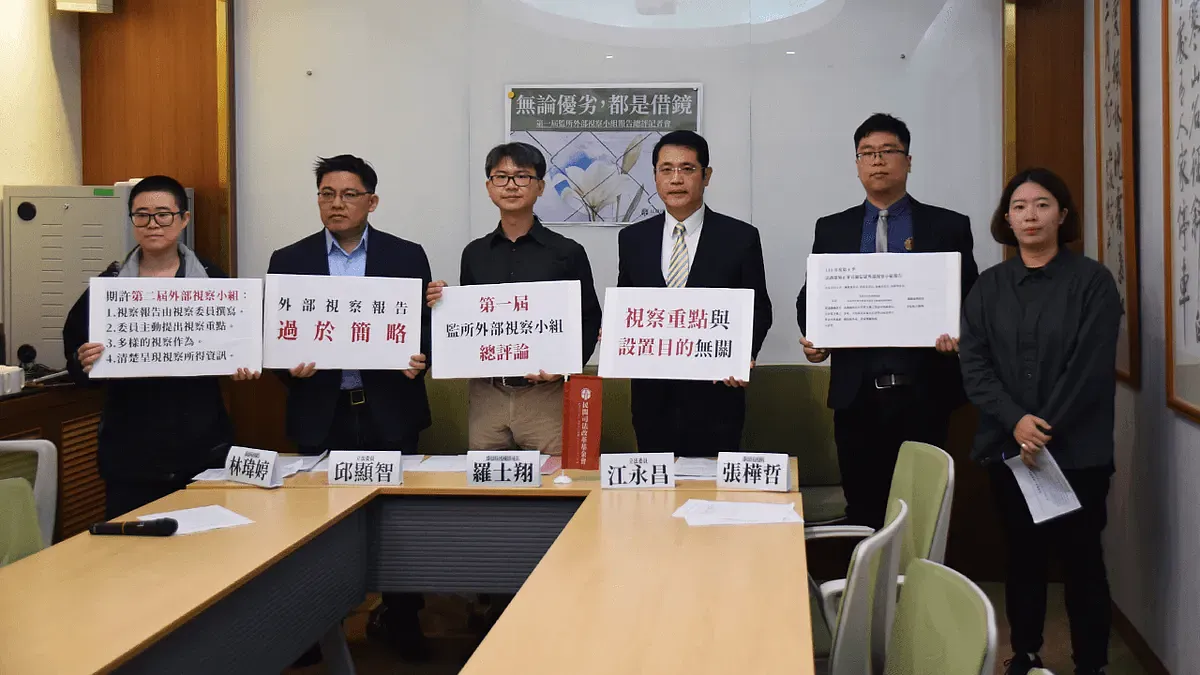
Press Conference | Good or Bad, Every Example Serves as a Lesson: Overall Evaluation of the Reports from the First Term of Prison and Detention House External Inspection Panels
Last edited: 2026-07-27
One of the highlights of the amendments to the new Prison Act and Detention Act is that, to implement the principle of transparency and safeguard the rights and interests of inmates, all prisons and detention houses are required to establish independent external inspection panels, which must submit inspection reports on a quarterly basis (Article 7 of the Prison Act, Article 5 of the Detention Act). The first-term external inspection panels served from the fourth quarter of 2020 (109) to the third quarter of 2022 (111). The third quarter of 2022 marked the final inspection report submitted by the first-term panels, and all reports were made public this February. The JRF has compiled an overall evaluation of these first-term reports to help the public understand the operation of this system and to set forth our expectations for the second-term external inspection panels.
-
Changes in Report Format: Enhancing Usability and Transparency
The most significant change in the first-term external inspection reports was the format. This evolved from requiring all panels to use forms prescribed by the Agency to providing only reference formats so that inspection members could adopt appropriate reporting layouts based on presentation needs; from initially presuming the report would be co-authored by members and the correctional institution to independently presenting reports written by members; and from omitting descriptions of inspection operations, prohibiting attachments, and withholding member names, to recommending that all such information be provided. Here, we affirm the Ministry of Justice, the Agency of Corrections, and the various external inspection panels for listening to external recommendations and improving the reporting formats.
-
Overview of the First-Term External Inspection Panel Reports
-
Enhanced Overall Report Transparency
Beginning in the first quarter of 2022, the majority of external inspection panels adopted the new report formats, enabling the public to grasp the basic and essential content of the inspection reports. However, when reading many of the reports, it remains difficult for outsiders to determine whether a report was actually written by the members or ghostwritten by the correctional institution, and whether the inspection focus was proposed by the members or arranged on their behalf by the institution. We maintain that inspection reports should be authored by the members; no matter how rich and substantial the content of an institution-drafted report may be, it runs counter to the fundamental purpose of the system. We expect members to have their own insights regarding inspection priorities rather than passively leaving arrangements to the correctional institutions.
-
Reports Worthy of Affirmation: Diverse Inspection Actions, Rich Information Presentation, and Regard for External Opinions
We consider reports that execute diverse inspection activities and present rich information gathered from inspections to be commendable. Some external inspection panels conducted interviews, produced interview records, or summarized important information obtained from interviews within their reports, using these to question or make recommendations to the institutions. These are all commendable practices.
Among the first-term external inspection panels, the panel that most consistently produced high-quality reports was the External Inspection Panel of the Yunlin Prison. Their reports were rich in content, featuring diverse information sources subject to cross-verification. Additionally, the External Inspection Panel of the Tunghsin Senior High School demonstrated a high degree of proactive engagement with inspections through their reports, making them highly worthy of reference.
-
Reports Needing Improvement: Overly Brief Content, Inspection Focus Seemingly Unrelated to the Purpose of the Panel, and Formats Difficult to Read
Some inspection reports were excessively brief and lacked relevant attachments, making it difficult for outsiders to understand the basic facts grasped by the inspection members through their visits. The fact that inspection panels failed to accomplish even such basic and simple tasks leaves much room for improvement. Furthermore, certain external inspection panels featured only a single inspection focus for the entire quarter that appeared unrelated to the purpose of establishing the panel—for instance: "Please clearly mark warning signs prohibiting mobile phones in the institution's visiting room to prevent visiting families from missing the signs, mistakenly bringing in phones, and taking photos that are leaked, causing trouble for the institution" (Yilan Prison External Inspection Panel, 2020 Q4 Inspection Report); or "High frequency of magnetic lock malfunctions for doors within the custody area" (Changhua Detention Center External Inspection Panel, 2022 Q2 Inspection Report). Such inspection focuses inevitably lead outsiders to suspect they were arranged by the correctional institutions, with the external inspection panels passively accepting them rather than acting independently.
Starting in the first quarter of 2022, the Agency of Corrections relaxed regulations on inspection report formats, no longer rigidly requiring the old Agency-prescribed forms. Therefore, theoretically, there should no longer be instances where reports were difficult to read due to being crammed into old forms. Nevertheless, some external inspection panels still used the old Agency-prescribed forms, and their method of completion ran counter to intuitive reading habits, making them difficult to understand (Green Island Prison External Inspection Panel, 2022 Q1–Q3 Inspection Reports), which truly warrants review.
-
Enhanced Overall Report Transparency
-
Expectations for the Second-Term External Inspection Panels
Based on the overall evaluation of the first-term external inspection reports, we have the following expectations for the second-term panels:
-
Inspection Reports Should Be Authored by Inspection Members, with the Lead Author Indicated
By law, inspection reports are submitted by the external inspection panels; thus, reports should naturally be written by the members rather than delegated to the correctional institutions. We recommend that inspection reports indicate the lead author, allowing the public to better understand individual members' levels of involvement and holding members accountable for the reports they author. For example, the 2022 Q2 inspection report of the Taoyuan Women's Prison external inspection panel explicitly indicated the lead author, which is a practice worth referencing.
-
Members Should Proactively Propose Inspection Focuses and Indicate Their Sources in the Report
We expect members to have their own insights regarding inspections and to proactively propose inspection focuses. While suggestions from correctional institutions are also important, if the vast majority or all inspection focuses for a quarter are arranged by the institution, it inevitably creates the impression that members are passive and lack proactivity. To enable the public to understand members' proactivity, we also expect inspection reports to clearly indicate the source of each inspection focus.
-
Diverse Inspection ActionsWe expect external inspection panels to carry out diverse inspection actions to understand specific inspection focus items. Interviews, reviewing written records, and distributing questionnaires were all methods implemented during the first term and can serve as references for second-term members. We look forward to seeing more inspection actions that help clarify inspection focuses.
-
Clear Presentation of Information Obtained from Inspections
Following the execution of diverse inspection actions, we expect to see a clear presentation of the information gathered within the inspection report, rather than mere notes stating that the panel conducted interviews or on-site visits without any explanatory content. The authority of an inspection report stems not from any coercive enforcement power, but from clear statements of fact and the provision of rational grounds.
The first inspection report of the second-term external inspection panels (2022 Q4) has already been released. The JRF, alongside our volunteers and interns, will begin reviewing them, and we invite more people to browse the reports.
-
Attachments
Overall Evaluation of the First-Term Prison External Inspection Reports (2020 Q4 ~ 2022 Q3)
Attendees
Ch'iu Hsien-chih / Legislator
Chiang Yung-ch'ang / Legislator
Lo Shih-hsiang / Attorney, Convener of the Prison Committee, Judicial Reform Foundation
Lin Wei-ting / Project Researcher, Judicial Reform Foundation
Chang Hua-che / Specialist, Taichung Office, Judicial Reform Foundation
Press Contacts
Lin Wei-ting, Project Researcher, Judicial Reform Foundation 02-25231178 #32
This article is an AI-generated translation of the original Chinese text. In the event of any discrepancy, the Chinese version shall prevail.