
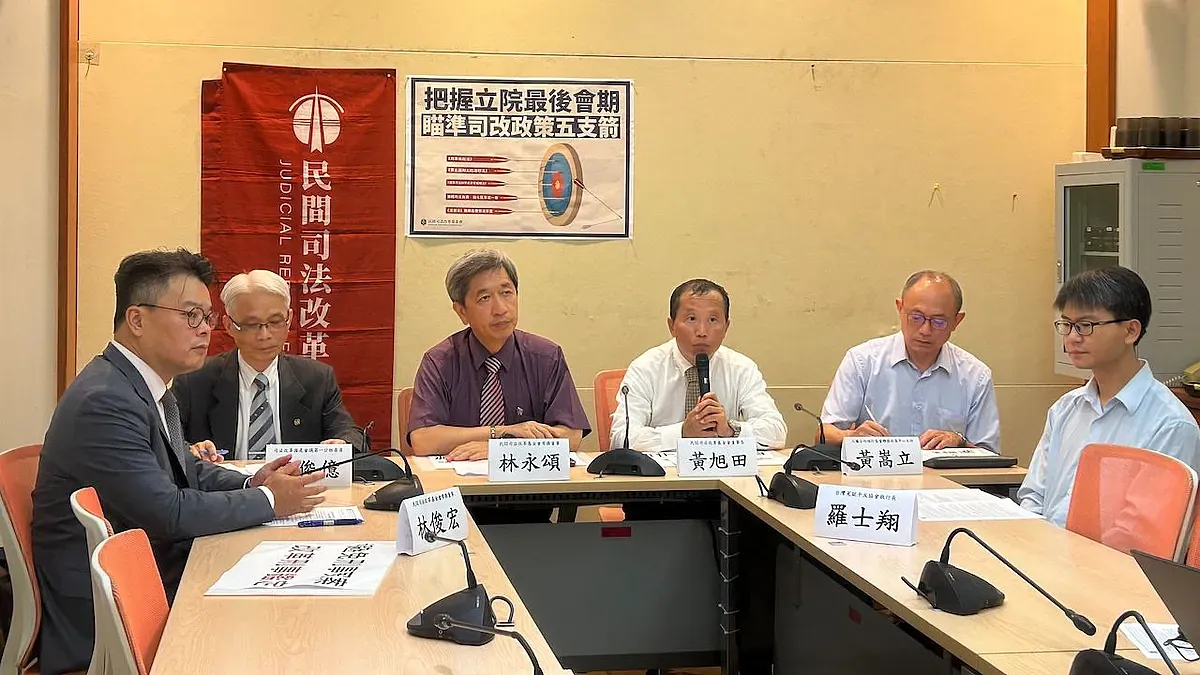
Press Conference | Seizing the Legislative Yuan's Final Session: Targeting Five Arrows for Judicial Reform Policy
Last edited: 2026-07-27
This month marks the opening of the new session of the Legislative Yuan, which is also the final session of the Tsai administration. If critical policies fail to pass, according to the rule of "continuity of bills," all halfway-deliberated bills will be rendered void after the Legislative Yuan elections next year and will have to start from scratch. In response, our Foundation has compiled the following judicial reform bills, calling on the Legislative Yuan and relevant agencies to attach importance to them and seize this final opportunity for legal amendment:
- Preventing Wrongful Convictions: Pass amendments to the Code of Criminal Procedure regarding the expert-testimony system to reduce systematic judicial errors.
- Aligning with International Standards: Pass the Enforcement Act of the Convention against Torture, establish a "National Preventive Mechanism against Torture," and prevent systematic human rights violations.
- Integrating Cross-Agency Resources: Establish a "National Forensic Science Committee" to integrate resources and promote judicial science policies.
- Safeguarding Judicial Quality: Alleviate judicial burdens and strengthen the first instance of civil litigation.
- Strengthening Judicial Accountability: Strengthen the responsibility of court presidents in supervising judges and amend the official supervision provisions in the Judges Act.
1. Preventing Wrongful Convictions: Pass Amendments to the Code of Criminal Procedure Regarding the Expert-Testimony System
Draft Version by the Judicial Reform Foundation
The improvement of the forensic science system is a fundamental prerequisite for preventing wrongful convictions. Only through the reform of the criminal forensic system, the establishment of forensic science standards, and the improvement of evidence custody mechanisms can we effectively strengthen factual adjudication and enhance the judiciary's ability to uncover the truth. Moreover, after cases are prosecuted and enter the court system, our Code of Criminal Procedure also lacks regulations requiring expert witnesses to appear in court for cross-examination, leaving judges unable to review the rationality and accuracy of expert reports and causing them to miss the final opportunity to prevent wrongful convictions. More than twenty years have passed since the cases of Chiang Kuo-ch'ing, Su Chien-ho, and Hsu Tzu-chiang, and a comprehensive review should be conducted through amendments to the criminal procedure expert-testimony provisions to reflect on the experiences and lessons learned from the causes of judicial wrongful convictions.
Both the Judicial Yuan and the Executive Yuan have drafted versions of the amendment to the expert-testimony chapter of the Code of Criminal Procedure, and the committee in the Legislative Yuan already completed its review during the last session, reserving certain parts for party caucus negotiations. Our Foundation calls on all not to let recent discussions be in vain, leaving systemic issues of wrongful convictions continuously shelved or even delayed. The Legislative Yuan must attach importance to and pass the amendments to the expert-testimony system.
2. Aligning with International Standards: Pass the Enforcement Act of the Convention against Torture
Draft Version by the Judicial Reform Foundation
Torture is the most cruel and degrading act against human dignity that a human society can inflict upon one of its members. Society as a whole should jointly support victims of torture and work together to ensure that no one is allowed to be treated in such a manner. Torture is not merely a thing of the past in Taiwan; just on the 13th of this month, the Control Yuan released an investigation report pointing out that the management of inmates at the Taipei Prison involved suspected illegal abuse and the practice of torture, which not only violated the International Covenant on Civil and Political Rights—which has already been domesticated into domestic law—but also violated the Convention against Torture, which is still pending passage by the Legislative Yuan. The Convention against Torture is not only meant to protect inmates; young children, students, persons with physical and mental disabilities, and institutional residents may all be subjected to improper treatment and require more comprehensive systems to provide protection.
However, the Legislative Yuan received the draft Enforcement Act of the Convention against Torture submitted by the Executive Yuan in 2018 and 2020 respectively, but it has yet to be scheduled for deliberation and discussion. Although President Tsai Ing-wen just touted our country's performance in the implementation and practice of international conventions to judicial representatives from 66 countries at the International Association of Judges annual meeting on September 18, Taiwan currently has not had a single core United Nations human rights convention passed during the Democratic Progressive Party's administration. We look forward to the Democratic Progressive Party administration seizing its current political influence to pass the Enforcement Act of the Convention against Torture as soon as possible, and accordingly building a more complete system, including enacting a clear crime of torture, regulating "cruel, inhuman or degrading treatment or punishment," strengthening the investigation and prosecution of the crime of torture, and establishing a "National Preventive Mechanism against Torture" to prevent systematic human rights violations through mechanisms such as regular and irregular visits.
3. Integrating Cross-Agency Resources: Establish a "National Forensic Science Committee"
Draft Version by the Judicial Reform Foundation
Currently, our country's appraisal practice lacks uniform scientific standards and methods, as well as a unified laboratory accreditation system, leading to severe mistakes such as the mass misidentification of emerging drugs as seen in the "Kaohsiung Medical University Drug Appraisal Incident." Subsequently, the labor, time, and costs required for the special investigation team to inspect related cases, resubmit samples for testing as appropriate, and handle retrial applications and retrials were finally able to return the proper judgments owed to numerous defendants.
To prevent the problem from happening again, the improvement of the judicial science system is the most important foundation. According to the resolutions of the National Customs Conference on Judicial Reform, cross-ministerial and cross-agency resources between the Executive Yuan and the Judicial Yuan should be integrated to establish a "National Forensic Science Committee" to formulate and promote forensic technical specifications, forensic institution accreditation and personnel licensing, establish review and verification mechanisms for inspection reports, and set up channels for error reporting. In this regard, our Foundation has drafted the draft Organic Act of the National Forensic Science Committee, and the government should promptly pass and establish the national and judicial science organization to integrate resources and promote judicial science policies.
4. Safeguarding Judicial Quality: Alleviate Judicial Burdens and Strengthen the First Instance of Civil Litigation
Draft Version by the Judicial Reform Foundation
Safeguarding judicial quality requires not only a sound judicial science system, but also a reasonable workload for judges and prosecutors in charge of judicial cases so that they can properly handle the cases in their hands. In recent years, the judiciary has been in a long-term state of case overload, making it difficult to ensure the quality of case handling or to help the public trust the judiciary. However, the premise of alleviating judicial burdens must be to safeguard and enhance judicial quality, and the public's right to litigation must not be sacrificed in the pursuit of easing judicial burdens.
The Judicial Yuan recently proposed lowering the volume of appeal cases by "narrowing the threshold for appeals." From a medium- to long-term perspective, this is not entirely unviable. However, our Code of Civil Procedure has long lacked a comprehensive review of rules of evidence and methods of investigating evidence. Closing the door before "strengthening the first instance" may severely impact the public's right to remedy. Our Foundation has proposed seven major plans to alleviate judicial burdens, including suggestions such as "relaxing circumstances where flagrant offenders are not transferred to prosecutors," "expanding the scope of non-prosecution and suspension of prosecution dispositions," and "judicial assistants assisting in drafting judgment documents." In addition, our Foundation has also proposed a draft to strengthen the first instance of civil litigation, incorporating issues such as "the investigation procedure for human evidence," "implementing collegial panels for major cases in the first instance," and "the boundaries of the court's authority to investigate evidence ex officio" into the scope of amendments, all of which are important directions toward solidifying factual adjudication. We call on the Legislative Yuan to pay serious attention to this!
5. Strengthening Judicial Accountability: Reinforce the Responsibility of Court Presidents in Supervising Judges
Draft Version by the Judicial Reform Foundation
In addition to solid judicial quality, judicial trust requires reasonable, transparent, and clear judicial accountability when mistakes occur. In this regard, the Judges Evaluation Commission noted in its third-year report that the "indirect function" of the judges evaluation system lies in prompting persons holding official supervision powers to proactively exercise official supervision or request the Judges Evaluation Commission to conduct individual case evaluations, producing an overall deterrent effect on the body of judges. However, even if this is true, the normative density in the Judges Act regarding the qualifications, appointment procedures, appraisals, and dismissal that judicial heads exercising official supervision should possess is indeed far too low.
Following the major judicial integrity scandal involving Shih Mu-ch'in in 2020, our Foundation proposed the draft amendment to the official supervision provisions of the Judges Act. From the recent sexual harassment incidents involving the presiding judge of the Shihlin District Court and the former president of the Disciplinary Court, to the bullying and harassment incidents at the Tainan District Court earlier this year, the necessity of strengthening the official supervision responsibilities of judicial heads is evident. To strengthen internal self-discipline within the judiciary and prevent major judicial integrity incidents, our Foundation calls on the Legislative Yuan to amend the Judges Act and strengthen the responsibility of court presidents in supervising judges.
In summary, passing important bills to strengthen judicial quality, judicial accountability, prevent wrongful convictions, and prevent torture will be the Tsai administration's final opportunity to build its judicial reform achievements. We urge members of the Legislative Yuan to prioritize the advancement of bills rather than merely focusing on elections!
Synthesis of Foundation Drafts
- Foundation Draft of the Code of Criminal Procedure (Expert Testimony Chapter)
- Foundation Draft on "Alleviating Judicial Burdens and Enhancing Judicial Quality"
- Foundation Draft of the Judges Act (Strengthening Official Supervision across Courts and Prosecutors Offices at All Levels)
- Foundation Draft of the Organic Act of the National Forensic Science Committee
- Foundation Draft for Solidifying Factual Adjudication under the Code of Civil Procedure
Attendees
- Huang Hsu-t'ien / Chairperson, Judicial Reform Foundation
- Lin Yung-sung / Standing Director, Judicial Reform Foundation
- Lin Chun-hung / Standing Director, Judicial Reform Foundation
- Lee Chun-i / Member of the First Division of the National Customs Conference on Judicial Reform, Professor at the Department and Graduate Institute of Forensic Medicine, College of Medicine, National Taiwan University
- Lo Shih-hsiang / Executive Director, Taiwan Association for Innocence, Convener of the Forensic Science Promotion Alliance
- Huang Sung-li / Director of the Policy Center, Covenants Watch
Press Contact
Lü Cheng-yen, Attorney-at-Law, Director of the Legal Policy Department, Judicial Reform Foundation
This article is an AI-generated translation of the original Chinese text. In the event of any discrepancy, the Chinese version shall prevail.