
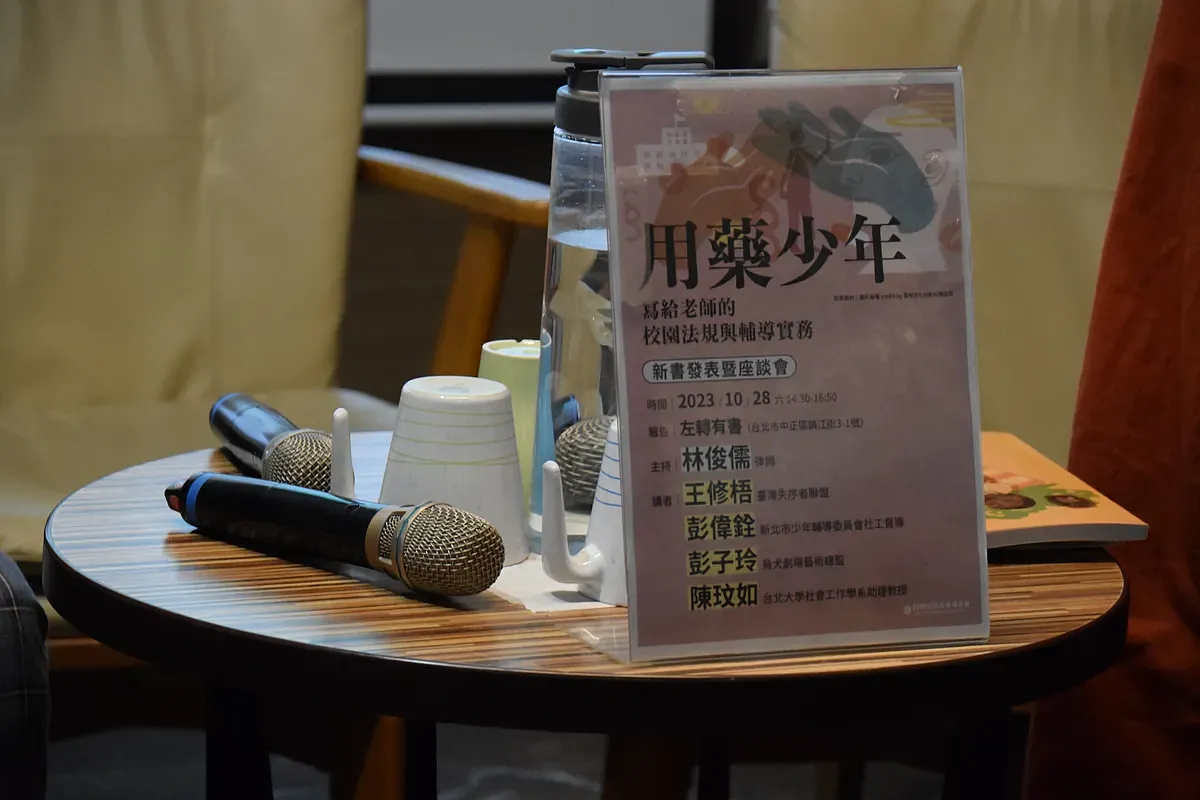
Sidelights | Book Launch: "Youth and Drug Use: Campus Regulations and Counseling Practices for Teachers"
Last edited: 2026-11-04
※ The authors of "Youth and Drug Use: Campus Regulations and Counseling Practices for Teachers" shared their thoughts and journey of collaborating on the book at their book launch on October 28, 2023. Below is a brief excerpt of the event:
Early Insights into Youths-in-Trouble
Lin Chun-ju|Attorney
Lin Chun-ju, general planner of the book, and Ko Che-yu of Jidi Culture, titled today's book launch "Early Insights into Youths-in-Trouble," which is also the title of a song Che-yu and Chun-ju created regarding the book's themes.
Writing this book together as a group of authors was a process that brought together the goodwill of many, allowing us to walk this path side by side.
Chun-ju modestly described his role as merely listening and recording. In the early stages, he conducted extensive field research and interviews while referencing domestic and international practical experiences.
The contributing authors provided substantial assistance along the way, including: Wen-ju, who responded to the manual's positioning and offered recommendations on writing direction;
Hsiu-wu, a working partner advocating for custodial measures and the Mental Health Act, who observed the light and shadow of judicial practical insights together with us;
Tzu-han, who serves in a school; Tzu-ling, a theater director; Tzu-ping, a social worker from a civil organization (The Association for Juveniles' Care and Guidance);
Wei-chuan, a social worker from the Juvenile Guidance Committee; and Chia-ling, a juvenile investigator and probation officer, all of whom offered constructive advice from the perspective of juvenile justice practice.
In addition to the contributing authors, many consulting partners participated in discussions and provided feedback.
The contributing authors hope to introduce what each of them knows—interpersonal interactions and conversations, understanding of drugs, the inner worlds of youths, legal procedures and judicial practice knowledge, and working alliances (case conferences)—to frontline teachers through this manual.
Huang Hsu-tian|Chairperson of JRF, Attorney
Social change is intertwined with adolescents. The issue of drug use is cross-disciplinary. Finding a method to address the issue of "youths using drugs" is also a driving force in finding society's way forward. This book is written from the positions, roles, functions, and predicaments of counseling and discipline, based on current regulations and institutional operations. It is a practical manual intended to provide capacity and skills for cross-disciplinary collaboration.
Peng Tzu-ling|Artistic Director and Director, Black Dog Troupe
The thoughts and pressures of adolescents around the age of 15 are not as simple as just saying "no to drugs." Therefore, the implementation plan of bringing forum theater to schools reached a consensus with competent authorities early on that this was not about anti-drug propaganda. Black Dog Troupe's forum theater plays only perform half the story, followed by discussions with children (students) about their choices and a critique of the status quo.
The original idea was to write the theater forum into lesson plans addressing life and emotions. After much deliberation regarding the consequences of a "universal lesson plan"—which might be unhelpful against attitudes of compartmentalization, humiliation, and exclusion—the focus shifted instead to writing about the process and reflections within schools. Black Dog Troupe understands that for a teacher to do this alone is far too difficult; this is a book to ensure you are no longer alone.
Wang Hsiu-wu|Taiwan Outcasts Alliance
The portrayal of drug users under anti-drug scare tactics is often unrealistic, and the design limitations of drug-user research may not reflect the true picture of drug use. As a result, propaganda deviates from reality, and the impression left on students may be that what teachers say is untrue.
Hsiu-wu focuses on the practice of harm reduction systems, where the extent of harm and impact of drug use on the user is intertwined with how they view themselves and how they interact in interpersonal relationships.
Chen Wen-ju|University Social Work Department Professor
During her social work internship, Wen-ju experienced life in a drug rehabilitation village, which she described as already practicing "harm reduction," even though the concept of "harm reduction" did not yet exist at the time. Transitioning from a social work helper to a university professor, Wen-ju, as an educator, is more concerned with the conditions of drug-using children and supports the agency of students who use drugs.
People often say that "all medicine is three-tenths poison"; Wen-ju proposed the counter-notion that "all poison is three-tenths medicine," referencing substance use intended to achieve psychological peace, for example.
In teaching, students often ask teachers for answers. Wen-ju's perspective on issues is that life's issues have no answers; life is merely a pathway.
Understanding a group of people with the prerequisite of prior knowledge is the original intention of this book.
Understanding the operational context of the green-gold industry, the roles children play (taking the blame, having sentences commuted, issues of poverty and drugs), and the lack of life health capital; for social workers assisting drug-using youths, understanding the green-gold industry and the children's lack of life capital, and promptly providing supplementation and support, is even more important.
It is hoped that everyone, whether possessing prior knowledge of drug use or not, can coexist peacefully.
Peng Wei-chuan|Juvenile Guidance Committee Social Worker
A very important part of what we do is making connections, stringing community resources together.
Are you willing to connect with the child? Are you willing to spend time accompanying them?
Adolescents exploring life directions
occasionally ride in Wei-chuan's car (the Focus Express).
Is the journey between social workers and children in the car an intervention? Or is it therapy?
No, actually, it is much more about accompanying each other while listening to them chat.
Wei-chuan asked the audience:
Yet, if your companionship does not ultimately lead the child down the path you expected, are you still willing to accept and connect?
Wei-chuan shared at the book launch that, just as he wrote in the book, it is about dialogue rather than answers or techniques.
【Q&A】
-
Will there be subsequent cooperation projects between civil organizations and the public sector following this book?
-
The book ultimately targets teachers and engages in dialogue with them. During the book's development, were there any missed opportunities or exclusions in content selection?
-
A counseling psychologist who previously worked in a prison felt that this book resonated with their own journey and experience: drug use itself is not the problem, but rather the result of life's helplessness and hardships.
-
Social work students experience an experiential gap and have limited knowledge regarding drug-using youths, leading to confusion and struggles regarding future social work services.
Peng Tzu-ling|Artistic Director and Director, Black Dog Troupe
Drama is about all aspects of human beings. Through theatrical education experience, we realize how little we actually know. Consequently, I feel doubt and reflection toward labels like "help" and "high-care." We hope not to shrink further inward and dare not act out of knowing too little or extreme awkwardness. The label of "helping" is not so important; every one of us in action is a cultural researcher.
Chen Wen-ju|University Social Work Department Professor
"Legitimacy," such as being someone with firsthand experience or empathy, does not hold up in social work; otherwise, social work could not function. Social work service is a reciprocal process.
In writing "Youth and Drug Use," when deciding the content of the chapters I was responsible for, I looked not only from the perspective of an educator in the school system but also looked forward while tracing back to my origins as a social worker. Although I spent time sorting out the past, I was moving forward simultaneously. People outside the school system reading this book are also experiencing a cross-disciplinary transition, which I think is akin to "One Piece," where each character finds their own function.
Peng Wei-chuan|Juvenile Guidance Committee Social Worker
To initiate cooperation and connect resources between the public sector and civil organizations, we must act like storytellers, letting others know that this is feasible. Moreover, we shouldn't do it merely for the sake of cooperation; we must ask ourselves what we actually want to accomplish, clarify our purpose, and solve problems with a goal in mind.
Huang Hsu-tian|Chairperson of JRF, Attorney
Lawyers also realize that there are many things they do not know. We are all ignorant of many things; what matters is maintaining curiosity. The book "Youth and Drug Use" emphasizes cross-disciplinary collaboration, presenting stances, attitudes, thoughts, and suggestions while awaiting future opportunities for cooperation with like-minded individuals.
Lin Chun-ju|Attorney
During the book's development, I acted as a listener, organizing and recording for everyone, allowing partners to find their respective places.
Everyone's decision to write this book is also a form of "coming into visibility," allowing our own values, stances, trade-offs, and understandings to be seen, thereby generating a language for dialogue and finding a foundation for mutual communication in the teaching field.

This article is an AI-generated translation of the original Chinese text. In the event of any discrepancy, the Chinese version shall prevail.